
Google's Free AI Coding Agent and the Week Free AI Tools Got Serious
Google released a free command-line AI coding agent, a voice assistant that connects to your calendar, and a chat tool that records and transcribes meetings. Here is how a small business can put all of it to work today.

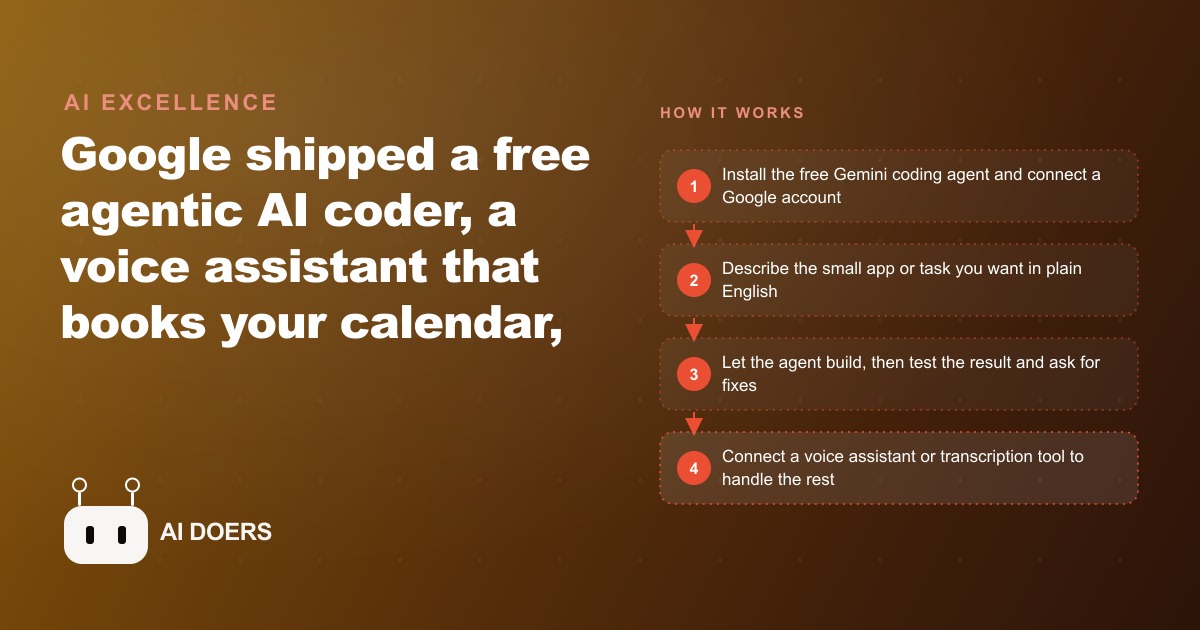
I am Madhuranjan Kumar, and there are weeks where following AI news feels like waiting for a bus that never comes. You read about models with impressive benchmarks, run them on a real task, and the gap between the claim and the reality is wide enough to make you skeptical of the next announcement. Then there are weeks where several things show up at once and that gap is noticeably smaller. This was one of those weeks. Google shipped a free command-line coding agent. A voice assistant connected to a work calendar and booked a meeting slot from a spoken sentence. A widely-used chat platform quietly made meeting transcription a standard feature rather than a premium add-on. The common thread across all of it: these tools did not just talk. They acted. That single word is the entire story of why this week mattered more than most of what preceded it.
The Week Several Things Arrived Together and the Signal Was Hard to Miss
Most AI announcements arrive as isolated events. A new model is released, a benchmark is published, a press cycle runs its course, and the product either holds up or does not when someone runs it on a real task in the days that follow. This particular week was different because five or six meaningful capabilities shipped nearly simultaneously, and each one addressed a different category of practical friction.
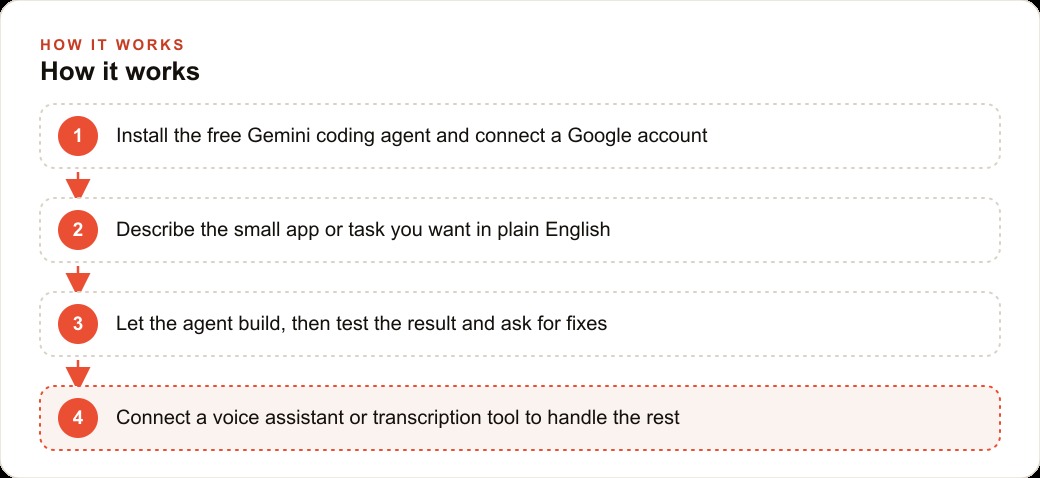
Google's Gemini CLI is a command-line coding agent that installs from a terminal, connects to a Google account, and turns a plain-English description into working code without the person writing a single line themselves. At launch it offered roughly a thousand requests per day at no cost. That free tier is not a stripped preview with artificial capability limits. It is the full tool, available to anyone, capable of building small applications that solve real problems. You describe what you want, the agent builds it, asks for confirmation at each decision point, and produces a finished result. A non-developer business owner can have a working internal tool in an afternoon. That sentence is worth sitting with for a moment.
The voice assistant that connected to a work calendar operated on a different kind of friction. Reading a schedule back has been something voice assistants could do for years, which is why most business owners stopped expecting much from them. Creating a new event from a single spoken sentence, confirming the date, and asking whether to proceed is a categorically different action. You say: book a two-hour block on Sunday afternoon for prep work. It checks the calendar, sees Sunday afternoon is open, and creates the event. The exchange takes under thirty seconds. For a business owner whose hands are occupied on a job site or behind a wheel, that is not a marginal convenience. It is the difference between a task that gets done and one that gets deferred.
The meeting transcription feature completed the picture. Recording calls has existed for a decade. The change is that transcription became accurate enough, fast enough, and cheap enough to bundle into the standard plan of a major chat platform rather than sell as a premium feature. The more interesting addition is flagging open questions: the specific moments in a conversation where something was raised and no one answered it. Most transcription tools produce a wall of text that no one reads. This one extracts the unresolved items and presents them as a list. For anyone who runs back-to-back calls where commitments get made and forgotten by the next morning, that automatic extraction changes what is possible without hiring someone specifically to take notes.
From Answering to Acting: The Distinction That Makes This Moment Different
A tool that answers your questions is useful for research, drafting, and thinking through problems. A tool that takes an instruction and executes it with real effects in real systems is useful for running a business. The distinction sounds like a slight capability upgrade. It is actually a categorical difference in the type of work the tool absorbs.
Consider the difference between an AI that explains how to build a quote calculator and one that builds the quote calculator. The first is useful for learning. The second eliminates the task entirely. For any business owner whose admin time is time stolen from revenue-generating work, eliminating a task produces far more value than accelerating it. The coding agent does not help you write an intake form faster. It writes the intake form. The transcription tool does not help you remember what was said on a call. It records what was said and extracts the unresolved items so you never have to remember them.
This shift from answering to acting is the frame that makes this week's releases coherent as a group rather than as five unrelated announcements. The previous generation of AI tools was primarily useful as a thought partner on work you were already doing. The current generation is starting to absorb whole task categories. You do not do the task faster. You do not do the task at all, because the tool does it without you.
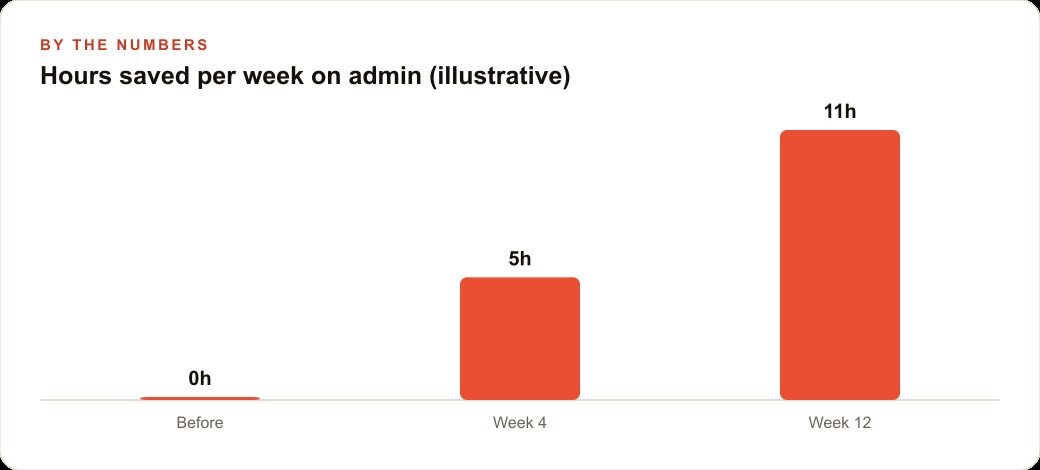
For a small business, the compounding effect of eliminating task categories is significant in ways that mere acceleration is not. An owner who eliminated one hour per day of administration through the tools available this week would reclaim roughly twenty working days per year. At a conservative billing rate of one hundred dollars per hour, that is twenty thousand dollars in reclaimed capacity annually. The tools cost nothing to start. The opportunity cost of not starting is real and calculable, not theoretical. Most businesses would spend several thousand dollars on a single piece of software if someone demonstrated it would return twenty thousand in annual capacity. The fact that these tools cost nothing makes it easy to dismiss them. That dismissal is the mistake.
The discipline that makes these tools reliable is precise instruction. A coding agent that acts on a vague request produces a vague output, and cleaning up a vague output takes longer than giving a clear brief at the start. The habit of writing one specific request, letting the agent execute it, confirming the result, and then moving to the next request is learnable in an afternoon and produces dramatically cleaner outputs than trying to describe a complete system in a single prompt. Businesses that build this habit now will be faster and more effective at using future versions of these tools than businesses that wait, because the habit itself is the skill.
What These Tools Look Like Inside a Business That Runs on Scheduling and Calls
To move from abstract to specific, let me trace what this week's tools look like inside a business where scheduling, quoting, and follow-up calls are the daily operational reality. A moving company is a good test case because the friction points are concrete: missed callbacks, inconsistent quotes, and dispatcher time spent rebuilding information that was already captured in a phone call.
Meeting transcription turns every inbound inquiry call into a permanent, searchable record. When a prospect calls to ask about a move and mentions a piano on the third floor, a flexible date window, and a competing quote they received, all of that gets captured automatically. The transcript flags the items that were raised but not resolved: the parking situation at the destination that the dispatcher asked about and the caller promised to check, the specialty item handling cost that was mentioned but not confirmed, the final date that was left open. The follow-up call that the dispatcher used to try to remember to make, or note on a sticky that got buried under the next call, now appears as a structured item extracted from the conversation. Nothing falls through because nothing relies on anyone's memory.
The coding agent handles the estimate tool. A dispatcher who currently builds quotes by consulting multiple spreadsheets and applying mental rules about how distance, floor count, parking constraints, and specialty items affect the final price can describe that logic to the coding agent in plain English. The agent builds a browser-based tool: enter the inputs, get the consistent price range based on the company's own rates. That build takes one afternoon. Running it takes thirty seconds per quote rather than five to ten minutes of cross-referencing. Over a week of fifty quotes, that is hours returned to the dispatcher for actual customer interaction rather than arithmetic.
The voice calendar assistant handles the owner's scheduling while they are on-site, in transit, or working with their hands. Booking a crew slot for a next-day job goes from pulling over to type to speaking a sentence. The calendar confirms the event exists. The owner continues moving. None of this required a technology hire, a development project, or a new software subscription. It required two afternoons of setup, a Google account, and the willingness to start with one task and confirm it works before building the next one on top.
The Cost of the Default Response, Measured in Specific Business Outcomes
There is a version of this story where a business owner finds the week's releases interesting and returns to what they were doing. For most of the previous two years of AI announcements, that was the correct response. The tools were not reliable enough at the task level where actual business friction sits. Benchmarks were impressive. Real tasks revealed limits that made adoption feel premature. Waiting made sense.
This week felt sufficiently different that the cost of the default response deserves to be named precisely rather than left abstract. The businesses that start using these tools now are building institutional knowledge about what the tools can and cannot do. They are learning the vocabulary for giving a coding agent a useful brief. They are figuring out where the transcription tool misses something and how to catch it before it causes a problem. That knowledge does not exist in a manual. It accumulates through use, and the gap between a team with three months of experience using these tools and a team that is still evaluating them will not close quickly once the experienced team has a head start.
A dental practice that builds a simple after-hours inquiry form using the free coding agent in one afternoon has that form collecting inquiries during evenings and weekends from that afternoon forward. A practice that decided to evaluate the tool more carefully over the next few weeks does not. The first practice starts capturing after-hours leads in week one. The second practice spends those weeks thinking about it. The cumulative difference in captured contacts over a quarter is measurable, and it matters to the practice's patient flow and revenue.
The broader point is that free and reliable are two independent properties, and this week brought both together for a specific set of business tasks. The tools being free makes them easy to try. The tools being reliable enough for real business tasks makes the try worth doing. That combination, applied consistently over the months ahead, produces a compounding operational advantage for the businesses that start now versus the ones that keep waiting for the tools to become serious. This week, they became serious.
When the Cost of Waiting Becomes the Cost of Falling Behind
The last thing worth saying about this week is about timing, not tools. The businesses that started experimenting with AI tools in 2023 are now on their second and third generation of internal capabilities. They have a library of prompts that work. They have team members who know how to catch a bad output before it causes a problem. They have workflows that have been tested and refined through dozens of real uses. They moved faster on a new tool release because they had the institutional knowledge of what a clear brief looks like and what a reliable output looks like.
The businesses that are still evaluating whether to start do not have that library, those habits, or that institutional knowledge. A new tool release is not a starting line where everyone begins at the same point. It is a release that the experienced teams incorporate in an afternoon and the inexperienced teams spend weeks reading about. The gap between those two groups is not about the tools. It is about the accumulated experience of using tools, which only comes from using them, which only happens by starting.
This particular week brought tools that cost nothing to try, require no developer and no budget to start, and demonstrably handle tasks where businesses currently lose time every day. The questions worth asking are: which task is costing us the most time this week, and which of these tools would absorb it. Starting with one task, confirming it works, and then building the next one on top is the entire strategy. The week that free AI tools got serious was this week. What happens next depends on what you decide to do about it before next week.
That is exactly what we do at AI DOERS. Book a private 30-minute call with Madhuranjan Kumar and we will map the fastest path to it for your specific business.
Book your call →
Madhuranjan Kumar
Madhuranjan Kumar brings 20 years of performance-marketing experience and has managed over $200 million in Facebook ad spend for brands across the United States and beyond. His expertise spans the full modern marketing stack: Meta, Google Ads, TikTok, email automation, CRM, and the websites that hold it together. At AI DOERS he turns that track record into lead-generation systems for businesses across every industry.