
Google AI Mode Is Live Worldwide. Here Are the Four Things That Actually Changed
Google AI Mode, the biggest search upgrade in over 25 years, is now live everywhere and turns search into a conversation. The box expands as you type, a plus button adds files and images, follow-up questions work, and Personal Intelligence can connect Gmail and Photos, all running on Gemini 3.5 Flash. Here is how I would put it to work.

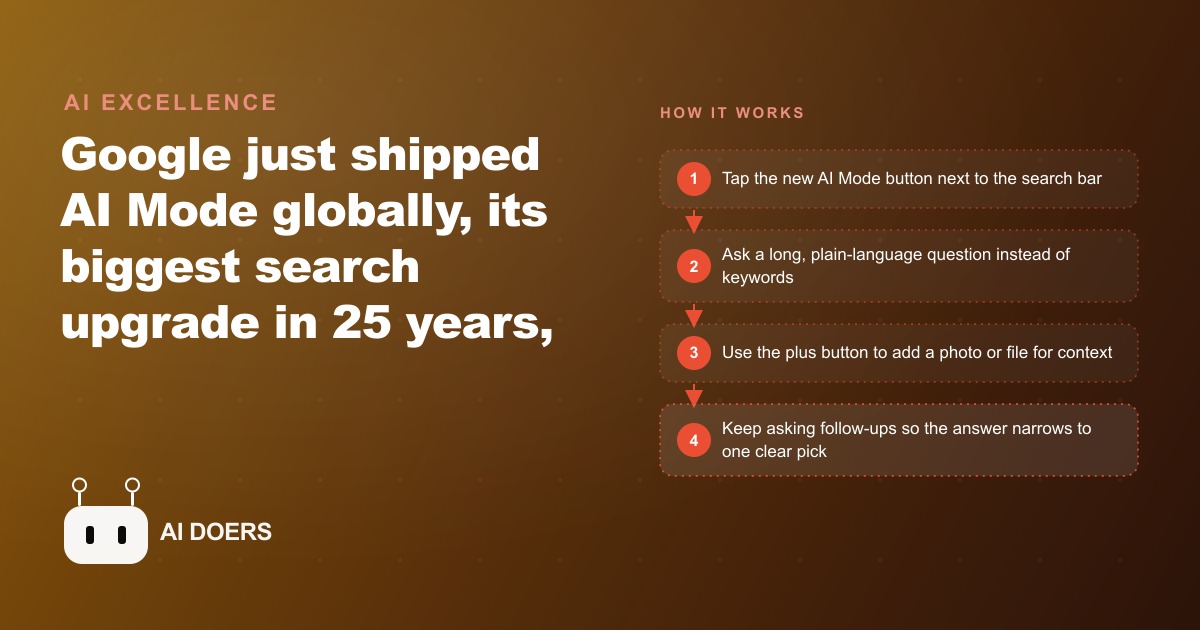
The day Google search became a conversation
Google processed roughly 8.5 billion searches per day for more than two decades on essentially the same interface: a small text box, a button, and a ranked list of ten blue links. Queries were short because the box invited short input. Users did the synthesis themselves, scanning results, clicking through several pages, comparing sources, and forming opinions from their own reading. That design had not changed in any fundamental way since the late 1990s. On the day AI Mode went live globally, it changed.
A new button now sits directly beside the familiar search bar. It opens a conversational interface powered by Gemini 3.5 Flash, Google's newest model built for speed at frontier-level reasoning. The search box itself expands as you type, so a multi-sentence question fits naturally. A plus button lets users upload images, generate images, or jump into Gemini from inside the search screen. Follow-up questions sustain a thread, unlike the old AI Overview that gave one answer and stopped. Personal Intelligence connects Gmail and Google Photos to the search experience on a strictly opt-in basis.
Google is calling this the biggest change to the search experience in more than 25 years. I am Madhuranjan Kumar, and I work with business owners on how they get found and chosen online. This is the most significant shift to that question in a generation. What follows is the story of how AI Mode reshapes discovery, told through the journey a real business now needs to take to stay findable, citable, and recommended in a world where customers describe their problems instead of typing keywords.
Classic search has not disappeared. Pressing the Google Search button or hitting Enter still returns the familiar link list. AI Mode is an addition, not a replacement. The transition will be gradual, and the businesses that prepare now will compound an advantage that only grows as more customers shift toward conversation-first search.
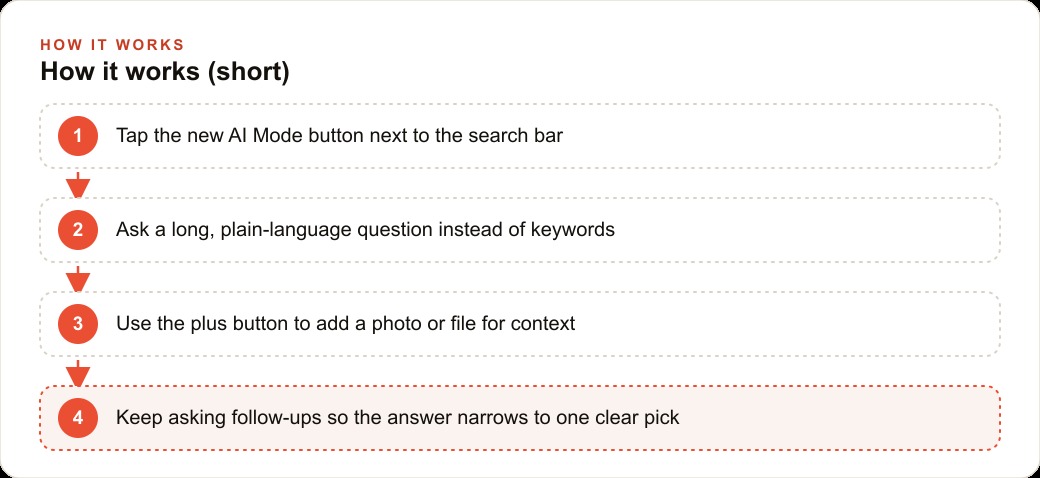
Four things that actually changed in the interface on launch day
Four concrete changes arrived with the global rollout, and each one reshapes a different part of the discovery process.
The search box now expands as you type. This is a small visual change with a large behavioral consequence. A box that grows with your input invites longer queries. A user who previously typed "plumber Dallas" now types "my kitchen sink has been leaking under the cabinet for two days and I need a licensed plumber who can come tomorrow morning in North Dallas." Those two queries surface very different results and very different businesses. The specificity in the longer query now reaches the model's reasoning rather than being lost in a keyword match.
The plus button adds three new capabilities from inside the search interface: uploading an image or file, generating an image, and jumping directly into Gemini. A homeowner can photograph a damaged fitting, tap the plus button, and ask what it is and who can replace it. The answer comes back grounded in live search results and can name specific local businesses.
Follow-up questions now sustain a thread. This is the sharpest break from the old AI Overview. Ask a follow-up to AI Overview and nothing happened. In AI Mode, the conversation continues. The model narrows rather than restating. By the third or fourth follow-up, a user often has a specific recommendation with specific reasons.
Personal Intelligence is the fourth change and the most far-reaching over time. A user who received a contractor estimate six months ago can ask AI Mode to find it in Gmail. A user comparing current quotes to a previous service relationship can pull that history into the search thread. Nothing connects by default; the user controls access entirely. Calendar support is coming soon.
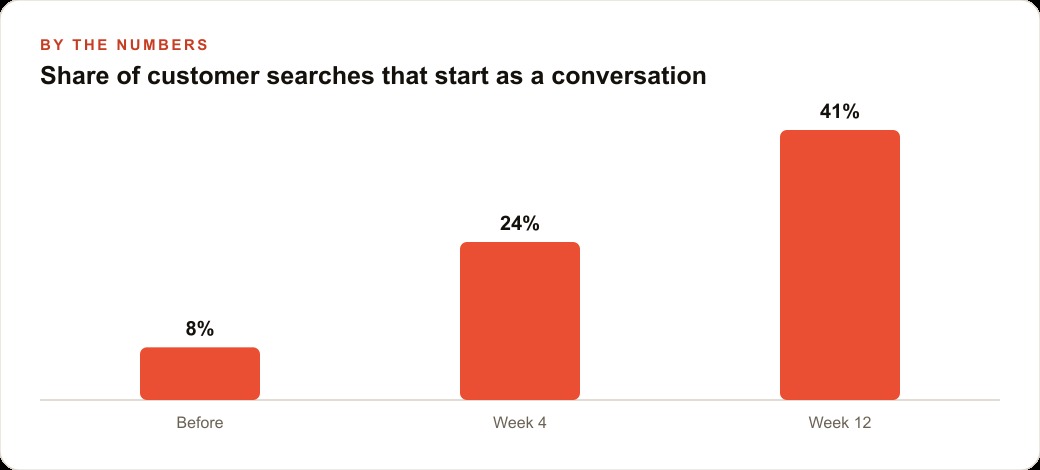
How a customer's discovery journey is different now
The old journey was linear and self-directed. A customer typed a keyword, received a ranked list, clicked through several links, read the pages, and formed an opinion through their own comparison. The business's only job was to appear in those top positions for the right keyword phrases.
The new journey is a narrowing conversation. The customer describes a full situation in plain language. AI Mode reads the entire description, grounds its answer in live search results, and returns a synthesized response that names specific businesses and explains the recommendation. The customer follows up. The model narrows. By the end of the conversation, the customer has a concrete recommendation with reasoning, not a list of links to evaluate on their own.
Two things change structurally. First, keyword ranking position matters less when the model assembles an answer from multiple sources. A business ranked seventh on a keyword page might be cited most confidently because its content directly addresses the full situation the customer described. Second, intent context is richer. The model knows the whole sentence, not just the keyword string, and surfaces businesses that match the described situation rather than just the phrase.
For businesses investing in Google Ads, this is also relevant on the paid side. Sponsored placements appear in AI Mode results, and the richer conversational context gives the targeting layer a cleaner signal about what the customer actually needs. A well-structured campaign is better positioned to appear in situations where the customer's full described intent is a genuine match for the service.
The businesses that will struggle are the ones whose online presence was built entirely around keyword coverage. The businesses that will thrive are the ones whose content answers the full-sentence situations customers actually bring to search.
A roofing company in the recommendation layer
To make this concrete, walk through how a roofing company earns a place in AI Mode's recommendation layer.
A homeowner in Dallas types: "My roof took hail damage last week. I need a licensed contractor who handles insurance claims and can inspect by end of this week. I am in the Lake Highlands area." The model reads every word. It does not extract just the keyword "roofer Dallas." It processes the insurance-claim requirement, the inspection timeline, the specific neighborhood, and the licensing detail.
The businesses it cites are the ones whose content directly addresses those specifics. Not the ones with the broadest keyword coverage, but the ones that clearly state: we are licensed in Texas, we handle hail-damage insurance claims, we serve Lake Highlands and surrounding neighborhoods, and here is what the inspection and claims process looks like when you call. A roofing company with a generic homepage titled "Dallas Roof Repair" and a brief bullet-point service list will appear less confidently than one with a specific page about storm damage, insurance coordination, and neighborhood coverage written in plain prose.
This is the core argument for investing in strong seo-content right now. Not keyword-stuffed pages and not bulk content that covers every variation of a phrase. Genuinely useful, specific content that matches the full-sentence situations customers describe. The conversational interface rewards specificity in a way that keyword ranking alone never required.
The customer follows up: "Which of those companies has the best reviews and can likely come soonest?" The model commits to a name. The roofing company with a real review profile that specifically mentions response speed, accurate business hours, and consistent contact details across every directory listing is the one that gets named.
A roofing company that runs a coordinated meta-ads campaign alongside its organic presence can reach the same customer at two points in the decision cycle: once when they are describing the problem in AI Mode, and again when they are moving toward a booking decision on social. The two channels reinforce each other when the messaging about insurance claims and fast response is consistent across both.
Illustratively, a roofing company that rewrites its storm-damage service page to cover insurance claim coordination, specific coverage areas, and licensing details in plain language should see a meaningful increase in the frequency with which it appears as a cited recommendation over a 90-day period. The conversational model needs specific, usable content to build a confident citation. Generic pages give it very little to work with. A page that explains the full process gives the model exactly what it needs to make a recommendation with reasons.
The agent rollout coming this summer and what it means for local businesses
What launched globally is the interface change. What is coming this summer is more consequential for businesses that depend on inbound inquiries.
Google has announced three capabilities in the agent rollout: mini-applications embedded inside search results, saved searches that monitor the web and notify a user's phone when something relevant changes, and Google calling businesses on a customer's behalf.
The call feature deserves immediate attention from any local service business. A customer in AI Mode searching for an emergency plumber on a Sunday evening will be able to ask Google to call local plumbers, check availability, and report back. Google makes the call. The customer stays in the conversation thread and receives a summary. The business that answers its phone, states its services clearly, and confirms availability gets the booking. The business that sends the call to voicemail, or whose hours on its Google Business Profile say it is closed when it is actually open, gets skipped and the conversation moves on.
This inverts the traditional inbound model. The customer no longer decides to call after they have already formed a shortlist. The AI calls while the decision is still open. Speed and clarity of the phone answer matter more than they did before, because the agent is gathering real-time information to build its recommendation in that moment.
Saved searches extend the timeline of discovery. A customer planning a kitchen renovation over three months can save a search for local countertop installers and receive notifications as relevant businesses or deals appear. For businesses already running retargeting campaigns, the saved search creates a parallel organic re-engagement path for customers in long decision cycles.
Mini-applications inside search results will let some businesses create lightweight interactive experiences inside the AI Mode interface without requiring a click to an external website. The technical specifications for these are still emerging, but the direction is clear: the search environment is becoming a place where a transaction can begin, not merely a list of destinations to navigate to.
Preparing your presence for a conversation-first world
The practical preparation divides into three areas, and all three reinforce each other.
Content specificity is the first. Go through every service page and ask whether it answers the full-sentence questions customers now bring to AI Mode. A page titled "Storm Damage Repair" is less useful to the model than a page that explains what happens when you call after a storm, how insurance claim coordination works, which carriers the company is familiar with, and what the inspection timeline looks like. The model needs specific, usable content to build a confident citation. A page that lists services as bullet points gives the model very little to work with. A page that explains the process in plain prose gives the model exactly what it needs.
Information accuracy across every platform is the second area. AI Mode pulls from live search results, which include your Google Business Profile, review platforms, directory listings, and anywhere else your business name and contact details appear. If your hours are inconsistent across sources, your phone number varies, or your address is formatted differently on three different platforms, the model has weaker confidence in citing you. Accuracy everywhere matters more now that the model is doing the cross-referencing rather than the customer.
The phone answer is the third, and it becomes decisive once Google's agent rollout reaches the call feature. Winning the recommendation layer is only useful if the call that follows produces a booking. A business that has done all the content work and all the accuracy work but routes calls to voicemail during business hours will lose the conversion at the final step. The entire purpose of earning the AI Mode recommendation is to get that phone to ring. If it rings and goes to voicemail, the work produced nothing.
Madhuranjan Kumar works with business owners on all three of these areas: the content that earns citations in conversational search, the information accuracy that builds the model's confidence in recommending you, and the structural presence that makes the recommendation worth winning. The starting point is simple. Open AI Mode yourself, type the full-sentence problem your best customer would describe, and see whose name appears and why. That single search tells you exactly where the gaps are and what needs to change first.
That is exactly what we do at AI DOERS. Book a private 30-minute call with Madhuranjan Kumar and we will map the fastest path to it for your specific business.
Book your call →
Madhuranjan Kumar
Madhuranjan Kumar brings 20 years of performance-marketing experience and has managed over $200 million in Facebook ad spend for brands across the United States and beyond. His expertise spans the full modern marketing stack: Meta, Google Ads, TikTok, email automation, CRM, and the websites that hold it together. At AI DOERS he turns that track record into lead-generation systems for businesses across every industry.