
Give Your AI a Soul Doc: Lock In a Consistent Brand Voice
Anthropic uses a soul document and a constitution to pin down Claude's character. Here is how a small business borrows the same idea so its AI never drifts off-brand.

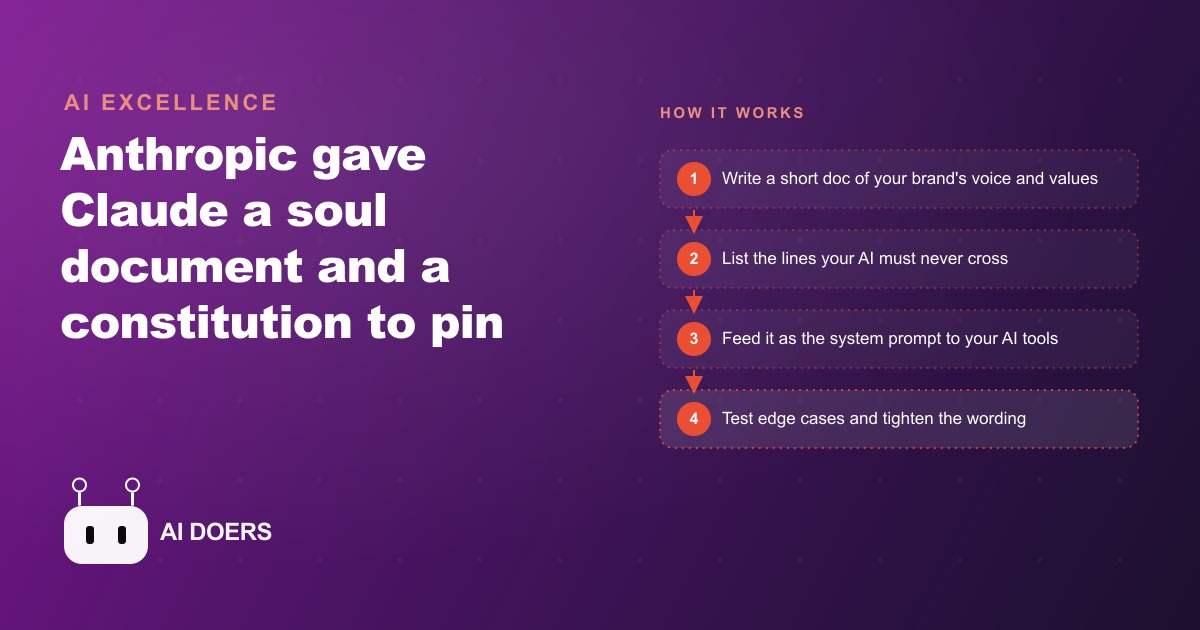
Here is a position most businesses will resist: the moment you put an AI in front of a customer, you have hired an employee, and you have hired it without an interview, a job description, or a single rule about how it should behave. That is reckless, and almost everyone is doing it. Anthropic, the lab behind Claude, does the opposite. It gives its model a soul document and a long constitution that pin down its character before it ever speaks. Small businesses can and should borrow the same idea, and I want to argue that skipping it is the quiet mistake behind most bad AI experiences.
I am Madhuranjan Kumar, and my claim is simple. A generic AI is not a neutral tool. It is a personality you did not choose, wearing your brand's name, and left to its own defaults it will drift.
The idea that AI is neutral is wrong
Start with why this matters, because the standard mental model is broken. People imagine an AI as a calculator: you type in a request, it returns a clean answer, no personality involved. That is not how these systems are built. They are not programmed line by line. They are grown on vast amounts of human text, which means each one contains countless characters inside it, every hero and villain and archetype humans have ever written down. The friendly, helpful assistant you talk to is just one persona pulled out of that enormous mix and placed at center stage.
Anthropic said as much when it published a long constitution for Claude and confirmed there had been an earlier soul document baked into training that shaped the model's psychological profile. The reason a leading lab bothers with a document like that is the part most businesses never consider: a persona can drift. Without something anchoring its character, a model can slip into the wrong tone, or get talked into a role you never wanted. If the labs that built these systems treat a stable character as essential, a business borrowing one off the shelf cannot afford to treat it as an afterthought.
A stronger identity is genuinely harder to break
The contrarian core of my argument is this: consistency is not a nice to have layer you add later, it is a safety feature. Research from Anthropic showed that when you steer a model toward its assistant persona, it becomes more resistant to prompts trying to pull it into a different character, and when you steer it away, it becomes easier to knock off course. In plain terms, a well defined identity is harder to derail.
This is also why most jailbreaks work through roleplay. They convince the model to pretend to be an evil version of itself, and a weak character folds. An anchored one refuses. So when a business skips the brand voice document to save an afternoon, it is not just risking an off tone reply. It is leaving the front door unlocked, running a customer facing system that any clever prompt can talk out of character. The people who think a soul doc is a branding luxury have the logic backwards. It is the cheapest security control you will ever write.
The default assistant is a liability wearing your logo
Here is where I expect pushback: surely the default assistant is fine for most businesses? It is not, and the reason is that there is no such thing as a neutral brand. A law firm needs a careful, precise tone. A kids' brand needs warmth and simple words. A luxury boutique speaks in a different register than a budget hardware store. Without a brand voice document, all of them get the same beige default, and customers feel the mismatch even when they cannot name it.
Worse, the default has no idea what your business will and will not promise. It can invent a refund policy you do not offer, quote a discount you never approved, or state a fact about your product that is simply wrong, all in a confident, fluent voice. Anthropic's constitution includes anti manipulation rules that tell the model not to bribe, blackmail, or exploit a person's psychological weak spots, and a rule to hold calibrated, honest confidence so it admits what it does not know instead of bluffing. Those are not abstract lab concerns. They are exactly the guardrails a small business needs on a bot that talks to paying customers, and the default ships without them.
What a brand voice document actually contains
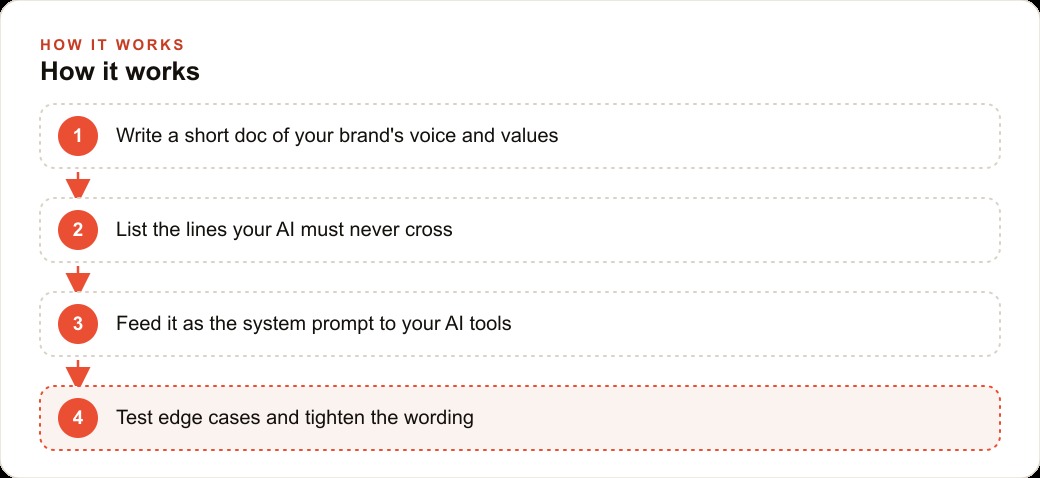
So what is the alternative I am arguing for? A short written document, one page is enough, that defines the character your AI must have: its values, its tone, the words it favors and avoids, and the lines it must never cross. In technical terms this becomes the system prompt, the standing instructions you give an AI tool before it ever talks to a customer. Everything the model does flows from it.
The document has two halves. The first describes who the assistant is and how it speaks. The second is your own small constitution: the hard rules. No invented facts. No unapproved discounts. No pressure tactics. An explicit instruction to admit uncertainty and offer to check rather than guess. That second half is where the safety lives, and it is the half businesses most often forget.
A boutique clothing store proves the point
Let me make this concrete with one business, because the argument is easy to nod along to and easy to underestimate. Picture a boutique clothing store that wants an AI on its website and Instagram to help shoppers pick outfits, answer sizing questions, and nudge them toward a purchase. Left on default, it replies like every other bot, and it will occasionally say something the owner never sanctioned.
Now write the soul doc. The assistant is a warm, tasteful personal stylist. It speaks in short, confident sentences. It uses the brand's own vocabulary, not generic retail speak, and it celebrates a customer's choices without flattery that rings false. Then add the store's constitution: it never invents stock that is not available, it never pressures or guilt trips a shopper, it is honest when it does not know a fit detail and offers to check, and it never quotes a discount the store has not approved. That single page becomes the system prompt feeding both the website chat and the social replies, so a customer meets the same stylist voice whether they message on the site or on Instagram.
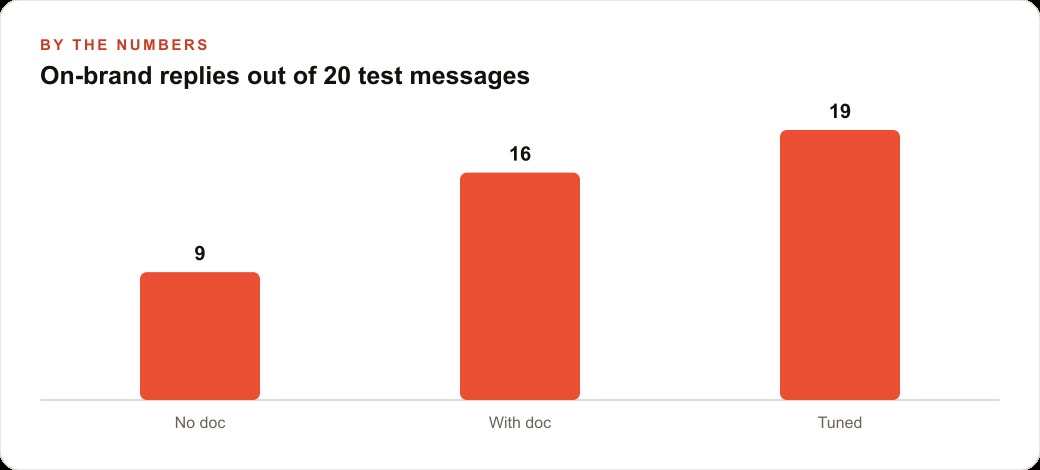
The payoff shows up in numbers you can actually track. Imagine testing the bot against twenty tricky messages before launch, including rude customers and attempts to roleplay it into saying something silly. A default bot might stay on brand on nine of them. With the soul doc in place, that climbs sharply, and after tightening the wording where it slipped, it holds character on nearly all of them. That gap, from roughly half to nearly all, is the difference between a bot that protects the brand and one that embarrasses it. And a consistent, trustworthy voice is not just defensive. A stylist that genuinely sounds like the brand converts browsers better, which is the same logic that makes strong creative lift results on Facebook and Instagram ad campaigns: coherence sells.
Where the voice needs to reach
The argument extends past the chat widget, and this is where most businesses under invest. The same character file should govern every place an AI writes on your behalf. The tool that drafts your email replies, the assistant that answers DMs, the system that writes captions for content feeding SEO and organic search: all of it should read from one document, so the brand sounds like a single person across every channel. When the voice lives in your CRM and website stack as the shared system prompt, consistency stops being something you police manually and becomes the default behavior. One character file, applied everywhere, is what makes an AISupported brand feel real instead of assembled from parts.
Write it before you connect anything
My closing position is unambiguous. Do not connect an AI to a customer until you have written its character down. Start with one page describing who the assistant is, the tone it uses, the words it favors, and the values behind your brand. List the lines it must never cross, including an instruction to admit uncertainty instead of guessing. Paste that into whatever tool you use as the system prompt. Then test it, because a character is only as strong as the edge cases it survives. Throw difficult messages at it, including ones that try to roleplay it out of character, and tighten the document wherever it slips.
The objection that a document is too rigid gets it backwards
A common pushback is that pinning a character down makes the AI stiff, that a document will strip out the warmth and flexibility people actually want from a helpful assistant. The evidence points the other way. A vague, undefined assistant is the rigid one, because it defaults to the same cautious, generic register no matter who it is talking to. A well written character document does not remove personality. It gives the model a specific personality to inhabit consistently, which is what makes it feel warm and human rather than beige and interchangeable.
Think about what actually makes a brand feel alive. It is not that the voice is unpredictable. It is that the voice is unmistakable. A luxury boutique that sounds tasteful in every message, a family brand that sounds warm every single time, a technical firm that sounds precise on every reply: that consistency is the personality. Removing the document does not free the assistant to be more human. It just lets it drift back to a lifeless average. The document is what buys you a real character, and drift is what a business should actually fear.
Consistency is a trust asset you can measure
The final piece of the argument is commercial. Brand trust is built through repetition, and every off character reply is a small withdrawal from that account. A customer who gets a warm, precise, honest answer on Monday and a generic, slightly pushy one on Thursday learns that the brand is not quite reliable, even if they never articulate why. That erosion is invisible until it shows up as lower repeat purchases and softer word of mouth.
A brand voice document turns that from a hope into something you can actually manage. You can test the assistant against a batch of hard messages, count how many stay on brand, tighten the wording, and test again, watching the on character rate climb from roughly half toward nearly all. That is a measurable quality control loop applied to something most businesses leave entirely to chance. The businesses that treat their AI's character as a testable, tunable asset will simply sound more coherent than the ones that plugged in a default and hoped, and coherence compounds into trust the same way inconsistency compounds into doubt.
Start before the first customer message, not after
The one timing mistake I see most is treating the character document as cleanup work, something to write after the bot is already live and someone complains about a weird reply. By then the damage is already accumulating, one off character message at a time, in front of real customers. The document is cheap to write and expensive to retrofit, because retrofitting means auditing everything the assistant has already said and rebuilding trust it has already spent. Write it first, test it against hard messages first, and only then connect it to a customer. A character defined before launch protects the brand from the very first interaction, which is exactly when first impressions are made.
You can absolutely write your own brand voice document and wire it in yourself, and I would encourage a small business to try. If you would rather have a battle tested character built and stress tested for you, so it holds up under real customer pressure from day one, you can hand that to an expert and simply review the finished result. Either way, the mistake to avoid is the one everyone is currently making: shipping a nameless, ruleless AI with your logo on it and hoping it behaves.
That is exactly what we do at AI DOERS. Book a private 30-minute call with Madhuranjan Kumar and we will map the fastest path to it for your specific business.
Book your call →
Madhuranjan Kumar
Madhuranjan Kumar brings 20 years of performance-marketing experience and has managed over $200 million in Facebook ad spend for brands across the United States and beyond. His expertise spans the full modern marketing stack: Meta, Google Ads, TikTok, email automation, CRM, and the websites that hold it together. At AI DOERS he turns that track record into lead-generation systems for businesses across every industry.