
Gemma 4: How Google Put Frontier-Level AI on Your Laptop and Phone
Gemma 4 is Google's new family of open-weight models under Apache 2.0. The 31B dense model ranks as the number three open model on the Arena AI text leaderboard while still running on consumer hardware, and the tiny E2B and E4B versions run fully offline on phones.

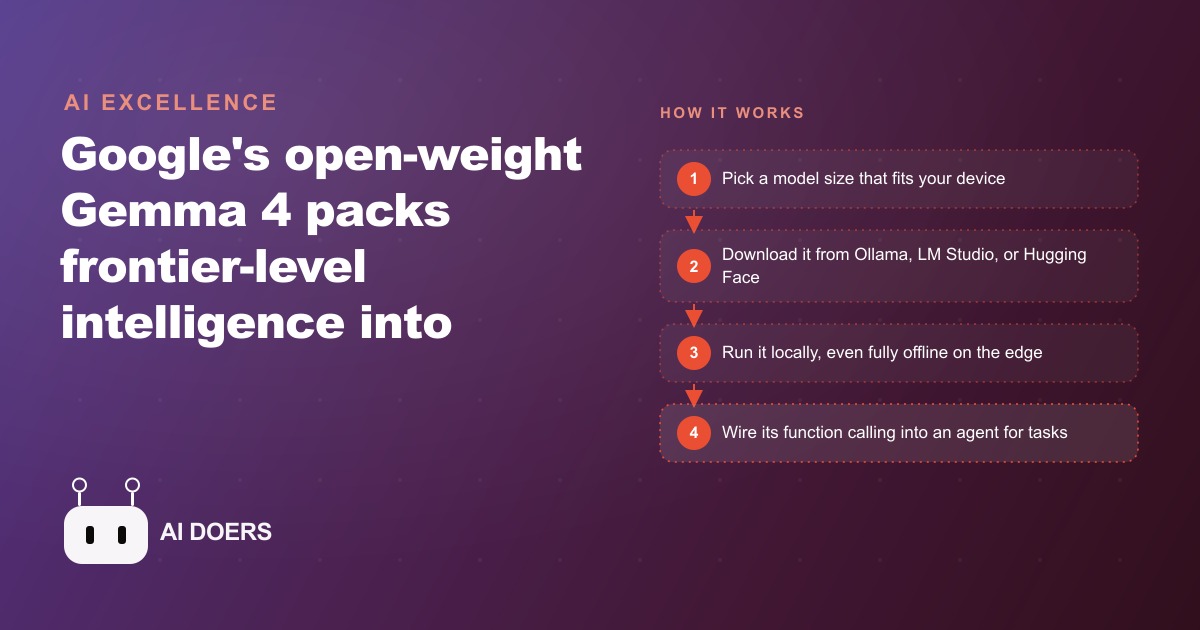
The third-best open AI model in the world now fits on a consumer GPU, and Google released it under a license that lets any business use it commercially with no fees attached. That is the headline for Gemma 4, and the implications extend well beyond what most coverage has focused on.
Google Just Put the Third-Best Open AI Model in the World on Consumer Hardware
On the Arena AI text leaderboard, the industry-standard benchmark where real users evaluate model quality side by side, Gemma 4 31B currently holds the third position among all open models worldwide with a score of 1452. The models surrounding it on that leaderboard are closed, proprietary systems with parameter counts many times larger, available only through paid API subscriptions. Gemma 4 31B matches their output quality on most tasks, runs on hardware you can buy at a consumer electronics store, and costs nothing to license.
The family covers four sizes: an effective 2B for phones and Raspberry Pi boards, an effective 4B for slightly heavier edge work, a 26B mixture-of-experts model with 4 billion parameters active at inference time, and a 31B dense model for peak local performance. All four share the same Apache 2.0 release. You can download any of them today, run them in a commercial product, and fine-tune them on your own data, without a licensing fee, without usage caps, and without a dependency on a provider's API uptime.
The benchmark story extends beyond the Arena leaderboard. On MMLU, the 31B scores 85.2. On LiveCodeBench it reaches 80 percent. On GPQA Diamond, a test of graduate-level reasoning, it posts 84.3. On the Tool Call 15 benchmark, which tests how reliably a model can call external tools in an agent workflow, Gemma 4 31B scores a perfect result. That last number is the one that matters most for practical deployment.
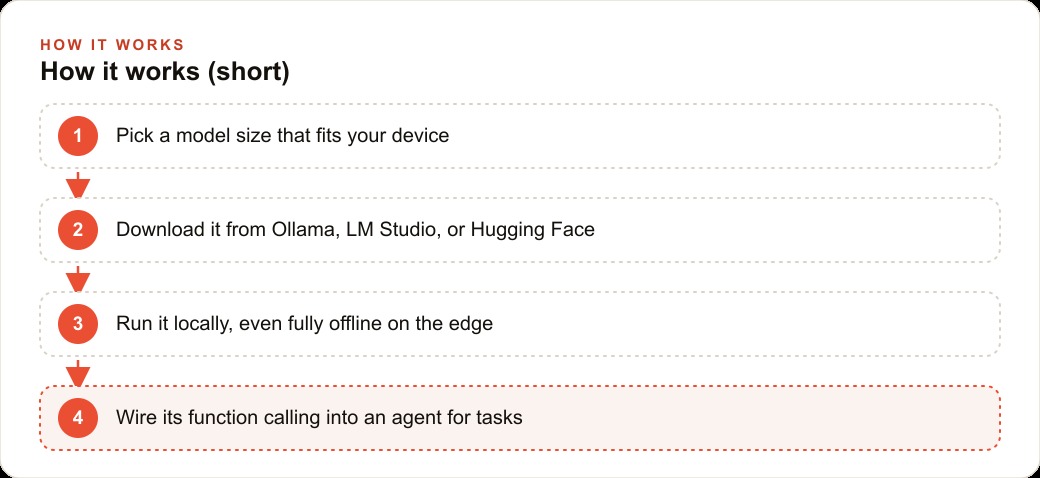
The deployment infrastructure is already in place across every major local inference stack. Gemma 4 is available today on Hugging Face, Ollama, vLLM, llama.cpp, MLX, LM Studio, Unsloth, and NVIDIA NIMs. You can be running the 31B model locally in under an hour on any of those platforms. The edge models run on phones, tablets, and single-board computers. For the first time, a model at this quality tier is genuinely available to any business willing to run it on their own hardware.
The Apache 2.0 License Is What Makes Frontier-Quality AI Economically Different for Small Business
The Apache 2.0 license is not a minor technical detail. It is the thing that separates Gemma 4 from every closed model in the frontier tier and from many open models that carry commercial restrictions.
Under Apache 2.0, you can run the model for commercial purposes, distribute it as part of a product, modify its weights through fine-tuning on proprietary data, and do all of this without paying a royalty or seeking permission. The only ongoing cost is the compute you run it on. That compute cost, expressed as hardware and electricity, behaves completely differently from a per-token API bill.
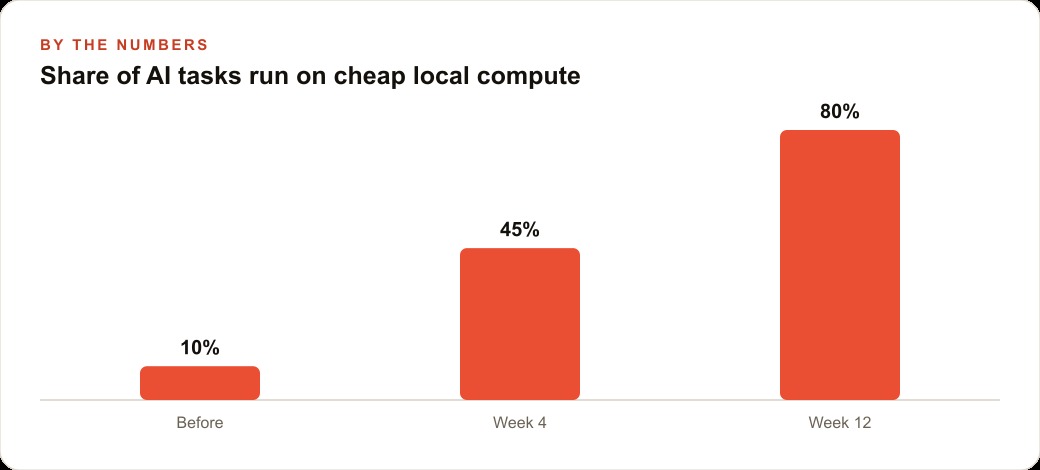
A hosted API charges you each time the model processes a request. For routine tasks run at volume, that cost accumulates fast. A business running 500 document analysis requests per day at 3,000 tokens each sends 1.5 million input tokens to a hosted API daily. At a common hosted rate of 3 dollars per million input tokens, the daily cost is 4.50 dollars, the monthly cost is 135 dollars, and the annual cost is 1,620 dollars. That is the recurring bill for keeping AI running on one document processing workflow.
A local Gemma 4 deployment replaces that bill with a one-time hardware purchase. A consumer GPU capable of running the 31B model in 4-bit quantization costs between 300 and 800 dollars depending on generation and availability. At a workload of 500 document requests per day, that hardware pays for itself in two to six months against a hosted API, and every request after that runs for the cost of electricity. For higher-volume workloads, the break-even arrives faster. For any regulated business that cannot use a cloud model at all due to compliance requirements, there is no hosted alternative to compare against, and the local model is the only viable path.
The privacy and compliance dimension compounds this economic case. Healthcare, legal, financial, and government organizations regularly face constraints that prevent sending sensitive data to third-party cloud endpoints. Gemma 4 under Apache 2.0 gives those organizations a frontier-quality model that operates entirely within their own infrastructure. There is no vendor data handling agreement to negotiate, no third-party privacy review to complete, and no risk of sensitive data transiting a network you do not control.
Native Tool Calling and Perfect Benchmark Scores Turn a Local Model Into an Actual Agent
The Tool Call 15 benchmark score is the technical detail that most coverage treats as a footnote and that practitioners should treat as the headline within the headline.
A perfect tool-calling score means the model can reliably select the right external function at the right moment, pass it the correct arguments in the correct format, interpret the return value, and continue reasoning from there. That is the full loop required for an autonomous agent: receive a goal, select a tool, call it, interpret the result, and continue. A model that fumbles any step in that loop requires human intervention to recover, which destroys the productivity case for automation.
Gemma 4 also ships with native structured JSON output and native system instructions. The JSON output capability means the model can produce reliably parseable outputs without prompting tricks or post-processing workarounds. System instructions mean you can define the model's behavior and constraints at the configuration level rather than embedding them in every prompt. Together, these three native capabilities, function calling, structured JSON, and system instructions, give you a local model that connects to your internal APIs, returns structured data, and follows a defined operational scope without a cloud connection and without paying per inference.
The multimodal capabilities add a further practical dimension. All four Gemma 4 model sizes natively process images and video at variable resolutions and handle OCR and chart understanding. The effective E2B and E4B models also accept native audio input. For a business processing mixed-format documents, handwritten notes, scanned forms, charts from reports, and verbal memos, a single local model handles all of these inputs without routing them to different specialized services.
The Mobile Models Run Fully Offline and That Changes What Is Possible in Healthcare and Field Work
The E2B and E4B models occupy a different category from the 31B. They are built specifically for on-device deployment on phones, tablets, and edge hardware, and they run fully offline at near-zero latency.
Google developed these models in collaboration with the Pixel team, Qualcomm, and MediaTek. The technical mechanism is per-layer embeddings: each decoder layer receives its own small lookup table, which keeps the active parameter footprint small enough for mobile hardware while preserving the model's reasoning capability for most tasks. Native audio input is included at both sizes, supporting speech recognition without a cloud round trip.
The business implications for field work and regulated environments are direct. A field technician with no reliable internet connection can run OCR and document analysis on a tablet. A healthcare worker can run intake transcription on a phone inside a facility where network access is restricted. A legal professional can process confidential documents on a secure device that has never had an internet connection enabled for that application. In all three cases, the model runs on hardware the worker already carries, at zero incremental cost per inference, with the data never leaving the device.
The practical deployment time for the edge models is short. Download through Ollama or a compatible local inference runtime, test on the primary use case, and the model is running in an afternoon. No server provisioning, no API key management, no usage monitoring to prevent unexpected costs.
A Dental Clinic That Needed AI Without Its Patient Data Leaving the Building
A dental clinic in this position faces a specific problem: it processes a steady stream of insurance forms, explanation of benefits documents, referral letters, and intake paperwork, and patient data is sensitive enough that sending it to a cloud model is either prohibited under its agreements or uncomfortable for patients. A cloud model solves the intelligence problem but creates a compliance and trust problem. A local model solves both at once.
The setup for this clinic involves a single consumer GPU on the office network, running Gemma 4 31B in 4-bit quantization at a hardware cost of roughly 400 to 600 dollars. The model's OCR capability reads scanned insurance forms and extracts the key fields, which are member ID, provider name, service date, and approved amount, into structured JSON. That JSON feeds directly into the practice management software through an internal API call. No staff member types data from a paper form by hand. No document leaves the building.
The time recovery calculation is concrete. A typical insurance form encounter requires approximately 10 minutes of staff time when done manually: pulling the form, reading the relevant fields, entering them into the system, and confirming accuracy. A clinic processing 90 patient encounters per month spends 900 minutes, or 15 hours, per month on insurance form data entry alone. Automating this step recovers those 15 hours for patient-facing work. At a fully loaded staff cost of 25 dollars per hour, that is 375 dollars per month in recovered labor, covering the hardware cost in under two months and producing net savings of over 4,000 dollars per year from one automated workflow on one document type.
The practical extension goes further. A small agent running on the same GPU can handle routine patient inquiries from a front-desk tablet. When the operator asks what a cleaning costs or how to prepare for a procedure, the agent looks up the answer from the clinic's FAQ data and drafts a response in seconds. When the internet connection drops during a busy morning, the E4B model on the front-desk tablet processes intake transcription fully offline without interrupting the workflow. The staff redirects the time recovered from data entry toward the patient interactions that require human presence and judgment.
The one thing to plan around is the 256K context limit on the 31B. If a specific task requires reasoning across a large set of records simultaneously, that cap means chunking the input or designating a hosted model for that one job. For routine form processing and FAQ handling, 256K is far more than enough.
The VRAM Calculation and the Context Cap to Check Before Committing to a Workflow
Two hardware and configuration constraints determine whether a Gemma 4 deployment works cleanly or creates problems.
The first is VRAM. A practical rule of thumb for 4-bit quantization is to multiply the model's parameter count in billions by 2 gigabytes and add 4 gigabytes of runtime overhead. For the 31B model, that gives roughly 20 to 22 gigabytes in 4-bit quantization. A consumer GPU with 24 GB of VRAM handles the 31B model cleanly at 4-bit. A GPU with 16 GB requires either more aggressive quantization, which degrades output quality noticeably, or a fallback to the 26B mixture-of-experts model, where only 4B parameters are active at inference time and the VRAM requirement drops substantially.
For the edge models, VRAM is not the constraint because they run on mobile NPU hardware. The E2B and E4B fit comfortably on current-generation phones and tablets and require no additional hardware beyond the device.
The second constraint is context length. The edge models top out at 128K tokens. The 31B model caps at 256K. For most document processing and agent tasks, these limits are more than sufficient. A 256K-token context holds roughly 200,000 words, which is longer than most novels and far longer than any single document most businesses process. The scenarios where this limit becomes a constraint are multi-document reasoning at scale, or long-running agent sessions that accumulate extensive tool-call histories. For those specific cases, chunk the input into sequential passes or designate a hosted model with a larger context window for that subset of tasks.
The Move to Make This Week for Any Business Processing Sensitive Documents at Volume
For any business where volume document processing meets a data sensitivity constraint, this is the week to run the evaluation.
The evaluation is straightforward. Download Gemma 4 31B through Ollama or LM Studio. Verify that your hardware meets the VRAM requirement for the quantization level you need. Run it against 20 to 30 representative documents from your actual workflow and evaluate the output quality on the specific fields you need to extract. For most structured document types, the OCR and extraction accuracy will be high enough to proceed to a pilot deployment.
The next step is connecting the model's JSON output to the internal system that needs the data. In most cases this is a short integration script. The model produces structured JSON, the internal system has an input it expects, and the integration layer between them is the only custom code required. For businesses without technical staff, this integration is the one piece that benefits from outside help to stand up correctly.
The broader move is to map every workflow in the business where sensitive document processing currently routes through a cloud model or through manual data entry. Each of those workflows is a candidate for local Gemma 4 deployment. The cost of running the evaluation is an afternoon and the cost of the hardware. The cost of not running it is the monthly API bill, the continued labor cost, and the ongoing compliance exposure from data that leaves the building every time a document is processed.
Madhuranjan Kumar has seen the same pattern across regulated businesses: the hesitation is almost always about setup complexity rather than capability. The capability, as the benchmarks confirm, is frontier-level. The setup is an afternoon. Every month of deferral is a month of API costs and labor hours that local deployment would have recovered.
That is exactly what we do at AI DOERS. Book a private 30-minute call with Madhuranjan Kumar and we will map the fastest path to it for your specific business.
Book your call →
Madhuranjan Kumar
Madhuranjan Kumar brings 20 years of performance-marketing experience and has managed over $200 million in Facebook ad spend for brands across the United States and beyond. His expertise spans the full modern marketing stack: Meta, Google Ads, TikTok, email automation, CRM, and the websites that hold it together. At AI DOERS he turns that track record into lead-generation systems for businesses across every industry.