
Gemini Deep Think vs ChatGPT 5.2, and the Prompt That Beats Them Both
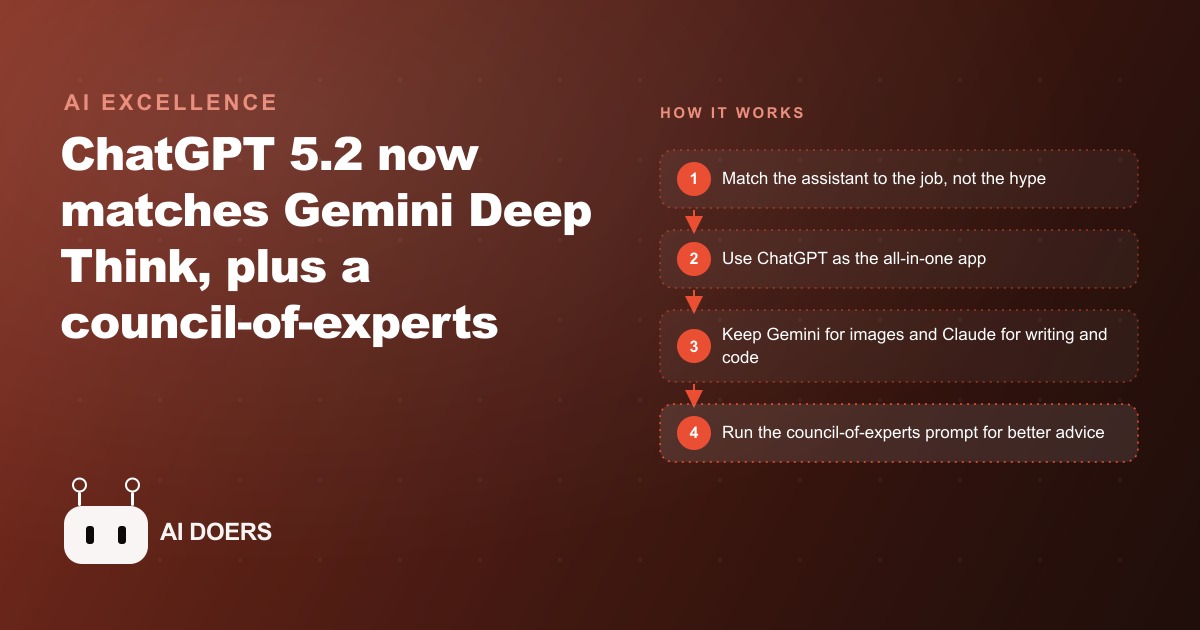
ChatGPT 5.2 now matches Gemini's best model, so pick ChatGPT for an all-in-one app, Gemini for images, and Claude for writing and code. The standout move is a council-of-experts prompt that returns far more varied, actionable advice than ordinary role prompting.
The week that ChatGPT 5.2 matched Gemini on capability benchmarks, the AI internet did exactly what it always does: picked sides.
I am Madhuranjan Kumar, and I want to make a case for ending the platform loyalty argument once and for all, not by crowning a winner, but by explaining why the argument itself is a waste of time that could be spent using these tools for actual work. The people who are winning with AI right now are not the ones who picked the best platform. They are the ones who stopped asking which platform is best and started asking which platform is right for this specific job, and then built a workflow around the answer.
The week everything converged and the debate got louder
ChatGPT shipped 5.2 and 5.2 Pro. Gemini pushed its Deep Think mode with additional reasoning capability. Claude continued doing what it has always done well, which is write and code with a naturalness the other two have not matched. Three strong models, all improving at roughly the same pace, all within range of each other on the benchmarks that matter for most business tasks.
The convergence should have quieted the debate. Instead it amplified it. When the gap between platforms is large, picking a winner is a practical decision with real consequences. When the gap closes, the choice becomes tribal, and tribal choices are defended loudly because there is no longer a clear functional argument to fall back on. The social dynamics of AI communities make this worse. People have built identities around their tool preferences, they have tutorials and workflows and audiences associated with a particular platform, and a convergence event that removes the clear winner also removes the neat story that held the community together.
Here is what the convergence actually means in plain terms. ChatGPT 5.2 now matches the best Gemini model on raw capability, closing the main reason anyone was switching from ChatGPT to Google's platform, which was the perception that Gemini's reasoning was noticeably ahead. It is not anymore. And because ChatGPT already owned the tooling advantage, offering better voice mode, more reliable dictation, a stronger projects integration, and a more mature ecosystem of connected apps, the closure of the capability gap removes most of the remaining reasons to leave. If you only want one AI and you are currently using ChatGPT, nothing that happened this week tells you to switch.
But the inverse is not an instruction to abandon Gemini. Gemini still clearly leads on image generation, where Nano Banana is a genuine step ahead of what ChatGPT produces natively. There is also Google Mixboard, which now has Nano Banana Pro built in: add a batch of images, tell it the story you want to tell, a pitch deck or a product showcase or a campaign narrative, and it builds a finished multi-page PDF. For any business that creates visual content regularly, that capability is not a marginal difference. It is a different category of output entirely, and it belongs in the workflow for image-heavy work regardless of what the text benchmarks say.
Claude, separately, retains a writing quality advantage that benchmark tables do not fully capture. The people who write for a living or who work closely with code notice the difference immediately when they run side-by-side comparisons. Claude's prose does not carry the small stylistic tells that reveal automated generation to a trained reader. Its code has a more thoughtful structure. These are not large gaps in the headline benchmarks, but they are consistent and they matter when the quality of the output is what the client is actually evaluating.
None of this is an argument for picking one and ignoring the others. It is an argument for assigning each a role and ending the competition framing entirely.
Three tools, three jobs, one decision that ends the argument
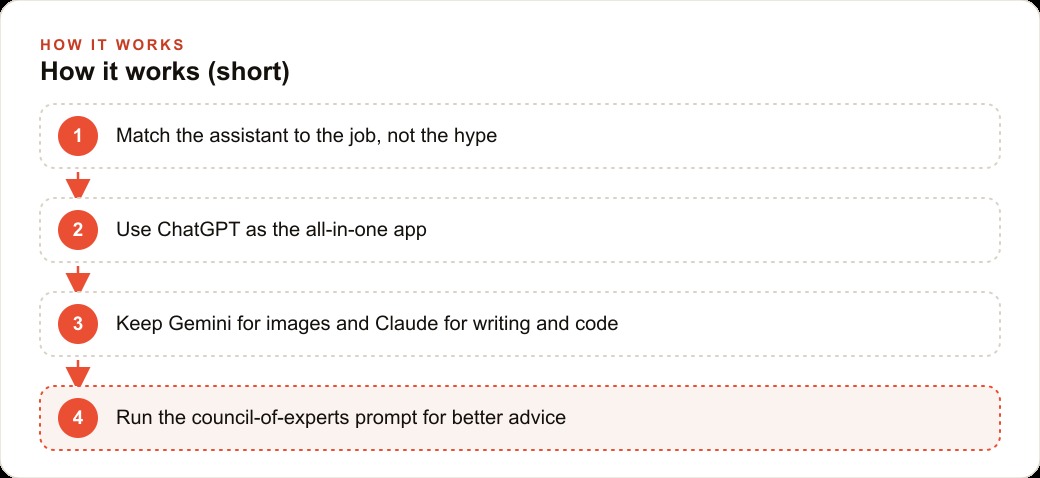
The practical question is never which AI is best. It is which AI handles this specific task better than the others, and the answer changes by task type.
For everyday business operations, ChatGPT is the right default. And the word "default" matters here. A default is not the tool you use for everything. It is the tool you reach for first because its surface area is wide enough to handle the first cut of almost any task. You refine the workflow from there, routing pieces of it to the tools that handle those pieces best, but ChatGPT as the starting point makes the daily workflow coherent rather than scattered across three different interfaces with three different session histories. The combination of dictation, voice mode, projects, and solid deep research means it handles the widest surface area of daily business work without forcing the user to switch contexts or tools. A business owner who wants to use one AI for everything and keep that number low should build habits around ChatGPT 5.2. The all-in-one value is real, and it has grown more real now that the capability gap with Gemini has closed.
For images and visual materials, Gemini and Nano Banana are the clear choice, and this matters for a large number of businesses. A boutique running social media and paid ad creative needs image quality that converts, not images that look like stock art with a prompt attached. A service company building banner assets for Google display campaigns needs visual output that matches a brand standard. A consultant putting together a pitch deck needs slides that look designed, not assembled. Gemini and Mixboard handle these tasks at a level the other platforms do not, and routing visual work to Gemini is the right call regardless of what this week's headlines said about the text benchmarks.
For writing and code, Claude holds a persistent advantage. For any business building a content and SEO program where the quality of the prose is part of the product, or for a developer generating code that will be read and maintained by a team, Claude is the right tool for those tasks. The advantage has not been eroded by 5.2's release. It may narrow over time, but right now the gap is consistent enough that routing writing-heavy and code-heavy work to Claude is the straightforward decision.
There is also an important point about Adobe Photoshop, which is now a connected app inside ChatGPT. Quick edits, blurring a background, cropping for a specific format, adjusting a color, can now happen inside ChatGPT with a slider interface. Deeper layer work still belongs in the full Photoshop application, but for the kind of fast image adjustments that a business makes a dozen times a week, having that available inside the AI platform the team already uses daily is a meaningful convenience reduction. The friction of switching to a dedicated tool for small edits is real, and removing it compounds over time.
The assignment is simple: ChatGPT for daily operations and research, Gemini for images and visual output, Claude for writing and code where quality is the primary measure. Three tools, three roles, no debate. The secondary benefit of this assignment is that you stop wasting time on updates as status signals. When ChatGPT ships a new model, you check whether it affects the daily driver role. When Gemini releases a new image feature, you check whether it improves the visual workflow. Each release has a specific question with a specific answer. The answer is almost always "the assignment holds" because the relative strengths have been more stable than the weekly coverage suggests.
For businesses that also need to manage customer relationships and follow-up automation, the tool assignment extends naturally. Use ChatGPT to draft and plan the CRM sequences, use Gemini to produce the visual elements for the touchpoints, and use Claude to write the actual email and message copy if the voice and naturalness of the writing matters for the relationship. The tools are not rivals. They are a toolbox. The right question has always been which wrench fits this bolt.
A prompting trick that beats all of them on advice
The most interesting practical development this week did not come from a model update. It came from a prompting approach that makes every one of these platforms produce noticeably better advice on complex questions.
The standard approach to getting expert advice from an AI is role prompting: tell the model to act as an expert in a specific field, then ask the question. That works tolerably. The model produces confident, structured advice in an expert register, and for simple questions the output is useful. But for harder questions, especially ones with real tradeoffs and competing considerations, role prompting tends to produce one perspective dressed in expert language, which is less useful than it sounds because the most important information is usually in the tension between perspectives, not in a single authoritative view.
A different framing produces something substantially better. Instead of assigning the AI a role, ask it a meta-question first: which group of people would best explore this problem, and what would each of them say about it? Then ask the AI to run that council and give you each voice separately before synthesizing. The researcher Andrej Karpathy has written about this approach, and the output difference is significant enough to be visible in a single side-by-side test.
Role prompting gives you one perspective. Council prompting gives you several distinct perspectives with genuine tension between them, because the model is actively generating different viewpoints rather than averaging toward a single authoritative voice. For a business making a real decision, the council output is far more useful. A gym owner deciding whether to launch a member-referral program gets, from role prompting, a recommendation with reasons. From council prompting, inside a deep-thinking mode, they get the retention strategist who argues for the program strongly, the community manager who warns about cheapening the membership feel, the pricing thinker who raises the margin math, and the operations lead who flags the redemption tracking cost. Those four perspectives in tension give the owner a real decision-making map.
The trick runs on any of the three platforms. It produces its best results inside Gemini's Deep Think mode or ChatGPT's deep research settings, because both give the model more space to develop each council voice before synthesizing. But even on a standard response, the council framing pushes output toward breadth and specificity in a way that ordinary role prompting does not, consistently and across different model versions.
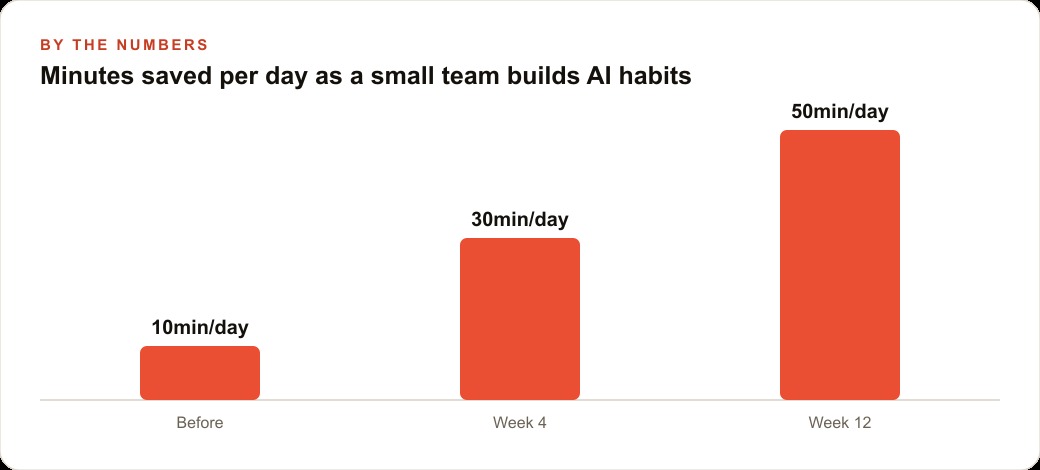
There is also something worth noting about the enterprise data that has been emerging from both OpenAI and Google about how AI is actually being used by high-performing teams. Frontier workers, the people getting the most from AI, send significantly more messages per day than average users. The research consistently shows it is not the sophistication of the prompts that creates the gap. It is the volume of interactions. Teams that talk to AI more, that treat it as a conversation partner on every decision rather than a tool pulled out for specific tasks, get more output at higher quality. The honest productivity gain from this habit, across multiple studies, lands in the range of twenty to fifty percent more output per day. Not the inflated ten times claims. A realistic, sustainable, compounding improvement. That improvement comes from frequency, not from picking the right platform.
The larger point is that the skill gap in AI is not between the platforms. It is between users who prompt toward one confident answer and users who prompt toward productive disagreement. The platforms are converging. The prompt quality is not. Building the habit of asking who would best think about this and what each of them would say is an upgrade that compounds regardless of which version ships next month.
The platform loyalty debate will continue because it is easy to have and hard to resolve. The work is to stop having it, assign roles, route tasks correctly, and run better prompts on all three. That is where the actual gains live, and they are available right now.
That is exactly what we do at AI DOERS. Book a private 30-minute call with Madhuranjan Kumar and we will map the fastest path to it for your specific business.
Book your call →
Madhuranjan Kumar
Madhuranjan Kumar brings 20 years of performance-marketing experience and has managed over $200 million in Facebook ad spend for brands across the United States and beyond. His expertise spans the full modern marketing stack: Meta, Google Ads, TikTok, email automation, CRM, and the websites that hold it together. At AI DOERS he turns that track record into lead-generation systems for businesses across every industry.