
Gemini 3 and Why Owning the Whole Stack Wins the AI Race
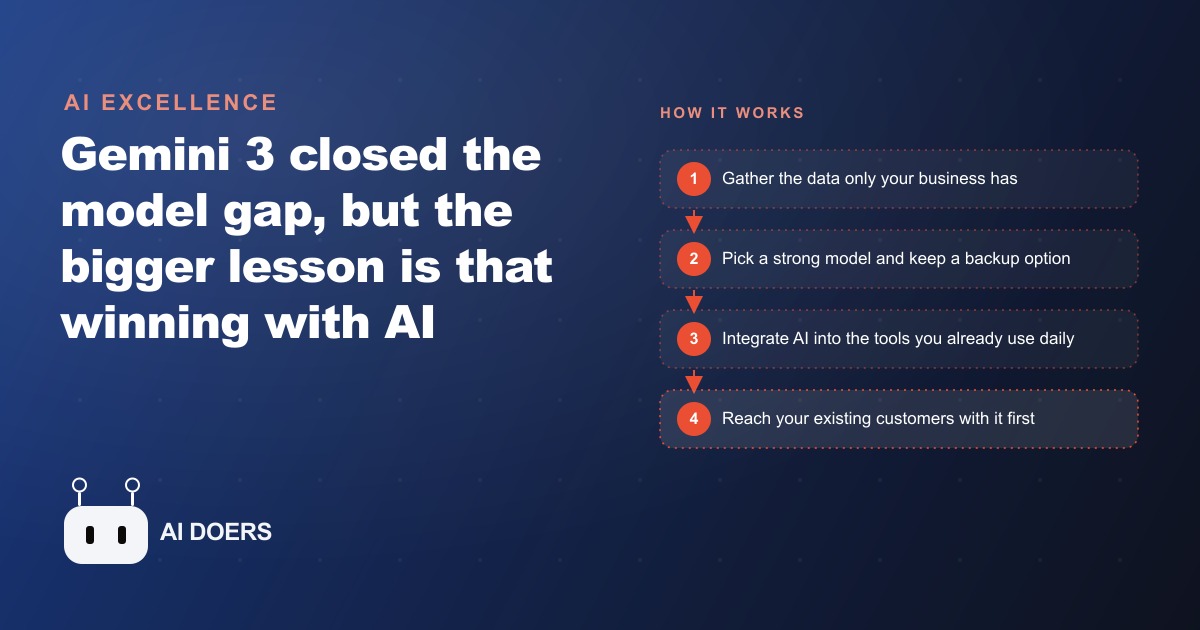
Gemini 3 closed the model gap, but the real lesson is that AI wins are built on data, distribution, and integration, not the model alone. Here is how a small business applies that same playbook.

The moment model quality stopped being the race
There was a specific week this year when I stopped thinking about AI as a model selection problem.
It was the week Gemini 3 launched and the technology press spent four days talking almost exclusively about benchmark scores. Which model beat which on MMLU. Whether the gap had closed. Whether OpenAI still led on agentic tasks. Whether Anthropic's position was secure. The conversation was about rankings, about which lab was ahead, about which model you should pick.
I am Madhuranjan Kumar, and what I noticed that week was a different question underneath the rankings conversation: the companies that actually look strong in 2026 are not the ones that won the benchmark race. They are the ones that own more of the stack. The model is one layer. The stack is the whole thing.
The specific realization that changed how I think about competitive position
Gemini 3 crossing benchmarks to match and in places exceed the previous leader is a real event. The capabilities are real. The improvement is measurable. But the reaction from the market was not "the better benchmark score will win." The reaction was something closer to recognition: one company now has a strong model and a large existing distribution and control of the hardware and a daily product that billions of people already open.
The benchmark score improved the position of a company that already had everything else. It was additive to a stack, not the foundation of one.
What struck me about that framing was how cleanly it mapped to what I see in businesses that are gaining on their competitors through AI, and what distinguishes them from the ones that are not.
The businesses I have watched pull ahead in 2025 and into 2026 are not the ones that found the best model. They are the ones that built the tightest integration between their data, their customer relationships, and the model they use. The model in both cases, for the big lab and for the small business, is a component in a larger system. The advantage comes from the system, not from the component.
What proprietary data means at a human scale
The large technology company's proprietary data moat is easy to see from the outside. Search history across billions of queries. Video watch patterns across hundreds of millions of hours of content per day. Email and calendar data from professional users. Maps data from mobile devices. The collection is staggering in scale and produces a training signal that no competitor can replicate by downloading the internet.
What took me longer to appreciate is that every service business has a version of this moat at human scale.
The owner of a med spa has a record of which treatments specific clients booked, how they responded, when they reboooked, what they said in their feedback, and which communication approach brought them back versus which let them drift. That record, across a few hundred or a few thousand clients over several years, is genuinely proprietary. No competitor has it. No AI lab has it. No benchmarking study captures it.
The question that the Gemini 3 week crystallized for me is whether that record is being used. Whether the business has connected a capable model to the specific data it holds, or whether the data sits in a CRM that nobody is using to its potential while the owner tries to find the right model to use.
The model matters less than whether the data you uniquely hold is informing how that model is applied.
The distribution insight that most business owners overlook
When Gemini 3 launched, the distribution advantage of the company behind it was described as a function of scale: they reach billions of users across existing products. The new AI capability can be surfaced immediately to that existing audience without a separate acquisition effort.
Transposing that to a small business, the equivalent insight is that your existing clients are your distribution advantage. Not prospective clients. Not the people who have not heard of you yet. The people who already know your quality, have experienced your service, and trust you enough to have come back at least once.
For most service businesses, the client who books a second appointment is worth three to five times the revenue of a single-visit client over a twelve-month window. The client who is actively referred to your services is worth substantially more than either. The distribution advantage of an existing client relationship is compounding in exactly the way that Gemini 3's deployment advantage is compounding: you reach someone who already has context and trust, which reduces the friction of every subsequent action.
What AI makes possible is making that distribution advantage work harder without proportionally more effort. An AI-drafted follow-up message that draws on the client's actual service history and sends at the right time after their appointment is more likely to generate a rebook than a generic reminder that ignores what they had done. The data is in the system. The model applies the data to the communication. The distribution advantage compounds.
Why integration depth produces results that model swapping cannot
I have watched business owners switch AI models trying to improve their results in the same way people switch from one productivity app to another hoping the new interface will fix their organizational habits. The model swap rarely produces the improvement they expect, for the same reason the productivity app swap rarely produces the habit change. The constraint was not the tool. It was the depth to which the tool was embedded in the actual work.
An AI assistant that a business owner opens in a browser tab a few times per week, types a question into, and then returns to their actual tools produces a limited return regardless of the model's benchmark scores. An AI integration that lives inside the booking system, the email inbox, and the client record and produces relevant outputs as part of the existing workflow produces returns that compound across every client interaction.
The depth of integration is what the big labs understand about their own position. The value of the AI is not in the chat window. It is in how deeply the capability is woven into the surface where the work actually happens. For the large technology company, that surface is the productivity suite and the communication tools and the maps app that people use every day. For the small business, that surface is the booking flow, the follow-up email, and the client record.
The business that integrates the AI into those existing surfaces does not get a marginal improvement on tasks it was already doing. It gets a compounding improvement that makes every subsequent client interaction a little more timely and a little more personal than the previous one.
The model diversity insight and why it matters even for small operators
One of the points that emerged from the Gemini 3 week was about model diversity: the companies that look structurally strong are not wholly dependent on a single model provider. They maintain the capability to switch, to test alternatives, and to pick the best fit for each task rather than committing to one provider whose terms and capabilities may change.
For a small business, model diversity sounds like a concern that belongs to enterprises with sophisticated technical teams. It is actually more practical than that. Having a fallback option in mind for any AI workflow you depend on is the equivalent of having a backup supplier for a critical input. You do not need to use both simultaneously. You need to know that if the primary option changes its pricing, changes its terms, or degrades in quality, you have a tested alternative that you could move to without rebuilding from scratch.
The cost of maintaining that optionality is low: try your most important workflows on a second model for a few hours to understand what the transition would require. The value of that optionality is clear when a provider announces a significant price change or a significant capability change that affects your use case.
What the week of Gemini 3 actually meant for how I run my own work
The week Gemini 3 launched, I spent less time than I might have expected looking at benchmark tables. I spent more time thinking about where the AI capabilities I already use are embedded in actual workflows versus where they are accessible but disconnected.
The accessible-but-disconnected category is where most of the unrealized value sits. A model that is excellent and available but not woven into the places where work happens produces limited results. A model that is adequate and deeply integrated produces compounding results.
The concrete move I made that week was reviewing which of the tools I use most frequently could have an AI layer added to them, specifically in the places where the AI would have access to the actual context of the work rather than a description of the context I type into a separate window. Every hour spent on that kind of integration work produces a more durable return than an hour spent evaluating whether the newest benchmark leader is worth switching to.
The lesson from the Gemini 3 week is the one that the biggest labs are demonstrating in public: model quality is a race to a threshold, and most serious providers now clear that threshold. After that threshold, the race is about the stack. And the stack is built from data, from distribution, and from integration depth. For a small business, all three of those are more within reach than building a frontier model. That is the opportunity that the week of Gemini 3 made clearer, not the benchmark score itself.
The compounding return that makes the stack argument decisive
The case for building a stack, for integrating AI into existing workflows and data rather than chasing the newest model, rests on a compounding dynamic that becomes visible over months rather than days.
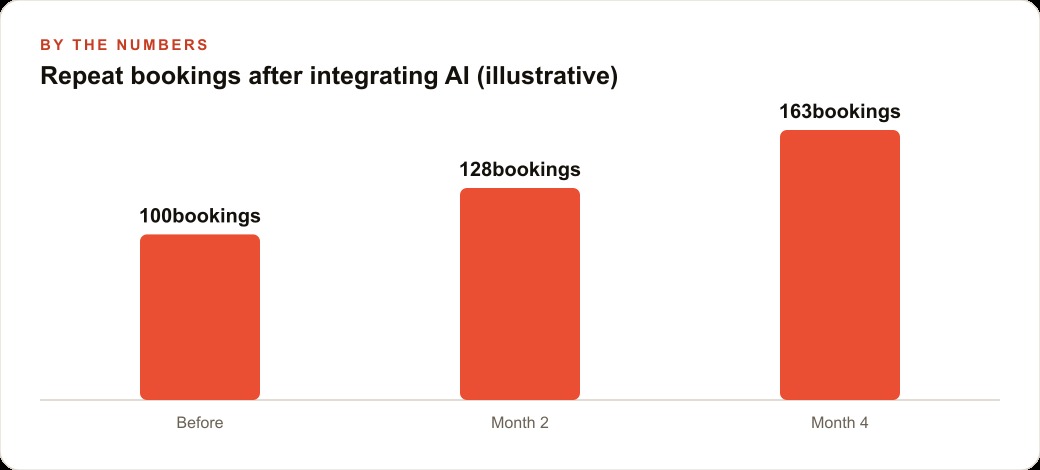
A business that spends the first month integrating a capable model into its follow-up workflow produces measurable results in that month: faster follow-up, more consistent outreach, some incremental rebookings that would not have happened with manual follow-up. Those results are the first-order return.
The second-order return appears in the data that the integration creates. Every AI-assisted interaction that is logged with its outcome, whether the client rebooked, whether they responded to the outreach, whether the timing was right, is a data point that makes the next interaction more informed. After three months of integrated operation, the business has a record of which communication patterns produce which outcomes for its specific client base. That record is proprietary and it is actionable.
The third-order return is the accumulated efficiency. Staff time that was previously spent on manual follow-up, manual scheduling reminders, and manual data entry is now spent on the interactions that require human judgment. The business is not just doing the same tasks faster. It is doing them at a different layer of complexity, with the mechanical layer automated and the judgment layer reserved for the humans best equipped to exercise it.
That three-layer compounding is why the stack argument beats the model selection argument over any meaningful time horizon. The best model applied shallowly produces a first-order return and stops. An adequate model applied deeply produces a compounding return that grows with each month of operation.
The Gemini 3 week was a reminder that the labs themselves are learning this lesson in public. The model is table stakes. The stack is the moat. For a small business with real customer relationships and real proprietary data and real existing distribution, the stack is more accessible than the frontier model. The opportunity is to build it rather than to keep watching which model takes the benchmark lead.
Starting points that produce real returns within the first month
The practical question that follows from this framing is where to start building the stack rather than staying in evaluation mode.
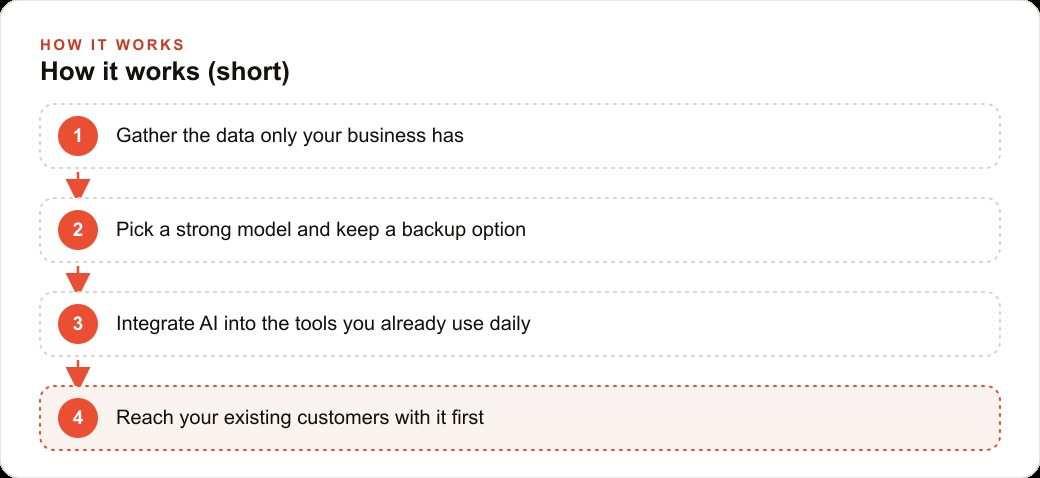
The highest-return starting points share three properties. They involve data the business already holds, meaning no new data collection infrastructure is required. They touch points in the customer relationship where timing matters, meaning faster and more personalized outreach produces measurable differences in outcome. And they connect to workflows the team already runs, meaning adoption friction is low because the AI output appears where the work already happens.
For a service business, those three properties converge on the re-engagement workflow: identifying clients who have not returned within their typical window, generating personalized outreach based on their service history, and sending it at the right moment in their likely decision cycle. Every element of that workflow can use data the business already holds, touches the point in the relationship where timing is highest-value, and can be wired into the email or CRM the team already uses.
That single workflow, built and running within two weeks of a decision to start, produces the first-order return immediately and the compounding return over every subsequent month. It is also the workflow that teaches the most about what integration looks like in practice for that specific business, which informs every subsequent integration decision. The first integration is rarely the best integration. It is the one that makes the second one better.
That is exactly what we do at AI DOERS. Book a private 30-minute call with Madhuranjan Kumar and we will map the fastest path to it for your specific business.
Book your call →
Madhuranjan Kumar
Madhuranjan Kumar brings 20 years of performance-marketing experience and has managed over $200 million in Facebook ad spend for brands across the United States and beyond. His expertise spans the full modern marketing stack: Meta, Google Ads, TikTok, email automation, CRM, and the websites that hold it together. At AI DOERS he turns that track record into lead-generation systems for businesses across every industry.