
Gemini 3 Launched Free and State-of-the-Art: The Full AI Week Recap
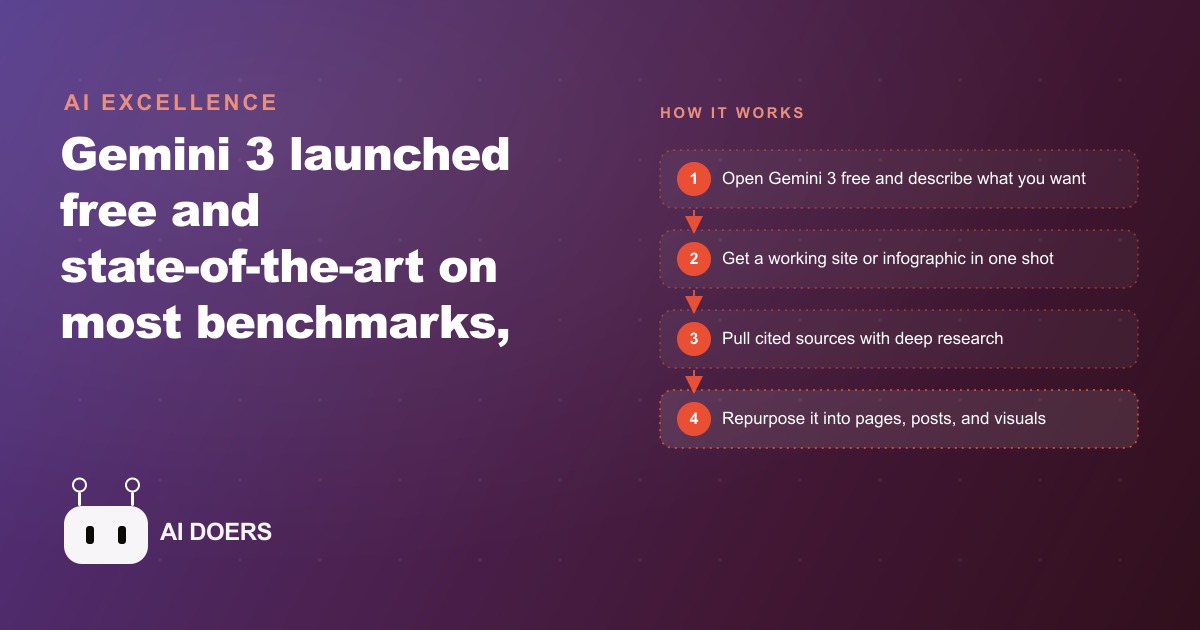
Google released Gemini 3 for free and it tops almost every benchmark, including a 37.5 percent score on Humanity's Last Exam with no tools. It led a week that also brought a reliable text image editor, deep research, a free agentic IDE, GPT 5.1 Pro, and Grok 4.1.

The agency had three tools for one job and none of them did it well
I am Madhuranjan Kumar, and the real estate brokerage at the center of this walkthrough had what most established agencies have: a web presence that looked like it was designed by committee over several years, a research process that depended on whoever had the most time to do it that week, and a habit of paying for three AI subscriptions that each handled one part of a workflow that should have been handled by one.
The agency operates in a competitive metro market. The team of six agents handles everything from first-time buyer condos in the lower price range up to custom-build luxury properties. The marketing side is handled internally by the owner and one part-time coordinator. Before the Gemini 3 shift, the stack included one tool for generating listing copy, a separate AI assistant for research tasks, and a third subscription for this breakdown briefing feature a couple of the agents had started using on mornings when they wanted a summary of the overnight market news. Total AI spend was around $280 per month across the three subscriptions.
The catalyst for change was a direct comparison the owner ran after reading about Gemini 3's launch. The model was released free at the highest available tier, which at launch meant the owner could test it without a financial commitment. The test took about two weeks of parallel use: give the same input to the existing tool and to Gemini 3 and compare the outputs on quality, reliability, and the specific characteristics that matter most for real estate marketing.
The frontend design capability changed what the coordinator could do alone
The first thing the coordinator tested was the website update backlog. The agency site had a section for neighborhood guides, pages about specific areas the agents worked in most frequently. These pages had not been updated in fourteen months. They were accurate enough that no one had complained, but they were also visually generic: a block of text, a couple of photos, no structure. The coordinator knew the pages needed visual work but the previous process required briefing an outside designer, getting a quote, waiting, and then approving revisions. The process was slow enough that it rarely happened.
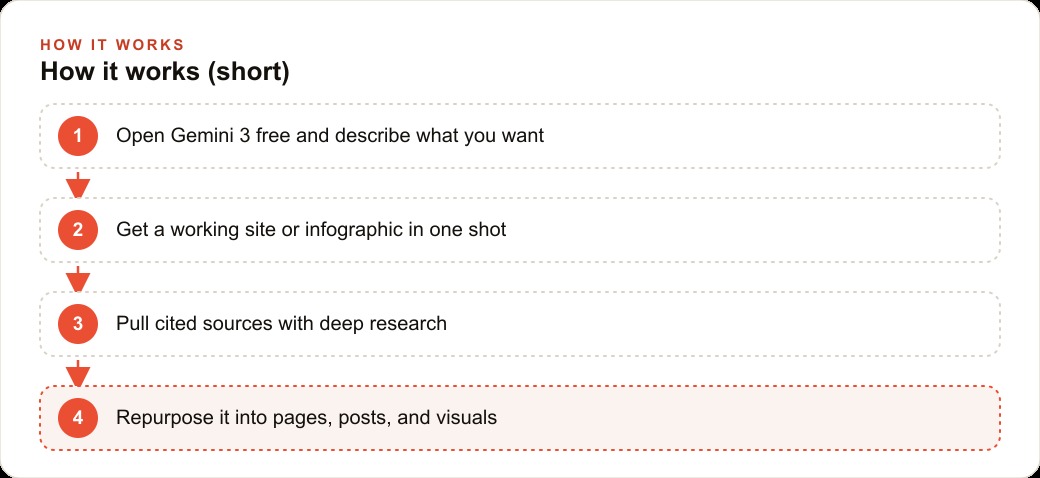
Gemini 3's frontend design lead capability changed the math. The coordinator described the existing page structure and asked for a redesigned layout that could be implemented without a developer, using a builder the agency's site was already on. The model produced a structured layout suggestion including the section order, the component types, the color application, and the copy structure for each block. The coordinator implemented it directly. The first two neighborhood guide pages were updated in an afternoon.
The quality difference was visible. The coordinator had the model review the before and after against the agency's brand guidelines and flag any inconsistencies, then made one round of adjustments. What had been a two-week process that cost several hundred dollars per page became an afternoon task with no external vendor cost. The agency's backlog of six outdated neighborhood pages was cleared in the first week.
Reliable text in technical contexts was the unlock for the financial summaries
The previous AI tool the agency used for market summaries had a reliable text problem the agents had learned to work around. When the model included numbers in its outputs, the agents had developed a habit of double-checking every figure before sharing anything with a client. It was not that the numbers were dramatically wrong, more that they were plausible enough to be mistaken for accurate but not quite right in ways that were hard to catch without re-pulling the source data anyway. The workaround of checking every number meant the time savings from the tool were partially eroded by the verification step.
Gemini 3 Nano Banana Pro, the reliable text variant within the model family, produced outputs where the numbers stayed consistent with the inputs provided and did not drift in ways that required catch-and-correct verification. The agents described the difference as trusting the output to go directly into a client-facing summary without a separate fact-check pass. That trust changed the workflow. Morning market summaries that had taken about thirty minutes to generate and verify per agent per day now took under fifteen minutes because the verification step was no longer necessary.
The practical volume impact across six agents is a daily time saving of roughly ninety minutes for the team. Over a working month that is approximately thirty hours of agent time that had been absorbed by verification work and is now available for client contact, property viewings, and follow-up. The agency does not track the downstream revenue impact of agent time freed from administrative verification, but the directional effect is clear: agents with more available contact hours generate more opportunities.
Deep research through Notebook LM changed how the agency prepared for listing presentations
The listing presentation is one of the highest-stakes interactions in a real estate agency's work. The agent presents to a homeowner who is deciding whether to list with this agency or a competitor. The quality of the market analysis, the clarity of the pricing rationale, and the confidence the agent projects in their understanding of current conditions all affect whether the agency wins the listing.
The prior research process for a listing presentation took one to two hours of preparation per presentation: pulling comparable sales data, reviewing recent market trends in the specific neighborhood, reviewing the agent's notes from prior listings in the area, and organizing everything into a coherent narrative. It was not inefficient work, but it was time-intensive and the quality varied with how much time was available before the appointment.
Notebook LM, accessed through the Gemini 3 interface, changed the preparation workflow. The coordinator assembled the relevant source documents for a listing presentation: the comparable sales data export, the neighborhood demographic summary, the agency's own performance data for the area from the prior twelve months, and three recent news articles about the local market. Notebook LM processed all four sources together and produced a briefing document that identified the key pricing signals, flagged the recent market changes most likely to come up in conversation with the homeowner, and organized the agency's performance data in the narrative most relevant to the specific listing.
The agent who used this process for the first time reported that the briefing was more thorough than the manual preparation would have been, because the model cross-referenced the sources in ways the agent would not have done under time pressure. The preparation time dropped to about thirty-five minutes. The listing presentation went two hours later and the agency won the listing.
The Antigravity IDE reduced the time from data to usable report
The agency runs a monthly investor report for a small group of clients who hold income properties and depend on the agency for market intelligence. The report covers rental vacancy rates, price-to-rent ratios in key submarkets, recent comparable leases, and a narrative summary of market direction. The owner had been producing this report manually, pulling data from three sources and writing the narrative each month. It took most of a Friday afternoon.
The Antigravity IDE in Gemini 3 gave the owner the ability to write a structured query once, connect it to the recurring data sources the agency already accessed, and produce a draft report automatically each month. The setup took about three hours in the first month, which was roughly equivalent to the time the manual process took, so there was no immediate time savings in month one. In month two and every month after, the report draft was available in under thirty minutes, requiring only a quick review and a final narrative pass from the owner before sending.
The cumulative time savings by month six was roughly fifteen hours returned to the owner from report preparation alone. The owner spent some of that time on the design of the report itself, improving the layout and the data visualization, which the manual process had never allowed time for. The investor clients noticed the improvement. Two of them referred the agency to other investors in their network after the report quality upgrade, which led to two new property management relationships.
What the consolidation cost and what it produced
After two months of parallel testing and staged adoption, the agency consolidated to the Gemini 3 subscription and cancelled the three prior AI subscriptions. The new monthly cost was $140, replacing $280. The saving of $140 per month was modest as a standalone number but compound over a year it is $1,680 returned to the marketing budget.
The operational changes were more significant than the subscription cost saving. The coordinator eliminated the external designer dependency for standard page updates. The six agents reduced daily administrative time by ninety minutes total. The listing preparation quality improved in a way the team was able to measure through a higher close rate on listing presentations in the period after the change. The investor reports improved enough to produce measurable referrals. The net operating effect of the Gemini 3 adoption was a team that was both cheaper to run and more productive on the tasks that directly generate revenue.
The owner's summary of the change was straightforward: the prior stack had been assembled one tool at a time as each need emerged, and no one had evaluated whether the whole thing made sense as a system. The Gemini 3 adoption was the first time the agency had looked at all four AI use cases together and asked which tool handles all of them best at a price the business can sustain. The answer was one subscription instead of three, with better outputs on the tasks that mattered most.
That is exactly what we do at AI DOERS. Book a private 30-minute call with Madhuranjan Kumar and we will map the fastest path to it for your specific business.
Book your call →
Madhuranjan Kumar
Madhuranjan Kumar brings 20 years of performance-marketing experience and has managed over $200 million in Facebook ad spend for brands across the United States and beyond. His expertise spans the full modern marketing stack: Meta, Google Ads, TikTok, email automation, CRM, and the websites that hold it together. At AI DOERS he turns that track record into lead-generation systems for businesses across every industry.