
Gemini 3 Is Built Into Everything Google Makes, and the Inbox Agent Is Where a Small Business Starts
Google launched Gemini 3 inside search, the Gemini app, and a new coding tool, and it can read full videos and organize your inbox. Here is what that means for a real business and how I would put it to work.

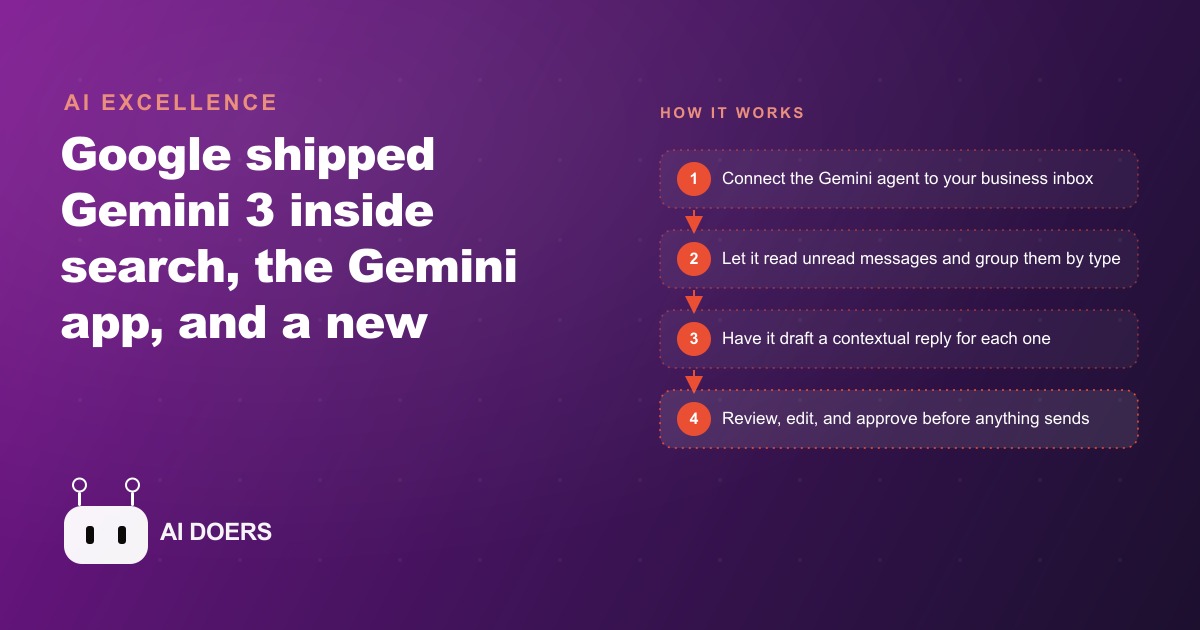
Google launched Gemini 3 embedded directly into Search, the Gemini app, and a new coding tool, with video understanding and inbox organization as two of its most visible new capabilities. I am Madhuranjan Kumar, and rather than treating this as a capabilities announcement, I want to walk through what this looks like when a real small business starts using it, because the gap between a press release description and a usable workflow is where most people get stuck. The business I will use for this walkthrough is a landscaping company with a single owner, a team of eight, and a client base of around 120 ongoing maintenance contracts.
Gemini 3 Is Embedded Everywhere in Google Without Any Separate Subscription
The distribution of Gemini 3 across Google products is the starting point for this walkthrough because it determines what the landscaping business owner actually has access to without any new procurement. If the owner runs the business on Google Workspace, which covers Gmail, Google Docs, Google Sheets, and Google Drive, then Gemini 3 is already embedded in every tool they use daily. It appears as a side panel in Docs, as a suggested response feature in Gmail, and as an enhancement to Search that builds structured answers rather than showing a list of links. There is no installation, no separate account, and no additional cost beyond the existing Workspace subscription.
This access model changes the adoption calculus significantly. The owner does not need to evaluate a new tool category, learn a new interface, or integrate a new service with existing accounts. Gemini 3 is simply already present in the tools that are already open on the screen. The decision is not whether to adopt AI assistance but whether to start using the capability already embedded in the tools already in use. For a small business owner who has been aware of AI tools but has not adopted any of them due to setup friction, this embedded access removes the primary friction point entirely.
The Inbox Agent Can Organize and Summarize Email Without the Owner Touching It
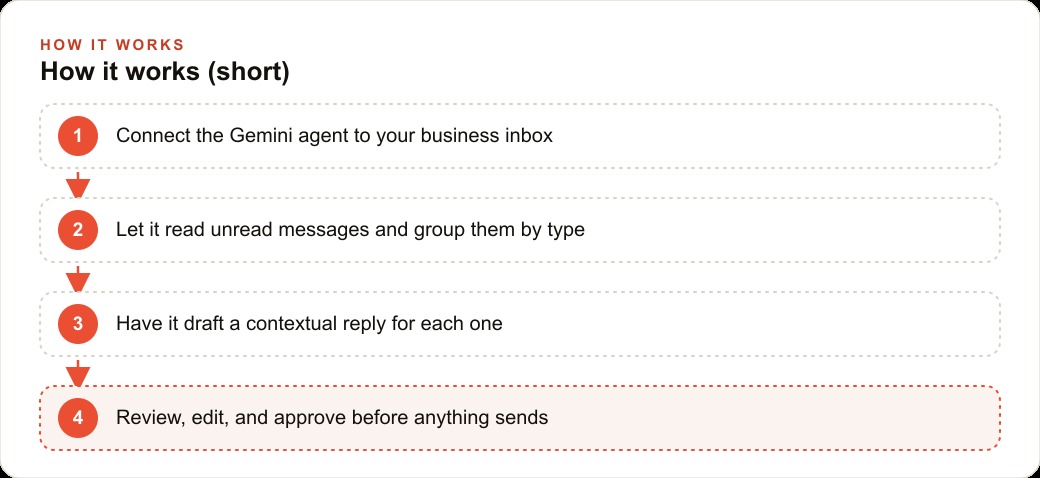
The inbox organization agent is the first Gemini 3 capability the landscaping owner tests. After a week in the field with four crews running simultaneously, there are 47 unread emails in the inbox, a mix of client inquiries, supplier invoices, scheduling requests, maintenance reminders, and a handful of promotional messages from equipment vendors. The owner asks Gemini to summarize the inbox, identify which emails require a response today, and draft response suggestions for the three highest-priority items.
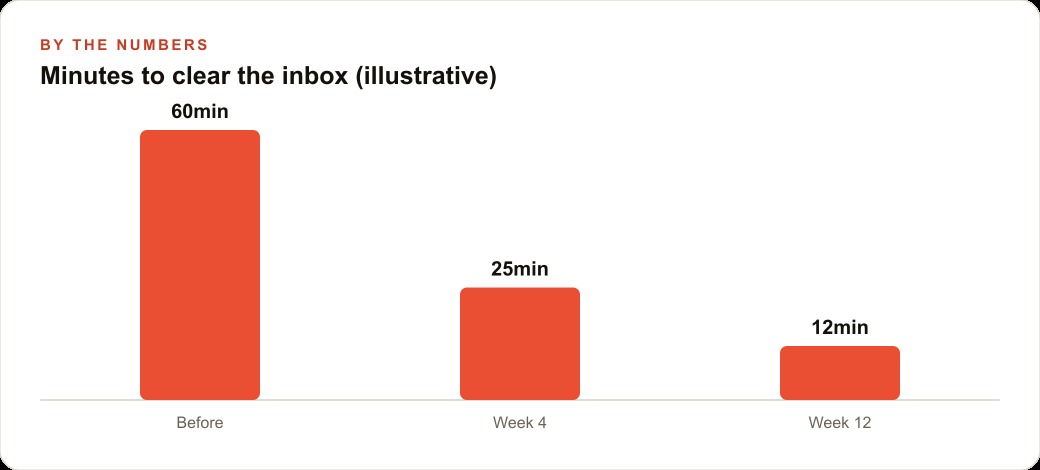
The model reads all 47 emails, categorizes them without being given categories in advance, identifies that two client maintenance requests contain specific time-sensitive language asking for confirmation before the following morning, and drafts responses to both that reference the specific service details mentioned in the client's email. The responses are not perfect first drafts. They need personalization and one factual correction where the model referenced a service that was not included in the contract for that client. But they represent a starting point that reduces the email response time from a thirty-minute drafting session to a five-minute review and edit. Over a full work week, that compression recaptures roughly two hours of the owner's time that was previously spent in the inbox.
The inbox agent continues running in the background after the initial setup, flagging new emails that match patterns the owner identified as high-priority during the first session. This is the value that compounds over time: not the initial time saving but the ongoing pattern recognition that makes the inbox manageable at a glance rather than requiring sustained attention throughout the day.
Full-Video Understanding Means a Single Training Recording Produces a Library of Reusable Reference Material
This breakdown understanding capability becomes relevant to the landscaping business when the owner decides to document the company's seasonal maintenance procedures for onboarding new crew members. Previously, the documentation consisted of handwritten notes and occasional photos, which meant every new hire required direct supervision from an experienced crew member to learn the correct procedure for tasks like winterizing irrigation systems, applying pre-emergent treatments, and calibrating equipment settings for different property sizes.
The owner records a thirty-minute video walkthrough of the full winterization procedure on one property. Instead of having to watch the entire video and manually write a transcript, the owner uploads it to Gemini and asks it to produce a step-by-step written procedure, identify any steps where safety precautions are mentioned that should be highlighted for new crew members, and generate a checklist version of the procedure that a crew member can use on-site without a phone screen. The model processes the full video and produces all three outputs in under three minutes. The written procedure requires one correction where the model misidentified the type of valve being closed in a specific step. The checklist is immediately usable.
The same process produces training documentation from existing service videos for six other common procedures in less than two hours of total owner time. What previously did not exist in documented form because the documentation effort was too high is now a full written procedure library that new crew members can reference and experienced crew members can use to check edge-case procedures they encounter infrequently.
The Search Experience Builds a Structured Answer That Replaces Three Separate Searches
For the landscaping business, the changed Search experience becomes visible when the owner is researching the current local market rate for snow removal contracts in the coverage area. A standard search previously required clicking through three or four results, reading each partially, and manually synthesizing a sense of what the current range looks like. The new Search builds a structured answer that aggregates information from multiple sources and presents a synthetic response alongside citations showing where each data point originated.
For a business owner making a pricing decision, the structured answer format reduces the time from initial search to a confident conclusion without reducing the ability to verify the underlying sources if the synthesized answer seems off. The owner can see immediately which sources contributed which numbers and open any of them directly if a specific data point needs verification before it goes into a proposal. The practical time saving is a reduction from roughly twenty minutes of multi-search research to roughly five minutes of review and verification. Across all the research tasks a small business owner performs in a week, that compression adds up to a meaningful reduction in the time the owner spends investigating before deciding.
Long Horizon Planning Improved, Which Means Multi-Week Projects Plan Better
The long horizon planning improvement means Gemini 3 can hold a multi-step project plan in context and reason about dependencies, scheduling constraints, and resource availability across the full project timeline rather than responding only to the most recent step of the question. For the landscaping business, this becomes relevant when the owner is planning the spring install schedule for fifteen new clients who all want their landscaping projects completed between April and June.
The owner inputs the scope, crew size, estimated hours per project, equipment requirements, and a few known constraints like equipment maintenance windows and a crew member's planned vacation. Gemini produces a draft schedule that identifies the constraint conflicts the owner had not yet noticed, including two projects that require the same specialized piece of equipment on overlapping dates, and suggests two alternative sequencing approaches with the tradeoffs of each explained clearly. The schedule is not final without the owner's review of the specific client priorities, but it identifies the constraint conflicts in fifteen minutes of conversation that would have taken the owner an afternoon of manual calendar work to discover independently.
One Million Tokens of Context Means an Entire Client Relationship Fits in One Session
The one million token context window means the landscaping business can load an entire client file, including three years of service records, all email correspondence, all proposals and invoices, and all notes from site visits, into a single Gemini session and ask questions about the full history without the model losing track of earlier documents as the conversation progresses. This matters most for complex client relationships where a nuanced service history is relevant to current decisions.
The owner uses this capability to prepare for a renewal negotiation with the company's largest commercial client, loading the full three-year service record and asking Gemini to summarize what has changed in the scope of services over the relationship, identify any recurring issues that came up in email correspondence, and calculate the actual labor hours spent on the property versus the original estimate. The analysis that would have taken an hour of manual file review takes eight minutes in a single Gemini session. For any business that manages complex, multi-year client relationships, this capability directly reduces the preparation time for important conversations.
Review Before You Trust Is the Operating Principle That Makes This Workflow Sustainable
The consistent theme across every capability in this walkthrough is the same: Gemini 3 produces a useful first draft faster than manual production would, and that first draft requires human review before it is used for anything consequential. The inbox agent draft needed one factual correction. The training video transcript needed one procedure correction. The project schedule needed owner review of client priorities. The client history analysis needed verification of one calculation.
None of those corrections took more than five minutes, and in each case the review time plus the correction time was significantly shorter than producing the same output from scratch would have been. The operating principle is not that Gemini is right and just needs to be used, but that Gemini is fast and useful enough to make human review dramatically more efficient than human production. That principle, and not the specific features of any particular model, is the productivity formula that makes AI assistance sustainable for any business running real client management and service delivery workflows. The businesses that adopt AI assistance with a consistent review habit capture the time savings reliably. The businesses that use AI assistance without review face a different and more expensive problem when errors reach clients.
The Measurement That Tells You Whether the Deployment Is Working
After deploying any Gemini 3 capability in a business workflow, the measurement that matters is not how impressive the output looks in isolation but how much total time the human spent on a task compared to before the tool was added. For the landscaping owner in this walkthrough, the relevant measurements are the time spent on inbox management per week before versus after the inbox agent, the time spent on training documentation production before versus after this breakdown understanding feature, and the time spent on research tasks before versus after the structured search answers.
Those before and after measurements are the honest ROI calculation for any AI tool. They also reveal where the tool is saving time versus where the human review and correction requirement is large enough to reduce the net saving to near zero. A tool that saves thirty minutes but requires twenty-five minutes of review for every output is a five-minute productivity gain, which may or may not be worth the workflow change required to use it. A tool that saves thirty minutes and requires five minutes of review is a twenty-five-minute gain, which compounds significantly across a full work year. Running this measurement for four weeks produces an accurate picture of where Gemini 3 is actually adding value in your specific business context versus where it is adding complexity without proportional return. That accuracy is what converts a technology test into a sustainable operational decision.
Scaling the Workflow When One Person Can No Longer Review Every AI Output
As a business grows and the volume of AI-generated content and analysis increases, the review bottleneck becomes the constraint that limits how much value the tool can produce. A single owner can personally review every AI output when the business is small, but once the volume reaches a point where personal review is not sustainable, the review process must be delegated or systematized. The systematization approach that works for businesses using Gemini 3 at scale is to define review checklists for each type of AI output rather than relying on individual reviewers to catch errors through intuitive reading.
For the landscaping business, the training documentation review checklist covers four items: Is every specific product or equipment name in the procedure verified against the current inventory? Are all safety-critical steps marked as such in the checklist version? Does the step count in the written procedure match the step count observable in the source video? Is the vocabulary consistent with the terminology the crew already uses for each task? A reviewer working from that checklist completes a review in eight minutes rather than thirty, and catches the specific errors that matter rather than relying on general reading comprehension to surface them. The checklist is the system that makes review scalable without degrading the quality of the review outcome.
That is exactly what we do at AI DOERS. Book a private 30-minute call with Madhuranjan Kumar and we will map the fastest path to it for your specific business.
Book your call →
Madhuranjan Kumar
Madhuranjan Kumar brings 20 years of performance-marketing experience and has managed over $200 million in Facebook ad spend for brands across the United States and beyond. His expertise spans the full modern marketing stack: Meta, Google Ads, TikTok, email automation, CRM, and the websites that hold it together. At AI DOERS he turns that track record into lead-generation systems for businesses across every industry.