
Gemini 3.1 Flash Live: Voice Agents That Finally Feel Human
Google's newest voice model goes straight speech to speech, with lower latency, true interruptions and the ability to see, making it ready for real business voice agents.

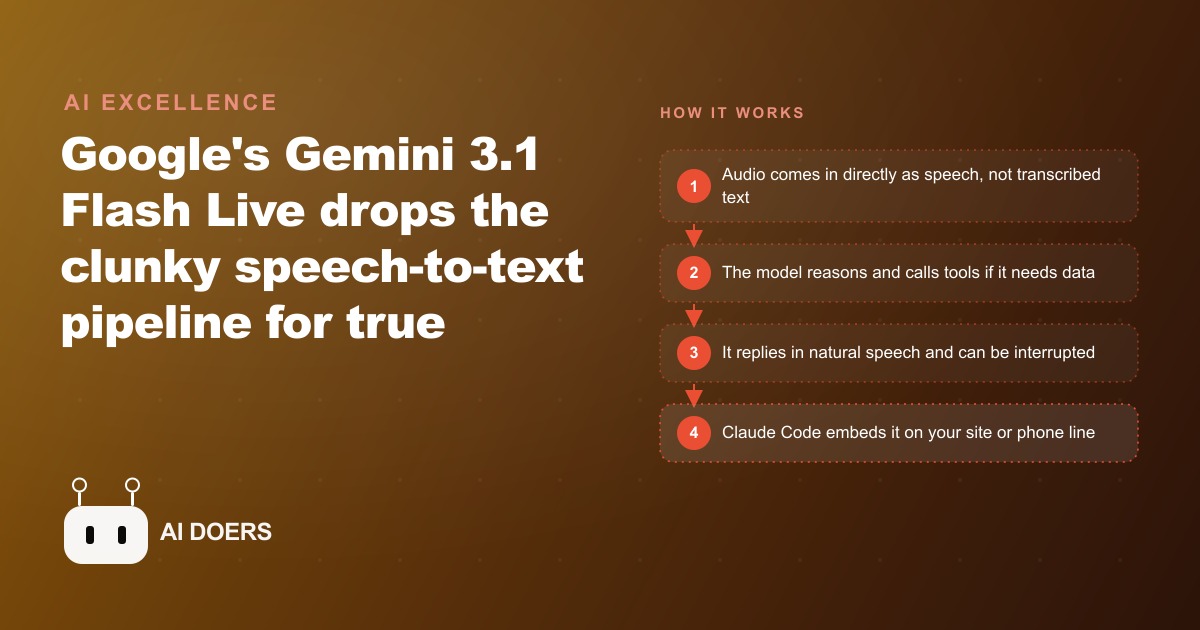
The phone call is the last channel most businesses have never actually fixed, and Google's Gemini 3.1 Flash Live is the first voice model that makes fixing it feel genuinely possible. I am Madhuranjan Kumar, and this article walks through how one unnamed fitness business went from a perpetually overwhelmed front desk to a voice agent handling the majority of its routine incoming calls, without adding a single person to payroll.
The moment the front desk stopped being enough
The studio had twelve group class formats, three membership tiers, a drop-in rate, a personal training package with three price points, and a trial offer that changed every couple of months. The people at the front desk were good at their jobs, but they were fielding the same four questions on loop: What are your hours? How much is a membership? Can I book a class? Do you have a free trial?
At peak times, those calls backed up. After hours, they went to voicemail. The voicemail conversion rate was poor. A prospect who called at nine in the evening and heard a recorded message was gone by morning, signed up somewhere else. The studio was losing real business not because of anything wrong with its product, but because the channel through which new customers first made contact was structurally unable to respond at the speed and consistency needed.
The owner had looked at chatbot products and tried one briefly. It felt clunky and robotic. People hung up or stopped engaging within two exchanges. The gap between what those products could do and what a natural conversation felt like was too wide to paper over with good scripting. What changed the calculation was trying Gemini 3.1 Flash Live and realizing the gap had closed in a way the previous generation of voice AI simply had not achieved.
Why this model behaves differently from what came before
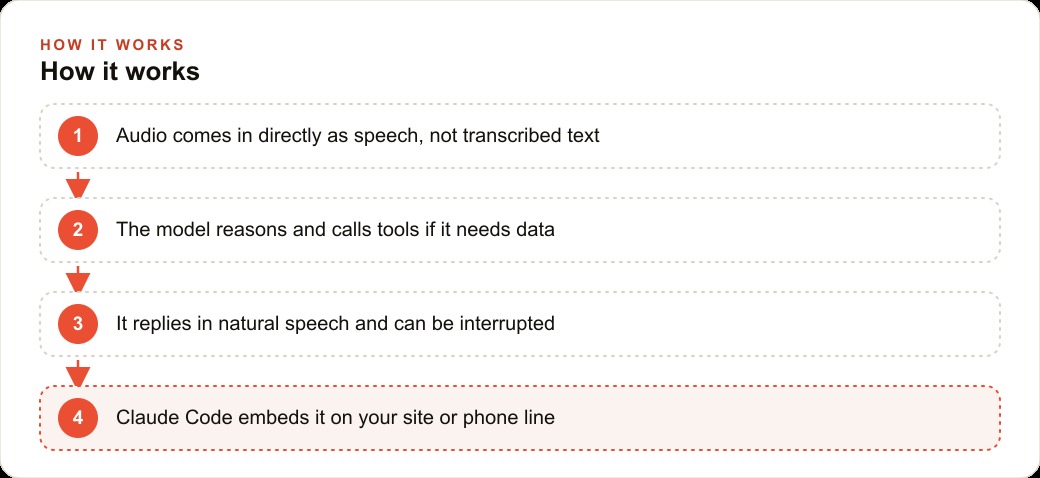
Every previous voice agent product worked the same way under the hood. Your speech was converted to text, the text was processed and a reply was generated in text, and that text was then converted back to speech. Each of those conversions added latency and stripped out information. The model never heard your actual voice. It read a transcript.
Gemini 3.1 Flash Live removes the transcription layer entirely. The model processes the audio directly and responds in audio. That single architectural change produces several effects that matter enormously in a real conversation. The latency drops to a level that stops feeling like a delay. The model picks up tone, stress, and pace, not just the words. It can hear that a caller is frustrated before a word of complaint has landed, or that someone is uncertain and needs a softer, more explanatory response.
The interruptibility is the other major shift. Older voice agents had an awkward freeze when you talked over them: they either bulldozed through their sentence or stopped mid-word and took several seconds to recover. This model stops the instant you start talking, exactly the way a person does. The caller never has to wait politely for the agent to finish. That single behavior change makes a voice agent feel like a conversation partner rather than a kiosk.
Because it understands tone, a sales conversation and a support conversation can be handled differently without any extra configuration. The model adjusts naturally to where the caller is emotionally, which is the behavior that separates a good human front desk person from a mediocre one. For the first time that behavior is replicable in a voice agent.
Writing the persona that runs the studio's calls
The first thing the studio built was a persona definition. This is a system instruction that tells the model who it is, what it knows, and how it should behave. The persona had a name, a tone that matched the studio's brand, and a complete knowledge base of every fact a front desk person would need: the class schedule, the membership tier pricing, the drop-in rate, the personal training options, the trial offer terms, what the cancellation policy was, and the exact address and parking situation.
The persona also had rules about what to do when it did not know something. Rather than making something up or going silent, it would say that it would have someone from the team follow up on that specific question, and it would offer to take a contact number. This matters because a voice agent that hallucinates a wrong price or a wrong policy detail causes real damage, and a well-written persona definition prevents most of those situations before they happen.
The persona was saved in Google AI Studio and took about ninety minutes to write and refine with real test conversations. The owner talked to it as if she were a prospect calling for the first time, flagged anything that felt wrong, and updated the instructions. By the end of that session it was answering consistently in the studio's voice, handling tangents and interruptions, and staying on topic without feeling rigid.
For any business considering this, the persona design is not an optional polish step. It is the foundation the entire experience rests on. A generic persona without specific business knowledge produces a generic experience that callers will immediately recognize as an AI and mentally dismiss. A specific persona with real business facts produces an experience that earns the caller's trust in the first thirty seconds.
Giving the agent hands: function calls that book real appointments
A voice agent that can only talk is useful but limited. The studio needed it to actually book classes, not just describe how to book them. This is where function calling comes in, and it is also where the technology earns its keep as a business tool rather than a demo.
Function calling means the model can reach outside the conversation and take real actions. The studio connected its scheduling software's API to the agent. The agent could now check what slots were open for a specific class on a specific day, confirm a booking, and tell the caller their spot was secured before the call ended. The caller did not need to hang up and visit a booking page. The outcome they called to achieve was completed during the conversation.
The function calls also connected to the studio's calendar for personal training bookings and to a simple intake form for trial registrations. A caller asking about the free trial could complete the registration entirely by voice, without being redirected to a website. This is the behavior that produces the conversion lift businesses actually care about, because it eliminates the drop-off between call and conversion that happens every time a caller is asked to go do something else after hanging up.
There is a current limitation worth knowing about: while the agent is waiting for a function call to complete and return data, it goes quiet. There is a brief pause during tool calls. It is noticeable but not disqualifying, and it is the kind of rough edge that tends to smooth over in successive model releases. The studio's experience was that callers accepted the pause naturally, the same way they accept a brief hold while a human looks something up.
For businesses thinking about how this fits alongside their broader marketing approach, a voice agent that books appointments is a natural complement to meta-ads campaigns where the conversion goal is a booked call or consultation. The ad drives the call, the agent closes the booking, and the loop is completed without human intervention at either end.
The noisy waiting room problem, and why it matters more than it looks
One test the studio ran before committing to a phone deployment was a noise test. The studio is loud. The front desk area has music, cardio machines audible through the door, and sometimes a group class wrapping up with its characteristic noise. They tested the agent with all of that in the background.
The model stayed accurate. It tracked the conversation correctly and responded to what was actually said rather than to artifacts and background noise. This matters because real-world voice agent deployments do not happen in quiet rooms. They happen wherever the business operates, and whatever ambient sound comes with that environment has to be something the model can filter through without losing the thread of the conversation.
The studio also tested alphanumeric confirmation strings, the kind of thing a booking system generates when a class is reserved. The agent read them back clearly and handled callers who asked to have them repeated. This sounds minor but it is the kind of operational detail that determines whether a tool works reliably in daily use or generates a steady stream of support tickets.
Visual guidance for members: the screen and webcam capability
The studio added one more capability that was not in the original plan but turned out to be consistently useful. Members could open a web chat with the agent on their phone and share their camera. They used this primarily for equipment guidance. A new member who was uncertain how to set up a rowing machine or adjust a cable station could show the agent what they were looking at and get step-by-step guidance without having to find a staff member, which many new members are reluctant to do in a busy environment.
This visual capability extends the model well beyond a phone line replacement. Any business with a product or space that benefits from visual guidance, whether that is retail, healthcare, or a service business with equipment, has a use case for an agent that can both hear and see. For the studio, it became a quiet retention tool. Members who might have quietly stopped coming because they felt uncertain about equipment felt more supported, and that comfort lowered the barrier to staying.
The numbers after three months
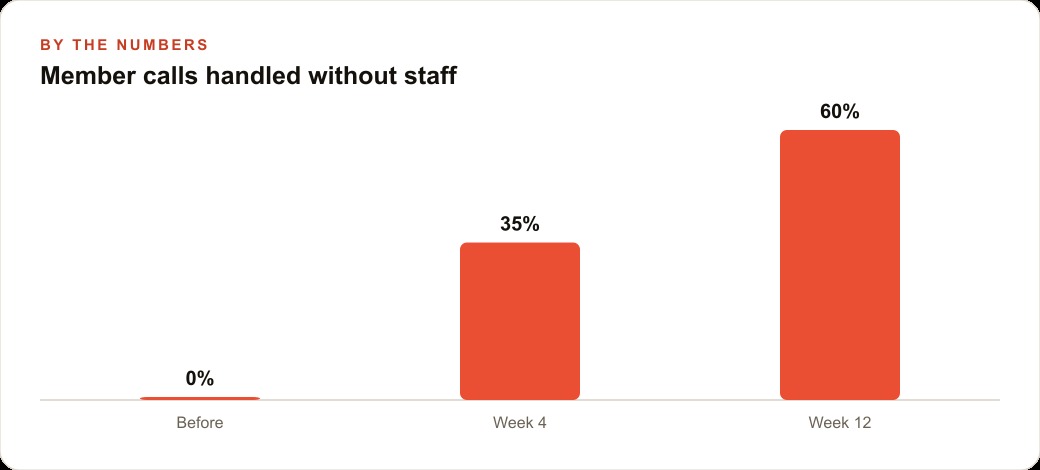
At the end of week four, the agent was handling 35 percent of incoming member calls. At the end of week twelve, it was handling 60 percent, primarily the routine inquiry calls that followed predictable patterns. The front desk team's call volume dropped substantially. They spent that recovered time on the calls that genuinely required human judgment, on in-person member relationships, and on the operational work that had previously been squeezed out by constant interruption.
The after-hours conversion improvement was the number that surprised the owner most. Prospects who called in the evening or on a Sunday and reached the agent completed bookings at a rate meaningfully higher than the historical voicemail return rate. The agent answered, ran the conversation, and booked the trial before the prospect had time to second-guess or sign up somewhere else. That change alone, recovering the after-hours bookings that had previously gone nowhere, covered the setup investment in the first month.
For businesses running any kind of paid acquisition, whether through google-ads or social channels, this kind of after-hours conversion improvement has a direct impact on effective cost per acquisition. The same ad spend produces more paying customers when the conversion path works at the times the ads run.
What the deployment taught about voice AI that is not obvious from a demo
Running this in a real business for three months taught several things that the demo in Google AI Studio does not surface.
First, the persona definition needs to be treated as a living document. The studio updated it four times over three months based on real calls. A caller asked about parking on a specific nearby street that was not in the original instructions. Another asked about a class format that had been renamed. Each gap in the knowledge base showed up as a slight fumble in a real call, and each update to the instructions made those calls go more smoothly going forward. The agent gets better as the instructions get more specific, and real call patterns are the best source of specificity.
Second, the handoff design matters a great deal. The studio built a specific path for calls the agent could not resolve confidently. Rather than letting those calls spiral into an awkward loop, the agent recognized the pattern, told the caller that a team member would reach out within a specific timeframe, and took their contact information. The team reviewed those calls daily in the first few weeks, used them to update the persona, and watched the escalation rate drop steadily as the knowledge base improved.
Third, voice agents and a strong web content strategy compound well together. A caller who has already read a detailed answer on the studio's website comes into the voice conversation with baseline knowledge and reaches a booking decision faster. Businesses that invest in seo-content to answer questions in depth online find that their voice agents handle shorter, more focused conversations because prospects arrive better informed.
Fourth, the multilingual behavior removed a friction point the studio had not fully recognized it had. A meaningful share of its neighborhood did not have English as a first language. The agent handled those calls in the caller's preferred language without any additional setup, and the booking rate from those calls was consistent with the overall average rather than lower, which had not been true of the previous voicemail experience.
The architectural reality of moving from demo to deployed
Trying Gemini 3.1 Flash Live in Google AI Studio takes about three minutes. You open the live screen, select the model, write a brief system instruction, and start talking. No API key, no payment. That accessibility is genuinely useful for evaluating the technology and building an initial persona.
Deploying it on a real phone number or as a live chat widget on a website is a meaningfully different problem. The Live API requires a persistent server connection. Unlike a standard API call that completes and closes, a voice session is a continuous stream that needs to stay open for the duration of the conversation. That means a server that holds the connection, routes audio in and out, handles function call responses, and manages session state across concurrent callers.
For the studio, this was handled by someone with server experience who read the API documentation and built the integration. The integration included the phone number routing, the function call definitions connected to the scheduling API, the persona instructions, and the handoff path for escalations. The build took a weekend. The result was a production-grade deployment that has run without significant issues for three months.
A business that wants to evaluate whether this investment makes sense should work through the Google AI Studio demo first, build a realistic persona, and test it with real scenarios that mirror actual incoming calls. That evaluation costs nothing and produces a much more accurate sense of what the deployed version will actually be capable of before any infrastructure commitment is made.
The broader principle the studio's experience illustrates
The studio's experience points at something that applies to any service business thinking about voice agents: the technology works best when it is treated as a channel in its own right, not as a patch on an existing channel that was already broken.
The studio did not deploy a voice agent on top of a broken phone system. It redesigned the phone experience from first principles, asking what a caller actually needed and what the fastest path to that outcome looked like. The agent was built to serve that redesigned experience, not to simulate the old one. That distinction drives most of the difference between voice agent deployments that work and ones that frustrate both the business and its customers.
A business running paid lead generation through any channel, whether through meta-ads, search, or organic content, needs the conversion path at the end of those ads to work as reliably as the targeting at the front. A voice agent that handles the incoming call professionally, books the appointment, and sends a confirmation is a conversion path that works. The front desk, after three months of watching the agent handle the routine with consistency it could never have matched at scale, agreed.
That is exactly what we do at AI DOERS. Book a private 30-minute call with Madhuranjan Kumar and we will map the fastest path to it for your specific business.
Book your call →
Madhuranjan Kumar
Madhuranjan Kumar brings 20 years of performance-marketing experience and has managed over $200 million in Facebook ad spend for brands across the United States and beyond. His expertise spans the full modern marketing stack: Meta, Google Ads, TikTok, email automation, CRM, and the websites that hold it together. At AI DOERS he turns that track record into lead-generation systems for businesses across every industry.