
From Non-Technical to $160K Per Month: The Full AI Automation Playbook
One operator went from zero coding experience to roughly $160K per month by starting a service-based AI agency, using a free-website decoy offer to land and upsell clients, scaling with cheap ads, and only later building software once the cash flow existed. The playbook works in any local market.

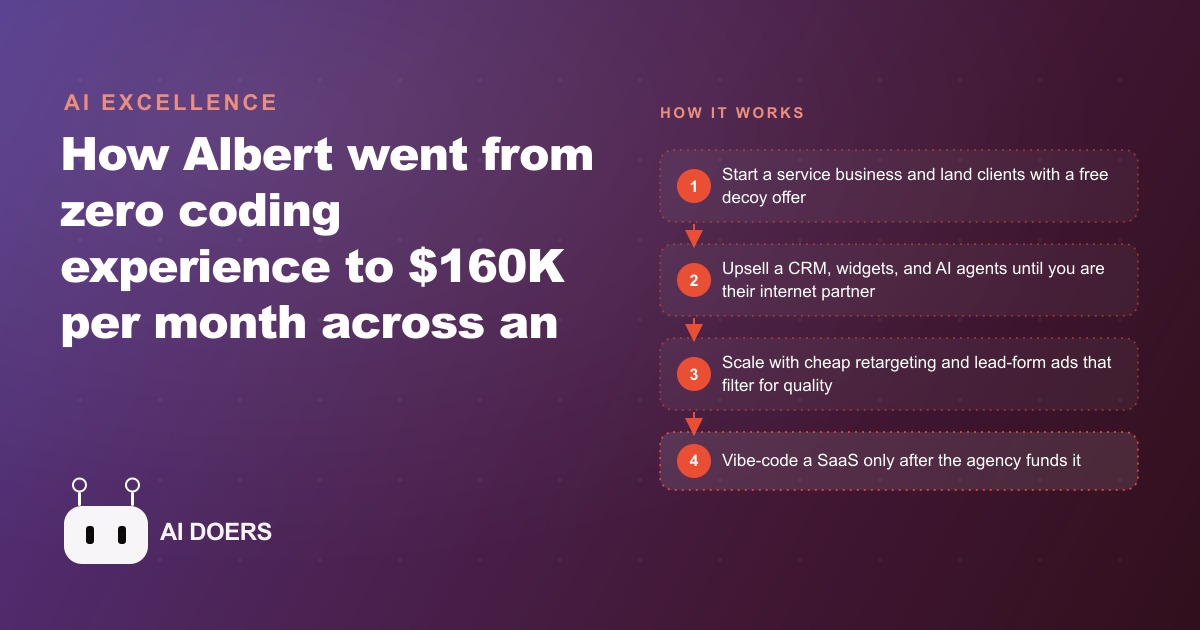
For the first time, there is a published, detailed step-by-step breakdown of a non-technical operator reaching $160,000 per month through an AI automation business, and the structure it reveals overturns the most commonly repeated advice in the field: that non-technical founders should acquire coding skills before building in the AI space. I am Madhuranjan Kumar, and the reason this breakdown is worth examining carefully is that every decision point in the path is replicable in any local market today, with no prior technical background and no upfront capital.
The first published step-by-step breakdown of a non-technical AI automation operator reaching six figures
Most accounts of AI business success describe outcomes without explaining the mechanisms that produced them. Revenue numbers appear without the client acquisition sequence, the offer structure, or the month-by-month decisions that separated periods of growth from periods of stagnation. The significance of the breakdown being referenced here is the granularity: the number of sales appointments booked and closed at each stage, the exact structure of the offer that produced the first paying client, the specific ad spend and cost-per-lead figures from campaigns that worked, and the product stack that converted individual clients from one-time projects into recurring relationships worth thousands of dollars each.
That level of operational detail is rare in public accounts of this kind. It is what makes the breakdown useful for someone who wants to build a similar business rather than simply knowing the outcome is possible. The operator documented the failure periods with the same honesty as the growth periods, which makes the timeline comprehensible rather than appearing as a smooth upward curve with the difficult months edited out.
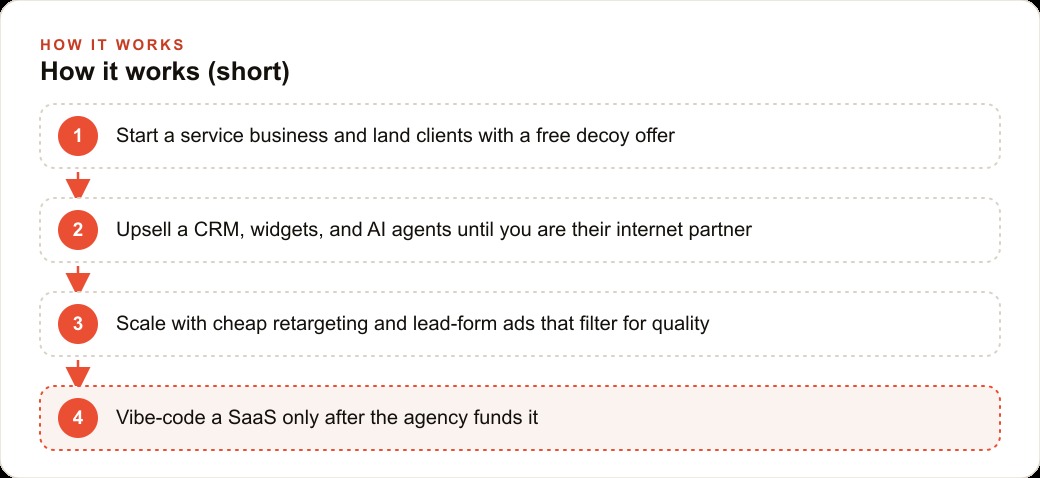
The $160,000 per month figure is distributed across three revenue sources: an AI automation agency serving local businesses, an information product, and a SaaS tool built after the agency was generating consistent cash flow. The sequencing of those three is the first structural lesson the breakdown contains: service before product, product before software, software only after the business has the cash flow to fund development without debt or outside capital. That sequencing is not incidental. It is the structural reason the outcome was achievable without a technical background.
Starting with service before software is not a consolation path; it is structurally superior
The conventional framing positions a service business as a fallback for operators who cannot build software, and positions software as the real goal because of its scalability. That framing is wrong, and the breakdown makes the structural reason clear. A service business generates revenue from the first month of operation, requires no upfront capital investment, and teaches the operator what clients actually need before a dollar is spent on building a product to serve those needs.
Software requires months of development before it generates its first dollar, costs money throughout that development period, and is built based on assumptions about what clients need rather than on direct knowledge acquired from serving them. The practical consequence is that operators who start with software frequently spend months building a product the market does not want in the form they built it, and they burn their capital finding that out. Operators who start with a service spend those same months learning exactly what the market needs from clients who are already paying for that knowledge. When they later build software, they build it for a validated problem, with existing clients who are already using a manual version of the solution. The development risk drops. The time to first revenue from the software drops. The product is better because it was designed from operational experience rather than speculation.
Service before software is not the slower path. It is the path that produces a fundable, well-designed software business rather than an unfunded guess about what the market wants.
The four months of zero closes were the skills-building phase, not the failure phase
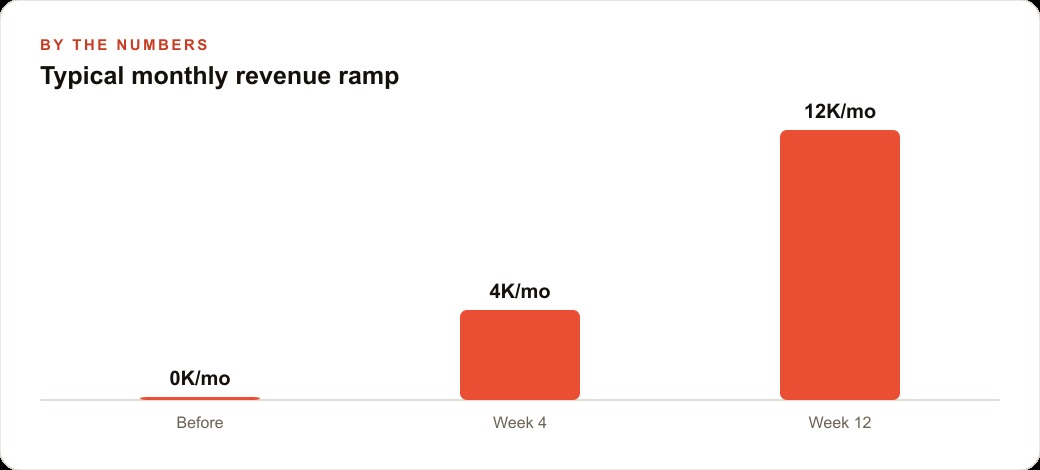
The operator booked 15 sales appointments in the first four months and closed zero of them. He had roughly $50 left and a 0 percent close rate going into month five. That sequence looks like failure from the outside and felt like it during the period itself. The reframe that makes sense of it is not motivational. It is operational.
Those 15 appointments produced something specific: the repeated experience of pitching, being objected to, failing to close, and being forced to diagnose what went wrong. Every appointment was a data point about where the conversation broke down and what the prospect actually needed to hear before they would say yes. That kind of learning is not available from a course, a book, or a mentor. It comes only from the repeated experience of losing and having to analyze the reason.
Month five closed differently because the skills those four months built were now in place. The pitch was tighter because it had been refined through 15 losses. The offer was clearer because the objections that had killed previous conversations had been systematically addressed. The close rate did not improve because the environment changed. It improved because the operator had built the competence the business required, even though the prior months produced nothing in revenue while they were building it.
For anyone four months into a zero-revenue period, the useful question is not whether the path is wrong. It is whether the period is building the competence the business will require. If each loss produces a clear insight about what to do differently, the period is productive even when the revenue line is flat.
A decoy offer and a proof-of-concept upsell remove the two highest barriers to the first closed client
Local business owners who have not worked with an AI automation agency before face two specific barriers when considering the first engagement. The first is uncertainty about what they will receive: a service they have never bought before from a provider they have no history with, at a price they cannot benchmark against prior experience. The second is the risk of paying for work that disappoints: committing money before knowing whether the provider can actually deliver.
The decoy offer directly addresses the first barrier. The pitch to a local business with no website or a weak one is simple: the operator builds a clean, functional site on a template at no cost to the owner, in exchange for a video testimonial once the site is live. The owner pays nothing and receives something they can see and use immediately. The operator invests two to four hours of work and a hosting cost typically under $20 per month. The testimonial becomes portfolio material. More importantly, the goodwill from delivering a real result for free makes the owner receptive to the paid conversation that follows.
The proof-of-concept upsell addresses the second barrier. After the free site is delivered, the operator proposes the first paid service. The specific structure is to charge upfront for the work but build the full deliverable first, so the owner can see exactly what they are receiving before committing fully, with a clear refund policy if the result does not meet expectations. The owner is no longer paying in advance for an invisible promise. They are evaluating a finished product and deciding whether to keep it. That change in the decision structure removes most of the risk that kills conversions at the proposal stage.
Once the first paid engagement closes on this structure, the upsell stack builds from there. A CRM captures every lead the new site generates. A website chat widget converts more visitors to contacts. An AI voice agent handles after-hours calls and inquiry qualification. A review request agent fires automatically after each completed service to build the owner's ratings over time. Some clients who entered through a free website build have reached $8,000 to $11,000 in total lifetime value across those stacked services.
For a roofer specifically: the decoy is a clean template site, live in a few hours at under $20 in hosting. Once the owner sees it, I introduce the CRM at $200 to $400 per month depending on features. An AI voice agent is added to capture after-hours storm-damage inquiries, which are the highest-value lead type for any roofer. A review automation agent fires after each completed job. Retargeting ads go live the day the site does, at $3 to $5 per day once the pixel has 30 days of audience data behind it. A lead-form campaign at $15 per day with conditional logic filtering out renters and out-of-area properties follows. Lifetime value per roofer client in a full configuration ranges from $400 to $2,000 or more per month in recurring retainer revenue. Across a two-year relationship, that figure is often $10,000 to $15,000 or more.
Database reactivation is the highest-leverage offer available to any business with a contact history
Most businesses that have been operating for more than two years have accumulated contact lists they are not actively using. These are old leads, past inquirers, previous customers who did not return, and people who requested quotes that were never followed through. The data exists because the business collected it at the time of first contact, but the cost of manually working through thousands of contacts to find which ones are still interested is high enough that most businesses leave the list sitting idle in a CRM or a spreadsheet.
AI SMS reactivation campaigns work through these lists on a results-only basis: the operator contacts old leads on behalf of the business, and the client pays only when a contact books an appointment. There is no upfront cost to the client and no risk of paying for contacts who do not convert. The only costs to the operator are the setup time and the API cost of the messages, which are low relative to the value of a booked appointment in most service businesses.
For a roofer with 2,000 old quote requests in their CRM from the past three years, a 1 percent booking rate produces 20 booked inspections from people who already raised their hand once. In a market where a roofing job is worth $8,000 to $25,000 in revenue, 20 inspections at a typical close rate of 30 to 40 percent represents significant additional revenue from data that was sitting completely idle. The operator earns a per-booking fee or a percentage of closed revenue. The client bears no financial risk before results arrive. That combination makes it the easiest offer to close of any in the stack, because the downside for the client is zero.
The reason it is the highest-leverage offer in the stack is not just the risk structure. It is the math of warm versus cold contacts. A contact who requested a quote two years ago has already demonstrated a specific intent to buy the service. Reaching them with a targeted message at the right moment converts at a meaningfully higher rate than any cold outreach effort at the same budget. Reactivating 2,000 warm contacts through an AI SMS campaign costs less per booked appointment than generating 20 new leads through paid advertising, and it converts at a higher rate because the contacts already know the business.
Daily posting to 240K followers in eight months came from volume, not strategy
The operator reached 240,000 followers and 10 million monthly views on his primary content channel in eight months. That pace is often attributed to discovering the right format or the right topic early. The honest account is different: it came from daily posting combined with a discipline of identifying which specific pieces gained traction faster than average and then producing more of them.
Two formats drove the majority of clients and software users: an authority-positioning clip that makes a confident, specific claim about an operational question in the niche, and a split-screen tutorial that walks through a task in a tight before-and-after structure. Both are high-information, low-production formats. They require no elaborate set, no expensive equipment, and no post-production budget. They require clarity of thinking about the specific problem being addressed and a commitment to producing daily.
The volume is the non-negotiable part. The format that performs is not predictable in advance. The operational move is to post every day across the formats being tested, note which specific pieces gain traction faster than the average, and shift a higher percentage of future production toward those formats. At one post per day for eight months, 240 pieces of content were produced. The few that took off did so unpredictably. The daily posting discipline is what made those few possible to identify and double down on.
The distribution that content builds also reinforces every other part of the business. Prospects who have seen ten posts before a sales call are already partially convinced. The close rate on sales conversations with warm content audiences is significantly higher than with cold outreach. The operator's four-month zero-close period preceded any meaningful content presence. His acceleration followed building one. Content creates a pool of warm, pre-educated prospects that makes every subsequent sales conversation easier and shortens the selling cycle considerably.
That is exactly what we do at AI DOERS. Book a private 30-minute call with Madhuranjan Kumar and we will map the fastest path to it for your specific business.
Book your call →
Madhuranjan Kumar
Madhuranjan Kumar brings 20 years of performance-marketing experience and has managed over $200 million in Facebook ad spend for brands across the United States and beyond. His expertise spans the full modern marketing stack: Meta, Google Ads, TikTok, email automation, CRM, and the websites that hold it together. At AI DOERS he turns that track record into lead-generation systems for businesses across every industry.