
How Free Deep Research Tools Change Decision-Making for a Plumbing Business
Perplexity and Grok 3 now offer AI-powered deep research at no cost. Here is what that shift means for a plumbing company trying to outresearch and outprice its competition.

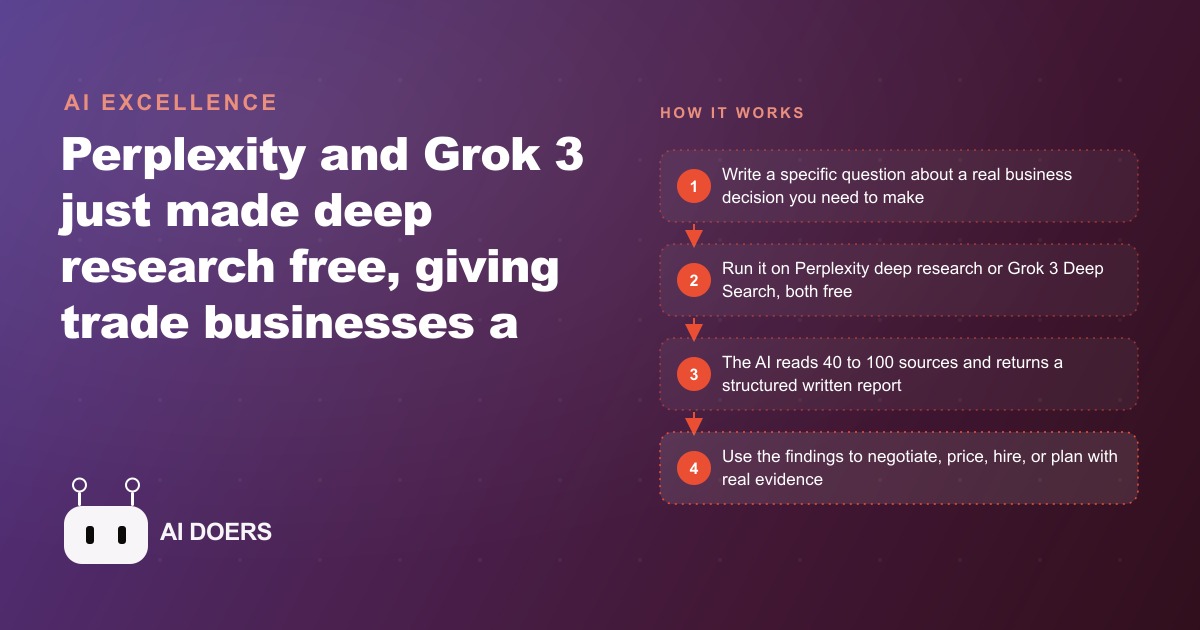
Until this month, AI-powered deep research that reads dozens of live web sources and synthesizes them into a structured report cost $200 per month through a ChatGPT Pro subscription. Perplexity AI and xAI's Grok 3 just made the same capability free, and the practical implications for any trade business that makes decisions based on market information, supplier pricing, or local competition are immediate.
I am Madhuranjan Kumar, and this matters for every small business owner who currently relies on manual Google searches and occasional phone calls to inform pricing decisions, supplier negotiations, and competitive research. The shift is not a minor feature upgrade. It is a change in who has access to professional-grade research capability, and the businesses that start using it this quarter will have a compounding information advantage over those that do not. This piece covers what changed, why the research quality gap matters specifically for a plumbing business or any trade operation, and the concrete queries to run this week.
Perplexity and Grok 3 Just Eliminated the $200 Per Month Research Gap
Deep research in AI is a specific capability distinct from a regular chatbot or a standard AI assistant. When you run a deep research query, the model does not answer from its training data. It opens the live internet, breaks your question into sub-questions, visits dozens or hundreds of actual web pages, reads the full content of each one, identifies agreements and contradictions across sources, and synthesizes the findings into a structured written report. The process takes eight to fifteen minutes and produces a document comparable to what a junior research analyst might produce in half a workday of focused work.
ChatGPT Pro offered the most capable version of this feature behind a $200 monthly subscription. That price was the effective barrier for most small businesses. A four-technician plumbing company was not spending $200 per month on research software. A solo HVAC contractor was not either. The information advantage went to organizations with the budget to pay for it.
Perplexity AI now includes five deep research queries per day on a free account, with each query reading between 50 and 100 web sources. Grok 3, accessible at grok.com with a free account linked to an X login, includes a Deep Search mode with no hard daily cap currently enforced. Both tools produce clear, well-organized summaries rather than the longer argumentative documents that the premium version generates, and for most business decisions a tight summary is more immediately actionable than a 10,000-word report. The price of access just dropped to zero, and the quality of what is available for free has crossed the threshold where it is genuinely useful for real business decisions rather than just interesting.
Synthesis Beats Search for Business Decisions
The reason deep research is different from Googling is synthesis. A Google search returns a ranked list of pages that each make their own argument. You read them sequentially, carry what you remember from one page into the next, and form your own conclusion. If ten sources disagree on a price point, you have to figure out why. If the most useful source is the eighth one you check, you have to stay patient through the first seven.
Deep research compresses that entire process. The model reads all ten sources, identifies the disagreement, explains what drives it, such as regional price differences or different quality tiers, and tells you which finding applies to your specific situation. That is a different cognitive task from reading ten pages and synthesizing them yourself. It is also faster and produces fewer gaps, because the model casts a wider net than most business owners do during a manual research session while also managing their other daily tasks.
For trade businesses specifically, the difference between good and poor research directly affects margins on individual jobs. A plumbing company that prices a commercial water heater replacement at $2,200 when the current market supports $2,600 is leaving $400 on the table on that one job, multiplied by every similar job in the quarter. A company that negotiates a supplier contract without knowing what competing suppliers are currently offering is negotiating blind against a counterpart who does know. Deep research is not interesting because it produces interesting information. It is useful because the decisions it informs have real dollar consequences that compound over time.
The Plumbing Company That Researches Better Prices Better
As a worked example, consider a plumbing company with four technicians covering a mid-size metro area. The owner currently sets prices by checking a few local competitor sites once a year, calling the parts distributor for current pricing, and relying on intuition built over years in the trade. That approach produces reasonable prices but leaves genuine money on the table during the periods between reviews, when market rates shift and the company's prices lag behind what the market will comfortably bear.
Here is how the same owner uses free deep research to close that gap. Before the quarterly pricing review, they open Perplexity and run this query: "What are plumbing companies currently charging for a water heater installation using a 50-gallon gas unit in [city]? Include data from Yelp reviews with price mentions, HomeAdvisor cost estimates, Angi project cost data, and contractor forum discussions from the past 12 months." The report arrives in 12 minutes. It shows the current market range, notes which price points appear most often in the data, and flags whether recent material cost increases appear to be reflected in local pricing yet. The owner uses that to set the review period's prices with actual market data behind the decision rather than intuition and an annual spot check.
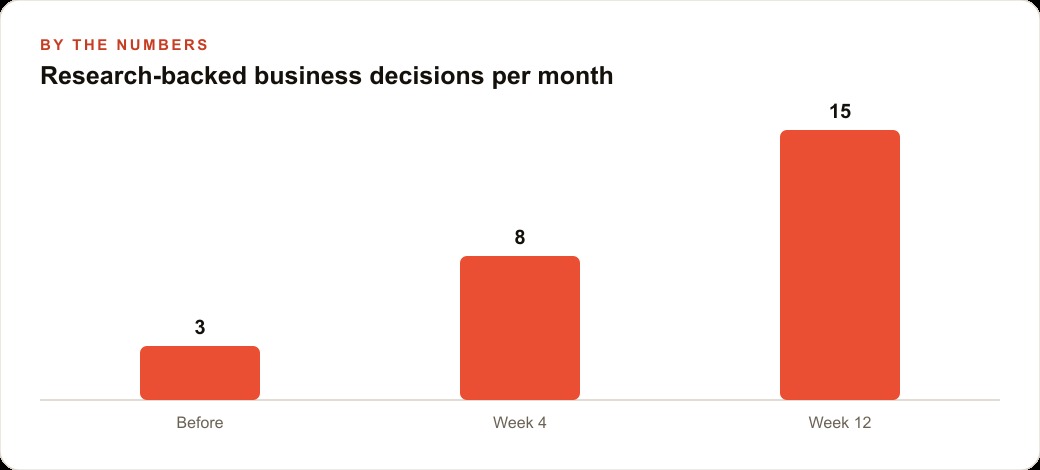
Illustratively, if this research approach helps the company price two commercial jobs per month at $400 higher each than they would have without the market data, that is $800 per month in additional margin from research that costs nothing and takes under thirty minutes total. Over a quarter that is $2,400 from three research sessions. The actual result for any specific company depends on their market, their job mix, and how they apply the findings. These are illustrative numbers based on realistic patterns for a mid-size trade operation, not a guarantee for any specific business.
For businesses also running Google Ads campaigns for their services, the same deep research flow is directly applicable to keyword strategy. A query asking what plumbing service questions local homeowners are asking most often on forums and review platforms produces exactly the kind of audience language data that makes ad copy and landing page content more relevant to what customers are actually searching for.
Supplier Negotiations Change When You Walk In With 100 Sources Behind You
The supplier negotiation use case is where deep research creates the most immediate leverage for a trade business. Most small contractors negotiate with a single primary supplier and accept the pricing they are offered, because they do not have the time to research alternatives thoroughly. The alternatives exist. The price differences across suppliers are real. But gathering them takes the kind of research time that a working owner typically does not have in the middle of a busy week.
A Perplexity deep research query on supplier options for a specific material category takes 12 minutes and reads up to 100 sources, including contractor forum discussions where tradespeople share actual price points and negotiated terms they obtained. That is qualitatively different from calling two competitor distributors to compare. Forum discussions contain the kinds of specific details that salespeople do not share proactively: the exact order thresholds that unlock better pricing tiers, the lead time commitments that are realistic versus aspirational, the contract terms that contractors found difficult when they tried to act on them.
Walking into a supplier meeting with that information changes the negotiating position without requiring anything adversarial. You know what alternatives exist and at what price level. You know what other contractors in your trade are paying for the same materials in comparable markets. You know which objections to the alternative suppliers are real concerns and which are standard retention arguments. That knowledge shifts the conversation consistently toward better terms over time.
The same dynamic applies to hiring research. Before posting a technician role, a Grok 3 Deep Search on current compensation for licensed plumbing technicians in your metro produces a market rate range informed by job board data, salary report sites, and trade forum discussions. Posting at the current market rate rather than the rate from two years ago produces more and better applicants in the same time window. For a trade business where hiring a licensed technician is a significant event, that difference matters.
Uncensored DeepSeek Opens a Door for International Supplier Research
Perplexity published a version of the DeepSeek R1 model with Chinese political content filters removed. The standard DeepSeek model declines to discuss certain historical events and topics the Chinese government restricts. The Perplexity version removes those restrictions, making it useful for researching topics that the standard version blocks or deflects.
For most plumbing or HVAC contractors operating in a domestic market, this distinction is not immediately relevant on most research questions. But for any contractor exploring imported fixture lines, international product sourcing, or supplier options that include Chinese manufacturers of fittings, valves, pipe components, or water treatment products, the uncensored version is meaningfully more complete. Research into Chinese manufacturing quality for specific product categories, export policy for plumbing components, or the supply chain situation around specific imported goods produces complete results rather than gaps where the standard version declines to engage.
The practical use case is narrow but specific: if you are researching a product category with significant Chinese production, run that research through the Perplexity interface with the DeepSeek model selected rather than through the standard model interface. The results will be more complete and more useful for making an actual sourcing or supplier decision, particularly if any part of the question touches on topics that Chinese content policy treats as sensitive.
Gemini's Memory Makes Every Future Query Smarter Than the Last
Google Gemini linked its assistant to your conversation history, giving it access to context from your last 18 months of interactions. This means every query you run going forward builds on what you have already discussed with it. If you spent three months asking about load calculations, material compatibility, or a specific supplier situation, Gemini knows that context when you ask a new question. You do not have to re-establish the background each time.
For a trade business that uses Gemini regularly, this gradually turns a general AI tool into something closer to a business-specific assistant. It does not remember what happened on job sites or what customers said. But it does remember the research questions you asked, the comparisons you worked through, and the context about your business that you shared in past conversations. That growing context makes future queries more targeted and more useful, because you can describe a new situation briefly and the assistant already understands the relevant background.
This is free to enable today and worth doing now rather than later, because the value compounds from the first query you run after enabling it. Inside your Gemini account settings under activity controls, there is a toggle for allowing the assistant to use your past conversation history. Turning it on today means that every research session you run for the rest of the year adds to a growing knowledge base about your business and your market. For SEO and organic content planning, the compounding context means you can build on competitive landscape discussions across multiple sessions rather than re-establishing the full background each time you want to extend the research in a new direction.
The Concrete Move: Three Queries to Run This Week
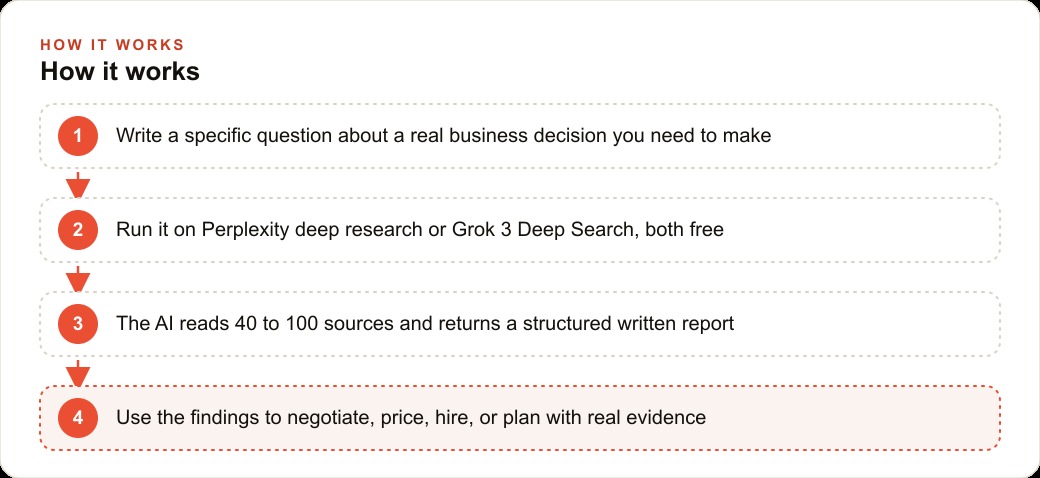
Getting started with deep research takes three minutes of setup. For Perplexity, go to perplexity.ai, create a free account with a Google login, and switch the model selector to Deep Research before typing your first query. For Grok 3, go to grok.com, log in with an X account, and enable the Deep Search toggle that appears in the query interface.
For a plumbing company or any trade business, run these three queries in order this week. First, a current pricing benchmark for your most common service, asking for multiple source types including review site data, cost estimator platforms, and contractor forum discussions, with a 12-month recency filter. Second, a supplier comparison for the material category you buy most frequently, asking specifically for pricing tier thresholds and contractor sentiment pulled from forum discussions in addition to official supplier information. Third, a regulatory tracking query asking for any code changes or proposed changes in your state in the last 60 days, because plumbing codes update with no direct notification to contractors and one avoided failed inspection is worth more than the twelve minutes the query takes.
A reliable prompt structure that works across all three: "Give me a comprehensive overview of [topic] for a [business type] in [region or market]. Cover [specific angle 1], [specific angle 2], and [specific angle 3]. Focus on current information from the last 12 months and include the sources with their publication dates."
Read the output critically and check the publication dates on key citations before acting on any finding. For any result that will drive a pricing or procurement decision, verify the key figure against the primary source. The output of a deep research query is an extremely well-organized starting point, not a finished recommendation. Treated that way, it is one of the most practically useful free tools available to a trade business right now, and the businesses that build it into their research routine this quarter will be making consistently better-informed decisions than competitors who are still relying on annual reviews and intuition.
That is exactly what we do at AI DOERS. Book a private 30-minute call with Madhuranjan Kumar and we will map the fastest path to it for your specific business.
Book your call →
Madhuranjan Kumar
Madhuranjan Kumar brings 20 years of performance-marketing experience and has managed over $200 million in Facebook ad spend for brands across the United States and beyond. His expertise spans the full modern marketing stack: Meta, Google Ads, TikTok, email automation, CRM, and the websites that hold it together. At AI DOERS he turns that track record into lead-generation systems for businesses across every industry.