
How This Free AI Image Editor Is Changing the Way Businesses Produce Marketing Photos
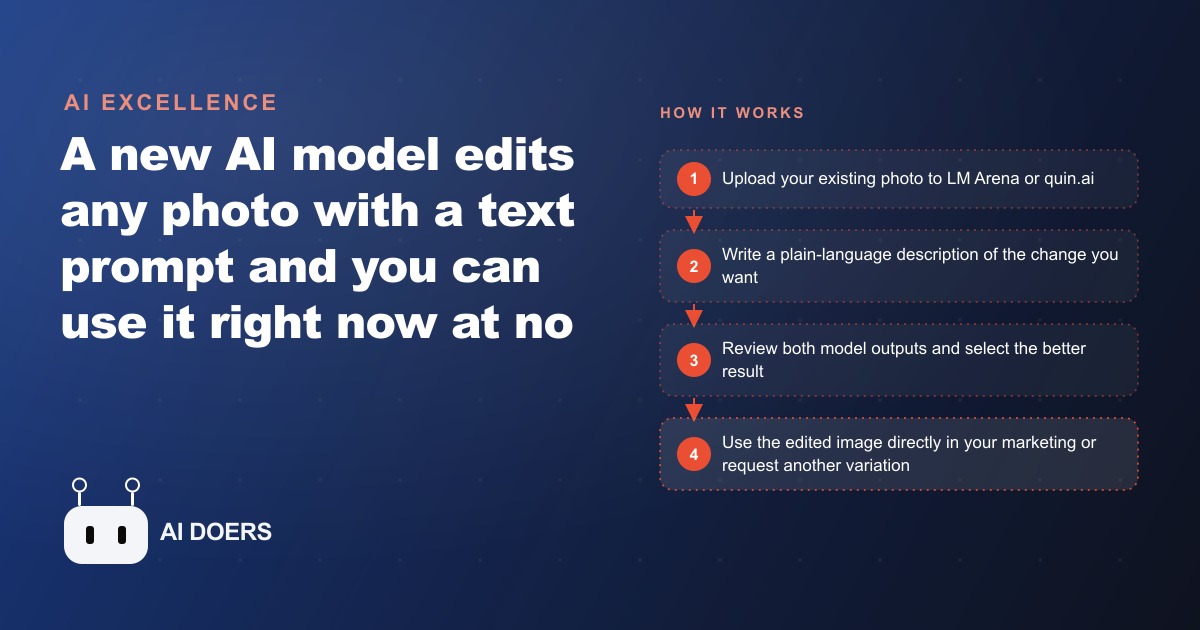
A model called Nano Banana edits photos with a text prompt at a level of spatial precision no previous free tool has matched, and you can access it today through LM Arena at no cost.

The difference between pixel-level processing and scene-level understanding is what separates the last wave of AI image tools from this one. For years, the defining limitation of AI image editing was that the model saw a photo as a flat grid of color values rather than as a scene containing objects that exist in space and relate to each other. That limitation is what is changing now, and a model called Nano Banana is the clearest demonstration of how much that change matters in practice.
The Ramen Bowl Test: Targeted Editing That Stopped at the Right Edge
The test that drew the most early attention to Nano Banana was simple to describe and surprisingly difficult to pass. A user uploaded a photo of a person sitting at a kitchen counter with a ramen bowl in front of them, and asked the model to convert only the ramen bowl into a 2D anime illustration, leaving everything else in the frame unchanged.
Nano Banana passed. The bowl became an anime illustration. The person, the counter, the background, and every other element in the frame remained exactly as they appeared in the original photograph.
The same prompt went to two other leading AI image tools. Both converted the entire photo to an anime style, not just the bowl. They had understood the instruction the way a flat-grid system would: "make this image anime" applied globally, because neither model had a way to isolate the bowl as a distinct object with its own spatial boundaries separate from the rest of the scene.
This is the test that makes the capability concrete. It is not about style quality or resolution or parameter count. It is about whether the model knows what the bowl is, where it sits in the scene, and where it ends relative to everything else around it. A model that passes this test has something the others do not: a working representation of the scene as a collection of objects in space rather than as a field of pixels to be transformed uniformly.
The practical consequence of that distinction extends well beyond cartoon conversion. It is what allows the model to replace a specific product on a shelf, modify a single garment on a figure, or change the background behind a person without disturbing the subject. Every one of those tasks requires knowing where the target object ends and the rest of the scene begins, which is exactly what scene-level understanding provides and what pixel-level processing cannot reliably deliver.
What the Model Is Actually Building When It Looks at a Photo
The proposed explanation for Nano Banana's spatial precision, based on what early researchers and testers have described, is that the model constructs an internal representation of the three-dimensional structure of the scene before it begins any editing operation.
This is fundamentally different from how a pixel-filtering approach works. A filter, including many AI filters that produce impressive results on certain tasks, operates on the image as a flat surface. It can restyle the whole thing, shift the palette, apply a texture uniformly, or change the lighting direction globally. What it cannot reliably do is identify that the bowl and the person and the counter are three different objects occupying three different depths in the scene, and then modify only one of them while leaving the physical relationships between all three intact.
A scene-level model builds something closer to a spatial map. It identifies objects, estimates their three-dimensional positions and sizes, understands which surfaces are facing the viewer and which are facing other objects, and infers the lighting conditions that produced the shadows and highlights visible in the photograph. When it receives an editing instruction, it applies that instruction to the region of the map corresponding to the named object, then regenerates the image with that region modified and everything else held constant.
This explains several of Nano Banana's reported capabilities beyond the ramen bowl test. When testers asked it to replace a purse in one photo with a different purse from a second reference image, it placed the new purse in the exact position of the original, matched the lighting and shadow consistent with the scene, and left the person holding it and the background undisturbed. When asked to blend a person from one photo into the scene of a different photo, it adjusted the positioning and apparent lighting of the transplanted person to be consistent with the new scene's geometry. These are not filter operations. They require spatial reasoning about the source image, the reference, and the desired composite.
Qwen Image Edit, the open-source model from Alibaba available at quin.ai under an Apache 2.0 license, operates on related principles and produces results in the same class. It is immediately accessible, fully operational, and free to use today, which makes it the practical starting point for any business beginning to work with these capabilities while Nano Banana remains in limited access through LM Arena.
Why Colorization Reveals the Same Intelligence as Targeted Replacement
Colorizing a black-and-white photograph is a problem that looks different from targeted object replacement on the surface, but it requires the same underlying capability.
To assign plausible colors to a black-and-white image, the model cannot simply map pixel brightness values to likely colors. It needs to understand what kind of scene is depicted, what types of objects appear in it, what era the photograph appears to come from, what the typical colors of those object types are under the lighting conditions visible in the image, and how those colors should vary across different surfaces and materials in the scene.
A person's skin tone in a portrait from the 1940s should receive different colorization treatment than the same skin tone in a contemporary outdoor shot, because the lighting, the photographic chemistry of the era, and the contextual clues about time period all differ. A dark suit in a photograph from the 1960s should receive different treatment than a dark suit in a contemporary studio shot, because the contextual clues about probable fabric type, cut, and texture differ as well.
The early colorization results from Nano Banana, where testers took blurry, low-quality black-and-white photographs and received clean, naturally colored outputs with improved image clarity, demonstrate that the model is drawing on exactly this kind of scene-level context. It is not applying a brightness-to-color lookup table. It is reasoning about what the scene contains and what those things would look like if photographed in color under the same conditions.
The same spatial scene intelligence that lets the model replace only the ramen bowl is what lets it infer that a bowl in a 1950s diner photograph would likely be white ceramic with a thick rim rather than translucent plastic, and colorize it accordingly. Targeted replacement and contextual colorization are not separate features built from different methods. They are expressions of the same underlying scene understanding applied to different types of editing requests.
The LM Arena Access Path and What Capability Leaks Tell You About Release Timing
Nano Banana does not have an official company claiming it or a public API. The model appeared in testing circles, generated significant attention for its spatial precision, and then began showing up on LM Arena, the blind comparison platform at lmarena.ai. Two senior employees at a major technology company posted banana-related imagery on social media in the same week the model appeared in testing circles, which is the kind of indirect signal the industry reads as deliberate when a company is assessing public reaction before making a formal announcement.
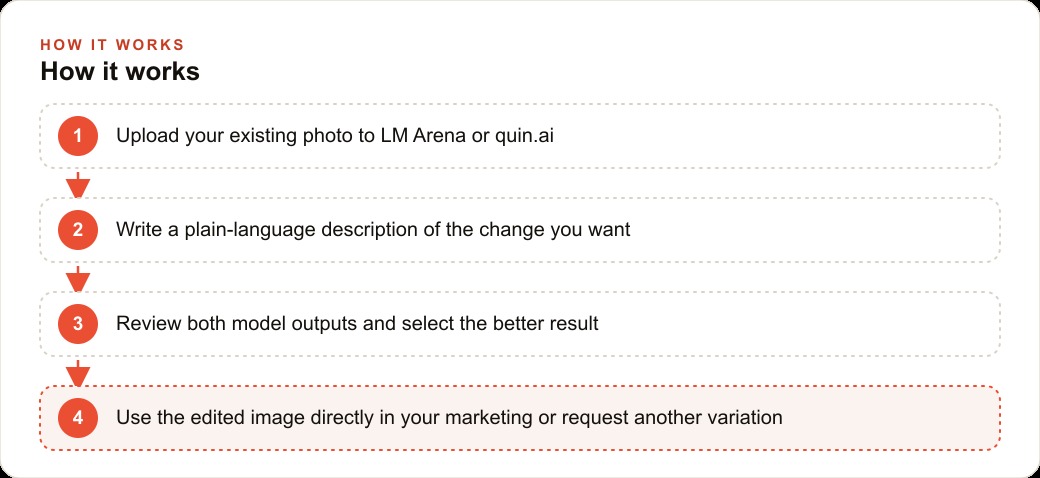
The access path through LM Arena is indirect but functional. Navigate to lmarena.ai, select Battle mode from the top options, enable image generation, drag your source photo into the prompt box, and write a clear description of the edit you want. The platform presents two anonymous model outputs simultaneously and asks you to vote for the better result. After voting, it reveals which models produced each output. Nano Banana appears in roughly one in five sessions at current availability levels, so you may need to submit the same prompt several times before it appears as one of your options. Since there are no usage limits on LM Arena, you can continue until you get the result you need.
The access path is worth understanding in itself because of what it reveals about how AI capabilities move into public use before formal release. The benchmark appearances, the indirect social signals, and the LM Arena availability all follow a pattern: the capability is technically accessible to anyone willing to find it before the company is ready to announce it officially. For business users, the implication is that waiting for a formal product launch means falling behind the users who are already developing prompt structures that consistently produce strong results. The learning curve on prompt specificity for these models is real, and starting early is an advantage that compounds.
A Beauty Salon Running Four Seasonal Variants From One Source Photo
Consider how a salon or beauty business would use these tools to solve a specific, recurring content production problem.
Most salons maintain a photo library of client transformations taken throughout the year. The best photos are high quality as portraits, with strong lighting and genuine documentation of the styling work. The limitation of these photos is that the setting is fixed: the salon interior visible in the background, the specific styling station, the season in which the original shoot took place. By the time spring arrives, the photos from the previous autumn look dated in the background even when the style work itself holds up well.
With Qwen Image Edit or Nano Banana, the process of refreshing that library changes substantially. The team loads a set of its strongest existing client photos and prompts the model to replace the background with a setting appropriate to the current season: a bright outdoor market for spring, a warm cafe interior for autumn, a clean neutral environment for winter promotions. The client, the stylist's work visible in the color or cut, and the quality of the portrait all remain unchanged. Only the environmental context shifts. The result is a fresh photo appropriate to the season without a new photography session.
The same approach extends to product promotion. When the salon runs a seasonal campaign featuring a specific treatment or product, rather than staging an entirely new product shoot, the team loads an existing strong product photo and prompts the model to adjust the background or shift the color temperature of the environment to match the seasonal palette. The lighting on the product stays consistent because the model understands the original lighting conditions and maintains them in the modification.
For client acquisition content, the image-blending capability opens additional options. A well-composed lifestyle photograph from a free stock library, where the setting matches the brand's desired positioning, can become the background for a composite that includes a team member or a featured style result, placed naturally into the scene through the model's understanding of the source image's spatial geometry.
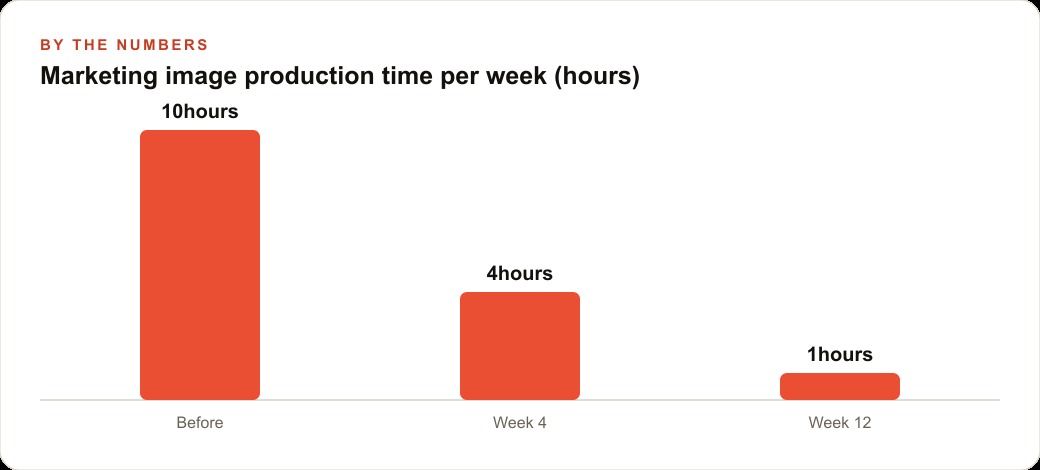
In illustrative terms, a salon that previously spent three to four hours per week on content production, between photography sessions, editing time, and asset preparation for different platforms, can reduce the per-image production time significantly once the prompt structures are calibrated for its specific content types. The first two weeks involve experimentation to identify which prompts produce reliable results. After that initial learning period, production becomes primarily a review and approval process rather than a creation process, and the volume of usable content per week increases substantially relative to the effort invested.
The economics hold across any business category that produces visual marketing content regularly. The limiting factor is the quality of the source photos and the clarity of the editing instructions. Models that understand scenes as three-dimensional spaces produce better results from clear instructions than models that require extensive prompt engineering to work around their spatial limitations. The tools described here are worth learning now precisely because that advantage is still recent enough to be a genuine differentiator.
That is exactly what we do at AI DOERS. Book a private 30-minute call with Madhuranjan Kumar and we will map the fastest path to it for your specific business.
Book your call →
Madhuranjan Kumar
Madhuranjan Kumar brings 20 years of performance-marketing experience and has managed over $200 million in Facebook ad spend for brands across the United States and beyond. His expertise spans the full modern marketing stack: Meta, Google Ads, TikTok, email automation, CRM, and the websites that hold it together. At AI DOERS he turns that track record into lead-generation systems for businesses across every industry.