
Four Open-Source AI Projects That Show Where Agents Are Headed
GStack, Hermes Agent, Superpowers, and Paperclip each push AI past simple chat: one founder can ship like a team of twenty, an assistant can improve itself across sessions, and a whole company can be orchestrated by agents. Here is what that means for a real business.

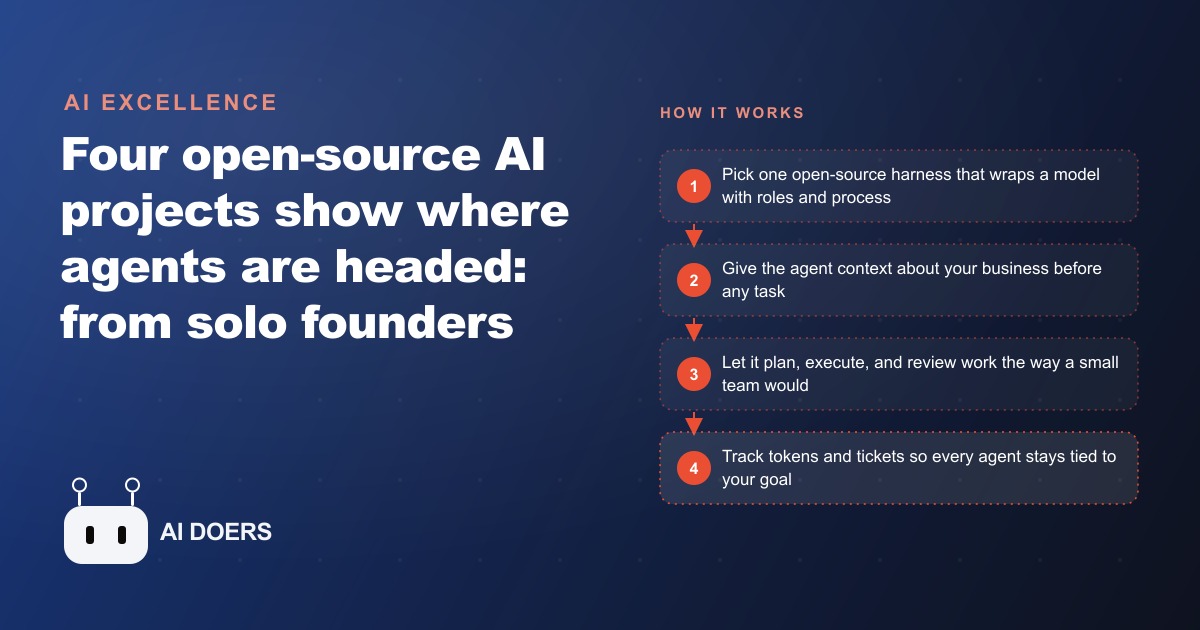
A repository hitting nearly 50,000 GitHub stars in a couple of weeks tells you where builder attention is moving, and that is exactly what GStack did. Madhuranjan Kumar recently walked through four open-source AI projects that, taken together, sketch a clear picture of where agents are headed: away from the chat box and toward something that behaves like staff. I am Madhuranjan Kumar, and after spending time with each of these, the pattern jumped out at me. None of them is a smarter chatbot. Each one wraps a model in roles, process, and memory so it can do sustained work instead of answering one question at a time. Here are the four projects, what each one actually does, and the practical lesson a business owner can pull from it.
GStack: a Y Combinator startup playbook compressed into a folder
GStack comes from Gary Tan, the president of Y Combinator, who took his hard-won startup experience and boiled it into a system that sits on top of Claude Code or Codex. That provenance is the whole point. This is not a random developer tool, it is a distillation of how one of the most respected startup accelerators thinks about building a product, packaged so an agent can run you through it.
What makes GStack interesting is that it is a process, not a pile of tools. Before you write any code, it runs you through office hours with six forcing questions, a CEO review, and a find-the-ten-star-product exercise, all designed to sharpen the idea before a single line exists. Most people rush straight to building. GStack makes the agent slow you down and interrogate the concept first, which is exactly what a good accelerator does to a founder.
The project quotes Andrej Karpathy saying he has barely typed a line of code since December, and the stated goal is to give a solo developer the power of an entire development team. The lesson for a business owner is not that you should install GStack tomorrow. It is that the value lives in the structure and the questions, not the software. If you are the bottleneck in your own company, the first move is to write down your process clearly enough that an agent could follow it. That discipline pays off no matter which tool you eventually use, and it is the same clarity that makes your Facebook and Instagram ad campaigns easier to brief when you can state exactly what a good customer looks like.
Roles as prompts: how GStack splits one agent into a team
There is a second idea inside GStack worth pulling out on its own, because it shows up across all four projects. Instead of one generic prompt, GStack breaks the work into separate markdown files for an engineering manager, a senior designer, a staff engineer, and a debugger. The agent then reads your code base through the lens of each role in turn rather than as one undifferentiated assistant.
This matters more than it sounds. A single prompt asks the model to be everything at once, and the output is usually mushy. When you make the same model wear one hat at a time, first the manager who worries about scope, then the designer who worries about the interface, then the engineer who worries about correctness, the quality climbs sharply. You are not adding intelligence, you are focusing it.
Any owner can borrow this without touching code. Write down the different roles that live inside your business and hand the agent one at a time. One pass reviews your pricing like a finance lead. Another reviews your customer messages like a support manager. A third reviews your listings like a merchandiser. The role framing forces the model to think from a specific angle, and specific angles produce useful work.
Hermes Agent: an assistant that gets smarter every session
Hermes Agent, from Nous Research, is an operating-system-style assistant with a built-in learning loop. Where a normal chat forgets everything the moment it ends, Hermes creates skills from experience, improves them while it uses them, and remembers who you are across sessions. It also runs from a single gateway across Telegram, Discord, Slack, WhatsApp, Signal, and a command line, and it can migrate your existing memories so you do not start from scratch.
The headline capability here is memory that compounds. Most people using AI today are stuck in an amnesia loop, re-explaining their business every single session. Hermes points at the fix: an assistant that accumulates context the way a long-tenured employee does. The first month it needs everything spelled out. By the third month it already knows your customers, your tone, and the objections you hear most.
For a business, the practical takeaway is to stop treating your AI like a stranger. Keep a living context file, feed it back every time, and let the assistant build on what it already knows. The value of an assistant is not raw intelligence, it is accumulated familiarity with your specific situation. That is also why the same context that trains your assistant can quietly feed SEO and organic search, because the questions your customers actually ask become the pages that rank.
Superpowers: engineering discipline the agent cannot skip
Superpowers, sitting at around 115,000 stars, takes a different tack. It forces Claude Code to follow real engineering discipline: test-driven development, the YAGNI principle of not building what you do not need yet, and DRY, the habit of not repeating yourself. It refines a rough idea, uses git worktrees to run parallel work, writes a clear plan, executes with tests, runs a code review, then finishes the branch. It installs as a Claude plugin in a single line, and its own description says it plans clearly enough that an enthusiastic junior engineer with poor taste could still follow along.
That last line is the whole philosophy. Superpowers assumes the executor is fast but not wise, so it wraps the work in guardrails that catch mistakes early. The plan comes before the code. The tests come before the feature. The review comes before the merge.
The business lesson is that speed without guardrails is a liability, not an asset. An agent that ships fast and breaks things quietly is worse than a slow human. Whatever you automate, build in the checkpoints: a plan you approve, a test that must pass, a review before anything goes live. This is exactly how I approach client automation, because a system that fails silently costs more than the manual work it replaced.
Paperclip: a company where every executive is an agent
The fourth project, Paperclip, is the most ambitious. It is open-source orchestration for a company run entirely by AI agents. The framing the project uses is sharp: if a single assistant is an employee, Paperclip is the whole company, with a CEO, a CMO, and a CTO that are all agents. It runs a ticketing system like a real engineering team and tracks how many tokens each agent spends, and every agent stays tied to the one high-level company goal you set.
Two details make Paperclip more than a novelty. The first is the ticketing system, which means work is queued, assigned, and tracked rather than lost in a chat log. The second is token tracking, which turns each agent's effort into a measurable cost you can watch. Together they make an agent swarm legible instead of chaotic.
You almost certainly do not need a fully autonomous company today, and Paperclip is early and rough at the edges. But the two ideas underneath it are worth stealing right now. Give your agents a single clear goal so their work does not drift, and track what each task actually costs so you can tell the productive automations from the expensive ones. Those two habits keep an AI system honest, and they are the same discipline that keeps a Google Ads account profitable, where every dollar is tracked against a goal and the losers get cut.
The one thread running through all four
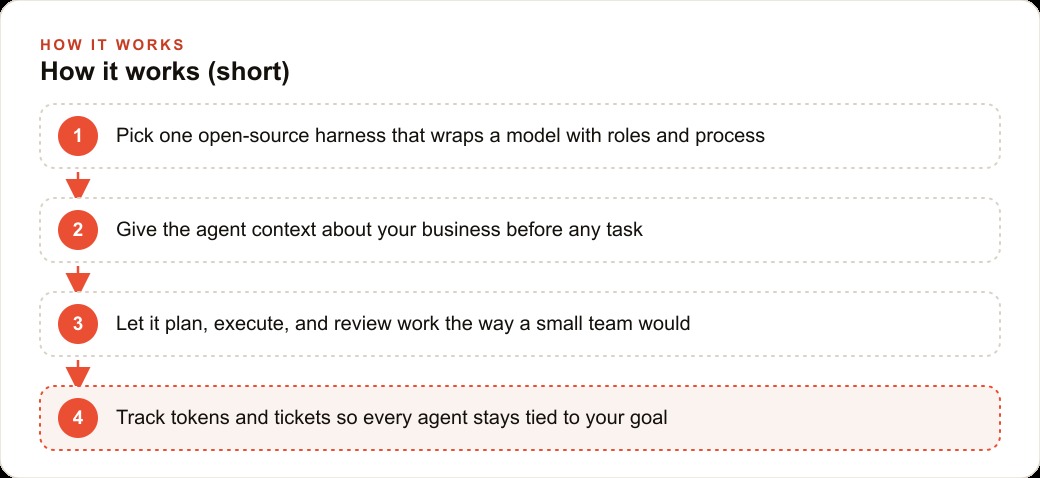
Line the four projects up and the same shape appears in every one, which is the real reason they are worth studying together. GStack gives the model context and roles before any task. Hermes gives it memory that carries across sessions. Superpowers gives it a disciplined process with checkpoints. Paperclip gives it a single goal and a way to track the cost of pursuing it. Context, roles, process, memory, and goal: those five ingredients are what turn a chat box into something that behaves like staff.
That is the takeaway I would hang onto long after these specific tools are replaced by newer ones, and they will be, because the space moves fast. The projects themselves are early and demanding to run well. The pattern underneath them is not going anywhere. A generic prompt asks a brilliant stranger to guess what you need. The five ingredients turn that stranger into a colleague who knows your business, remembers your history, follows a reliable process, and stays pointed at one clear outcome. Any owner who understands that shift can apply it with whatever tool is best next year, which is exactly why the concept matters more than the four repositories. When you evaluate the next agent framework that goes viral, the question to ask is not how many stars it has, it is how well it lets you supply those five ingredients for your specific business.
Being early is the edge, not the tool
Berman closes with a caution I want to repeat, because it is the most important line in the whole tour. None of these projects will magically deposit money in your account. They are powerful, they are free, and they are also rough and demanding to run well. The real advantage does not come from the software. It comes from being early and hands-on while most people still treat AI as a question-and-answer box.
Consider how this plays out for a mid-sized roofing company where the owner is the bottleneck. The owner estimates jobs on a ladder all morning and drowns in paperwork all night. Borrowing the four lessons, the owner writes one plain-language context file describing the service area, the roof types the crew handles, the average job size, the claim language local adjusters expect, and who handles estimates versus scheduling versus collections. That is the GStack move. Then the owner defines a few roles: one drafts estimate follow-ups for homeowners who got a quote but did not book, one turns rough storm-damage notes into a clean scope document, one reconciles which jobs are still unpaid. That is the role split. The system remembers each neighborhood it has quoted and the objections that came up, so follow-ups sharpen over time. That is the Hermes lesson. Every task runs through a ticket-style flow with a review step before anything reaches a customer. That is the Superpowers and Paperclip discipline.
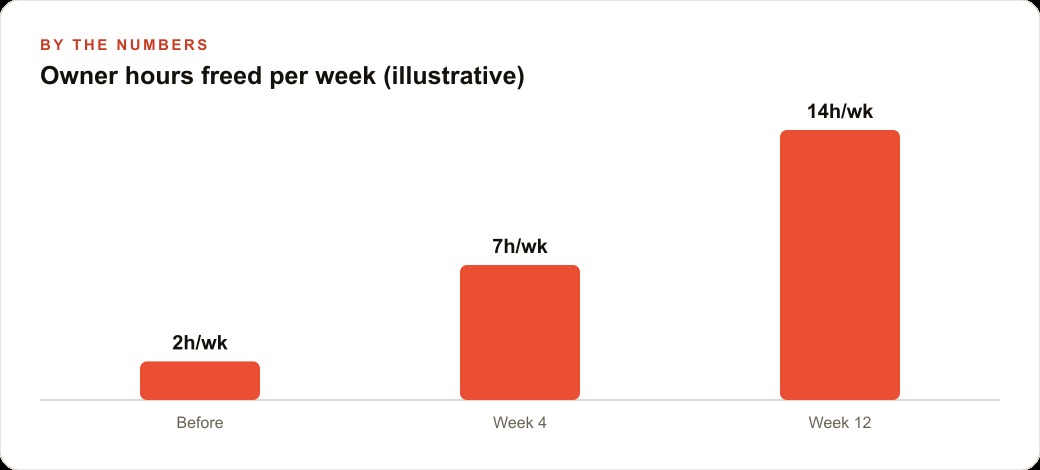
Say this frees roughly two hours in week one, seven by week four, and fourteen by week twelve as the context deepens and the roles get tuned. The crew keeps climbing, measuring, and laying shingles exactly as before. What changes is that the owner stops being the only operating system holding the office together, and the quiet admin that used to eat evenings gets handled by an agent that already knows the business. Those recovered hours are the illustrative payoff, and they compound because the memory does.
You can absolutely start this yourself this week. Pick the one project closest to your need, spend an afternoon writing your business context in plain language, and define a single role to test. That one file becomes the foundation every later build inherits for free, and it will also make your CRM and website stack more useful, because the same context that guides an agent tells your follow-up automation who to prioritize. If you would rather have someone map your specific business, write the role files, and stand up the daily brief so it works on the first morning, that is exactly the kind of build I do for clients, and you can bring me in to handle it.
That is exactly what we do at AI DOERS. Book a private 30-minute call with Madhuranjan Kumar and we will map the fastest path to it for your specific business.
Book your call →
Madhuranjan Kumar
Madhuranjan Kumar brings 20 years of performance-marketing experience and has managed over $200 million in Facebook ad spend for brands across the United States and beyond. His expertise spans the full modern marketing stack: Meta, Google Ads, TikTok, email automation, CRM, and the websites that hold it together. At AI DOERS he turns that track record into lead-generation systems for businesses across every industry.