
My Five Step System for Making Content Fast With AI
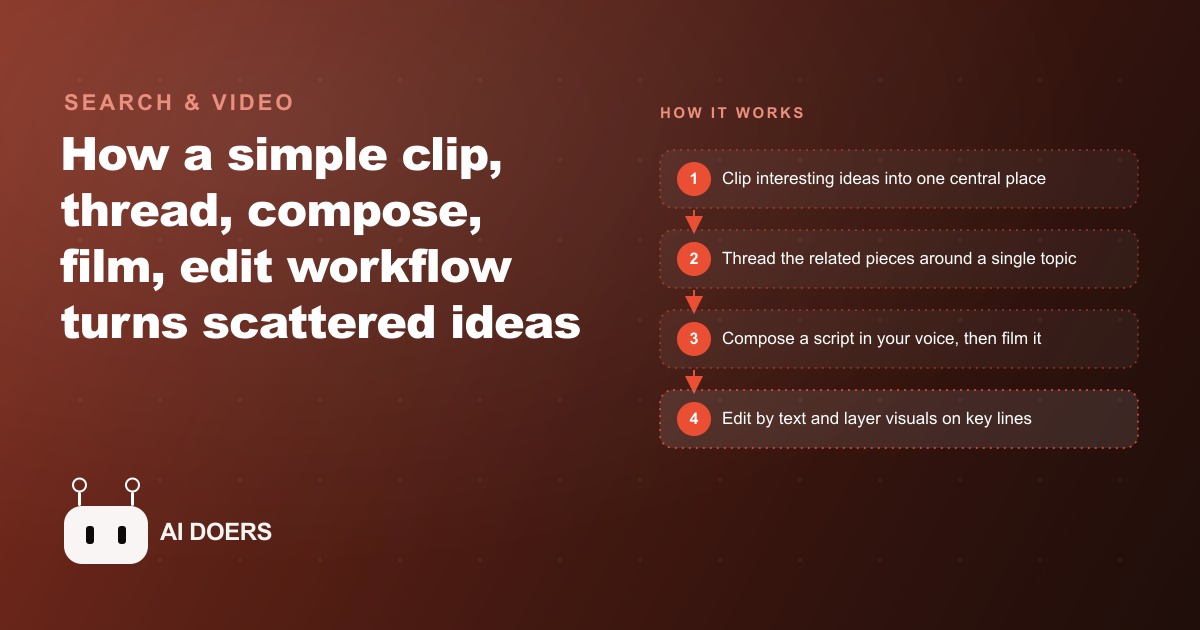
A clip, thread, compose, film, edit workflow turns scattered ideas into finished, on brand videos in a fraction of the usual time.

Almost everyone teaching AI content is selling you the wrong fix. They obsess over prompts, over which model writes the cleanest paragraph, over the magic instruction that turns a chatbot into a copywriter. I think that focus is backwards, and I have come to believe it is the reason so many businesses try AI content, get a wall of generic text, and quietly give up.
I am Madhuranjan Kumar, and here is my position stated plainly: the writing was never your bottleneck. Capturing and organizing your own thinking was. Fix that, and AI becomes genuinely useful. Skip it, and no prompt on earth will save you. Everything below is an argument for that claim, built around a five-step workflow that puts writing dead last on purpose.
The blank page is the real enemy, not the writing
When people say they cannot keep up with content, they almost never mean they physically cannot type sentences. They mean they sit down, open a blank document, and their mind goes empty. The intimidation of starting from nothing is what kills consistency, and consistency is the only thing that actually builds an audience.
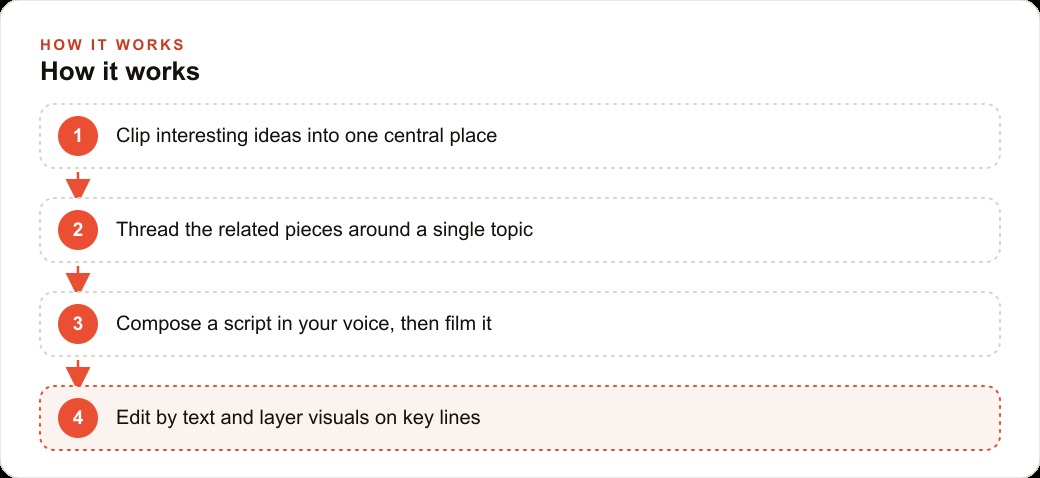
So the popular solution, get a better AI writer, aims at the wrong target. A better writer does not help someone who has nothing gathered to write about. It just produces more confident-sounding filler, faster. The workflow I trust flips the order entirely. It treats writing as a downstream step that only happens after the hard part, gathering raw material, is already done. Five steps: clip, thread, compose, film, edit. Notice that composing, the AI writing part everyone fixates on, sits third, not first.
Clipping is the step that actually decides everything
Step one is clipping, and I will argue it is the single most important habit in the entire system, far more important than your choice of model. Whenever you see something interesting, a quote, a chart, a short video, a customer question, you save it to one central place. Immediately. This runs quietly in the background all day, every day, so that by the time you sit down to create, you are never staring at nothing.
This is the contrarian heart of my whole argument. The quality of your content is set months before you write a word, by whether you were paying attention and capturing along the way. The people who publish effortlessly are not faster writers. They are diligent collectors. Their advantage is a full library, not a clever prompt. If you take only one thing from this piece, build the clipping habit and ignore everything else for a month. You will already be ahead of people fussing over prompt templates.
Threading turns a pile into a point
Step two is threading. You pull the saved pieces that belong to one topic into a single ordered group and add a little quick research so the idea is fully fed. This is where a scattered pile becomes an argument with a spine. You are not writing yet. You are arranging.
I want to dwell on why this matters, because it is the step most people skip straight past on their way to the AI. When you hand a model a rich, ordered thread, three saved clips, a statistic, a customer objection, a point of view, it has real substance to work with. When you hand it a one-line request, it fills the gap with the blandest average of everything it has ever read. Same model, wildly different output. The difference was never the prompt. It was how much of your own thinking you brought to the table.
Composing is where AI belongs, and only here
Now, step three, composing, is where AI finally earns its place. You hand your thread to a model along with examples of your own writing so it drafts a script that sounds like you rather than a generic machine. This is the one step where the tool genuinely saves you time, and it saves the most time precisely because you did the first two steps well.
Here is the concession I will make to the prompt crowd: context does matter enormously. But context is not a clever instruction. Context is your clipped material and your voice samples. The reason AI writing reads flat is almost never a weak prompt. It is that the model does not know who you are, what you believe, or what you have gathered. Feed it your notes, your opinions, and a few examples of how you actually talk, and the first draft stops sounding like a robot. You are not prompting harder. You are informing better.
Film and edit are where personality survives
Steps four and five are filming and editing, and they exist to protect the one thing AI cannot manufacture, your presence. You load the script into a teleprompter app and read it straight off the camera with real energy, capturing it in a take or two. Then you edit by text rather than by timeline, cutting and rearranging this breakdown by editing the transcript, and you drag charts, clips, and images onto the exact lines where you mention them.
I include these steps deliberately, because a lot of AI-content advice stops at the written draft and wonders why the results feel hollow. Text alone is a commodity now. Your face, your delivery, your emphasis on the line that matters, that is the part no model can copy. The workflow gets you ninety percent of the way there fast so that your energy goes into the ten percent that is uniquely yours, not into fighting a blank page or wrestling complicated editing software.
Why this beats the prompt-first crowd, in numbers
Let me make the argument concrete with an illustrative example. Picture a boutique fitness studio that wants to fill more classes and has tried AI content twice already, both times abandoning it after the output felt generic. The owner was doing it prompt-first: open the chatbot, ask for a post about squats, publish something forgettable, repeat until bored.
We switch the order. The coaches start clipping all week. A member asks a sharp question about recovery, saved. A trainer reads a useful mobility study, clipped. A phone video of a tricky lift, saved. By the weekend the raw material for a dozen posts already exists. They thread one topic, three common squat mistakes, pulling the saved clips and a research note into one group. Only then do they compose, feeding that thread to AI with a few examples of the studio's warm, motivating tone. The draft sounds like a real coach because it was built from a real coach's captured thinking. The owner films it in one or two energetic takes and edits by trimming the transcript, dropping the correct-form clip onto the exact line that describes it.
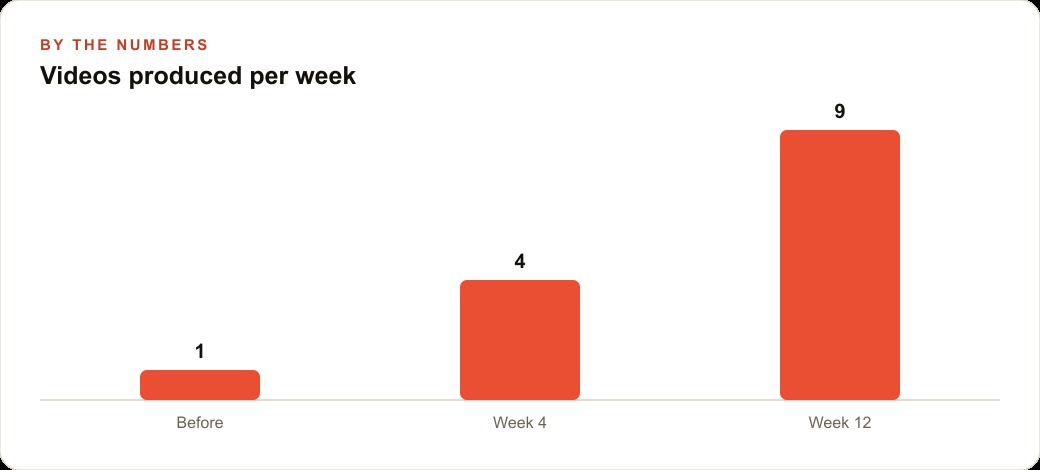
The illustrative shift: before, the studio managed maybe one forced post a week and stopped whenever it got busy. With the capture habit running in the background, it comfortably ships four to nine short videos a week within a couple of months, without the owner's schedule collapsing. That steady, on-brand drip is what turns a quiet local page into a following that fills classes, and every one of those posts also feeds the studio's SEO and organic search footprint and gives its Facebook and Instagram ad campaigns genuine creative to run instead of stock filler. The leads those videos generate land in the CRM and website stack where a simple sequence books the trial class. None of that came from a better prompt. All of it came from a better order of operations.
The habit is what compounds, not the tool
I want to widen the argument, because the deepest reason the capture-first approach wins is that it is a compounding habit, and habits beat tools over any real time horizon. A prompt is a one-time act. A clipping habit is an asset that grows every single day, whether or not you are actively making content. Six months of diligent capturing leaves you with a library so deep that creation becomes a matter of choosing which good idea to develop, not scrounging for any idea at all.
This is where the prompt-first crowd quietly loses, even when their individual outputs look fine in isolation. They can produce one decent post on demand, but they cannot produce a steady stream of them without burning out, because every post starts from empty. The capture-first creator produces a steady stream almost effortlessly, because every post starts from a full shelf. Over a year, the difference is not incremental. One person publishes sporadically and gives up twice. The other builds an audience. And an audience is the only content outcome that actually matters for a business, because it is the thing that converts.
Notice too that the captured library is not single-use. The same clipped question that becomes a video can become a social caption, an email to your list, and a section of a longer article, each feeding a different channel from one piece of raw material. That reuse is invisible to anyone fixated on prompts, because they are thinking one output at a time. The capture-first thinker is building a private content warehouse that supplies everything downstream, which is why their SEO and organic search presence and their Facebook and Instagram ad campaigns both get stronger from the same daily habit without any extra effort.
There is also a quality dividend that no prompt can buy. Content built from things you genuinely found interesting carries a point of view, because you were reacting to the real world as you captured it. That reaction, your opinion, your framing, your example, is the exact ingredient that makes AI writing sound like a person instead of an average. The clip is not just raw material. It is a fossil of your genuine interest, and genuine interest is what audiences respond to. So the habit does not only make you consistent. It makes you consistent and distinctive at the same time, which is the combination that is almost impossible to compete with.
One more thing the capture habit quietly fixes is the fear of running dry, which is the reason most people abandon content in the first place. When your only method is to sit down and think of something, every publishing day feels like a gamble against a blank mind, and a few bad days in a row is all it takes to quit. When your method is to open a shelf that has been filling itself all week, the question changes from can I think of anything to which of these is best right now. That shift from scarcity to abundance is the real psychological unlock, and no model upgrade delivers it. Only the habit does. The people who look effortless are simply never starting from zero, and once you have felt the difference between choosing from a full shelf and staring at an empty page, you will never willingly go back to prompting your way out of nothing.
The objection, and my answer
The obvious pushback: is this not just extra work dressed up as strategy? Clipping, threading, filming, that is more steps than typing a prompt. Yes, and that is the point. The prompt-first approach feels faster because it front-loads nothing and back-loads all the pain into generic output nobody engages with. The capture-first approach spreads a little effort across every day so that creation day is quick and the result is actually good. You are trading a fake shortcut for a real system.
So I will restate my position without hedging. Stop shopping for the perfect prompt. Start capturing your own thinking every single day, arrange it before you write, let AI draft from that rich context, and protect your personality in the film and edit. The workflow, not the model, is the moat. You can absolutely run this system yourself, and I would genuinely start with nothing but the clipping step today. But if you would rather have someone design the threads, tune the AI to your voice, and hand you a content engine that simply runs, that is exactly the kind of system I help businesses build.
That is exactly what we do at AI DOERS. Book a private 30-minute call with Madhuranjan Kumar and we will map the fastest path to it for your specific business.
Book your call →
Madhuranjan Kumar
Madhuranjan Kumar brings 20 years of performance-marketing experience and has managed over $200 million in Facebook ad spend for brands across the United States and beyond. His expertise spans the full modern marketing stack: Meta, Google Ads, TikTok, email automation, CRM, and the websites that hold it together. At AI DOERS he turns that track record into lead-generation systems for businesses across every industry.