
Five AI Ways to Make Money From Home in 2026
Five tested ways to earn from home with AI, each tied to a real tool and a clear price ladder. The thread running through all of them is that you show the result first, then talk price.

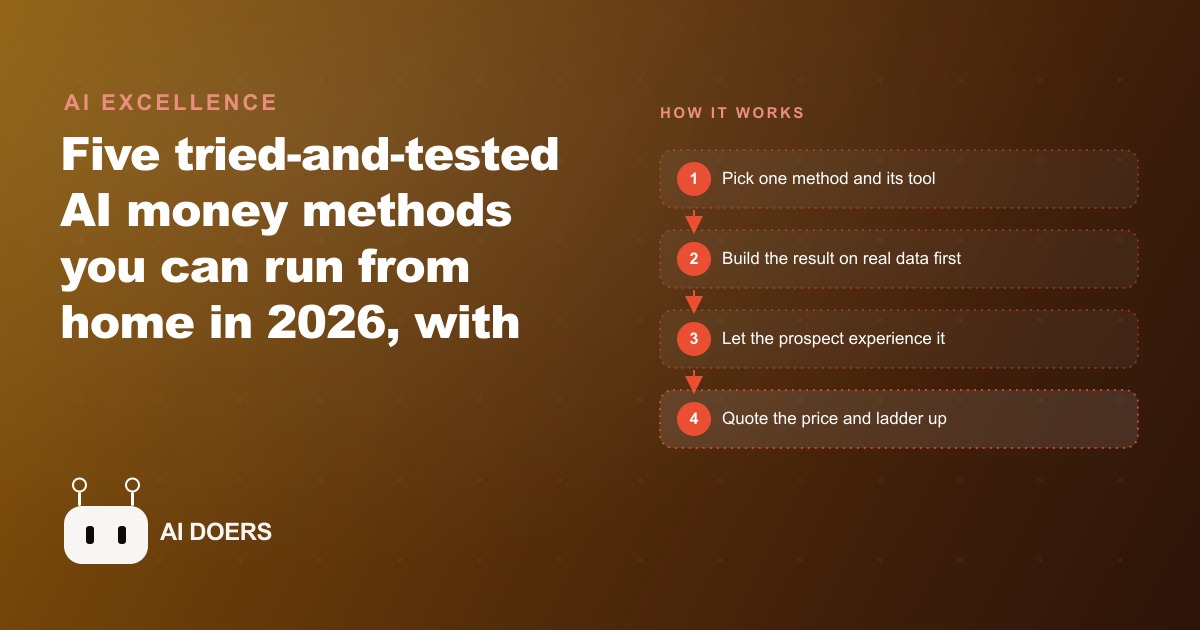
Twelve weeks is enough time to go from zero to a real monthly income with AI, and I want to show you exactly how by following one path from start to finish rather than tossing you a list of ideas. I am Madhuranjan Kumar, and there are thousands of so-called AI money methods floating around, most of them noise. So instead of listing five and wishing you luck, let me walk you through the journey of a single home-based operator building the business one client at a time, using illustrative numbers so you can see how the pieces stack. The thread running through every stage is the same: show the result first, then talk price.
Chapter one: the audit that needs no code
The operator starts with the most beginner-friendly method there is, the AI tools audit, precisely because it requires no technical skill and the demand is enormous. The premise is simple. Almost every business wastes hours each week on tasks that some AI tool already solves, but the owner has no idea which tools exist or which ones fit. So the operator sells clarity. They sit with an owner, learn the biggest time-wasting tasks, then find three to five tools that target those exact problems and hand over a clean one-page report.
There is not even any hunting involved. A free directory lets you search a task like invoices and instantly surface tools that handle it, which means a complete beginner can assemble a professional-looking audit in an afternoon. The operator picks a niche they already understand a little, in this case local accounting firms, and spends the first few days learning the common pain points: manual receipt sorting, chasing clients for missing documents, retyping the same reminder emails week after week.
The pricing on an audit ranges from a couple hundred dollars into the thousands depending on the depth, and the operator prices their first one deliberately low to land it. Community data on this exact method shows an average of about nine days to a first paying client with steady outreach, so the operator commits to reaching out to ten local firms a day and treats the first two weeks as the real work.
Before the retainers, though, there is an even faster way to earn a first check and warm up a niche, and the operator uses it to fund the early weeks: the instant website flip. Plenty of local businesses, dentists, plumbers, small accounting firms, are sitting on a website that looks like it was built in 2005. They know it is bad, but they assume a web agency will charge five figures over three months to fix it, so they do nothing. The operator copies the existing page content into a modern builder, rebuilds a clean version in minutes, and sells it starting around 500 dollars and climbing toward 2,000 as their eye sharpens. It is the same show-first principle: the owner is looking at their own rebuilt site, not imagining one. A couple of these flips in the first fortnight cover the operator's costs and, more importantly, put them face to face with exactly the kind of local owners who later buy audits.
Chapter two: the first client and the report that closed it
The outreach that works is not a cold sales pitch. It is warm and specific. The operator messages their own network first, old colleagues and former bosses, asking for introductions rather than a sale, and offers a couple of free assessments to build early case studies. One introduction lands a small accounting firm on day eight, right in line with the nine-day average.
The operator does the sit-down, maps where the hours actually go, and builds the report. Three tools, each tied to a named pain: a document-sorting tool for the receipts, a reminder automation for the document chasing, a drafting tool for the repetitive client emails. The report shows each task, the tool that fixes it, and the rough hours saved per week. Because the firm can see the specific relief on paper rather than imagining a vague AI benefit, they say yes. First invoice: 500 dollars. Small, but it is real, and it is proof.
What makes accounting firms such a clean fit becomes obvious here, and it shapes the whole rest of the journey. Their pain is predictable and seasonal. Tax deadlines, month-end closes, and quarterly filings create the same crunch every year, and the same manual tasks pile up each time. An audit that quietly removes a few hours of that grind pays for itself immediately, and once an owner feels that relief they rarely want to give it back. That is the seed of a retainer, not a one-time sale.
Chapter three: laddering the audit into a built automation
Here is where the income stops being a trickle. Once the firm trusts the audit, the operator proposes the next rung: actually building one of the automations instead of just recommending it. The obvious choice is an AI phone agent, because the firm loses money every time a call goes unanswered during the busy season and a client cannot get a straight answer about a deadline or a required document.
The build is not intimidating. Using a voice-agent tool, the operator stands up a 24/7 customer support agent from a short prompt and a knowledge base pulled straight from the firm's own website and FAQ. The demo is the whole sale. The operator builds the agent on the firm's real pages so it answers questions about their actual team, deadlines, and document requirements, then lets the owner pick up a phone and talk to it. Watching their own business answer the phone perfectly at midnight is what converts a skeptic. This piece prices at 2,000 dollars a month as a managed service, because it is not a one-off file, it is an ongoing system the operator maintains.
That phone agent does not live in isolation, either. The smart move is to wire it into the CRM and website stack so every captured call becomes a lead with follow-up attached, which turns a support tool into a revenue tool the owner can actually see working.
Chapter four: adding a creative studio retainer
By week six the operator has one firm on a 2,000 dollar monthly retainer plus the original audit fee, and they use the case study to land a second niche entirely: a small e-commerce brand that constantly needs product photos and social content. This is the AI creative studio method. One person with the right tool can turn a single product photo into a full set of shots, ad formats, and short clips, work that used to require a photographer and an editor.
The operator packages this as a monthly content service at around 2,000 dollars a month. The brand gets a steady flow of fresh creative without hiring a studio, and the operator produces it in a fraction of the time by letting the tool do the heavy lifting. The natural place all that creative goes is the brand's paid promotion, so the operator makes sure the assets are built to drop straight into Facebook and Instagram ad campaigns, where fresh creative is exactly what keeps the cost per sale from creeping up. The same library of images and clips also feeds the brand's SEO and organic search presence at no extra effort, which the operator points out as a bonus that makes the retainer easy to justify.
Chapter five: the workshop that turns into recurring work
The last method the operator adds is the AI training workshop, and it is the sneakiest source of growth. Plenty of companies pay for AI subscriptions but their teams only use them to write birthday messages. The operator offers an old employer a free workshop in exchange for a testimonial, then automates one real, repetitive task live in front of the team and proves the value on the spot. This free-workshop approach is a quiet Trojan horse. Community data on the method shows that a large share of these free sessions, on the order of seven in ten, turn into much bigger paid projects afterward, because once a team sees one task automated they immediately want the next ten handled too.
Every method in this journey works the same way underneath, which is the lesson worth carrying out of it. The operator never describes value, they demonstrate it. They walk in holding the rebuilt website, the working phone agent, or the audit that names the three worst time-wasters, and the demonstration does the selling. Small business owners do not buy ideas, they buy relief from a specific pain, and proof removes the guesswork from their decision.
It is worth pausing on why the ladder holds together so well, because it is not luck. Each rung lowers the trust barrier for the next one. A 500 dollar website flip proves the operator can deliver something concrete. The audit that follows proves they understand the business, not just the tools. The built automation proves the operator can turn advice into a working system. By the time a monthly retainer is on the table, the owner is not taking a leap of faith, they are extending a relationship that has already paid off three times over. That is why the average deal size climbs across the twelve weeks even though the operator's underlying skill barely changed. What changed is the accumulated proof, and proof is the currency this whole business runs on.
Chapter six: the numbers after twelve weeks
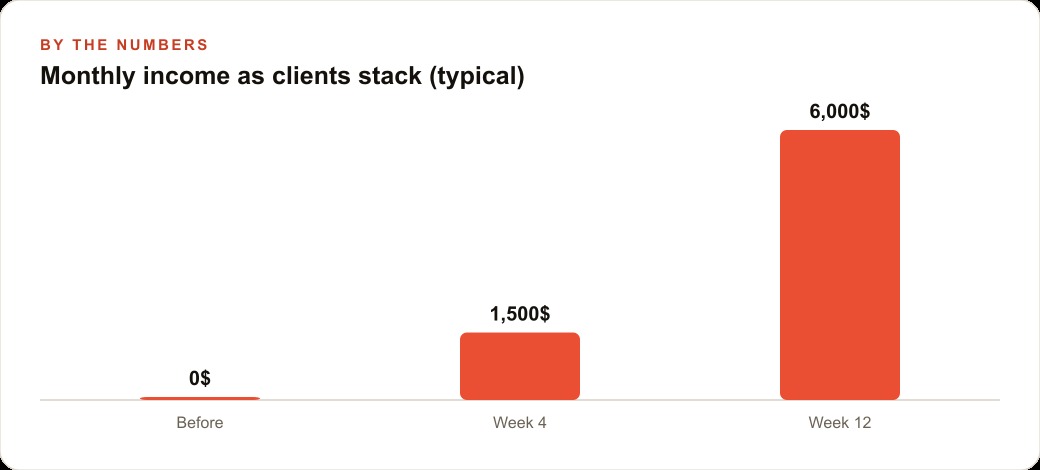
Let me total the illustrative journey so the shape is clear. The operator started at zero. By around week four they had landed the first audit and a second small client, putting them near 1,500 dollars for the month. By week twelve they had one accounting firm on a 2,000 dollar phone-agent retainer, an e-commerce brand on a 2,000 dollar creative retainer, a workshop that converted into a paid automation project, and a couple of smaller audits still trickling in, stacking to roughly 6,000 dollars a month. None of it required a technical background. Each piece laddered naturally into the next: a website flip leads to an audit, an audit leads to a built automation, an automation leads to creative or voice work, and a workshop leads to recurring projects.
The path to a five-figure month from there is not a mystery, it is just more of the same ladder. Two or three more retainer clients at similar rates, or deepening the existing ones, and 10,000 dollars a month stops being a fantasy and becomes arithmetic. The reason it compounds is that every satisfied client is both a testimonial and a source of the next referral, so outreach gets easier at exactly the moment the operator has less time for it.
One practical note on the outreach that carried the whole journey, because it is where most people quit too soon. The operator did not blast a generic pitch to strangers. They ran two motions in parallel. The warm motion was messaging their own network for introductions and offering free assessments, which produced the first client fastest. The cold motion was a small, disciplined test: pick four niches, send roughly 500 emails to each, and watch which niche actually replies. Then double down on the one that responds instead of spreading thin across all four. That simple test is the difference between guessing which market wants this and knowing, and it is why by week twelve the operator was spending their outreach time only where it converted.
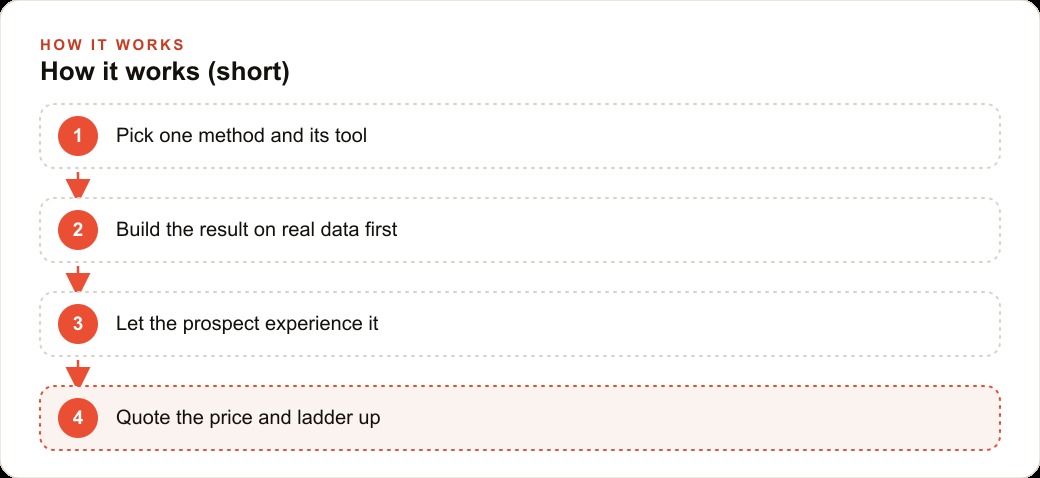
If you take one thing from this walkthrough, let it be the sequence rather than any single tool. Pick one method, and if you want the fastest route to a first paying client, start with the tools audit because it needs no skill and the demand is real. Build the result on genuine data, let the prospect experience it, quote a price, and then ladder up from there. You can run every stage of this yourself, and plenty of people do exactly that. If you would rather have someone who does this daily help you map a niche's bottlenecks and set up the audit-to-automation ladder so it actually sticks, that is worth a short conversation before you spend weeks figuring out which tools deserve your time.
That is exactly what we do at AI DOERS. Book a private 30-minute call with Madhuranjan Kumar and we will map the fastest path to it for your specific business.
Book your call →
Madhuranjan Kumar
Madhuranjan Kumar brings 20 years of performance-marketing experience and has managed over $200 million in Facebook ad spend for brands across the United States and beyond. His expertise spans the full modern marketing stack: Meta, Google Ads, TikTok, email automation, CRM, and the websites that hold it together. At AI DOERS he turns that track record into lead-generation systems for businesses across every industry.