
Fine Tuning vs Knowledge Base: Making GPT 10x Better For Your Business
There are two real ways to make GPT perform for your specific use case. Here is how to tell which one you need and how a pest control company would put both to work.

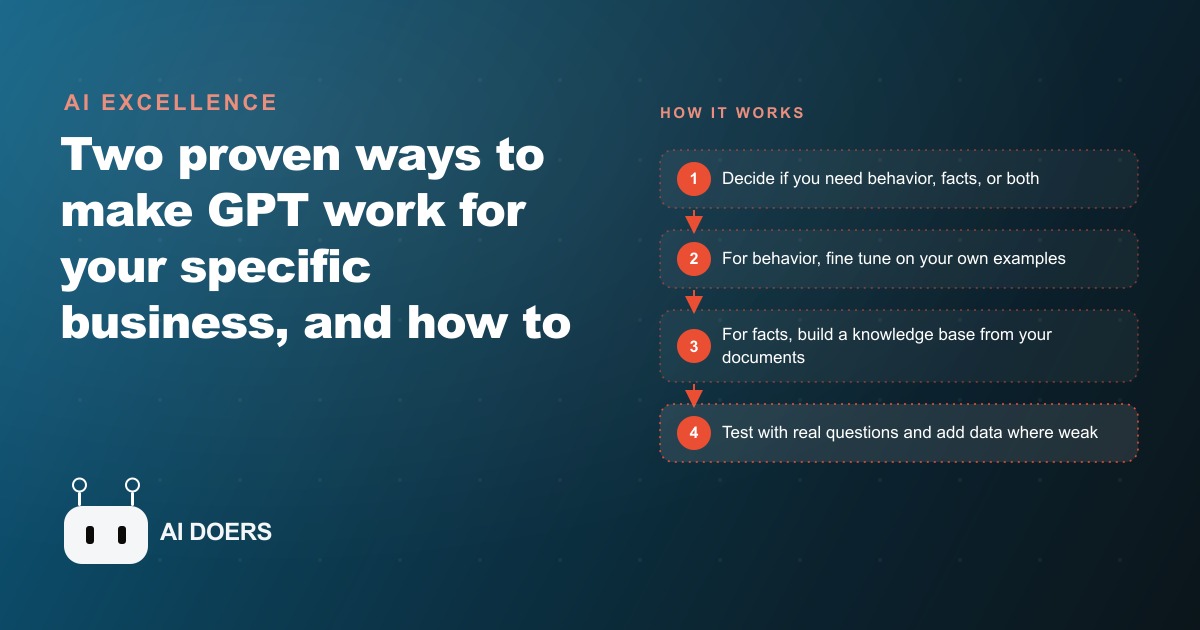
There is a pest control company in this story, and by the end of it the owner has a working AI system that handles roughly forty of every fifty daily inquiries automatically, with a human reviewing before anything goes out. Getting there required understanding the difference between two distinct problems that look similar from the outside and require completely different solutions.
I am Madhuranjan Kumar. The two methods are fine tuning and a knowledge base. Each one solves a specific type of problem. Using the wrong one for a given use case produces a system that fails in a way that is difficult to diagnose because the output looks plausible even when it is wrong. This is the story of how a pest control company discovered that distinction the hard way, and what they built afterward.
The afternoon the AI quoted a price it had never been told
The company had been using a general AI model to help their front office handle the steady flow of inquiries that arrived through their website and local ads. The inquiry volume was real: around fifty messages and calls per day asking about services, coverage areas, treatment options, and prices. The team was spending two to three hours per day on replies, and the owner wanted to find a way to get that time back.
The experiment started with a simple setup: a general model with a system prompt explaining what the company does, the types of inquiries to expect, and a request to respond in the tone of a helpful professional. For a few weeks, it seemed to be working adequately. Replies came out grammatically correct and politely structured.
Then a homeowner asked about the price for treating carpenter ants in a two-story house. The model replied with a specific dollar figure. The figure was plausible. It was also completely invented, because pricing had never been included in the system prompt. The model had estimated based on patterns from its training data, and its estimate did not match the company's actual pricing structure at all.
That is the failure mode of a general model used for factual recall without a knowledge base. The model produces confident, formatted, plausible-looking answers to factual questions from its general training data when the specific facts are not available in the prompt. For a pest control company where pricing is local and variable, and where service area coverage matters specifically for the geography the company operates in, invented answers create customer service problems as soon as a customer tries to hold the company to what the AI told them.
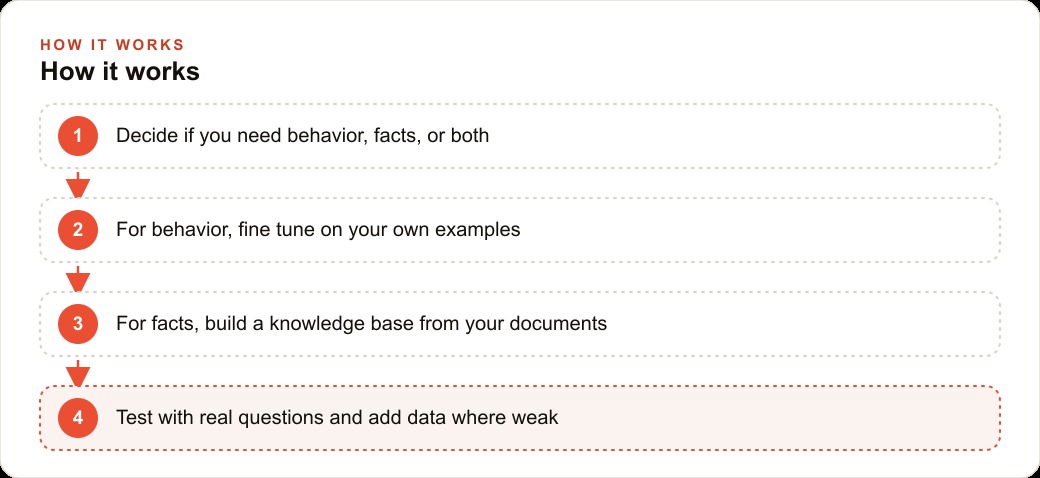
The problem is not the model. The problem is using the wrong tool for the job. Fine tuning teaches behavior. A knowledge base provides facts. Using a fine-tuned model for fact recall is like asking a well-trained salesperson to improvise technical specifications they were never given. Using a knowledge base without fine tuning produces accurate facts delivered in a generic voice that does not match how the company communicates.
The behavior layer: one hundred and fifty replies that taught the model how to sound
The company's front office has a distinctive voice in its written communications. Replies are warm but direct, they always name the specific pest problem the customer mentioned, they avoid jargon that a homeowner would not understand, and they close with a clear single next step rather than a list of options. That voice took years to develop and it is part of why the company has strong repeat business and referrals.
Building a fine-tuned model that captures that voice starts with collecting examples. The owner went through the last several months of the best email and message replies the front office had sent, selecting around one hundred and fifty that represented the voice at its clearest. Not the rushed replies, not the edge cases, the ones where whoever wrote them was at their best. Those became the training dataset.
The format for a fine-tuning dataset is pairs of input and output. The input is the customer inquiry, including the type of pest mentioned, the concern they raised, and any specific details they included. The output is the ideal reply, in the company's voice, addressing those specifics. Generating a dataset of one hundred and fifty pairs from real examples is a day of work, and the quality of that curation determines the quality of the trained model.
The training job runs on a base model with efficient low-rank adapters, which is the standard approach for this kind of business fine tuning because it produces results quickly on modest hardware and the resulting model is small enough to deploy without specialized infrastructure. After training, the model consistently opened with the customer's specific pest problem, moved to the appropriate treatment option, and closed with a clear next step, in a voice that matched how the company actually communicates.
One cost benefit of fine tuning that is easy to overlook: once the model has learned the behavior, the detailed system prompt that previously defined that behavior can be removed from every call. The knowledge is in the weights rather than in the prompt. For a company making thousands of AI-assisted replies per month, removing a long system prompt from every single call produces meaningful token savings that compound at scale.
The facts layer: treatment guides, price sheets, and service areas in a database
Fine tuning the model fixed the voice problem. It did not fix the pricing problem, because fine tuning is not designed to provide accurate factual recall from private documents. For that, the company needed a knowledge base.
Building the knowledge base started with gathering every document that contained information the front office needed to give accurate answers: the full treatment guide for every pest type the company handles, the current pricing sheet with regional variations, the service area list by zip code and city, the safety information for customers with pets and children, and the seasonal availability notes for treatments that are weather-dependent.
Each document was split into chunks of appropriate size for retrieval. Small enough that retrieved chunks are relevant rather than sprawling; large enough that each chunk contains a complete thought that can be understood in isolation. The chunks were converted to vector embeddings and stored in a vector database alongside the original text.
When a customer asks a question that requires a factual answer, the system retrieves the three to five most relevant chunks from the knowledge base and includes them in the context sent to the model. The model reads those specific chunks and answers from them rather than from its general training data. When the customer asks about carpenter ant treatment in a two-story house, the model retrieves the carpenter ant section from the treatment guide and the pricing sheet entry for that service, and answers with accurate numbers and procedures drawn from the actual documents.
The knowledge base also enables the system to say accurately that it does not service a specific area, rather than improvising a plausible but incorrect answer. A customer asking whether the company covers a zip code on the edge of the service area gets a truthful answer from the service area document rather than an estimated yes that creates an expectation the company cannot fulfill.
What the two layers look like working together in the same system
With both layers in place, the system routes each incoming inquiry through both mechanisms simultaneously. The fine-tuned model provides the tone, the structure, and the specific way the company communicates. The knowledge base retrieval provides the accurate facts specific to the customer's inquiry. The combined output is a reply that sounds like the company and contains correct information.
The human review step sits between the AI output and the outgoing message. A front office staff member reviews each generated reply before it sends. This is the correct design for a first-phase system in a customer-facing context. The review takes ten to twenty seconds for a good reply, and the staff member catches any case where the retrieval pulled the wrong information or where the tone missed the mark. Over time, as the system proves reliable on specific categories of inquiry, the review gate can be adjusted to a lighter touch for those categories.
The contact between the fine-tuned voice and the knowledge base accuracy also creates an improvement loop. When a reply gets edited before sending, the original AI output and the edited version can be added to the fine-tuning dataset for the next training run. The model improves on the specific cases where it needed correction rather than on synthetic examples. The knowledge base is updated when pricing changes or new services are added. The system gets better continuously rather than being static after the initial deployment.
The numbers, framed as estimates rather than guarantees
A company handling around fifty inquiries per day has a front office team spending roughly two to three hours per day on replies, quotes, and follow-up messages. These are illustrative estimates built on typical patterns rather than figures from a specific company's data.
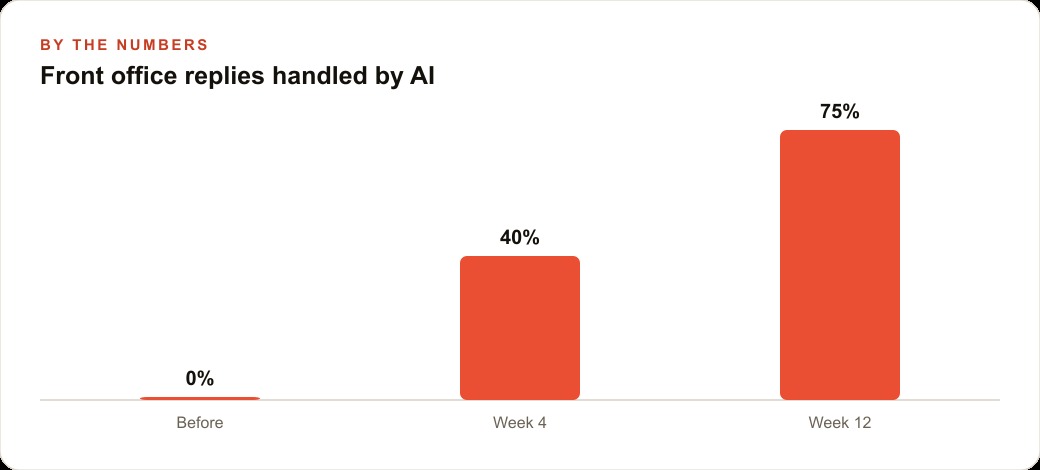
If the combined system handles forty of every fifty daily inquiries automatically, with a staff member reviewing each one, the team goes from writing and editing every reply to reviewing and occasionally adjusting a generated draft. The time per handled inquiry drops from a few minutes to under thirty seconds in most cases. Across a full working month with the system handling around twelve hundred inquiries, the estimated time recovery is in the range of twenty-five to thirty-five hours of front office capacity.
Those hours redirect toward scheduling actual jobs, following up on estimates that have not converted, and calling customers who left reviews to maintain the relationship. The activities that build the business rather than the administrative work that maintains it.
The cost to build and run the system is modest. A fine-tuning job on a commercially usable base model runs to a few dollars in compute. A basic vector database for a document set of this size fits on a free or low-cost tier of most hosting providers. The API cost per reply, with the knowledge base retrieval included, is a fraction of a cent per message. The system pays for itself in recovered labor time within the first few weeks of deployment under realistic assumptions.
For any service business where the front office spends hours per day on repetitive written communication, fine tuning the voice and building a knowledge base from the company's own documents is the combination that produces a system that sounds right and answers accurately. Neither one alone solves the problem. Fine tuning without a knowledge base produces a confident voice that invents facts. A knowledge base without fine tuning produces accurate facts in a generic voice that does not match how the company communicates. Both together produce a system the front office actually trusts.
A CRM and website stack that already holds inquiry history and customer records connects naturally to both the fine-tuned model and the knowledge base. Customer records provide context that makes each reply more specific to the individual relationship rather than generic to the inquiry category. For businesses that generate inquiry volume through Google Ads or similar channels, the speed and quality of the first AI-assisted reply is often the variable that determines whether a lead converts or moves to a competitor who responded faster with a more accurate answer.
The build is learnable with the right tools and a focused approach to data quality. The most important variable is the quality of the training examples for fine tuning and the quality of the documents loaded into the knowledge base. Both reward careful curation rather than volume. A small, clean set of your best replies and your most accurate documents will outperform a large, inconsistent collection every time.
That is exactly what we do at AI DOERS. Book a private 30-minute call with Madhuranjan Kumar and we will map the fastest path to it for your specific business.
Book your call →
Madhuranjan Kumar
Madhuranjan Kumar brings 20 years of performance-marketing experience and has managed over $200 million in Facebook ad spend for brands across the United States and beyond. His expertise spans the full modern marketing stack: Meta, Google Ads, TikTok, email automation, CRM, and the websites that hold it together. At AI DOERS he turns that track record into lead-generation systems for businesses across every industry.