
How Insurance Agencies Can Fine-Tune AI to Sound Like Their Brand
Fine-tuning a language model on your own content is the most effective way to eliminate generic AI copy and make every output read like it came from your actual team.

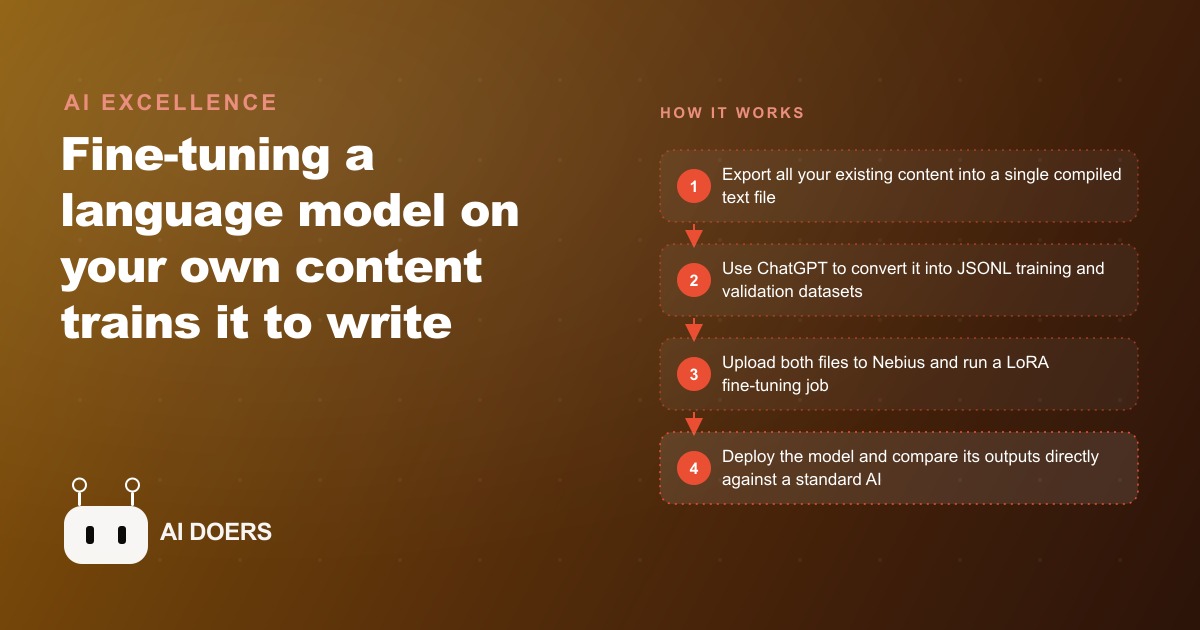
Most AI copy fails an insurance agency for one boring reason: it sounds like AI, not like the agency. You can feel it instantly, that slightly stiff, formal, interchangeable tone that could belong to any business on earth. The fix is not a better prompt. It is fine-tuning, the process of training a model on your own writing until its instincts shift to match yours. I am Madhuranjan Kumar, and here are eight things you need to get right to make a language model write in your brand voice, laid out as a working checklist rather than a lecture.
1. Fine-tuning changes the voice, not just the knowledge
The first thing to understand is what fine-tuning actually does, because most people confuse it with the other main technique. Uploading documents or writing detailed prompts only gives the model more information. It still writes in its own voice on top of that information. Fine-tuning changes the voice itself. Think of hiring a copywriter and handing them every policy document your agency has ever produced. They would know all your facts, but they would still write in their own style. Fine-tuning is the equivalent of also giving that copywriter hundreds of examples of your best emails and FAQs and having them study those until their instincts change, until they naturally reach for your sentence lengths, your level of formality, your way of opening a paragraph. The closest alternative, RAG, gives a model a reference library to pull facts from during a chat. RAG is like giving AI your notebook. Fine-tuning is like giving it acting lessons. For copy that has to sound like the brand, fine-tuning is the right tool.
2. Your existing content is already the training set
You do not need to write anything special to train the model. Everything the agency has already published is training material: social posts, client emails, FAQ answers, newsletters, policy explanation guides, agent bio pages. The more varied the examples, the sharper the voice transfer, because the model learns how you write across different situations and audiences rather than in one narrow lane. The practical target is at least 300 to 500 solid examples spread across your content types. That volume requirement is also the one real qualifier for this technique. An agency with two or three years of published content has more than enough. A brand-new business with a dozen blog posts does not yet have a clear enough voice pattern to train on, and should wait until it does.
3. A general assistant turns your content into the training format
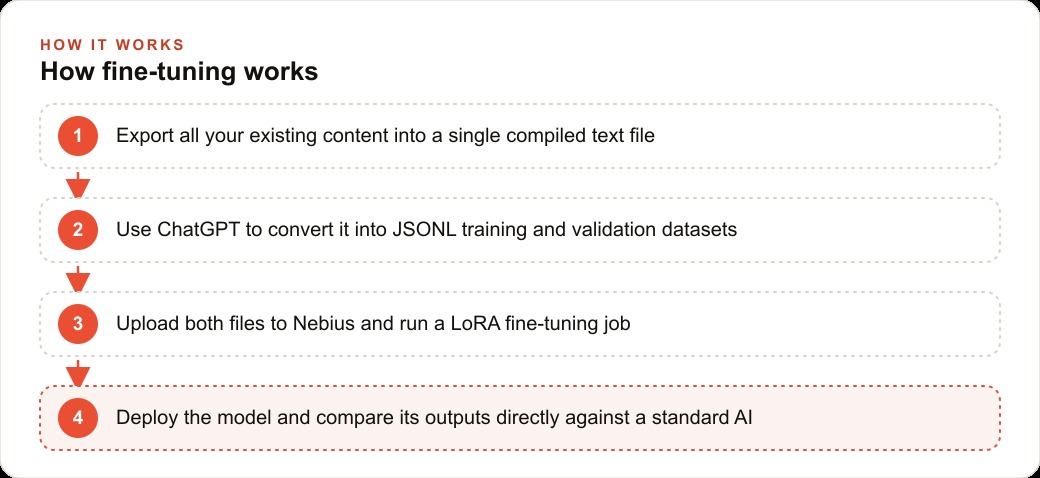
The training data lives in a format called JSONL, where each line pairs a prompt with the completed output you want the model to learn from. Building that file used to require coding knowledge, and that barrier is the thing that scared most people off. It is gone now. You compile your existing content into a single text file, hand it to a general-purpose assistant like ChatGPT, and ask it to convert the document into properly formatted JSONL, generating a synthetic prompt for each piece of your content and splitting the result into a training file and a validation file. If the document has an FAQ answer about deductible limits, the assistant writes a prompt like explain deductible limits to a homeowner and pairs it with your actual written answer. A few minutes of processing produces both files, ready to upload, with no code written by you at all.
4. Match the model size to your content length
Bigger is not better here, it is just more expensive. For short content like emails and social captions, a smaller base model in the 7 to 8 billion parameter range handles the job well and keeps costs at the floor. Reserve the larger models, the 70 billion parameter range, for long-form work like detailed policy guides or multi-section blog posts, where the extra size buys better coherence over a long document. The common mistake is reaching for the biggest model by default. If you mostly produce short copy, a giant model costs more, trains slower, and performs no better than a well-trained small one on the content you actually make. Pick the size that fits the average length and complexity of your most frequent work.
5. LoRA makes the training fast and nearly free
The specific method to use is called LoRA, or low-rank adaptation, and its whole appeal is efficiency. LoRA is faster and cheaper than full model fine-tuning while delivering comparable results for voice and style transfer, which is exactly the kind of task an insurance agency needs. A LoRA run on a few thousand examples with a smaller model typically finishes in under 30 minutes and costs somewhere in the range of two to four dollars. Even a larger 70 billion parameter model on a big dataset tops out around 75 dollars. A platform like Nebius handles the infrastructure, so you upload your two JSONL files, pick a base model, set your parameters, and it runs the job. During training you can watch the training loss fall with each pass, which is the visible sign the model is actually learning your patterns.
6. Clean the data or the model learns your mistakes
This is the single most important item on the list, because it is where most fine-tuning projects quietly fail. The model learns from everything you feed it, indiscriminately. If your export includes email replies that quote a client's question at the top, error messages, internal memos written in casual shorthand, or heavily edited rough drafts that do not represent your published voice, the model learns from all of it. Garbage in produces garbage out, consistently. So before you convert anything to JSONL, spend real time cleaning the dataset. Strip out the quoted client text so the model does not learn to open every message with someone else's framing. Remove the internal drafts and the off-brand one-offs. And preserve the structural habits you want kept, so if your agency always writes short paragraphs and avoids bullet points in client emails, make sure the training examples reflect that, because the model learns structure alongside vocabulary.
7. The validation split proves it learned instead of memorized
When the assistant splits your data, it holds back roughly 10 percent as a validation set rather than putting everything into training. That held-back slice is not wasted, it is the check that keeps the whole thing honest. During training, the validation loss tells you whether the model is learning genuine, generalizable patterns or just memorizing specific phrases from your examples. A model that memorizes will parrot your exact old sentences back and fall apart on anything new. A model that generalizes takes your style and applies it to prompts it has never seen. Skipping the validation split to squeeze a few more examples into training is a false economy, because you lose the only signal that tells you the model actually learned your voice rather than your word list. Always include it.
8. Train once, then reuse the voice across everything
The payoff of getting the first seven right is that a single fine-tuned model becomes a reusable asset across your entire content operation. The same trained model writes FAQ answers, welcome emails, social captions, and policy guides, all in the same learned voice and with the same preferences. You do not retrain per content type. And beyond the time savings, you get consistency that a human cannot match. A fine-tuned model does not have bad days, does not drift toward generic phrasing on a complex prompt, and produces every output from the same trained set of preferences. For an agency where tone consistency across every client touchpoint slowly builds or erodes trust, that steadiness has real value beyond the raw hours saved.
9. Deploy it and prove the difference side by side
Training is only half the job. Once the run finishes, you deploy the model from the checkpoints and open it in a playground where you can test it on real content. This is the step that turns a leap of faith into visible proof. Ask it to write an FAQ answer about umbrella coverage, an introductory email for a new auto policy client, and a caption explaining the difference between term and whole life. Then run the exact same prompts through a standard, untrained model and put the two outputs next to each other. The gap in voice, vocabulary, and sentence rhythm shows up in the very first comparison. That side-by-side test is also how you sell the result internally, because a skeptical owner who reads the two versions back to back stops asking whether fine-tuning was worth it. Add a short system prompt that tells the model what it is and what context it is writing for, and the transfer sharpens even further.
A worked example: an agency that recaptured its editing hours
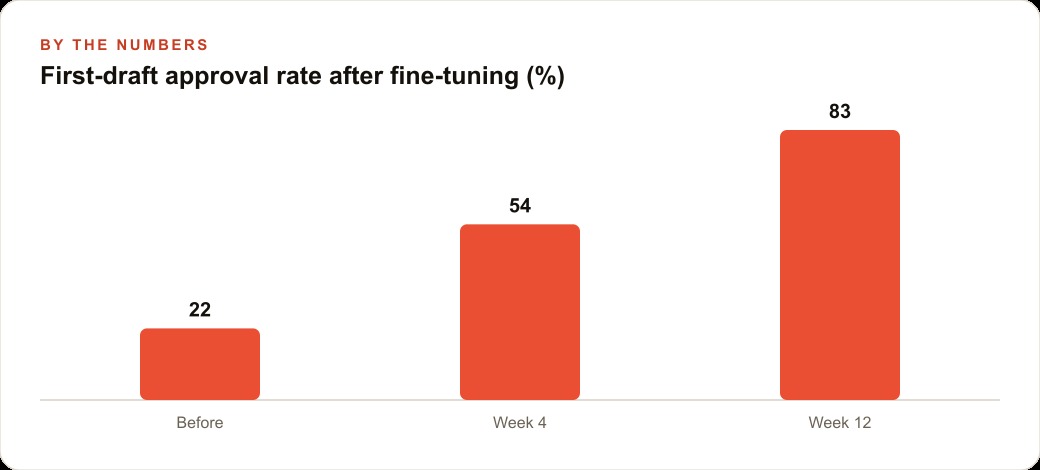
Let me put illustrative numbers on it. Picture a small insurance agency that publishes around 20 pieces of content a week, everything from policy FAQs to newsletter segments, and edits every one heavily because the AI drafts arrive sounding generic. Before fine-tuning, the average editing time per piece runs about 30 minutes, because the AI gets them 60 or 70 percent of the way there and the last mile, the voice, eats the rest. That is roughly 10 hours a week spent fixing tone.
Now they fine-tune. They compile two or three years of published content, clean it, convert it to JSONL with a general assistant, and run a LoRA job on a smaller model for a few dollars. The first drafts start arriving much closer to publishable because the model has learned the agency's sentence rhythm, vocabulary, and level of technicality. Say editing time per piece drops from 30 minutes to 8. Across 20 pieces that is about seven hours a week recovered. For a content manager whose time is worth roughly 40 dollars an hour, that is around 280 dollars of recaptured capacity every week, against a one-time training cost of a few dollars. The model pays for itself on the first day. Those recovered hours can go straight into the work that actually grows the agency, feeding sharper copy into Facebook and Instagram ad campaigns and strengthening SEO and organic search, while the consistent client emails flow through the CRM and website stack sounding unmistakably like the brand every time.
The timing on all of this is better than most owners realize, which is worth naming plainly. A year ago, setting up a fine-tuning job genuinely required meaningful coding knowledge, and that alone kept the technique out of reach for the average agency. Today a platform handles the infrastructure and a general assistant handles the data conversion, so the entire process, from exporting your content to holding a deployable model, can happen in a single afternoon. That collapse in the technical barrier is exactly why the agencies that move now get an edge. The gap between passable AI copy and copy that builds real client trust is costing them time and money every week, and that gap is almost always a voice problem, which is precisely the problem fine-tuning was built to solve.
Do not expect perfection on the first run, though. The first version of a fine-tuned model is a starting point. Use it for a few weeks, note where the outputs still feel off, and trace those gaps back to missing or inconsistent examples in your training data. A second round with a cleaned and expanded dataset closes most of the remaining distance. If you are spending more time editing AI copy than you would spend writing it yourself, fine-tuning is worth the small upfront effort. You can follow this checklist and build it yourself, or bring in someone who has mapped these datasets before to help you decide what your training set should contain and which model size fits your volume, and hand you a plan that works from the first run.
That is exactly what we do at AI DOERS. Book a private 30-minute call with Madhuranjan Kumar and we will map the fastest path to it for your specific business.
Book your call →
Madhuranjan Kumar
Madhuranjan Kumar brings 20 years of performance-marketing experience and has managed over $200 million in Facebook ad spend for brands across the United States and beyond. His expertise spans the full modern marketing stack: Meta, Google Ads, TikTok, email automation, CRM, and the websites that hold it together. At AI DOERS he turns that track record into lead-generation systems for businesses across every industry.