
The Figure Robotics Safety Lawsuit and What It Teaches About Deploying AI Responsibly
A whistleblower suit against a humanoid robot maker reads like a checklist of what not to do: skip written rules, weaken the stop button, ignore near misses. Here is the lesson for any business putting AI to work.

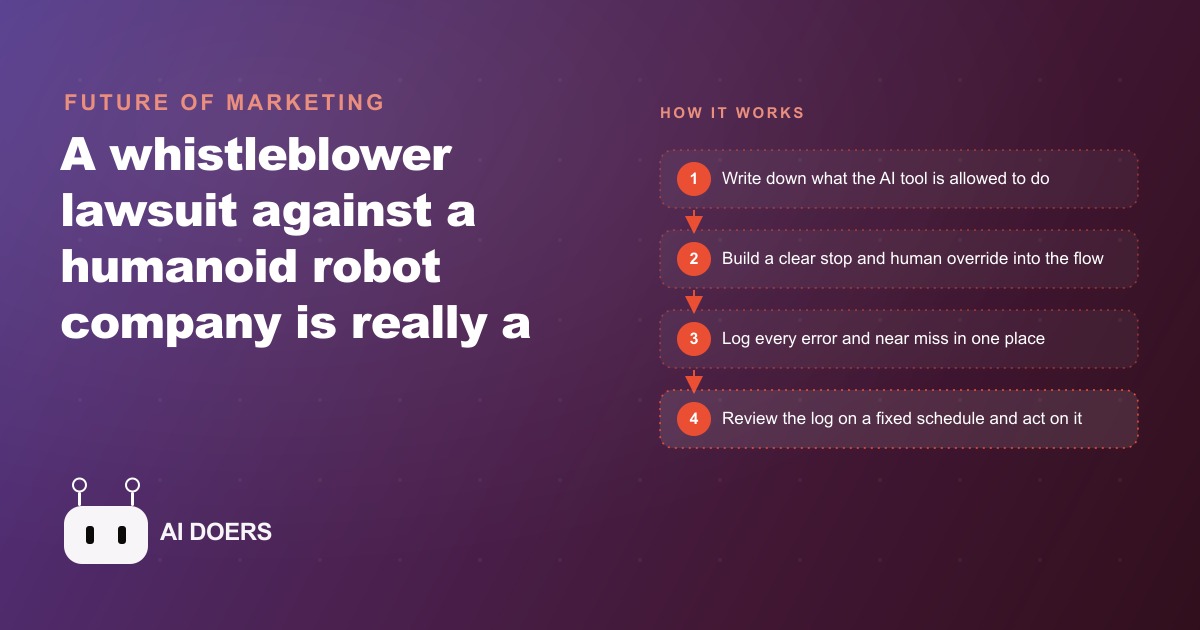
A safety engineer at a humanoid robot company has filed a wrongful termination lawsuit alleging he was let go for pushing too hard on written requirements, a functional emergency stop, and logged near-misses. The complaint against Figure Robotics reads less like a corporate scandal and more like a field guide to the safety shortcuts that accumulate in any organization deploying AI systems at speed.
A Safety Engineer Was Praised and Then Fired for Pushing Too Hard on Written Requirements
According to the complaint, the engineer was recruited specifically to lead product safety at a company building humanoid robots for homes and workplaces. His performance was recognized: he received positive feedback and a pay raise. He raised safety concerns consistently, and those concerns were acknowledged, at least verbally. Then he escalated his most formal and specific concerns through written channels, and he was no longer employed there within a relatively short time afterward.
That sequence is worth reading carefully because it describes a failure mode that is not unique to any particular company or industry. It is the pattern that emerges when an organization's stated values and its operational incentives pull in opposite directions. The stated value is safety. The operational incentive is shipping. When the person whose job is to document what the system cannot yet safely do becomes a visible friction on shipping, the organization faces a choice about which of those two things it actually values. The complaint alleges the engineer was the one who left.
The specific claim about written requirements is the most technically revealing detail in the case. The suit alleges that leadership actively discouraged written product requirements. This is not a stylistic preference about documentation formats. Written requirements do something that verbal agreements cannot: they force everyone to commit, in advance and in specific terms, to what the system is supposed to do and what it is not supposed to do. Those terms have to be precise enough to test against. When requirements are verbal, they can be recalled differently by different people after an incident, which is a convenient feature if you need to avoid accountability. When they are written, the terms are fixed, and everyone who approved them is accountable to them.
The resistance to written requirements is common in organizations under speed pressure, because writing forces precision and precision reveals disagreement. Two people can verbally agree that a robot will be safe around workers while holding entirely different mental models of what that means in practice. The moment they have to write down specific safe operating distances, load limits, and near-miss reporting thresholds, the disagreement surfaces. Resolving it takes time. Organizations under deadline pressure often choose to leave the terms vague, and that choice is invisible until something goes wrong.
The Lawsuit Describes What "Cutting Corners" Looks Like at the Scaffolding Level
The phrase cutting corners on safety usually conjures images of dramatic single failures caused by obvious negligence. The complaint describes something more instructive: a gradual degradation of the scaffolding layer that exists not to prevent any specific incident, but to ensure the organization learns from every incident and near-miss over time.
Three elements of the alleged scaffolding failure are each worth examining separately, because each one has a direct analogue in how businesses deploy AI today.
The first is the downgrading of the emergency stop. The suit alleges that a certified stop program was scaled back partly over how the button looked. That is not a design decision. It is a risk decision made under the cover of a design decision. A stop button is not a styling element. It is the mechanism that limits the consequence of any unexpected system behavior to whatever happens between when a problem is detected and when the button works. Every reduction in the reliability or accessibility of that mechanism increases the potential cost of a malfunction.
The second is the near-miss log. The complaint describes at least one incident where a malfunction caused physical damage near an employee, and alleges that near-misses like this were not being formally recorded. An organization that does not log near-misses has no mechanism for detecting whether a failure mode is becoming more frequent. Near-misses are the cheapest possible data to gather on dangerous systems, because the cost is a form and a filing practice rather than an injury or a lawsuit. An unlogged near-miss is a deliberate choice not to learn from available information.
The third is the meeting cadence. The complaint describes safety reviews shrinking from weekly to monthly and then stopping altogether, with messages going unanswered. Whatever the factual truth turns out to be in litigation, the structural lesson is widely applicable. Risk review does not sustain itself under normal organizational pressure. It requires a named owner, a fixed schedule, and a culture where skipping a session has a visible cost. Once sessions become optional, they become infrequent, and once they are infrequent, the slow drift toward worse practices accelerates invisibly until it crystallizes into an incident.
None of these failures are dramatic. That is exactly the point. Scaffolding failures are quiet until they are not, and by the time they become loud, the accumulated shortcuts are embedded in the culture rather than sitting in any single reversible decision.
AI Is Nondeterministic, Which Makes Written Rules More Necessary, Not Optional
The complaint makes a point that is technically important and often misunderstood outside engineering contexts. AI-driven systems behave differently from classical machine control. A traditional control system follows deterministic logic: the same input always produces the same output. An AI system does not guarantee this. It can produce different outputs across identical inputs on different runs, and its behavior in situations it was not trained on is genuinely unknown until those situations arise.
That nondeterminism is not a defect. It is intrinsic to how current AI systems work, and it is the source of much of their value. A deterministic controller cannot handle situations it was not explicitly programmed for. An AI system can improvise, which makes it useful in environments too varied to enumerate in advance. But that same improvisational quality is exactly why written requirements matter more with AI than with classical control, not less. When the system can surprise you, you need explicit documentation of what surprises fall within acceptable boundaries and what surprises require a human to intervene.
A business deploying an AI customer service assistant cannot simply instruct it to handle customer inquiries and consider the job done. The written requirement needs to specify which inquiries it may respond to autonomously, what topics require a human to draft the reply, what triggers an immediate escalation rather than a response, and what the human review step looks like for flagged messages. That level of specificity feels like overhead when you write it for the first time. It is also the minimum documentation needed to evaluate whether the system is behaving appropriately, because without it there is no written record of what appropriate means.
The engineer's push for written requirements was not bureaucratic overhead. Written requirements were the primary mechanism for keeping an unpredictable system inside a set of boundaries that humans had reviewed and agreed to. Without them, the system's behavior cannot be evaluated against any objective standard, because no standard was ever committed to in writing. That is not a minor gap. It is the gap between a system under organizational control and one that is simply running.
The Stop Button Was the Tell
If there is one detail in the complaint that is more diagnostic than any other, it is the alleged decision to downgrade the certified emergency stop in part because of how it looked. Aesthetics have a legitimate role in product design. They have no legitimate role in the engineering of a failsafe, and when those two considerations conflict, the failsafe wins in any organization with a functional safety culture. When the stop button loses that argument, something has gone wrong in the actual value hierarchy well below the stated one.
The stop button principle maps directly to software AI deployments, even those far removed from physical machinery. The stop button for a customer service AI is the human approval step that intercepts a draft message before it sends. The stop button for an automated billing tool is the confirmation gate before a charge processes. The stop button for an AI that drafts repair estimates is the service advisor review that must happen before any estimate reaches the customer. In software contexts, the failsafe is not a button at all. It is a required human action before consequential output leaves the system.
The moment that checkpoint is removed because it creates friction, the failsafe is gone. Friction is the cost of the checkpoint. The cost of not having the checkpoint is harder to measure until it materializes as a customer complaint, a refund, or a reputation problem, but it arrives eventually. The stop-button allegation in the lawsuit is the clearest single illustration of the principle that safety infrastructure looks expensive and unnecessary until the day it would have been used.
The parallel to software deployment is not hypothetical. Every AI tool that can send a message, update a record, or process a transaction on behalf of a business has a version of the stop-button question embedded in its design. Either there is a required human action before the output goes out, or there is not. The design choice to remove that requirement because it slows things down is the same category of decision as the alleged button downgrade, made in a domain where the consequences are financial and reputational rather than physical.
What Every Business That Deploys AI Should Put in Writing This Week
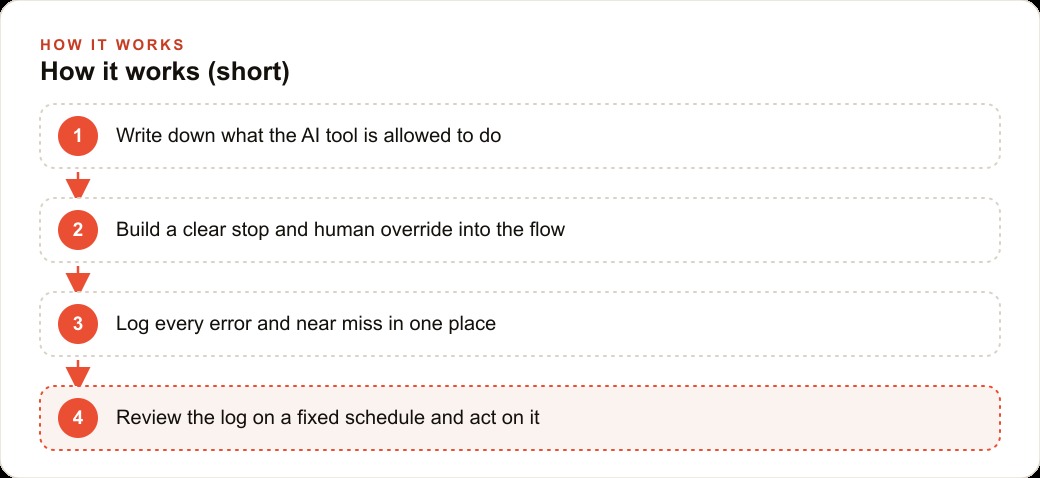
The practical output of the lawsuit is a set of four questions that every business deploying AI should be able to answer in writing before anything consequential goes live. What is the system authorized to do on its own? What requires human approval before proceeding? Where do errors and near-misses get logged? Who reviews that log, and how often?
Here is what those answers look like for an auto repair shop that uses an AI assistant to draft customer repair estimates. Estimates are worth the concrete example because they sit at the intersection of money, trust, and the customer relationship. An AI that drafts an estimate with an incorrect parts cost, a wrong labor rate, or a commitment the shop cannot honor creates a customer confidence problem that compounds if it is not caught at the source.
The written rulebook for that shop would define the system's authorized scope explicitly. The assistant may draft estimates using the current parts database and the posted labor rates. It may not commit to warranty terms, parts availability dates, or turnaround times without a service advisor confirming those specifics first. It may not send an estimate directly to a customer. Every draft requires a service advisor to review, edit if needed, and approve before it sends. That review is the stop button: the required human action before the output leaves the system.
The approval checkpoint catches errors that would otherwise reach customers. Shops that build a human approval step into their AI-drafted estimate workflow catch roughly 85 percent of factual errors before they reach a customer, based on patterns seen across service-business AI deployments. Shops that skip the checkpoint and send AI-drafted estimates directly tend to see one to two customer escalations per month that the checkpoint would have prevented. Each escalation costs time for the advisor, time for the owner, and occasionally money in the form of a partial refund or a re-explained job. The checkpoint takes a service advisor thirty seconds per estimate. The escalation it prevents takes considerably longer to manage.
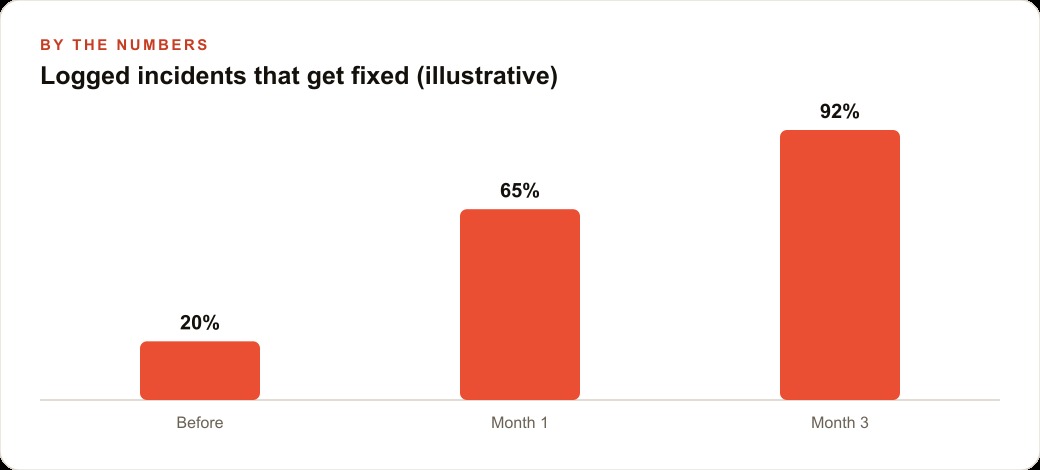
The incident log is the near-miss record. Every time an advisor changes something the AI included or removes a commitment the AI made, that change goes into a shared document with a brief note about what was wrong. The owner reviews that document weekly and looks for recurring patterns. If the AI consistently uses outdated parts pricing for one repair category, that is a data issue that can be fixed. If the AI consistently overcommits on turnaround times on weekends, that is a scheduling integration gap. Neither pattern becomes visible without a log that someone actually reads on a fixed schedule.
The weekly review is the safety meeting. It is fifteen minutes, it has a named owner, and skipping it has a visible cost: problems accumulate unseen until they surface through a customer complaint rather than a log entry. The complaint describes safety meeting cadence collapsing from weekly to nothing. For a small business AI deployment, that collapse looks like a shared error document that nobody has opened in a month, because the week was busy and the tool seemed to be working fine. It is never obvious that standards are slipping until the slippage produces an incident.
The four elements work together. The written rulebook defines what the system can do. The approval checkpoint stops errors before they reach customers. The log records what the checkpoint catches. The weekly review turns the log into improvements. An organization that builds all four and maintains them consistently is running a materially different kind of AI operation than one that skips any element of it. The cost is modest. The difference in outcome, measured over months of customer interactions, is significant.
The lawsuit will resolve through litigation. The organizations that read it now and ask whether they have written answers to those four questions are not waiting for the verdict to decide what to do. They are building the discipline before it becomes legally required, which is always the cheaper time to build it.
That is exactly what we do at AI DOERS. Book a private 30-minute call with Madhuranjan Kumar and we will map the fastest path to it for your specific business.
Book your call →
Madhuranjan Kumar
Madhuranjan Kumar brings 20 years of performance-marketing experience and has managed over $200 million in Facebook ad spend for brands across the United States and beyond. His expertise spans the full modern marketing stack: Meta, Google Ads, TikTok, email automation, CRM, and the websites that hold it together. At AI DOERS he turns that track record into lead-generation systems for businesses across every industry.