
Federal AI Rules vs the State Patchwork: What It Means for Your Business
There is a push to regulate AI with one national rulebook instead of 50 state ones. Here is the argument, why it matters for ordinary companies, and how I would prepare a business either way.

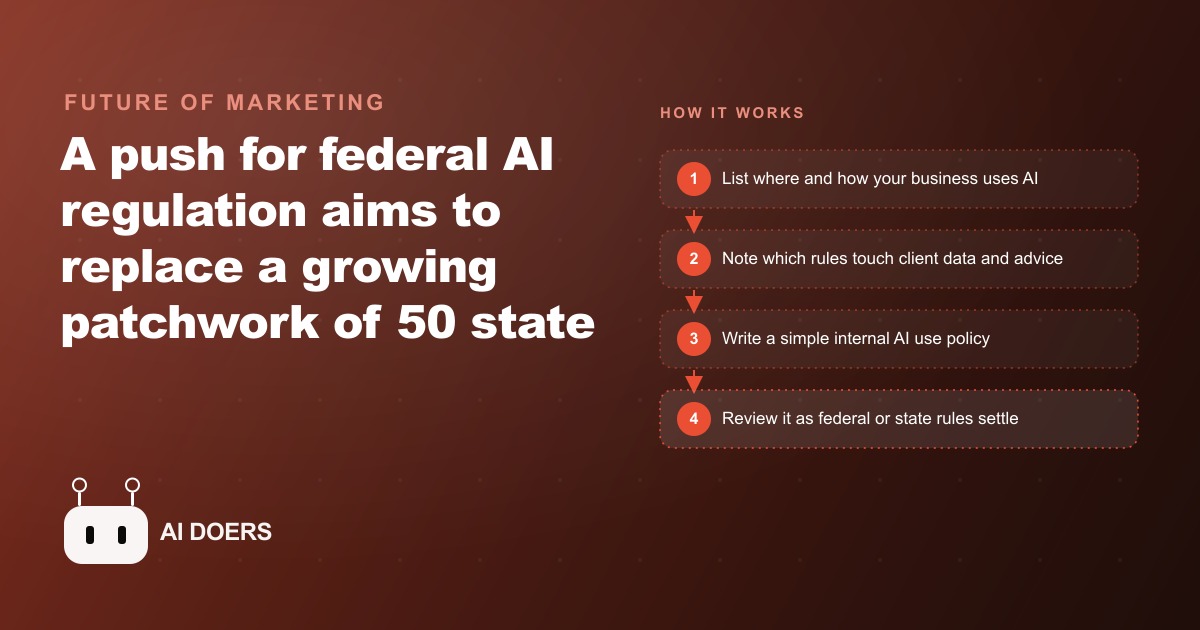
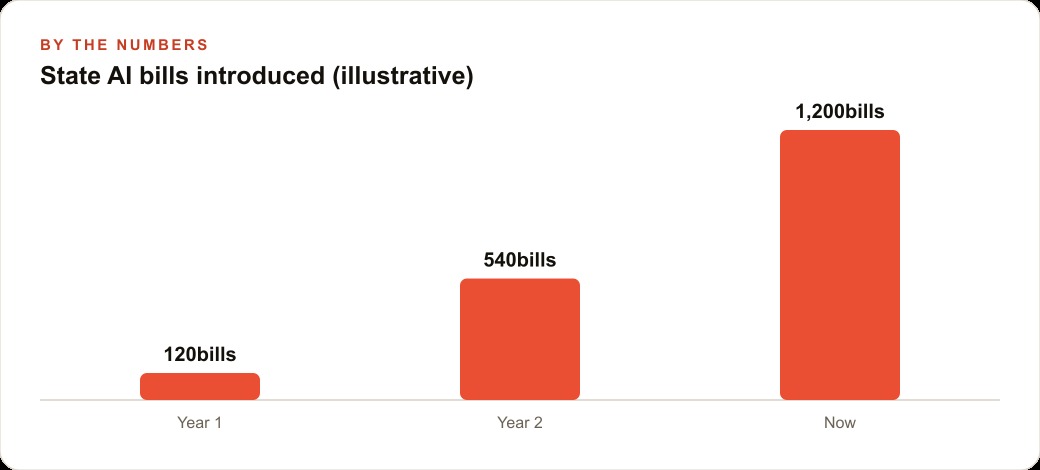
More than 1,200 state-level AI bills have been introduced across the United States, and more than 100 of them have already passed into law. I am Madhuranjan Kumar, and the practical question I keep getting from business owners is not which state has the strictest rules but a simpler one: which rules actually apply to my business right now? The answer is harder than it should be, and the reason for that difficulty sits at the center of a federal-versus-state debate that is reshaping how AI will be governed.
Over 1,200 state AI bills have been introduced and the patchwork is now a compliance maze
The legislative activity around AI at the state level has been extraordinary. A small number of bills in the first wave grew into dozens, then hundreds, and now more than twelve hundred introduced across fifty states, each carrying its own definitions, thresholds, and enforcement mechanisms. Some target algorithmic decision-making in hiring. Others address AI-generated content, facial recognition, or data handling for automated systems. A handful impose disclosure requirements. Several require impact assessments for high-risk AI applications.
The problem is not that any single state has gone too far. The problem is that the definitions do not align. What counts as a high-risk AI system in one state is not the same thing as what counts in another. Disclosure requirements vary. Exemptions vary. Enforcement bodies vary. A company operating across multiple states faces a compliance picture where satisfying one state's rule does not mean it has satisfied another's, even for the same tool doing the same job.
For a business owner, the practical effect is uncertainty. When the rules are unclear, many owners either ignore the issue entirely and hope for the best, or avoid AI tools they could legitimately and beneficially use because the regulatory picture feels too complicated to navigate safely. Both responses are costly. The first creates real exposure. The second leaves competitive ground on the table.
For businesses running Meta ads to drive traffic, the AI tools involved in targeting, creative testing, and lead qualification all sit inside this uncertain zone. Knowing which rules touch those tools is not optional once the volume of AI-assisted work crosses a certain threshold.
Why AI is interstate by nature, and why that matters for who regulates it
The legal case for federal oversight rests on a straightforward observation: AI does not stay inside state lines. A model is often developed in one state, where the engineers and researchers are based. It is trained in another, where large data centers with the required computing power are located. It runs inference from a third state's infrastructure, and it is delivered over the internet to users anywhere in the country or the world. That flow is what the Constitution means by interstate commerce, which is the category of activity the federal government is designed to regulate rather than individual states acting separately.
The comparison that gets raised most often is car emissions. California established strict vehicle emissions standards and automakers built California-specific versions of their cars because pollution is local. The harm from a tailpipe happens where the car drives, so a state-level response to a state-level harm made sense. AI risk does not work that way. A model that produces biased hiring decisions, generates misleading content, or processes data insecurely affects people across the country simultaneously, not within the boundaries of the state where the server running the model happens to be located. The geographic anchor that made state-level emissions rules sensible does not exist for AI.
There is also a measurement problem that makes state-by-state regulation particularly difficult. Car emissions have a clean, testable number: grams of pollutant per mile. AI risks are harder to define and the definitions are still evolving. Does the risk come from training data? From the output? From the use case? From the context in which a model is deployed? Fifty states developing fifty different answers to those questions produces a compliance environment where a business cannot know with confidence whether it is operating within the rules, even with legal counsel, because the rules themselves may contradict each other.
The proposal being discussed does not target every regulation that touches AI adjacent areas. It carves out child safety, local decisions about infrastructure, and copyright, which is already governed at the federal level and being worked through the courts. The focus is the AI-specific patchwork of state rules that has grown without coordination.
The businesses that lose most from regulatory fragmentation are the small ones
The organizations that benefit from regulatory complexity are the ones large enough to employ compliance teams whose full-time job is tracking rule changes across fifty states and building different operating procedures for different jurisdictions. The ones harmed by it are the small businesses and early-stage companies that cannot afford that overhead.
Consider a concrete illustrative example. A five-person digital agency uses AI to assist with web CRM setup for clients: the tool scores incoming leads, categorizes them by intent, and drafts initial follow-up sequences. In a world with one federal standard, the agency builds this workflow once and applies it for all clients under a clear set of rules. In the current patchwork, the agency needs to consider whether each client's state has enacted any relevant rule about automated decision-making, whether lead scoring constitutes an automated decision under that rule, whether the state requires disclosure to the leads being scored, and whether a human review requirement applies before any action is taken. Repeating that analysis across eight client states for one internal workflow is disproportionate to the benefit the workflow provides.
Many agencies simply avoid building the workflow at all. The result is that the small agency loses a competitive tool while larger competitors with dedicated compliance staff use it freely. That dynamic is what critics mean when they raise regulatory capture: a fragmented environment, regardless of whether the fragmentation comes from too many state rules or from an overly complex federal framework, advantages the established firms that can absorb the overhead while squeezing out the smaller competitors who would otherwise challenge them.
The same applies to any business that uses AI for customer-facing functions, from a solo consultant using a chatbot on their website to a regional retailer using AI to personalize recommendations. The tools exist, the value is real, and the businesses that should be using them are held back not by technical complexity but by legal uncertainty they cannot afford to resolve properly.
What a responsible AI use policy looks like regardless of how the politics land
The political resolution of the federal-versus-state question will take time, and the timeline is not within a business owner's control. What is within the owner's control is building a responsible AI use practice that holds up under almost any version of the final rules, because the core of what regulators across the spectrum are trying to address is consistent: accountability, transparency in how AI affects decisions, and protection of personal data.
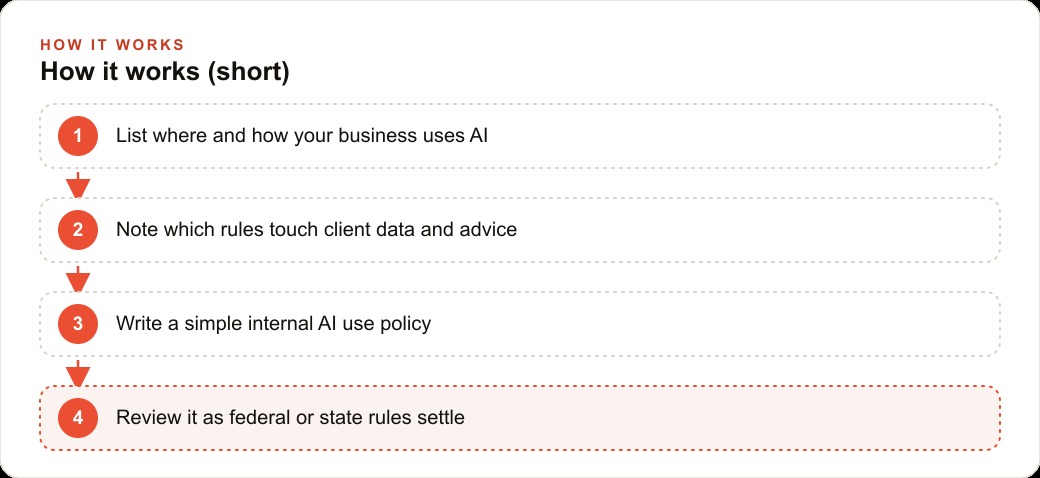
The first step is an honest inventory. List every place the business uses AI, including the informal and casual uses: drafting emails, summarizing documents, answering customer questions through a chatbot, processing data for reporting. For each use, note whether customer data or employee data is involved, because data-touching uses are where virtually every regulatory framework, state or federal, concentrates its requirements first.
The second step is a short, plain internal policy. It does not need to be long. It needs to say which tools are approved for business use, that personal or confidential data is not entered into a public AI tool without explicit safeguards, and that any output intended for a customer or a decision that affects a customer is reviewed by a human before it goes out. That policy, documented and consistently followed, is the strongest protection a business has regardless of which jurisdiction's rules end up applying, because it demonstrates deliberate and responsible use rather than careless adoption.
For businesses building their organic presence through SEO content, the AI components of content workflows are worth capturing in the same policy. If an AI tool drafts articles, reviews keyword strategies, or generates outlines that a human editor then refines, documenting that process is both good governance and a useful internal record. It takes almost nothing to maintain and provides real protection if questions arise later.
The third step, particularly for businesses that use AI in customer-facing ways, is specific documentation of those processes. If the AI helps qualify leads, personalize recommendations, or flag customer service issues, note what it does and what a human confirms or overrides. That documentation becomes the evidence of responsible use if a rule change requires demonstrating it, and it has no downside.
The businesses that will be in the clearest position when federal or state rules solidify are the ones that built deliberate habits before the rules required them. The businesses that face the most exposure are the ones that adopted AI casually, with no documentation, no internal accountability, and no clear answer to the question of what the AI was actually doing with customer data. Clarity on which rulebook applies is coming. The practical work of building responsible habits does not need to wait for it.
One area worth specific attention is AI use that touches hiring or employment decisions. Several states have already passed rules requiring disclosure or impact assessments when AI influences a hiring decision. If your business uses AI to screen resumes, score job applications, or filter candidates before a human reviews them, that use sits in the category regulators are most likely to reach first regardless of whether the final framework is federal or state. Treating it with the same documentation discipline as data-touching customer tools is the prudent position.
A second area is customer-facing AI that gives advice or recommendations. An e-commerce recommendation engine, a chatbot that answers product or service questions, and a lead-scoring system that determines which prospects receive outreach all fall into this category. None of these require a legal analysis before being used. They require documentation of what the tool does, what data it uses, and what human oversight exists in the process. That documentation is inexpensive to create and invaluable if a regulator, a customer, or a business partner asks how you use AI in decisions that affect them.
For businesses that rely on paid acquisition alongside organic content, keeping the AI policy current as SEO content workflows evolve and Meta ads targeting tools incorporate more AI-assisted features is increasingly practical rather than theoretical. The tools are changing faster than the rules, and the businesses that know exactly what each tool does with their customer data are the ones positioned to adapt quickly when the rules do settle.
The honest practical summary is this: one afternoon of honest inventory, one short policy document, and a habit of keeping both current is what separates a business that is prepared from one that is exposed. Neither the federal approach nor the state patchwork will be completely settled soon, and waiting for that settlement before building a responsible practice means arriving late to a requirement that will exist either way.
Regulatory uncertainty also tends to produce a specific kind of competitive dynamic worth noting. When rules are unclear, well-resourced incumbents move forward anyway because they have the legal and compliance capacity to manage the risk. Smaller firms freeze. The gap between them widens not because the small firm lacks good tools or good judgment but because it cannot afford the uncertainty. A clear internal policy is the small firm's answer to that dynamic: it creates a defensible position that allows moving forward with AI adoption at the same pace as better-resourced competitors, without requiring an expensive outside opinion on every new tool.
A practical first step that does not require waiting for the legal picture to clarify: write out every AI tool your business currently uses and note, for each one, whether customer data touches it and whether a human reviews the output before it affects a customer or a business decision. That list is the inventory. From it, the short policy almost writes itself: approved tools, data rules, review requirements. Keep it current as the tools change. Share it with the team. That four-step cycle, list, policy, review, update, is a responsible AI practice that holds up under almost any version of the rules that eventually land.
That is exactly what we do at AI DOERS. Book a private 30-minute call with Madhuranjan Kumar and we will map the fastest path to it for your specific business.
Book your call →
Madhuranjan Kumar
Madhuranjan Kumar brings 20 years of performance-marketing experience and has managed over $200 million in Facebook ad spend for brands across the United States and beyond. His expertise spans the full modern marketing stack: Meta, Google Ads, TikTok, email automation, CRM, and the websites that hold it together. At AI DOERS he turns that track record into lead-generation systems for businesses across every industry.