
Faster AI Coding Models: Build Real Business Tools From a Prompt
A new generation of AI coding models is faster, cheaper per task, and smart enough to fill in sensible defaults when you do not spell everything out. Here is what that means for owners who want custom tools without a big dev budget.

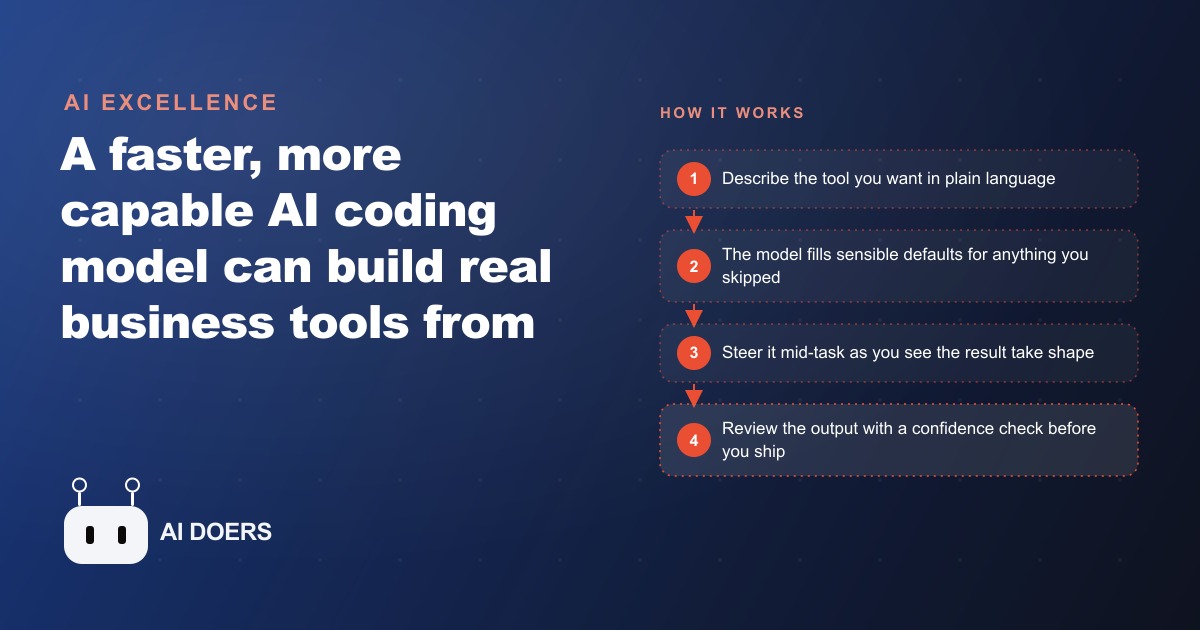
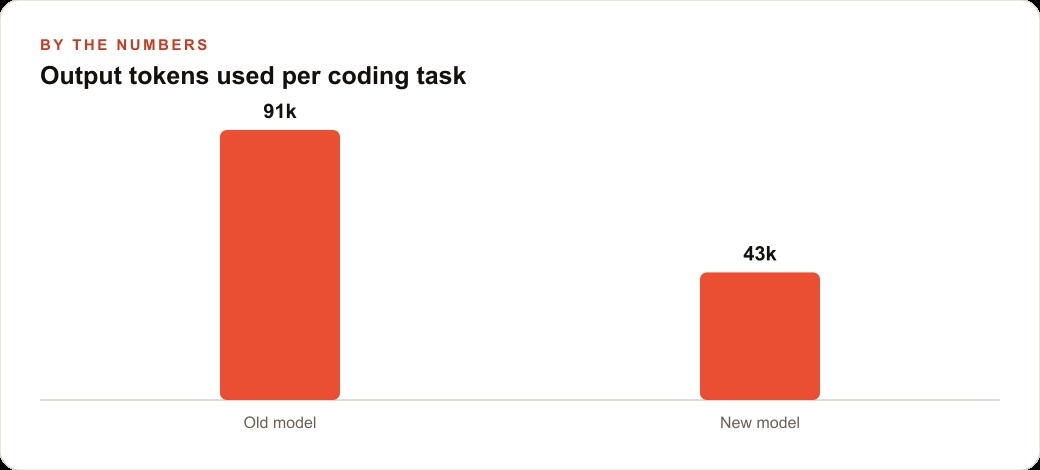
A new generation of AI coding models hit a benchmark score on hard tasks using roughly 43,000 output tokens where the previous generation used around 91,000 to reach a similar result. That number is not interesting because it saves money on tokens. It is interesting because of what it unlocks at the level of iteration. When a tool is twice as fast and costs half as much per request, you can iterate on it four times as much for the same budget, and iteration is where a custom business tool goes from a good first draft to something that actually fits how your business works. I am Madhuranjan Kumar, and the efficiency gain is the buried lead in every story about faster models.
The efficiency gain unlocks something more important than cost savings
The ceiling on using AI coding tools for real business applications was never capability. The models could build things. The ceiling was patience and cost. If iterating a dozen times on a trade-in valuation form costs as much as hiring a developer for the afternoon, the economics stop working. If each iteration takes long enough that the feedback loop feels slow, the process stops feeling like collaboration and starts feeling like waiting. Faster output at lower cost per request changes both of those constraints at the same time, which is why this generation of models feels different in practice compared to what came before.
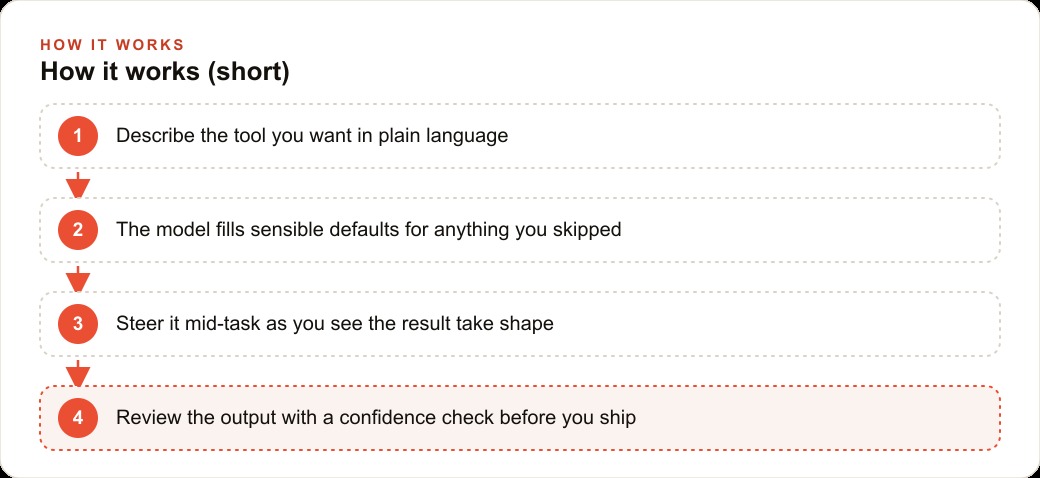
The mid-task steering is the second efficiency gain that matters, and it works alongside the token efficiency to change the experience of building something. Earlier AI coding tools had a frustrating property: you could not redirect them while they were working. If the model started building the layout in a way that would not work for your use case, you either waited for it to finish and then described the change, or you abandoned the session and started over. Both options wasted the work already done. Being able to steer mid-task means you catch wrong turns early, before the model has produced hundreds of lines in the wrong direction. The combination of fewer tokens per task and mid-task steering means the cost of a wrong turn is much lower than it used to be, which makes it practical to explore multiple approaches on the same afternoon rather than committing to one at the start and hoping it lands.
The third gain is the model filling in sensible defaults for the parts of a prompt you did not specify. Most business owners know what they want a tool to do and what the key inputs and outputs should be. They do not know how the database should be structured, what the exact layout logic should be, or how validation should work. A model that makes reasonable choices for the unspecified parts means you can describe a quote calculator in plain business terms and get a working draft without needing to describe the technical architecture. Your prompt is the goal and the constraints. The model fills in the rest and waits to be steered.
What you can do with four times the iterations
The number that matters is not the cost per session. It is the number of iterations you can afford before the tool is good enough to use in production. On an older generation of model, a business owner who built a finance estimate calculator might do three or four rounds of iteration before the cost-per-session math made continuing feel wasteful. The result was a tool that was close enough but had rough edges that bothered the people who used it every day: a field that was in the wrong order, a result displayed in a format the finance office did not use, a label that a customer found confusing.
With a model that uses half the tokens per task, the same budget now covers eight to twelve rounds of iteration. Eight to twelve rounds is enough to find the rough edges and fix them before you ship, not after. It is enough to test the calculator with one person from the finance office, hear what they would change, make that change, show it again, and repeat until the result matches how they actually talk to customers. It is enough to notice that the trade-in form has a field nobody fills in, remove it, and simplify the interface to the point where a first-time user understands it immediately.
This is the point about iteration that most business owners underestimate when they first start using AI coding tools. The value is not in the first draft. The first draft is a starting point. The value accumulates across the iterations that turn the starting point into a tool the team actually uses without frustration. The efficiency of the new generation extends the iteration budget to the point where that work can happen in a single afternoon rather than requiring multiple sessions spread across several days.
For a car dealership, this changes what is practical to build in one sitting. The owner wants a trade-in valuation form, a finance estimate calculator, and a landing page for the month's promotion. On an older model, getting all three to the level where they could go to a customer meant multiple days of building. On the current generation, all three can be built, iterated on repeatedly, and reviewed for errors in one business day. Each tool gets refined until it matches how the dealership actually operates, not just how a generic version of a dealership might operate.
The trade-in form starts with a description: a form where a customer enters the make, model, year, mileage, and condition, and it returns an estimated trade-in range with a note to bring the vehicle in for a full appraisal. The model fills in the layout and validation logic. Then the iteration begins. Add a field for number of previous owners. Move the estimated range into a highlighted box rather than inline text. Change the condition scale from three options to five to match the language the sales team actually uses with customers. Match the button color to the dealership's brand. Each of those adjustments takes a brief mid-task instruction and produces an immediate result. After eight rounds, the form looks and works the way the sales manager would have designed it if they had built it themselves.
The finance calculator follows the same pattern. Describe the inputs: vehicle price, down payment, term in months, interest rate. Describe the outputs: monthly payment, total interest, total cost in a clear table. Let the model lay out the table, then steer it to match the way the finance office presents those numbers in an actual conversation with a customer. A few iterations align the layout with the mental model the finance team uses, so showing it to a customer during a meeting does not require explanation.
The promotion landing page gets built last because it builds on the same session. Describe the offer, the audience, and the key selling points. The model produces a first draft with sensible defaults for layout and copy hierarchy. Steer it to match the dealership's tone. Add the specific terms and legal text. The result is a page the dealership can update next month when the promotion changes, without starting from scratch or submitting a design request.
The review step is now the bottleneck, and that is a good problem to have
Faster output and lower cost per iteration produce a new constraint that did not exist before. When building is slow, the bottleneck is the build. When building is fast, the bottleneck shifts to review. More code produced more quickly means more output to check before anything goes live, and the review step cannot be skipped just because the build was efficient. A finance calculator that does the math wrong is worse than no calculator at all. A trade-in form that submits data to the wrong place creates a gap in the sales team's leads. A landing page that loads poorly on a phone turns away the majority of mobile visitors.
This is a good problem to have because the alternative is a slow build that limits how much you can produce. A faster build with a careful review step still produces more, and it produces it faster. The discipline that the review step demands is simply the discipline of checking the output against the real use case before shipping it. For a finance calculator, that means running through five or six representative deals with the real numbers and confirming the math matches what the finance office would have computed manually. For a trade-in form, that means submitting a test entry and confirming the data arrives where it should. For a landing page, that means loading it on a phone and confirming the layout holds.
The confidence score available in some AI coding platforms, a signal that rates how certain the model is about the correctness of what it produced, is useful as a triage tool. A high score on a promotional landing page means the review can be lighter. A lower score on a calculator that does arithmetic means the review should be more careful. That signal does not replace the review. It prioritizes where to focus attention during the review, which is itself an efficiency gain on top of the efficiency gains already described.
Madhuranjan Kumar builds these tools for clients who want to avoid the situation of shipping something fast and finding the error during a customer interaction. The finance estimate calculator lives at a moment in the sales process where a wrong number is maximally damaging: the customer already has the number in their head, the discrepancy surfaces during signing, and the deal either closes late or falls apart. The review that prevents that scenario takes twenty minutes. The conversation that repairs it after the fact takes much longer. The review step is the investment that makes the speed of the build actually valuable rather than just fast.
The same principle applies to any tool built for a business that also manages marketing through Facebook and Instagram ad campaigns or other paid channels. A landing page built in an afternoon is only useful if it converts visitors at the quality level that justifies the ad spend behind it. A review that catches a broken form field, a confusing layout on mobile, or a missing call-to-action before the campaign goes live protects the entire media investment, not just the development effort. The tools that serve as the endpoint of paid acquisition are worth reviewing with particular care, and the efficiency of the build creates room in the same day to do that review properly.
For businesses that manage organic inbound through SEO and organic search as well as paid channels, a promotion landing page or a trade-in calculator that ranks for relevant searches compounds its value further. A tool that was built in an afternoon, reviewed carefully, and then accumulated search visibility over months represents an ongoing return on a one-time investment. The review that makes the page trustworthy for a customer is also the review that makes it worthy of search visibility. Both benefits flow from the same discipline of checking the output before relying on it.
The broader shift this generation of AI coding models represents is not that the tools got smarter in isolation. It is that they got efficient enough that building, iterating extensively, and reviewing carefully all fit within the time and budget of a single business day. The trade-in form, the finance calculator, and the promotion page that used to represent a multi-day project or a development agency engagement now represent an afternoon and a careful review. The ceiling that was patience and cost has moved. The new ceiling is the quality of the review, and clearing it is well within the capacity of any attentive business owner who knows what the right output should look like.
That is exactly what we do at AI DOERS. Book a private 30-minute call with Madhuranjan Kumar and we will map the fastest path to it for your specific business.
Book your call →
Madhuranjan Kumar
Madhuranjan Kumar brings 20 years of performance-marketing experience and has managed over $200 million in Facebook ad spend for brands across the United States and beyond. His expertise spans the full modern marketing stack: Meta, Google Ads, TikTok, email automation, CRM, and the websites that hold it together. At AI DOERS he turns that track record into lead-generation systems for businesses across every industry.