
Every Essential AI Skill, Mapped: Prompting, Agents, and Vibe Coding
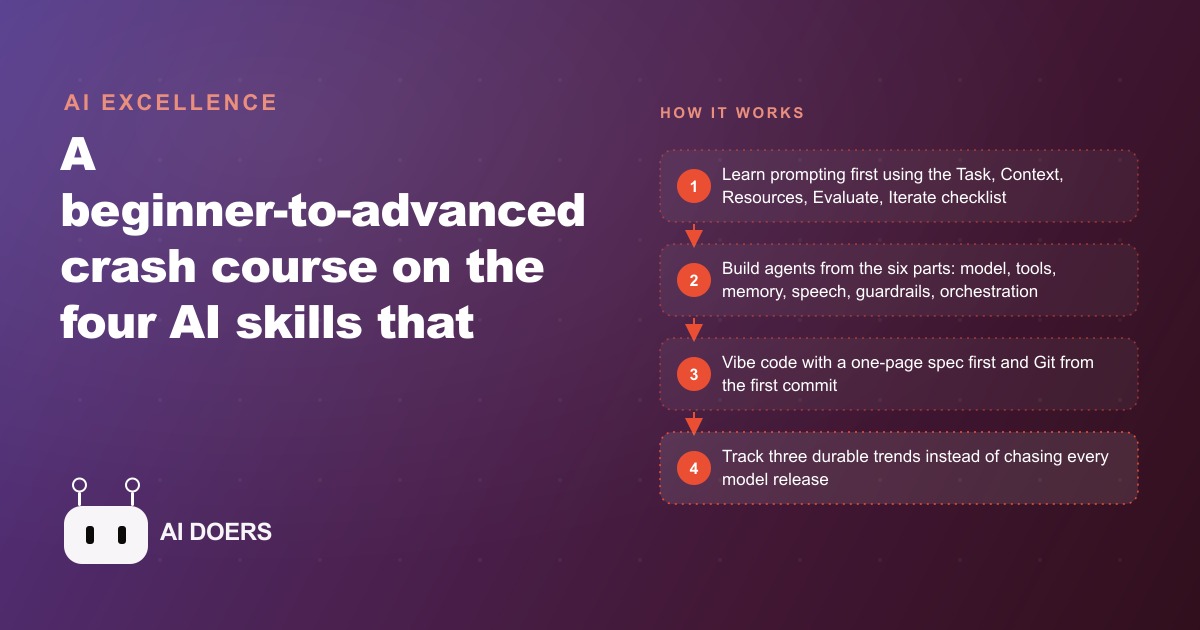
The four AI skills that compound are prompting, building agents, vibe coding, and reading trends instead of news. Master prompting first because it glues the other three together, then layer on the six-part agent model and a PRD-first way of building.

There is a losing way to learn AI, and most people are doing it: chasing every model release and tool launch until they burn out and retain nothing. There is also a winning way, which is to learn a small handful of skills that compound, where each one makes the next more valuable. I am Madhuranjan Kumar, and this is the exact sequence I walk clients through. Four skills matter, in this order: prompting, building agents, vibe coding, and reading trends instead of news. Below is the playbook, stage by stage, with the fifth stage being the one where it all pays off inside a real business.
Before the stages, one definition clears the fog. Traditional AI is the older machine learning behind things like Google search and YouTube recommendations. Generative AI is the newer subset that produces text, images, audio, and video, with models like GPT, Gemini, and Claude as the obvious examples. Everything below sits on the generative side, and the whole point of doing it in order is that skipping ahead wastes the skills stacked underneath.
Stage 1: Master prompting before you touch anything fancier
Prompting sits underneath every other skill, so it comes first and nothing else works well without it. It is simply how you communicate with a model, and the most advanced agent in the world is useless if you cannot tell it clearly what you want. Learn this and every output you ever generate improves. Skip it and you will blame the tools for problems that are really communication failures.
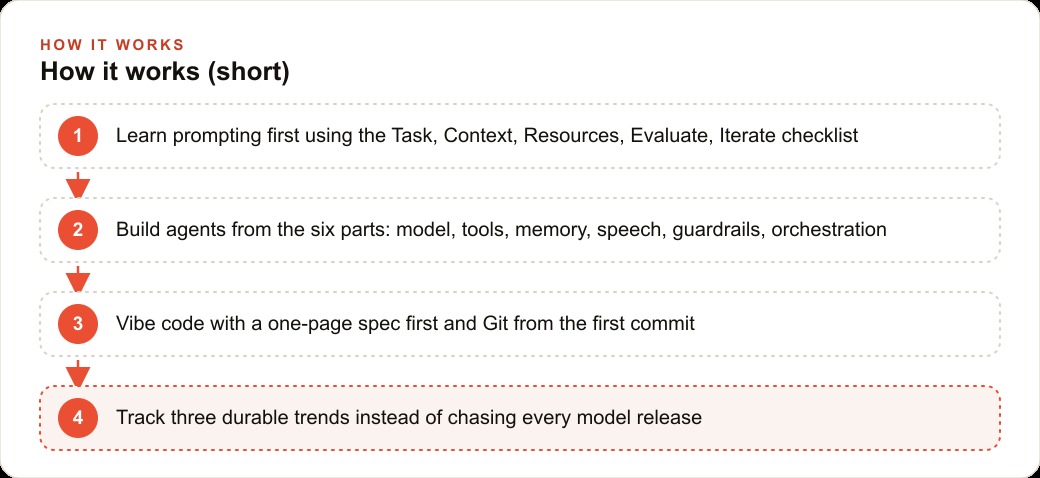
The first framework worth committing to memory is Tiny Crabs Ride Enormous Iguanas, which stands for Task, Context, Resources, Evaluate, Iterate. You name the task plainly, add a persona and the output format you want, pile on the relevant context, hand it reference examples to anchor the style, then evaluate the result and iterate. When that is not enough, a second framework, Ramen Saves Tragic Idiots, layers on refinement: revisit the first framework, separate your prompt into short sentences, try analogous phrasing when the model misunderstands, and introduce constraints to rein it in. These frameworks come from Google's own guidance, and the mnemonics are just memory aids. Spend a full week running every real prompt through the first checklist until it is automatic. That single habit is the highest-return thing you will do in this entire playbook.
Stage 2: Learn the six parts of an agent, not the tool of the week
Once prompting is second nature, move up to agents, and learn the parts rather than the products. The cleanest breakdown comes from OpenAI's six components: a model to reason, tools to act, knowledge and memory to inform, audio and speech for natural interaction, guardrails for safety, and orchestration to run and monitor the whole thing. The model reasons, the tools do things in the world, memory gives it what it needs to know, guardrails keep it from going off the rails, and orchestration coordinates it all. Learn these six and you can understand any agent framework, because the frameworks change every few weeks while the parts do not.
Two ideas carry real weight at this stage. The first is MCP, Anthropic's Model Context Protocol, which acts like a universal plug that lets any compliant tool connect to an agent the same standardized way. Before it, wiring every API and database to an agent was painful and custom. With it, connecting a new tool becomes routine. The second is that multi-agent systems beat one overloaded agent. One agent trying to do everything gets confused, the same way one person running an entire company does. The move is to break the work into sub-agents with specific roles that collaborate toward the result. There is a useful line from the startup world worth holding here: for every major software company, there will be a vertical AI agent equivalent, which tells you where a lot of the next wave of building happens.
Stage 3: Vibe code one small tool with a spec and version control
The third skill is vibe coding, a term that caught on across the developer community, which means you describe what you want in plain language and let the model handle the implementation. It dramatically lowers the barrier to building real, working software, and it is how a non-technical owner ends up with a custom internal tool in an afternoon. But there is a right way to do it that keeps you from losing your work, wrapped in its own checklist: Thinking, Frameworks, Checkpoints, Debugging, Context.
Thinking means writing a one-page spec, a short product requirements document, before you build anything, so the model knows the target. Frameworks means letting the tool pick sensible defaults rather than fighting them. Checkpoints means using Git from the very first commit, because skipping version control is exactly how people lose an entire app when a later change breaks something and there is nothing to roll back to. Debugging means treating errors as a normal step, pasting them back to the model to fix rather than panicking. Context means giving the tool the relevant files and information so it is not guessing. Build one small internal tool this way, not a platform, and you will understand more about agents from shipping it than from reading about a dozen.
Stage 4: Track three durable trends instead of chasing every release
The last skill is knowing what to ignore. You cannot keep up with every model launch without burning out, and the attempt is the fast path to the brain fog that heavy AI users complain about. Instead, track three durable trends that are not going to reverse: AI being integrated directly into existing workflows, the productivity jump that vibe coding delivers, and the steady rise of capable agents. Anchor to those three and you can let ninety percent of the daily announcements wash past you without losing the plot. This stage is what protects the other three, because a person drowning in news never gets around to actually building anything.
Stage 5: Point the stack at one real business and watch it compound
Now the payoff, with a worked example and illustrative numbers, because a skill stack only matters when it lands on real work. Take an accounting firm, since the work is high volume, repetitive, and deadline driven, which is exactly where compounding pays off.
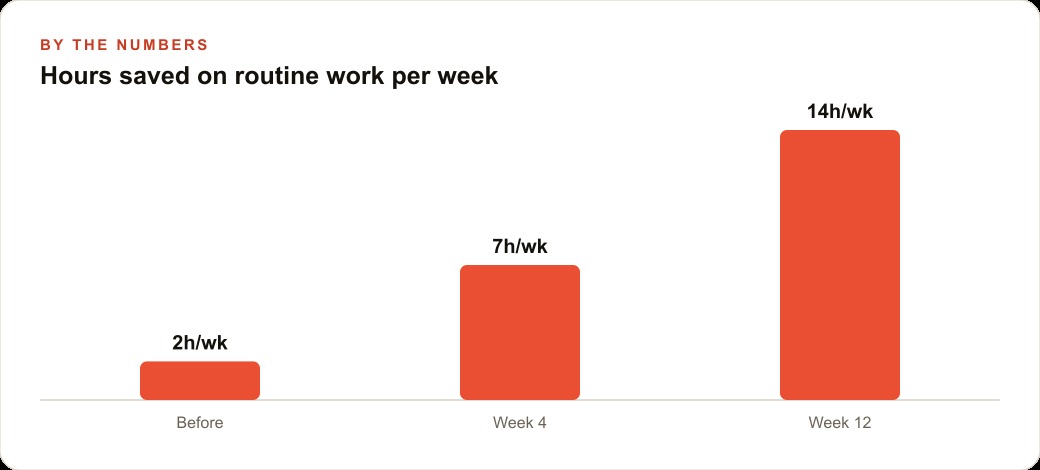
Start with prompting. I would give the team the Task, Context, Resources, Evaluate, Iterate checklist for everyday jobs like drafting a client email about a missing document, summarizing a messy bank statement, or turning a tax-law update into plain client language. If each staff member does even a dozen such tasks a day and the checklist saves ten minutes on each, that is two hours a day per person recovered from staring at a blank screen. Next, a simple agent built from the six parts: a model wired to the firm's document store as its knowledge, a tool to read uploaded statements, and guardrails around anything it must not assert as advice. Now a junior can ask what changed in a client's filings year over year and get a sourced first draft instead of building it by hand.
Then vibe coding for one internal tool. With a one-page spec and Git from the first commit, the firm can stand up a small intake utility that takes a new client's documents, checks which items are missing against a standard list, and emails a polite reminder. Not a software project, just a clean tool built in an afternoon that removes a recurring chore. Finally, trend reading keeps the partners from thrashing: instead of trialing every new tax-AI product, they watch the same three durable trends and adopt deliberately. If the firm reclaims even two hours per person per day across a ten-person team, that is a hundred hours a week returned to billable work, and those figures are illustrative but the direction is not.
None of this stays walled off inside the back office either. The prompting skill that sharpens client emails is the same skill that sharpens ad copy for Facebook and Instagram ad campaigns. The content the firm produces while explaining tax topics in plain language quietly feeds SEO and organic search. The intake tool you vibe code plugs naturally into the firm's CRM and website stack so new leads never sit unanswered. The skills compound across the whole business, not just one corner of it, which is the entire reason to learn them in order rather than collecting scattered tricks.
The firm keeps doing tax and audit work exactly as before. The difference is that the routine drafting, checking, and summarizing now compounds quietly in the background, and the owner who learned four skills in sequence pulls ahead of competitors still refreshing their feeds.
Why the order is the whole point, and skipping ahead fails
People routinely try to start this stack in the middle, and it almost always backfires. They hear about agents or vibe coding, jump straight to building one, and end up frustrated when the results are mediocre and unreliable. The reason is that the skills are not a menu you pick from, they are a ladder, and each rung only holds because of the one beneath it. Skip prompting and your agent produces vague, inconsistent output, because an agent is just a model you communicate with through many small prompts. Skip agents and your vibe-coded tool has no real capability behind it. The sequence is not a suggestion, it is load-bearing.
Prompting first is non-negotiable because it is the interface to everything else. When people complain that an agent gave bad results, the failure is almost always upstream, in an unclear task, missing context, or no examples, which are exactly the things the prompting frameworks force you to supply. Fix the prompting and the same agent suddenly performs. This is why a week spent making the Task, Context, Resources, Evaluate, Iterate checklist automatic pays off across every skill above it. You are not learning a trick, you are learning the language the whole stack runs on, and every hour invested there compounds into every agent and tool you ever build.
The same logic explains why learning the six parts of an agent beats learning a specific agent-building product. The products churn constantly, a new framework or platform arrives every few weeks, and anyone who tied their understanding to one tool has to relearn from scratch each time. Someone who learned the parts, model, tools, memory, speech, guardrails, and orchestration, can pick up any new framework in an afternoon, because they already know what the pieces are and are just learning where this particular tool puts them. Durable knowledge sits at the level of the components, not the products, which is why the playbook anchors there.
Vibe coding sits third for the same reason, not because it is advanced but because it depends on the two below it. To describe an app well enough for a model to build it, you need solid prompting. To make that app actually do something, you need to understand agents and tools. The one-page spec and Git-from-the-first-commit discipline are what keep the whole thing from collapsing, and they are habits, not talents. The people who lose an entire app to a broken change are almost always the ones who skipped the checkpoints step because it felt like overhead, right up until it was the only thing that could have saved them.
Trend reading comes last on purpose, because it is worthless without the first three and dangerous before them. A beginner who leads with trend-chasing just drowns in news and never builds anything. Someone who has already learned to prompt, build agents, and ship a small tool can use trend awareness correctly, as a filter that tells them which durable shift is worth investing another skill into next. The order protects you from the exact burnout that sinks most people trying to learn AI.
You can absolutely build this stack yourself, one skill at a time, and I would encourage any owner to start with prompting this week. If you would rather have someone map your specific firm, set up your first agent against your real documents, and ship that first internal tool so it works on day one, that is exactly the kind of build I do for clients, and you can bring me in to handle it.
That is exactly what we do at AI DOERS. Book a private 30-minute call with Madhuranjan Kumar and we will map the fastest path to it for your specific business.
Book your call →
Madhuranjan Kumar
Madhuranjan Kumar brings 20 years of performance-marketing experience and has managed over $200 million in Facebook ad spend for brands across the United States and beyond. His expertise spans the full modern marketing stack: Meta, Google Ads, TikTok, email automation, CRM, and the websites that hold it together. At AI DOERS he turns that track record into lead-generation systems for businesses across every industry.