
Eight AI Trends Reshaping Work, and What They Mean for a Real Business
Search-enabled assistants, inline file editing, far cheaper reasoning models, converging chat tools, vibe coding and its security risks, and the new premium on design. Here is what each shift means and how I would apply it.

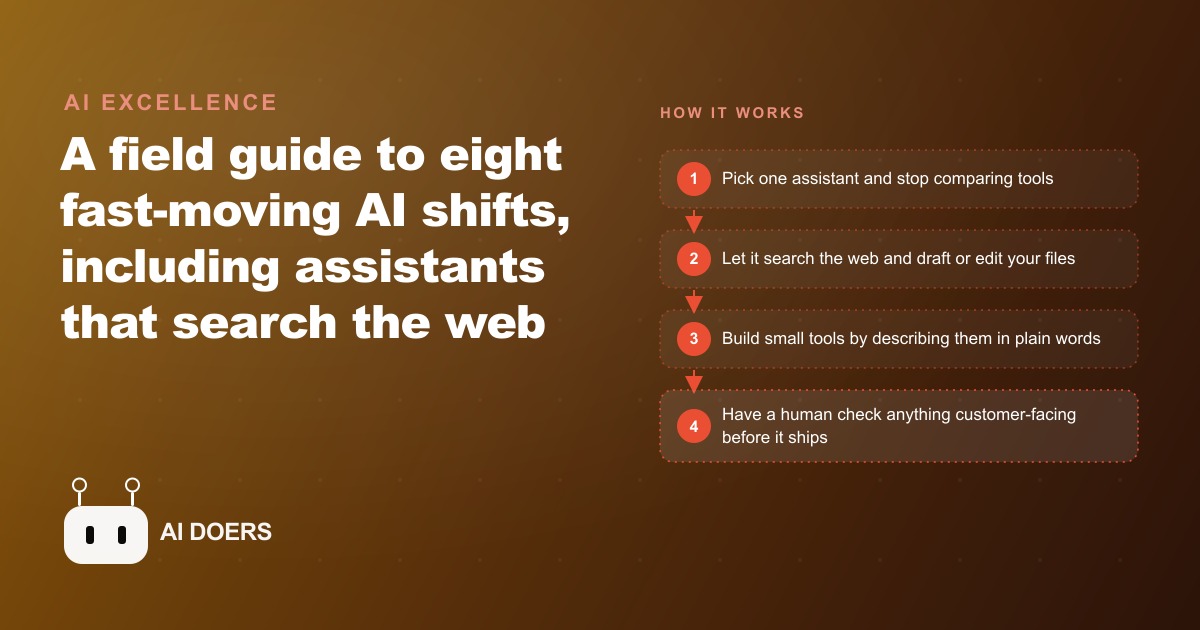
Eight discrete shifts in how AI tools work reached small businesses this year, and the ones that arrived with no announcement are the ones quietly repricing who owns what kind of work.
This is not a list of things that might happen. These are changes that already happened and are already showing up in operating costs, team structures, and which businesses can produce more with the same headcount. Some arrived with press coverage. Others arrived in pricing pages that most people never read. The useful version of staying current is not following every new model release. It is understanding which structural changes in the tools are now affecting real business decisions. Here are the eight that matter most, ranked by how directly each one changes the math for a small business.
1. Assistants That Search the Web and Edit Files on Your Computer Closed the Gap That Kept People on Older Tools
For two years, the single feature that differentiated AI assistants was real-time search. Tools with it could be trusted for current information. Tools without it were frozen at their training cutoff, which made them unreliable for anything time-sensitive. That differentiator is gone. The major assistants now search the web and write or update files directly on the user's computer, not just answer questions about what is online but retrieve the information, synthesize it, and insert the result into a document that already exists.
For a small business, the practical change is immediate. An owner who wants a competitor pricing comparison, a draft FAQ reflecting current industry standards, or a refreshed bio that references recent press can now get a working draft in minutes without switching between a search tab, a writing app, and a file manager. The assistant pulls the information, writes the draft, and saves it to the file. The workflow that required hopping between three or four tools is now one conversation. For any recurring research-and-write task, that consolidation saves real time each week and removes the friction that caused people to defer the task until it became urgent.
2. Inline Editing Replaced Full Regeneration as the Default Interaction for Document Work
Most AI users picked up the habit of regenerating an entire document to fix one sentence, because that was the only option available. The tool produced a full draft and if any part needed changing, the usual path was to rephrase the instruction and regenerate the whole thing. Inline editing changes that interaction pattern entirely. You highlight the specific line or paragraph that needs adjustment, describe the change, and only that portion updates. Everything else stays exactly as written.
For any business that does recurring document work, the difference in friction is significant in aggregate. A medical practice that needs to update its after-visit instructions in three places across its patient communication templates no longer regenerates every document and reviews the unchanged sections for unintended alterations. It selects each relevant sentence, makes the targeted change, and moves on. A legal practice updating one clause in a standard engagement letter makes the edit in place rather than reviewing the entire document for drift. The cumulative hours saved across a month of small edits translate directly into recovered focus time that previously went into reviewing content that did not need to change.
3. Reasoning Model Prices Collapsed While Quality Held, and That Changes the Cost Math for Any Business Running Repeated Tasks
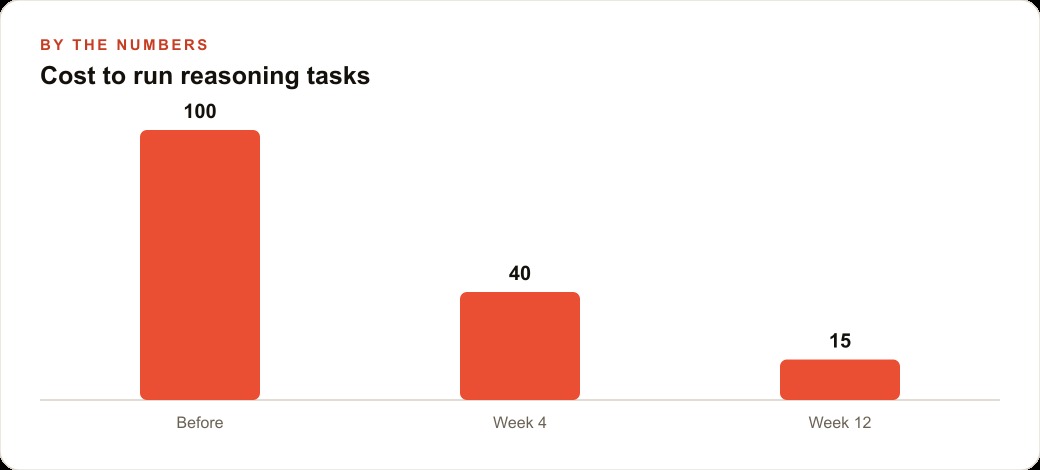
This is the shift with the most direct impact on operating cost for businesses that use AI at any volume. Reasoning models, the kind that think through a problem step by step before producing an answer, were expensive enough a year ago that most small businesses could not justify them for anything but the highest-stakes queries. Competing providers entered the market at significantly lower prices while maintaining comparable quality on most real-world tasks. The result is that tasks which used to be too costly to automate at volume are now economically viable for businesses with modest monthly AI budgets.
A chiropractic clinic that produces health and wellness content for patient education illustrates the change concretely. The practice generates roughly fifty content drafts per month: posts about posture correction, stretching protocols, post-adjustment recovery, seasonal health topics, and nutrition basics, all written in a professional but approachable voice for the patient base. Each draft runs through a reasoning model to check internal consistency, appropriate clinical tone, and accuracy on any health-related references before the chiropractor reviews and approves it.
At pricing levels from one year ago, running fifty drafts through a premium reasoning model cost approximately thirty to forty dollars per month in API usage, which was manageable but noticeable against a small marketing budget. After the pricing compression this year, the same volume runs at roughly eight to twelve dollars per month on models that match or exceed the quality of what cost three to four times more before. Across a full year, that represents approximately two hundred fifty to three hundred forty dollars in savings on a single content workflow. For a marketing agency running the same process across thirty clinic clients instead of one, the annual savings on that single task type exceeds eight thousand dollars. That math changes which services are profitable to offer and at what price point.
4. The Major Chat Tools Converged on the Same Feature Set, Making Commitment More Valuable Than Comparison
Search integration, canvas editing, side panels, file upload, image generation, custom instructions, multi-step reasoning: twelve months ago these features existed in some tools and not others and the differences between them were large enough to justify evaluating each one carefully before choosing. Today they exist in nearly every major AI assistant. The tools have converged on a shared feature set that covers the vast majority of what small businesses need from a daily assistant.
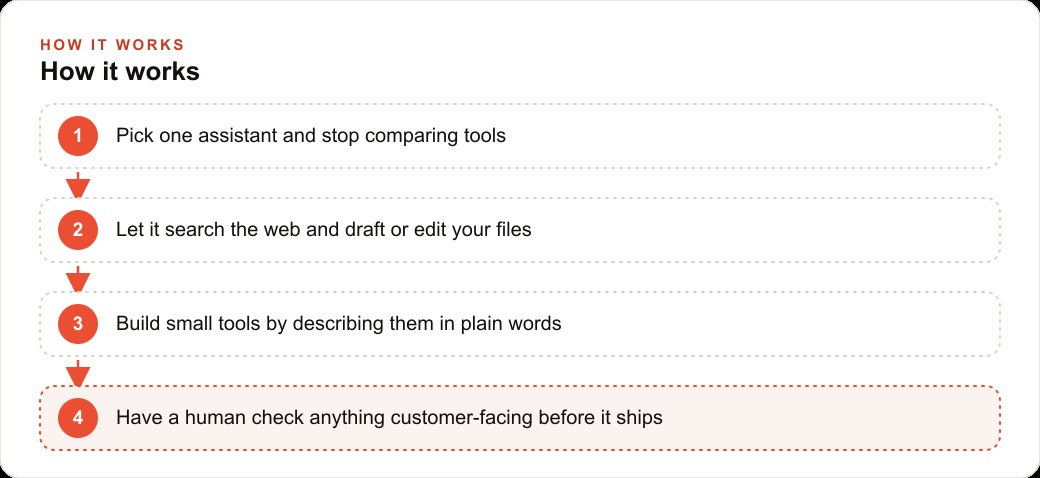
The counterintuitive implication of convergence is that the tool a business selects matters less than whether it commits to using it deeply. A business that rotates between tools every month based on the latest benchmark release learns a little about many platforms and masters none of them, which means it gets none of the compounding benefit of deep familiarity: consistent prompting patterns, saved custom instructions, learned shortcuts, and the accumulated context that comes from using one tool for everything. The business that picks one assistant and uses it for every relevant task for ninety consecutive days builds more capability with that tool than any amount of comparison shopping would provide.
5. Vibe-Coded Apps Shipped Without Security Reviews and Some Got Attacked for It
Building software by describing it in plain English became genuinely accessible this year, and a new category of problem arrived alongside it. A content creator publicly documented building an app without writing any code, celebrated the speed and accessibility of the workflow, and then watched the app get attacked by someone who found an obvious input vulnerability that any developer would have caught before shipping. Madhuranjan Kumar had built a functioning product. He had not built a secure one.
The vulnerability was not in the AI-generated code itself. It was in the absence of review. Code that solves the described problem often does not, by default, defend against inputs that the description never mentioned. An app that accepts user text input without sanitizing it is an attack surface whether the code was written by a developer or generated by a model at the end of a conversational prompt. The vibe coding workflow eliminates the generation problem. It does not eliminate the security review problem, and conflating the two is where the risk lives. A customer-facing app that handles personal information, payment data, or any form of account authentication requires a security review before it reaches users, regardless of how it was built.
6. Hardening Vibe-Coded Prototypes Became a Distinct and Growing Job Category
The flip side of the security shadow is the emergence of a specific new demand. As more non-technical people build working prototypes by describing them, the need for people who can take those prototypes and make them secure, reliable, and production-ready is growing. The work is not building from scratch. It is reviewing what the agent produced, identifying the gap between a working demo and a dependable daily system, and adding the error handling, input validation, logging, and integration work that a prototype is missing.
For a small business, the practical move is to budget for one round of technical review before any customer-facing tool goes live. This cost is far lower than a full development contract and should be treated not as a luxury but as the price of shipping safely rather than the price of building. A tool that goes to customers without review and fails in a visible or damaging way has a remediation cost, in customer trust and in time, that exceeds what the review would have cost. Building cheap and reviewing before shipping is the correct sequence. Building cheap and skipping the review is the shortcut that costs more than it saves.
7. Design Became the Primary Competitive Edge the Moment Anyone Could Build
The bottleneck in digital product development for most of the past decade was engineering capacity. Ideas existed. Designs existed. The constraint was access to engineers who could implement them and waiting time while they did. When that bottleneck disappears because anyone can build by describing what they want, the competitive question shifts. It moves from who can build to who builds the clearest, most intuitive, most visually coherent experience for the customer.
Design always mattered. It matters more now because the field of competitors has expanded dramatically. A business that produces something technically functional but confusing to navigate is now competing against a neighbor who produced something equally functional and immediately clear, with no additional engineering advantage. The differentiator is judgment about what the customer needs to see, where they need to find it, and how the interface should respond to their actions. That judgment comes from testing with real users, iterating on layout based on what people actually do rather than what they say, and treating copy and visual hierarchy as serious competitive tools rather than finishing touches. Businesses that invest in getting those things right will have more durable advantages than businesses that treat design as a polish pass after the build is done.
8. Routine Computer Tasks Became the Most Exposed Category of Work to Automation
Repetitive tasks performed on a computer without physical presence requirements are the category most directly in the path of what AI tools handle reliably today. Data entry, standard document formatting, templated email responses, recurring report generation, basic research synthesis for internal summaries, scheduling coordination across known parameters: these are the tasks that AI handles at a fraction of the human time cost. For a business with employees spending significant hours on these activities, that is simultaneously a cost opportunity and a workforce planning reality that should not be left unaddressed.
The most important move is to identify which tasks fall into this category and decide deliberately how to handle the transition rather than encountering it reactively. Some of that work will be automated and the person freed for higher-judgment tasks that the business has been under-resourced on. Some will remain human-owned because the judgment and relationship components are inseparable from the mechanical parts in ways that make full automation produce inferior results. The worst outcome is ignoring the category entirely, keeping expensive human time on tasks that run better automatically, and watching competitors who automated those tasks use the freed cost to undercut on price or invest more in customer acquisition. The gap between businesses that made this transition deliberately and those that did not will be visible in their cost structures within eighteen months. The businesses most at risk are the ones that frame this as a question to revisit later. There is no neutral position here. Every month of continued manual effort on automatable tasks is a month of compounding cost disadvantage against a competitor who automated them already. The decision to start is the decision that matters most, and it is available to make right now without a large upfront investment.
That is exactly what we do at AI DOERS. Book a private 30-minute call with Madhuranjan Kumar and we will map the fastest path to it for your specific business.
Book your call →
Madhuranjan Kumar
Madhuranjan Kumar brings 20 years of performance-marketing experience and has managed over $200 million in Facebook ad spend for brands across the United States and beyond. His expertise spans the full modern marketing stack: Meta, Google Ads, TikTok, email automation, CRM, and the websites that hold it together. At AI DOERS he turns that track record into lead-generation systems for businesses across every industry.