
Don't Run Fable 5 in the Claude App, Run It Here Instead
Fable 5 is Anthropic's biggest model jump since GPT-4, but where you run it decides whether you get its power or a wall of refusals. Here is the setup I use so a tripped safeguard quietly downgrades instead of failing.

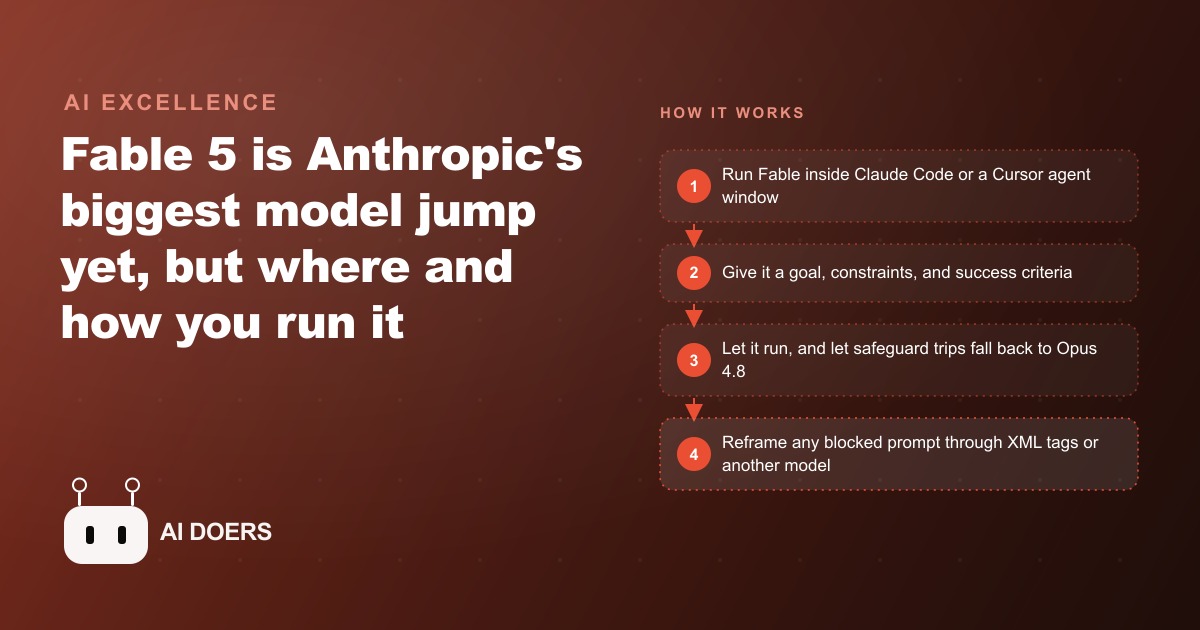
Fable 5 is the largest single capability jump from Anthropic since the original GPT-4 era, and the single most consequential decision you will make about it is not which prompts to write. It is where you run it. Get that wrong and a model capable of cloning full applications in two prompts spends its time throwing hard errors instead of shipping.
Fable 5 Is Anthropic's Largest Model Leap in Years and the Consumer App Is the Worst Place to Run It
After sustained testing across code generation, reasoning, multi-step planning, and document analysis, Fable 5 represents a qualitative step up rather than an incremental improvement. It writes its own test suites without being asked. It pushes back on flawed approaches rather than implementing them politely. It catches edge cases on the first pass that previous models required several retries to surface. The feeling of working with it is meaningfully different from working with earlier versions: it behaves more like a senior collaborator and less like an autocomplete engine.
But those strengths only surface when the model runs in an environment designed to handle its safeguard behavior gracefully. Fable 5 has protective systems that can trip on certain prompt shapes, including prompts that look like requests for security analysis, model introspection, or detailed technical breakdowns of sensitive systems. When a safeguard trips, what happens next depends entirely on the harness around the model.
In the Claude consumer application, what happens next is a refusal. The consumer app carries the heaviest guardrails of any surface Anthropic operates, because it serves hundreds of millions of users across every possible background and intent. That is the right call for a general-purpose consumer product. It is the wrong environment for professional or technical work that occasionally needs to explore sensitive topics, test security properties, or reason about complex system behavior. The consumer app is the most widely known surface and the least suitable for serious work with this model.
The raw API through OpenRouter or any similar routing layer has the opposite problem. It is lightly guardrailed, but it has no fallback mechanism. When a safeguard trips, the entire run dies with an error code. There is no graceful degradation, no automatic retry on a less restricted model, no continuation. The run stops and you start over. For exploratory or creative work where prompts are evolving, a hard failure on one prompt means rebuilding the session context from scratch. The raw API is the right environment for tightly controlled production pipelines with explicit retry logic built in, not for the kind of iterative professional work where prompt shapes evolve across a session.
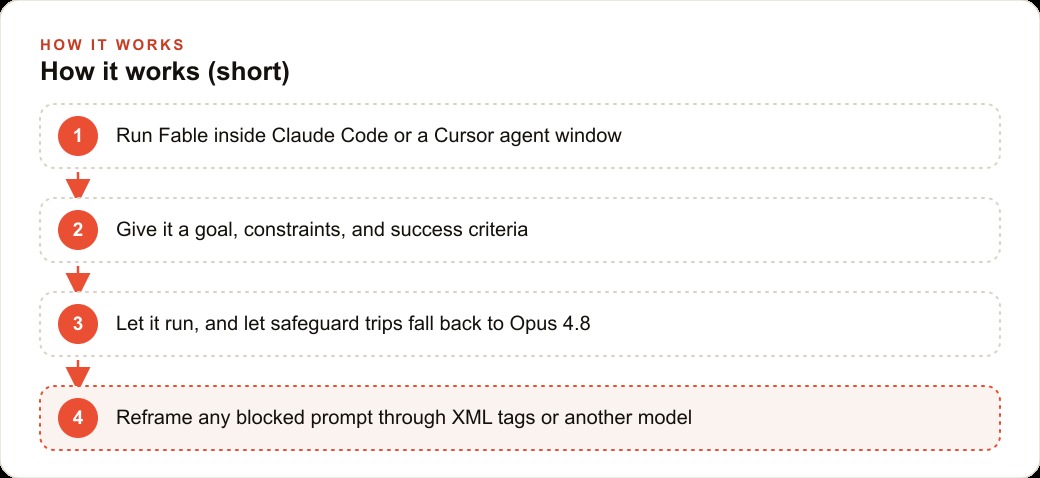
Claude Code and Cursor Agent Windows Provide the Graceful Fallback That Prevents Dead Runs
Claude Code and Cursor agent windows are the right harnesses for Fable 5 because they share one critical behavior: when a safeguard trips, they fall back to Opus 4.8 and continue rather than dying.
The practical meaning of this is significant. Opus 4.8 is itself a highly capable model. A safeguard trip on Fable that silently falls back to Opus 4.8 produces output that is very close to what Fable would have produced, without interrupting the session, without requiring manual intervention, and without losing the context built up across the preceding turns. In a working session where Fable handles 20 prompts and two of them trip the safeguard, you lose almost nothing. In a raw API setup where those same two prompts throw hard errors, you lose the session context both times.
Claude Code is built specifically for code generation, review, and multi-file reasoning tasks. It has native support for large codebases, can operate across multiple files simultaneously, and understands the relationship between files in ways that a stateless chat interface does not. For any business with a software project, an internal tool to build, or a codebase to maintain, Claude Code is the natural harness for Fable 5.
Cursor's agent windows handle a slightly different use case. They let you run multiple agents in parallel, switch between projects quickly, and see the agent's reasoning in the editor alongside the code it is producing. For teams that work across several projects simultaneously, the parallel agent capability is a meaningful productivity advantage.
Both environments are also the right home for the commission-style prompting that Fable rewards. The environment and the prompting style are not independent choices. The harness you pick shapes how you prompt, and the prompting style you use shapes how much value the harness can deliver. Setting up the right environment first, before worrying about prompt technique, is the correct order of operations.
The Max Plan Delivers Ten Times the Value of Raw API Credits at the Same Capability Level
The Anthropic Max subscription is priced at 200 dollars per month. At current API pricing for Fable 5, reaching the same volume of model usage through raw API credits typically costs between 1,500 and 2,000 dollars per month, depending on task mix and average token length per request.
That ratio, roughly eight to ten times more usage per dollar on the subscription versus the raw API, is the subsidy Anthropic provides through the professional subscription tier. The business case for the Max plan over raw API access is not subtle: for any user whose volume of use is high enough to hit subscription limits before running out of tasks, the subscription is the correct economic choice by a wide margin.
The break-even analysis is quick. If a professional using Fable 5 sends an average of 30 substantial prompts per day on working days, running around 5 to 10 model outputs per prompt at meaningful token length, raw API costs accumulate to several hundred dollars per month before the month is halfway through. The 200-dollar subscription replaces that variable recurring cost with a fixed one and provides substantially more headroom.
For businesses evaluating the cost of AI tooling, the Max plan also simplifies budgeting. A fixed monthly cost is easier to plan around than a variable token bill that fluctuates with project intensity. A month where a large project requires heavy AI use does not produce a billing surprise on the subscription. On the raw API, that same heavy month can produce a bill that triggers budget review and slows down the work that was producing value.
The one scenario where the raw API is the right choice is a production system with a predictable, controllable token volume, where the system is written to handle errors and retries explicitly, and where exact API behavior needs to be stable and reproducible. For most professional and small business work, the Max plan is the correct starting point.
Old Verbose Prompting Scaffolding Now Actively Degrades Fable's Output Quality
This is a counterintuitive shift that trips up experienced users who developed their prompting habits on earlier models.
Models from two or three generations ago required detailed scaffolding to produce reliable outputs. You specified the format explicitly. You described the approach in steps. You told the model exactly what to consider, in what order, with what constraints. That scaffolding was compensating for the model's limited ability to infer intent and plan approach on its own.
Fable 5 does not need that scaffolding. More than that: it degrades with it. When a prompt contains long chains of procedural instructions that were written for a weaker model, Fable follows those instructions literally, including the parts that reflect the older model's limitations rather than the task's requirements. The scaffolding written to compensate for a model that could not plan now prevents a model that can plan from doing so.
The prompting style that works with Fable is the opposite of scaffolding. Write a goal. Describe what success looks like. Add the constraints that are genuinely non-negotiable. Then stop. Let the model determine the approach, because it is frequently a better architect than the person giving the instructions, particularly for complex technical tasks where there are many valid paths to the outcome.
This means auditing existing prompts that were written for earlier models and stripping the procedural instructions that are no longer compensating for a real limitation. If a prompt says "first do this, then do this, then check this, then format the output like this," each of those instructions should be evaluated: does this encode a genuine requirement about the result, or does it encode an assumption about how a weaker model needs to be guided? Keep the first category. Remove the second.
Madhuranjan Kumar ran this audit across a set of prompts originally written for an older model and found that roughly 60 percent of the content was scaffolding rather than genuine requirements. Stripping that scaffolding and rewriting as goal-plus-constraints produced noticeably better output on the first try. The output quality difference between a scaffolded prompt and a goal-oriented prompt with Fable 5 is large enough to notice immediately. Commission the model, do not manage it.
The Thirty-Day Data Retention Policy Is the Detail Every Business With Sensitive Data Must Plan Around
Anthropic introduced a mandatory 30-day data retention policy for Fable 5 across both the API and the Claude.ai platform. Prompts and outputs sent to the model are retained for 30 days before deletion.
For many businesses, this policy is a non-issue. Their use cases do not involve data that requires strict access control, and 30-day retention is a shorter window than most cloud services maintain by default. For these businesses, the policy is background information rather than an operational constraint.
For businesses in regulated industries or those handling contractually sensitive data, the policy requires active planning. Healthcare businesses cannot send individually identifiable patient information to a service with third-party data retention without appropriate agreements in place. Legal firms have confidentiality obligations that may restrict sending client-specific details through a retained service. Financial institutions have similar constraints depending on the nature of the information involved.
The practical response is not to avoid Fable 5, but to structure what is sent to it. Use anonymized inputs for analysis tasks, reference patterns and structures rather than live data when possible, and reserve Fable for work that either does not involve sensitive specifics or where the information can be abstracted before submission. Many business tasks, including code generation, competitive analysis, communication drafting, and planning, do not require sending sensitive data to complete effectively.
Large enterprises are the group most affected by this policy, and many will manage it at the corporate level by restricting which services employees are officially authorized to use for which data types. Individual employees will continue to use Fable for non-sensitive work regardless, which creates a policy gap that enterprise IT teams are increasingly focused on closing. For small and mid-size businesses without formal data governance structures, the right approach is to make a deliberate decision about which task categories are appropriate for Fable before the workflow is established rather than after.
A Plumbing Company Replaced a Developer Quote With a Commission-Style Goal Prompt
The gap between a commission-style goal prompt and a traditional development request is most visible in how quickly it produces a working tool.
A plumbing company needed two things: a booking page where customers select a service and submit a request with upfront pricing visible, and a back-office job list view showing the day's confirmed bookings in chronological order. A developer quote for that scope came in at several thousand dollars and a three-week timeline.
The same scope, expressed as a commission-style goal prompt in Claude Code on the Max plan, produced a working prototype in under a day. The prompt was not a detailed technical specification. It described the result: a clean booking flow for a plumbing service business with these service types and price ranges, designed for mobile, with a simple chronological job list for office use. It included the constraints that were genuinely non-negotiable, mobile-first layout, specific service categories, and upfront pricing display, and said nothing about implementation approach.
The model planned the implementation, chose the technical approach, built across multiple files, and flagged a decision point when there was genuine ambiguity about how submitted bookings should be stored. That question required one answer, provided in a single sentence, and the build continued. When a prompt occasionally tripped a safeguard during the session, the Claude Code harness fell back to Opus 4.8 and continued without interrupting the session context.
The finished tool is a functional internal application that does exactly what the business needs, built in a fraction of the time and cost of a traditional development engagement. For the operator, the practical value is immediate: customers can book online with visible pricing, the office has a daily job list without someone manually updating a spreadsheet, and the business is no longer paying for phone time coordinating simple bookings. Extending the tool with additional features, sending booking confirmation texts, flagging jobs that have not been acknowledged after a set time, generating a weekly revenue summary, follows the same commission pattern for each new capability added.
The Reframing Technique That Clears Most Safeguard Friction Without Any Workarounds
When a prompt trips a Fable safeguard and the fallback to Opus 4.8 produces output that is not sufficient for the task, there is a reliable technique for clearing the friction without adversarial prompt engineering.
Run the blocked prompt through a different model first. A capable model without the same safeguard profile produces the analysis or output the original prompt was seeking. Take that output and place it inside XML tags in a new Fable prompt that asks the model to evaluate, critique, or extend the existing analysis rather than produce it from scratch.
Fable 5 handling a request to evaluate an existing analysis is a different prompt shape from Fable 5 handling a request to produce that analysis directly. The safeguard that tripped on the second form does not trip on the first, because the model is not being asked to generate the sensitive content, it is being asked to reason about already-generated content that another model produced.
This technique is not a workaround in the adversarial sense. It does not ask Fable to do something it has decided not to do. It changes what Fable is being asked to do: instead of producing an analysis, it is evaluating one. The distinction is real and the safeguard behavior reflects it.
In Madhuranjan Kumar's testing across different prompt categories, the reframing technique clears the majority of non-core safeguard friction without requiring any modification to the underlying task or output. The cases where it does not work are genuine restrictions that reflect core policy rather than surface-level pattern matching, and those restrictions are worth respecting. The technique works because most safeguard friction is pattern-based rather than content-based, and changing the framing changes the pattern while preserving the substance of what you are trying to accomplish.
That is exactly what we do at AI DOERS. Book a private 30-minute call with Madhuranjan Kumar and we will map the fastest path to it for your specific business.
Book your call →
Madhuranjan Kumar
Madhuranjan Kumar brings 20 years of performance-marketing experience and has managed over $200 million in Facebook ad spend for brands across the United States and beyond. His expertise spans the full modern marketing stack: Meta, Google Ads, TikTok, email automation, CRM, and the websites that hold it together. At AI DOERS he turns that track record into lead-generation systems for businesses across every industry.