
Did Google Get Dethroned? What the New AI Models Actually Mean for Your Business
In a single week the AI labs shipped a state-of-the-art coding model and a near-photorealistic image model. Forget the benchmark scoreboard. Here is what the real shift, cheap custom software, means for an everyday business and how I would use it.

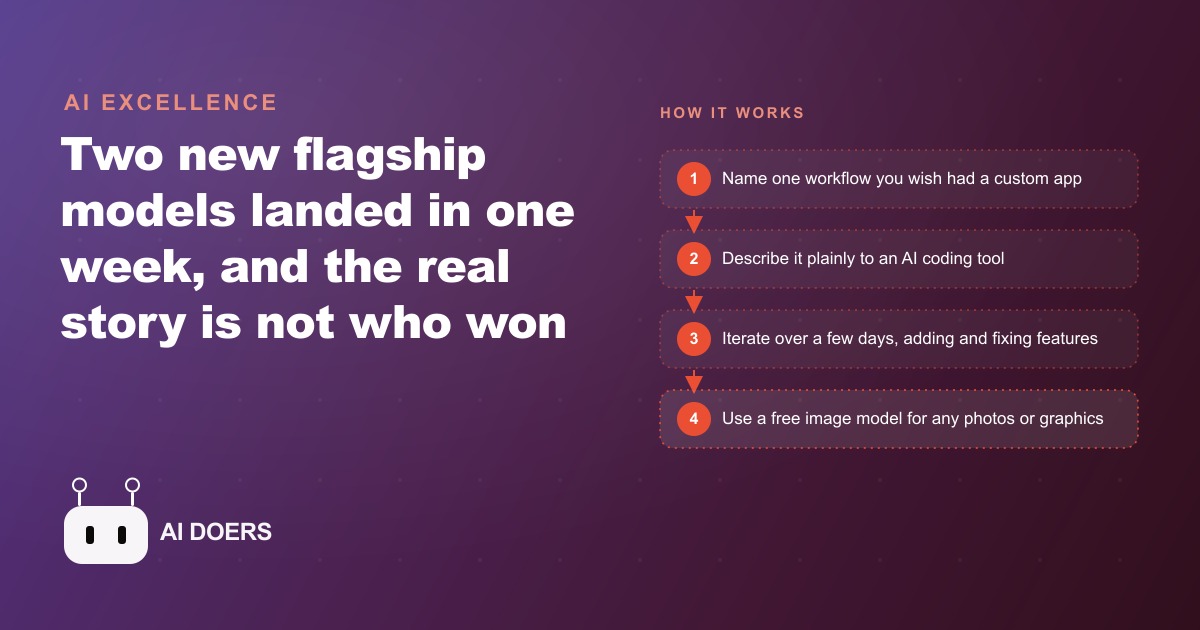
Two flagship AI models landed within a single week of each other, one the strongest coding and reasoning model on the market, the other a near-photorealistic image model, and half the internet spent the week arguing about which lab dethroned which. I am Madhuranjan Kumar, and I think the scoreboard is the least interesting part of this story. The benchmark race is fun to watch and almost useless to a business owner. The real news, the thing that should actually change your plans, is that building your own custom tools just got dramatically cheaper and easier. Here are seven takeaways from this release that matter more than who topped a leaderboard.
1. Two frontier models in seven days means the release pace is now measured in days
The first thing to absorb is not either model. It is the cadence. A top coding model and a top image model both shipped within a week. The gap between major AI capabilities used to be measured in years. Now it is measured in days. For a business, the lesson is not to chase every release. It is to stop treating any single model as a permanent choice, because the best tool for a job will change again next month. Build your process to be model-agnostic, so swapping in a better engine later is a config change, not a rebuild. The owners who get burned are the ones who bet their whole operation on one model being permanently best. In a market that ships this fast, the only durable strategy is staying loose enough to switch.
2. The new coding model finally handles deep, messy, real projects
Early AI coding tools were great at a clean demo and helpless the moment a real project got complicated. This new coding model is different in a specific way: it handles ambiguity, reasons about trade-offs, and walks through bugs that span several systems at once. That matters because real business tools are never clean. They have edge cases, weird data, and features that touch each other. A model that only shines on a toy example cannot build something you would actually run. A model that stays coherent deep inside a messy project can. This is the shift that turns build-your-own-software from a party trick into a genuine option. It shines once you are actually inside a real project, not in the first thirty seconds of a demo, which is exactly the moment that used to make non-technical builders give up.
3. Flagship power got cheaper, with a dial for how hard to think
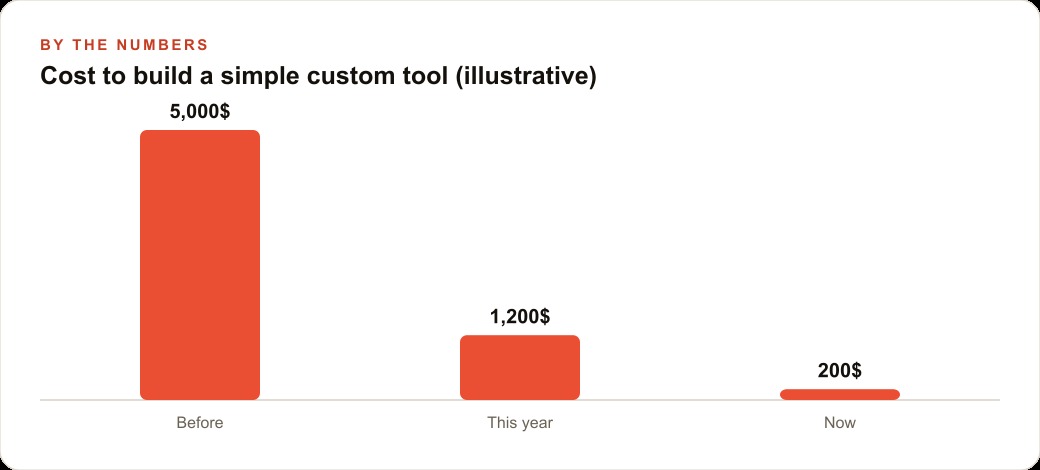
Two things dropped at once: the price per token and the friction of choosing effort. Flagship-level performance now costs less per token than the previous generation, and an effort setting lets you pick speed and low cost for a simple job or maximum brainpower for a hard one. That dial is quietly important for cost control. You are no longer paying premium reasoning rates for a task that needs none. For a business running a lot of small automated jobs, matching effort to difficulty is the difference between an AI bill that scales sanely and one that surprises you.
4. You can now run several AI sessions in parallel
Here is a capability that changes throughput, not just quality. You can have one session fixing bugs while another updates documentation and a third searches your codebase, all at once. Parallel work multiplies what a single person gets done. The practical effect is that one non-technical owner, steering three sessions, produces the output of a small team. This is the mechanic behind the claim that a solo operator can now build and maintain tools that used to require hiring. You are not typing faster. You are running more tracks at the same time.
5. Custom software is now a weekend project, not a payroll line
Put the previous points together and you get the headline for business owners. A custom tool that solves one specific problem for you is now buildable over a weekend. The ideal app for your exact workflow no longer needs a developer on payroll. Think about what that unlocks. Every spreadsheet you maintain by hand, every report you rebuild every Monday, every booking flow that annoys your customers, every small one-off tool that never justified a developer's fee, all of that just crossed into buildable. The math that kept those tools unbuilt for years flipped this week.
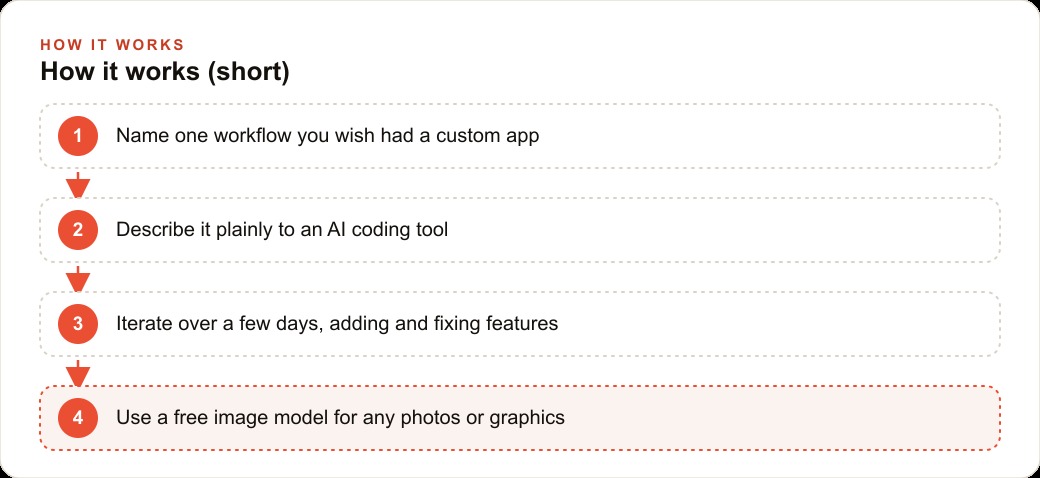
The person who stress-tested these models showed exactly what this looks like in practice, and it is worth copying. Instead of asking for one perfect app in a single prompt, they spent a few days going back and forth: add this feature, remove that one, here is a bug, fix it. Out of that patient loop came a deeply personal app with audio transcription, handwriting scanning, and automatic tagging, the kind of thing that would have been a serious software project a year ago. The pattern is the lesson. You do not describe a finished product and hope. You grow it in small, tested steps, and the model keeps up with every one. That is why the cost fell so far: the expensive part of software was never the typing, it was the coordination and the iterations, and the model now absorbs both.
6. Free image models caught up to the paid studios
The image side of this release matters just as much for a business that sells anything visual. Open and low-cost image models now produce photorealistic shots and, crucially, readable text on posters and graphics, which used to be the thing free models could never do. Product photos, before-and-after graphics, social posts, and clean posters no longer require a studio budget or a designer on retainer. For a small business, this removes one of the last expensive dependencies in marketing. You can turn a plain phone photo into a polished, professional image at effectively zero cost. Consider what that used to require: a photographer for the product shots, a designer for the posters, and a wait of days between asking and receiving. Now the same output is a prompt and a few seconds. The businesses that lean on visuals most, shops, clinics, restaurants, trades showing off their work, are exactly the ones who felt that cost most sharply, and they are the ones who gain the most from it collapsing.
7. There is no single winner, so use each model for what it does best
The most useful mental model after this week is to drop the idea of a single best AI. Some models design a beautiful first version and have better taste. Others are stronger at fixing and refining once you are deep in the details. Smart builders use each for the part it does best: let the model with better design sense create the first draft, then hand it to the model that is better at debugging and adding features. Test both on your actual problem, keep whichever solves it cleanly, and stay flexible, because the right choice keeps moving. Loyalty to one provider is now a liability, not a virtue. The right question is never which model is best, but which model is best for this specific task today.
The benchmark scoreboard is a distraction dressed up as news
It is worth naming why the dethroned-Google framing pulls so much attention and deserves so little of yours. Benchmark wins are easy to turn into a headline, a number went up, one lab passed another, and they feed the sport of following AI like a league table. But a benchmark measures how a model performs on a standardized test, not how much it changes what your business can afford to build. Those two things have almost nothing to do with each other for an owner who just wants a tool that does not exist yet.
Here is the tell. Whether the coding model that shipped this week scores two points higher or lower than its rival on some evaluation will not change your afternoon. What changes your afternoon is that either of them can now build the intake app or the weekly report you have been putting off, at a price that would have sounded like a joke last year. The scoreboard is a spectator sport. The capability floor rising underneath the whole industry is the actual event. Watch the floor, not the leaderboard, and you will make far better decisions about when and what to build.
A worked example: small custom tools for a chiropractic clinic
Let me ground all seven points in one business. Picture a chiropractic clinic where off-the-shelf software never quite fits how the practice actually works, and marketing is the thing that never gets done because there is no time and no budget for a designer.
I would start with the new-patient intake, because that is where the friction is. Instead of a clipboard and a stack of forms, I would build a simple intake app that collects symptoms, history, and insurance, then drafts a clean summary the chiropractor can scan before the patient walks in. Using the deep-project coding model and the back-and-forth approach, you add a feature, test it on a real intake, fix what breaks, and within a few days you have a tool shaped exactly around this clinic, not around a generic vendor's assumptions. Say the intake summary saves the chiropractor 6 minutes of chart review per new patient. At 15 new patients a week, that is about 90 minutes a week handed back, roughly 6 hours a month, for a tool that cost a weekend to build.
Then I would use the free image model for the marketing the clinic never has time for. Turn a plain phone photo of the adjustment room into a warm, professional shot for the website, generate clean before-and-after posture graphics with readable labels, and produce social posts about back pain and desk posture without hiring a designer. For the back office, a second tool can summarize the week's appointments, draft recall texts for patients overdue for a visit, and write the monthly newsletter. And here is takeaway seven in action: let the model with better design taste create the first version of each graphic, then hand it to the model that is stronger at fixing and refining. The professional images feed the clinic's SEO and organic search and give real substance to Facebook and Instagram ad campaigns that used to run on stock photos, while the recall texts route through the CRM and website stack so overdue patients get a nudge without anyone remembering to send it.
Where to start, and the one honest caveat
If you want to act on this, the rule is start with one tool, not ten, and resist the urge to one-shot it. Pick the single workflow that frustrates you most, describe it in plain language to an AI coding tool, and iterate over a few days, adding and fixing features until it fits your business. Use a free image model for any photos or graphics along the way. Keep early versions simple and only add the fancy features once the core works. And do not pledge loyalty to one provider, because the best choice keeps changing week to week.
The honest caveat is that the difficulty did not vanish, it moved. A focused owner can genuinely build that first intake or recall tool over a weekend. The harder part is describing the workflow precisely and steering the model when it gets stuck, which is the judgment that separates a working tool from an abandoned demo. If you would rather have the whole thing built, tuned to your practice, and handed over working, that is a reasonable path too. But the point of this week's news is not that you should buy more software. It is that the cost of having software built exactly for you fell through the floor, and the businesses that notice first will quietly out-operate the ones still waiting for a vendor to build a worse version at ten times the price.
That is exactly what we do at AI DOERS. Book a private 30-minute call with Madhuranjan Kumar and we will map the fastest path to it for your specific business.
Book your call →
Madhuranjan Kumar
Madhuranjan Kumar brings 20 years of performance-marketing experience and has managed over $200 million in Facebook ad spend for brands across the United States and beyond. His expertise spans the full modern marketing stack: Meta, Google Ads, TikTok, email automation, CRM, and the websites that hold it together. At AI DOERS he turns that track record into lead-generation systems for businesses across every industry.