
Did Claude Just Replace Video Editors? Inside Vibe Editing
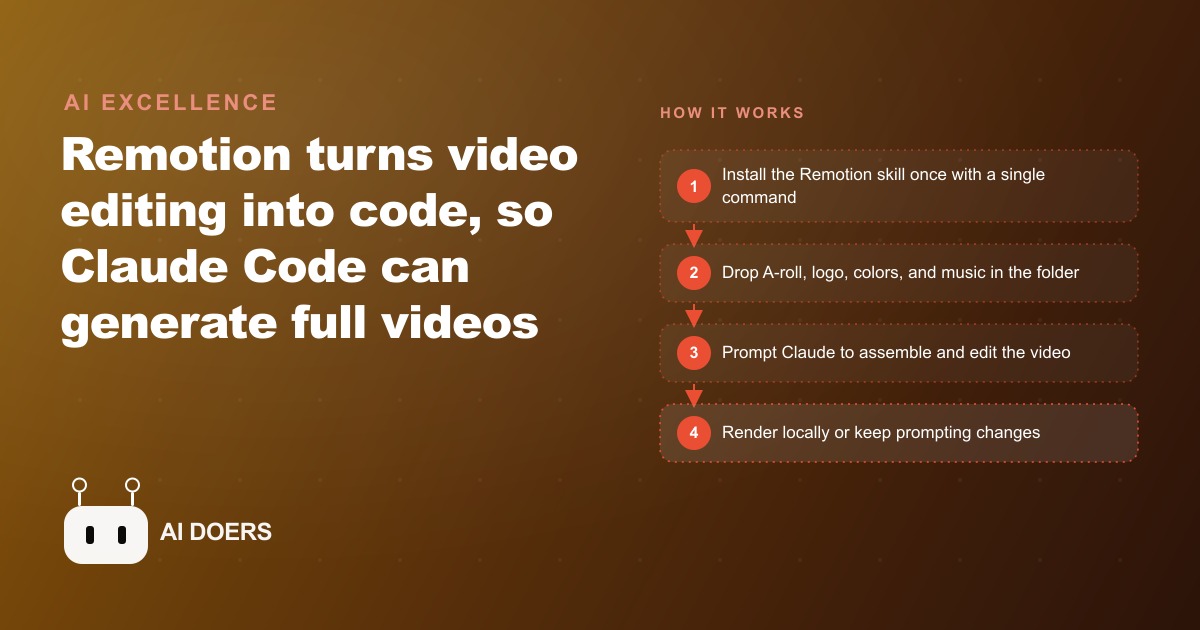
Remotion turns video editing into code, and because Claude Code is strong at writing code it can generate full branded videos, motion graphics, and edits from a single prompt. It is a code based video editor you control by talking to it.

Three hundred dollars a day on a freelance editor is not unusual for a small agency that needs consistent social video. I tracked that cost for six months before I started looking for an alternative. What I found was Remotion, a framework that turns video editing into code, combined with Claude Code's ability to write that code from a single prompt. I am Madhuranjan Kumar, and what follows is not a feature comparison. It is a walkthrough of how a vibe editing system gets built and what it actually produces at real client volume.
The setup that started a different kind of production agency
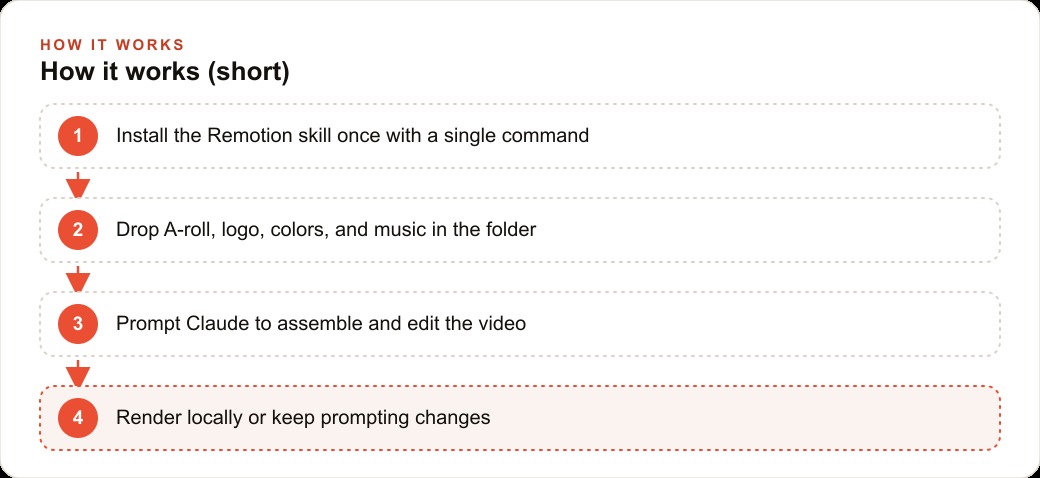
The starting point was a project folder on a laptop. Inside it: a logo SVG, a set of brand hex codes, a short piece of licensed music, and a handful of product photos. The first move was installing the Remotion skill into Claude Code with a single command. The Remotion team describes the install as being like entering a cheat code, and the analogy is precise. One command, and Claude understands the Remotion component model, what props it uses, how scenes chain together, and what a render-ready output looks like. That knowledge does not need to be re-explained. It fires on every subsequent video prompt automatically.
After the install, the workflow changed in one concrete way. Instead of opening an editor and dragging clips, I typed. That is the whole shift. A prompt describes this breakdown, Claude Code writes the Remotion project that produces it, and Remotion opens a local editor with a real timeline, an assets panel, and a render button. Fine-tuning is available by hand or through follow-up prompts. Both paths are usable. The second path is faster for everything except very precise positioning that is easier to handle visually.
The production cost per video dropped immediately. Not because quality fell, but because the time cost of producing each clip dropped from a multi-hour editor session to a prompt and a render. The constraint shifted from editor availability to prompt quality and asset quality, which are both manageable and improvable over time.
The brand scrape that produced an explainer in four minutes
The first real test was pointing Claude Code at a business website with no pre-loaded assets and asking for an explainer. The instruction was: find the name, the logo, the brand colors, and a founder image from this URL, then build a 30-second explainer. What came back in four minutes was a previewing Remotion project with the correct logo applied to motion graphic backgrounds, brand colors used throughout, and copy pulled from the site's own headline text.
No assets were provided in advance. Claude fetched what it needed, assembled the project, and the preview played cleanly on the first attempt. The only follow-up prompt adjusted the font weight on the overlay text. Everything else was usable without correction.
That test established the production model that I now use for new clients. The first output for a client is generated directly from their website, which proves the system works for their brand before any asset collection happens. If the website-sourced output is already usable, more controlled inputs with delivered assets will produce better outputs. The first test also surfaces gaps in brand clarity. A website with no clearly dominant color palette or a low-resolution logo produces a messier first output than a site with strong visual identity, which is useful information for a brand conversation with the client.
For businesses running Google Ads alongside social video, that first output is also a quick test of whether a video creative can match the visual language of their existing display assets. Consistency across paid channels matters for recognition, and the four-minute scrape gives a fast answer on whether the system can hold the brand identity across formats.
Layering A-roll, an AI avatar, and motion graphics without touching a timeline
The more complex production test was combining multiple asset types. The inputs were an A-roll clip from a previous recording session, an AI avatar generated externally, a piece of licensed music, and a product photo. The instruction to Claude Code: place the avatar on the right side of the frame, the product photo on the left, use the brand background color, and add a text benefit overlay on each scene transition.
Remotion handles this as layered code. Claude writes the positioning as props, the timing as sequences, and the text overlays as components. The result was a 45-second video with the avatar, the product, the music underneath, and timed text that appeared correctly on each beat. It was not identical to a professionally directed shoot, but it was close enough to publish and test, which is the practical standard that matters for a first creative.
Follow-up prompts covered every requested revision. Changing the text on one overlay took one sentence. Moving the avatar to the left side took another. Extending the final scene by two seconds took a third. Each revision produced a new preview in under a minute. The iteration loop that would have required reopening a timeline, re-rendering, and re-previewing in a traditional edit session was replaced by a typed sentence and a thirty-second wait.
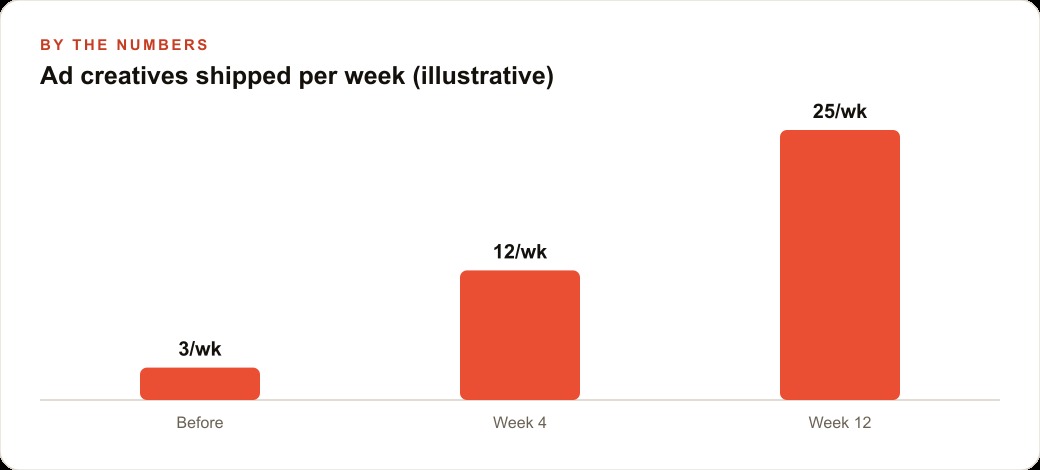
This speed matters most for agencies managing Facebook and Instagram ad campaigns where creative testing is the primary lever for improving cost per lead. When producing a new video creative drops from a half-day editor session to an afternoon of prompting, the number of creatives in market per month doubles or triples. More creatives means more data on what the audience responds to, which feeds back into better prompts and better performance over time.
The brand file that keeps every output consistent
A system that produces ten videos a month needs those ten videos to look like they came from the same brand. Without a mechanism for consistency, colors drift, fonts change between outputs, and logo placement varies in ways that erode visual identity over time. The mechanism that prevents this is a short configuration file saved in the project folder.
The brand file is a plain markdown document: hex codes, font names, logo file path, tone directive, and any specific layout rules that the brand requires. Claude Code reads this file before every new video build. The result is that every output uses the same colors, the same typography, and the same logo placement without the person running the prompt having to repeat any of that information.
Stack in product photos and team face cutouts at the root of the project folder, and the system picks them up automatically when a prompt calls for them. This breakdown that comes out of a well-organized project folder looks like it was produced by an in-house creative team that has been working together for a year. That consistency is the thing that makes vibe editing a real production pipeline rather than a tool for occasional one-off clips.
For clients running an SEO and organic content strategy alongside paid ads, video consistency across the content library compounds the trust that regular publishing builds. An audience that sees a recognizably consistent visual identity across ten clips over a month associates that identity with reliability in a way that scattered, inconsistent content never produces.
Building the client folder system that makes this a real service
The commercial model follows directly from the folder structure. Each client gets their own Remotion project folder, set up once and maintained over the duration of the engagement. Inside: logo, hex codes, product photos, face cutouts, music, brand configuration file, and a short prompt history that records what has been produced and what worked.
Once a folder exists, producing a new video for that client is a prompt. The folder handles everything else. An agency managing ten active clients with this system can realistically produce five to ten videos per client per month from one person running prompts and approving renders. At the old editor-hour cost per video, that volume would have required a full editing team and a production schedule planned weeks in advance. At the new cost, it requires an afternoon of prompting and a few hours of quality review spread across the week.
The pricing model that fits this structure is a monthly retainer per client folder rather than per-video billing. A client who previously paid high per-video rates for three videos a month pays a lower monthly retainer for ten videos and gets more creative output for less spend. The agency earns more total revenue per client and delivers more value. Both sides win because production cost has been restructured, not because quality has been compromised.
What the numbers look like at volume
Before this system, the binding constraint on video output was editor hours. After building it, the binding constraint is prompt quality and asset quality. A poorly structured prompt with generic inputs produces a mediocre video quickly. A well-structured prompt with properly organized assets in a clean brand folder produces a strong one just as quickly. The skill that matters shifted from timeline proficiency to prompt precision and brand file accuracy.
At the volume I currently run, producing a full week of social video for a client takes approximately two hours of active attention spread across the week. One session to write the prompts and review previews. A second session to approve the final renders and export for scheduling. The actual rendering happens in the background. The editing, in the old sense of the word, does not happen at all.
The compounding effect shows up in the data over months. For clients whose video output feeds a CRM and website stack that tracks lead source and conversion by creative, the increase in video volume produces measurable improvements in lead quality data within a few weeks. More creatives in market means more data on what resonates, which feeds back into better direction for the next round of prompts. The system improves as it runs, not by learning on its own, but because the person running it gets better at reading the data and writing prompts that reflect what the audience has demonstrated it responds to.
Skill stacking is the furthest edge of what is currently possible. Produce a set of stills from an image generation model, send those stills to a video generation model to animate them, then stitch the resulting clips in Remotion into a sequence that looks cinematic. The result is a produced brand video that would have cost thousands of dollars in a traditional production house. At the new cost structure, it costs the price of the tool subscriptions and a few hours of direction work. The economics of the model have changed permanently, and the businesses and agencies that build this system now will be operating at a cost structure their competitors cannot match without building the same thing themselves.
That is exactly what we do at AI DOERS. Book a private 30-minute call with Madhuranjan Kumar and we will map the fastest path to it for your specific business.
Book your call →
Madhuranjan Kumar
Madhuranjan Kumar brings 20 years of performance-marketing experience and has managed over $200 million in Facebook ad spend for brands across the United States and beyond. His expertise spans the full modern marketing stack: Meta, Google Ads, TikTok, email automation, CRM, and the websites that hold it together. At AI DOERS he turns that track record into lead-generation systems for businesses across every industry.