
DeepMind CEO Demis Hassabis Explains What Comes After LLMs and What It Means for Skilled Trade Businesses
The head of the organization that already changed biology with AlphaFold has a clear view of where AI goes next. The implications for businesses that depend on specialized expertise are more immediate than most people expect.
Who is Demis Hassabis and why does his perspective on AI carry unusual weight?
Demis Hassabis is the CEO and co-founder of Google DeepMind, the AI research organization responsible for AlphaFold, AlphaGo, AlphaCode, and a series of scientific AI systems that have produced concrete breakthroughs in biology, chemistry, and game theory. He is not a technology commentator or a venture capitalist speculating about AI's potential. He runs the organization that built one of the most consequential AI systems of the past decade in AlphaFold, which predicted the three-dimensional structure of almost every protein known to science and made the database freely available to researchers worldwide.
When Hassabis talks about where AI is going, the perspective is grounded in years of hands-on research at the frontier, not in product marketing or investment thesis development. He is also notably measured in his claims, which makes his statements about both AI's capabilities and its current limitations more credible than those from commentators with incentives to either hype or dismiss the technology.
What does Hassabis say is missing in current AI systems?
Hassabis's critique of current large language models is architectural rather than qualitative. He is not saying they are not impressive. He is saying that the architecture of a transformer model, which generates outputs by predicting the next token based on patterns in training data, lacks fundamental capabilities that would be required for anything approaching general intelligence.
The two core gaps he identifies are persistent memory and genuine planning. Current AI models do not accumulate knowledge between conversations. Each session starts from the same baseline unless explicit tools are added to supply prior context. This means a model cannot learn from interactions with you over time the way a human colleague would. It cannot remember that last week you told it your diagnostic approach for a specific electrical issue, and apply that knowledge this week without you repeating it.
Planning, in Hassabis's framing, means the ability to reason about sequences of actions and their downstream consequences across many steps. A current LLM can suggest the next best step in a process, but it does not genuinely model the consequences of that step for what happens in steps three, five, and seven. For complex, multi-variable problems like electrical system troubleshooting where the initial diagnosis affects which subsequent tests are informative, this is a meaningful limitation.
How does AlphaFold actually illustrate what AI can do for specialized knowledge domains?
AlphaFold predicted the three-dimensional folded structure of proteins from their amino acid sequence, a problem that had stumped biochemists for fifty years because the number of possible shapes a protein chain can fold into is astronomically large. The system learned the patterns from a training set of known protein structures and achieved accuracy that rivals experimental determination methods.
The resulting database, made freely available, covers over 200 million protein structures. Before AlphaFold, researchers might spend years determining the structure of a single protein of interest. After AlphaFold, they can look up the predicted structure of almost any protein in seconds and direct their experimental work toward questions that the prediction cannot answer.
For an electrician, the direct analogy is not in biochemistry. It is in the principle that a specialized AI system trained on domain-specific data and patterns can outperform human specialists on specific tasks within that domain, and can do it at a scale and speed that humans cannot match.
Electrical troubleshooting has a large body of structured knowledge: what symptoms indicate which fault types, which fault types are associated with which components, what the standard diagnostic sequence is for a given symptom cluster, and what the code violations associated with specific configurations look like. A system trained on that knowledge, specifically for electrical troubleshooting, would be a more useful field reference than any current general-purpose AI tool.
What are AI agents and why do they represent the next major step?
Hassabis describes AI agents as systems that can take sequences of actions in digital environments, not just generate text responses. An AI agent might book an appointment by navigating a scheduling interface, search the web and compile the results into a structured document, send emails on behalf of a user, or run code and return the output. These are tasks that go beyond answering a question.
The current state of AI agents is early but functional for specific tasks. OpenAI's operator capabilities, Anthropic's computer use feature, and various agent frameworks allow AI systems to take actions in digital environments under human supervision. The reliability and the range of tasks these agents can handle will expand significantly over the next two to three years.
For an electrical contracting business, the near-term relevant version of AI agents is not autonomous field work. It is automated back-office tasks: scheduling follow-ups automatically after job completion, generating invoices from completed job data, updating CRM records with notes from service calls, and researching permit requirements for a specific jurisdiction before a job. Each of these is a task that currently requires human attention but is procedural enough that an AI agent can handle it reliably.
What does drug discovery tell us about AI's potential for trade business expertise?
The drug discovery parallel is not about the science. It is about the pattern. A domain with highly specialized expertise, a large body of structured prior knowledge, extremely high value per decision, and significant consequences from errors, turns out to be a domain where AI systems can provide meaningful assistance even before they have general intelligence.
Electrical contracting fits this pattern in a way that is directly useful. Electrical troubleshooting has specialized expertise, structured prior knowledge in the form of codes and diagnostic flowcharts, high value per decision because an incorrect diagnosis results in a return trip, and significant consequences from errors because electrical faults can cause fires or electrocution.
AI tools are already useful in this domain for specific sub-tasks, and the trajectory of their capability suggests they will become substantially more useful over the next two to four years. An electrician who begins developing their approach to using AI tools for diagnostics, code lookups, and job preparation now will have a meaningful workflow advantage over competitors who wait until the tools are more mature.
How would an electrical contracting company use current AI tools effectively?
Here is a specific example for a four-person electrical contracting company doing a mix of residential service and commercial maintenance work. The owner-operator is the lead technician and spends significant time on diagnostic calls that end without a clear answer, requiring a return visit after more research.
Current workflow: technician arrives at a residential call for intermittent power loss in a specific circuit. Inspects the panel, tests outlets, finds no obvious fault. Returns to the shop, spends 30 to 45 minutes reviewing possible causes, calls a supplier with more experience on the specific panel manufacturer, and books a return visit. Two trips, two scheduling slots, one frustrated customer.
AI-assisted workflow: technician, at the property, opens Claude on their phone and inputs the symptom description: circuit breaker for the kitchen circuit trips intermittently, occurs mainly in the morning, panel is a 20-year-old Zinsco brand, customer reports a burning smell occasionally but it cleared. Claude responds with a prioritized list of possible causes specific to Zinsco panels, including the known breaker failure mode where Zinsco breakers can appear to reset without actually resetting the mechanism, with a specific field test to confirm. The technician runs the field test, confirms the diagnosis, and resolves the issue on the same visit.
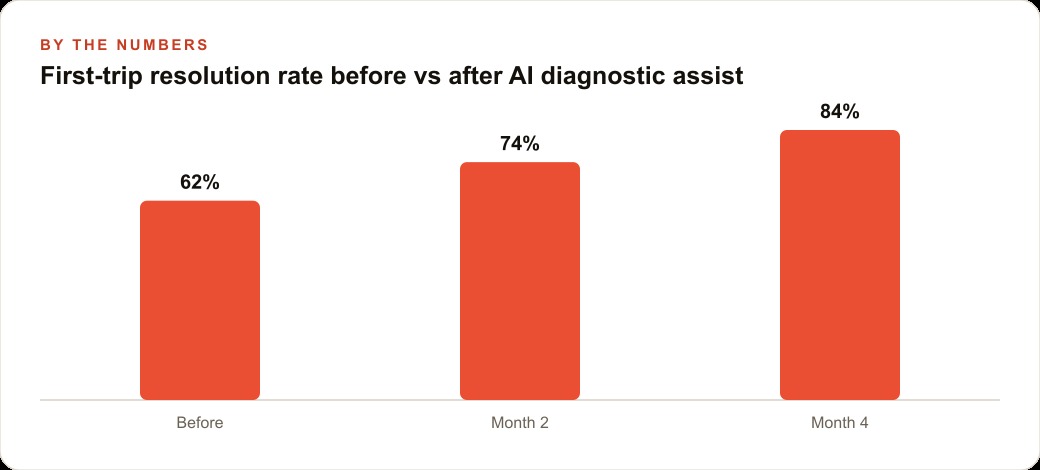
One trip instead of two. Customer satisfaction is higher. The scheduling slot recovered is booked with a new job. At $250 per service call average revenue, recovering four return-trip situations per month is $1,000 per month in additional revenue, plus the associated labor and fuel savings.
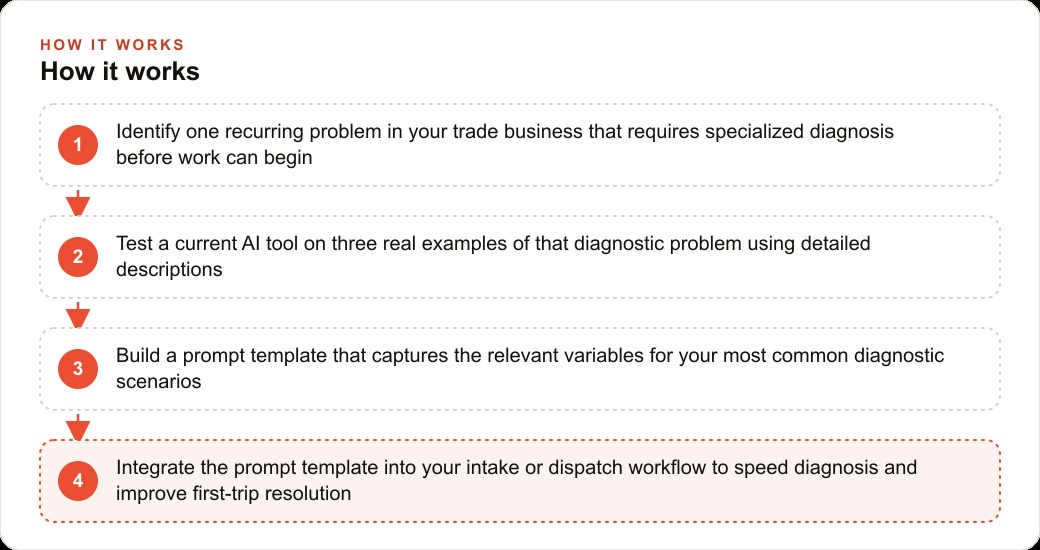
The prompt template for this workflow is straightforward to build: 'I am an electrician troubleshooting [symptom]. The panel is [brand/age]. Customer reports [additional symptoms]. I have ruled out [what was already checked]. Give me the three most likely causes in priority order and the field test that distinguishes between them.'
The second category of AI use for electrical contractors is job preparation. Before arriving at a commercial maintenance site, a technician can describe the site's system specifications to an AI tool and ask for the most common failure modes and inspection points for that configuration. The result is a pre-visit checklist tailored to the specific system type rather than a generic form. On larger jobs with unfamiliar equipment brands, this preparation step reduces the on-site time spent reading through installation manuals by a meaningful margin and reduces the chance of missing a fault that a prepared technician would catch immediately.
Code reference is the third practical category. Current AI tools produce accurate guidance on NEC sections for common residential and commercial scenarios with one important limitation: any code section number cited should be verified against the actual code before it is stated to an inspector or included in a written report. Using AI as a fast first-pass reference and the code book as the verification step is measurably faster than starting with the code book cold on every lookup, and builds a habit that keeps the AI tool in its correct role as an assistant rather than an authority.
What are the limitations of current AI for this domain?
The most important limitation is that AI models hallucinate code references. An AI tool that confidently states a specific NEC code section number can be wrong about the section number while being right about the underlying rule. Any code reference from an AI tool should be verified against the actual NEC before citing it to an inspector or a customer.
The second limitation is that AI tools do not have specific knowledge of local amendments to the NEC unless that information is in their training data, which is inconsistent. Permit requirements, local AHJ interpretation standards, and inspection preferences vary by jurisdiction, and AI tools are not reliable sources for this jurisdiction-specific information.
The third limitation is that AI diagnostic suggestions are only as good as the symptom description provided. A vague description produces a vague diagnostic direction. The electrician who learns to describe symptoms precisely, including what was tested and ruled out, gets significantly better diagnostic assistance than the electrician who provides minimal input.
How should an electrician start using AI tools in their field workflow?
Start with code lookups rather than diagnostics. For the next two weeks, any time you need to verify a code requirement, look it up in AI first and then confirm in the actual code book. This builds your sense of where the AI is reliable and where it makes errors, in a context where you can catch and verify the errors without consequence.
After two weeks of code lookup practice, move to diagnostic assistance on straightforward service calls where you are fairly confident you know the answer anyway. Use AI to generate the diagnostic checklist and compare it to what you were already planning to do. This calibrates your confidence in the tool for the scenarios where it overlaps with your expertise.
After four weeks, you will have a well-calibrated sense of which diagnostic scenario types benefit from AI assistance and which are better handled from your own experience alone. That calibration is the foundation for systematically integrating AI tools into your field workflow.
If you want help building a systematic knowledge capture and AI integration approach for your trade business, one that turns your expertise into structured prompts and diagnostic guides, that is a concrete engagement worth exploring.
The most valuable early investment alongside regular use is building a personal prompt library. Each time a prompt produces a useful diagnostic direction or a solid code reference summary, save it in a shared document with notes on the scenario it was built for. After three months of consistent use, a set of twenty to thirty calibrated prompts covers the majority of recurring scenario types on service calls. This library also becomes a training resource for apprentices, giving new technicians access to structured diagnostic thinking before they have accumulated the field experience to generate it independently.
Track one outcome metric from the beginning: the rate of single-visit resolution on diagnostic service calls. This is the metric most directly affected by AI-assisted diagnostic quality, and it translates most directly into recoverable revenue and customer satisfaction. Knowing the baseline before starting AI-assisted diagnostics makes it possible to measure the actual improvement after sixty to ninety days of consistent use, which is the data needed to decide how deeply to integrate AI tools into the standard field workflow.
That is exactly what we do at AI DOERS. Book a private 30-minute call with Madhuranjan Kumar and we will map the fastest path to it for your specific business.
Book your call →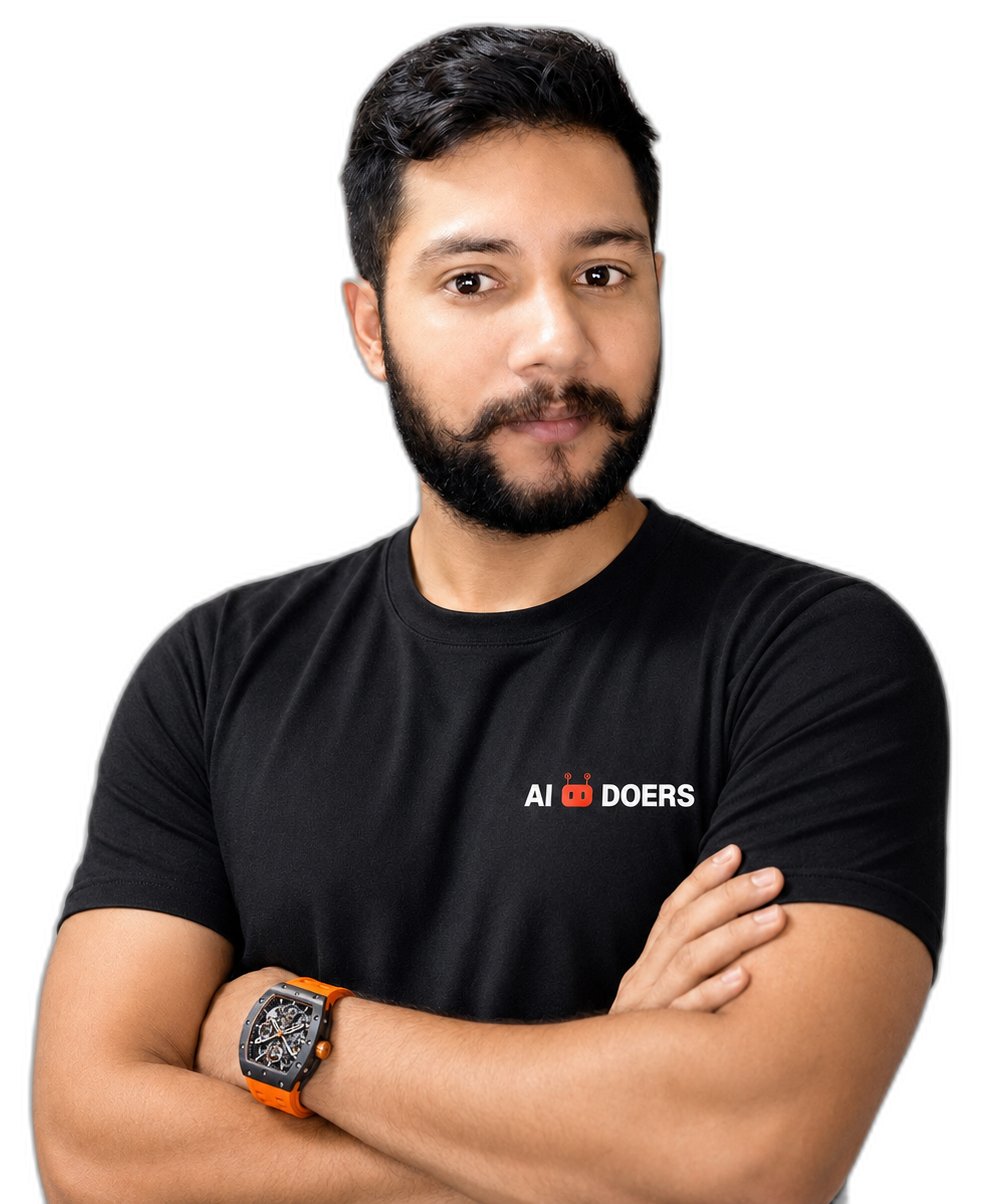
Madhuranjan Kumar
Madhuranjan Kumar brings 20 years of performance-marketing experience and has managed over $200 million in Facebook ad spend for brands across the United States and beyond. His expertise spans the full modern marketing stack: Meta, Google Ads, TikTok, email automation, CRM, and the websites that hold it together. At AI DOERS he turns that track record into lead-generation systems for businesses across every industry.