
DeepSWE: The Coding Benchmark That Finally Matches the Vibe Check
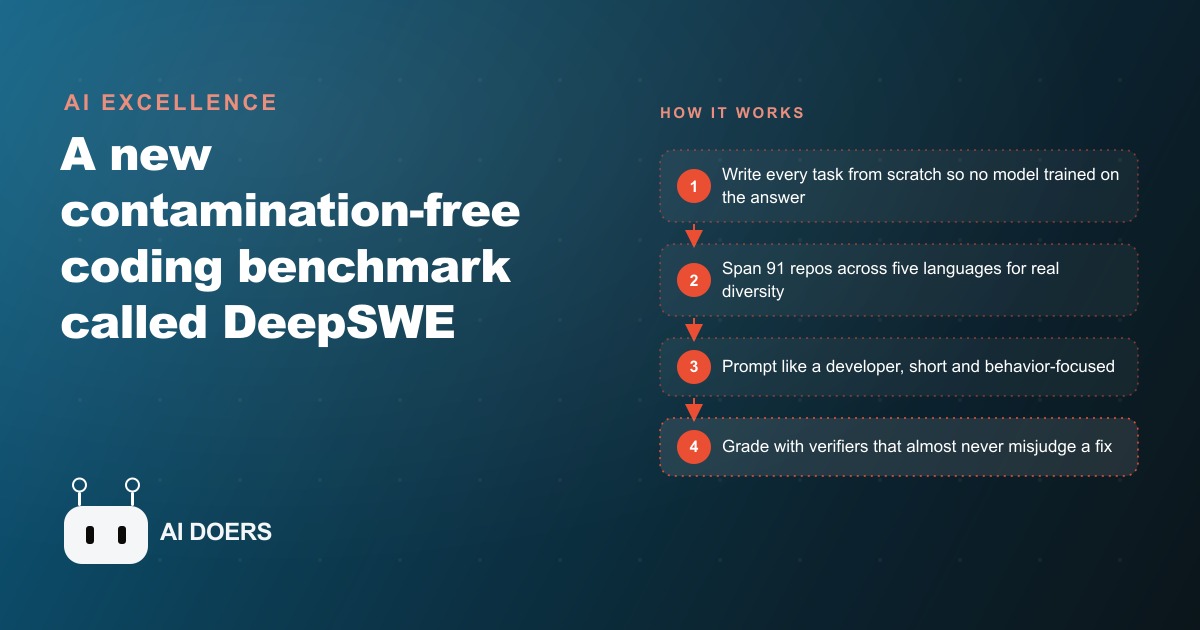
DeepSWE is a contamination-free, long-horizon coding benchmark that writes every task from scratch and grades with far more reliable verifiers. On it, GPT 5.5 leads Opus 4.7 by more than 15 points at roughly a third of the cost per trial.

Why Every Benchmark Before DeepSWE Was Partly Measuring Memory, Not Reasoning
Choosing the wrong model for your coding workload is not a one-time mistake. It compounds with every run, every week, and every month you continue paying for the wrong tool at the wrong price while getting lower output quality than a better choice would have delivered. The root of the problem is that most leaderboards the industry has relied on to make this selection were, at least in part, measuring whether a model had seen the answer during training rather than whether it could reason its way to a novel solution.
Every benchmark task adapted from a real GitHub issue, a public commit, or a Stack Overflow thread carries contamination risk. A model trained on billions of tokens of public code may have processed the solution during pre-training. When it solves the benchmark task, there is no reliable way to distinguish retrieval of a memorized pattern from genuine problem-solving. The benchmark score looks real. The selection decision built on it may not be.
This is not a calibration nuance. A 24 percent false negative rate in the grading system used by the most widely cited prior benchmark meant a correct solution was marked wrong almost one in four times. Teams using that leaderboard to pick models were evaluating scores built on unreliable grades for tasks that may have tested recall rather than reasoning. The practical consequence was that engineering teams chasing the leaderboard sometimes switched models every few weeks based on launch announcements that did not reflect real-world performance on their actual work.
DeepSWE addresses the contamination problem at the source. Every task is written from scratch by the benchmark authors, not adapted from any public repository. No model could have encountered the solution during pre-training. What a model earns on this benchmark, it earns by reasoning through a genuinely new problem.
Three Design Choices That Make the Scores on This Benchmark Actually Trustworthy
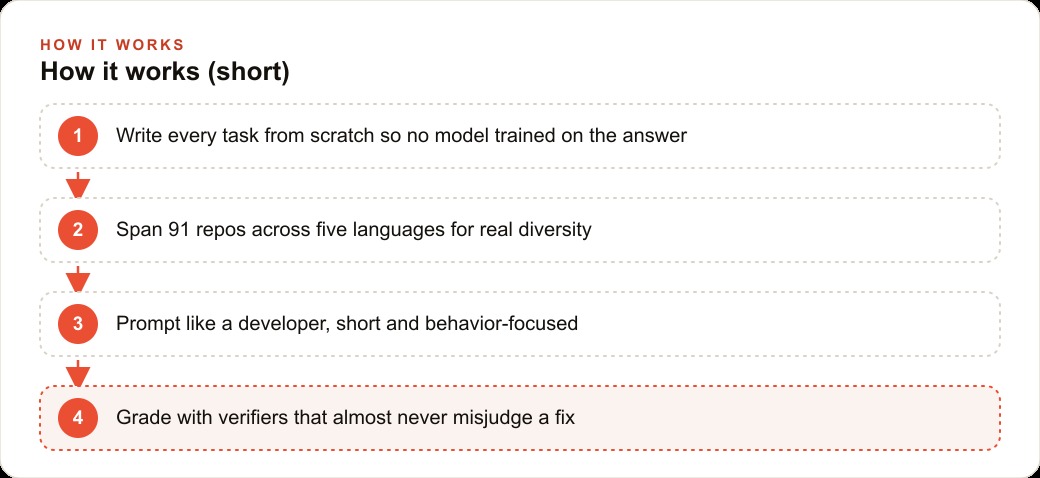
Contamination-free tasks are the foundation, but three additional design choices make DeepSWE scores useful for real selection decisions rather than just more defensible than prior benchmarks.
The first is genuine diversity across languages and repositories. Tasks span 91 active open-source repositories across five programming languages: TypeScript, JavaScript, Python, Go, and Rust. Earlier benchmarks were heavily Python-weighted, which meant models with stronger Python training looked better than they actually were on mixed-language production codebases. A team that builds primarily in TypeScript and selects a model based on a Python-heavy leaderboard may be optimizing for the wrong environment entirely. The 91-repository spread makes scores meaningfully more representative of real engineering teams' actual codebases.
The second is prompt style that matches real developer behavior. DeepSWE prompts are half the length of the prompts used in the older SWE-bench Pro benchmark, yet each task requires approximately 5.5 times more code output and twice the output tokens. The prompts sound like a senior developer writing a brief ticket: describe the behavior that needs to change, not the implementation steps for changing it. A model that only performs well on long prescriptive specifications is a model that will struggle the moment a developer hands it a short behavior-focused task description. This benchmark tests the actual interaction pattern rather than an artificial one.
The third is reliable verification. The prior benchmark had a false positive rate of 8.5 percent and a false negative rate of 24 percent. DeepSWE cut those to 0.3 percent and 1.1 percent respectively. The false negative rate is the one that distorts selection decisions most badly, because a correct solution being marked as wrong inflates the apparent gap between models that actually perform similarly and deflates the apparent quality of the stronger model's work. At 24 percent false negatives, comparative scores are built on a grading system that is wrong one in four times. Any team using those scores to justify switching models is working from a shaky foundation.
Together, these choices produce a benchmark where scores spread out meaningfully across the full capability range. The strongest configuration tops 70 percent and weaker configurations score far below that. A meaningful spread is what makes a benchmark useful for selection decisions rather than producing a table of numbers clustered within a few points of each other where no clear winner emerges.
What the Leaderboard Shows When the Data Is Finally Clean
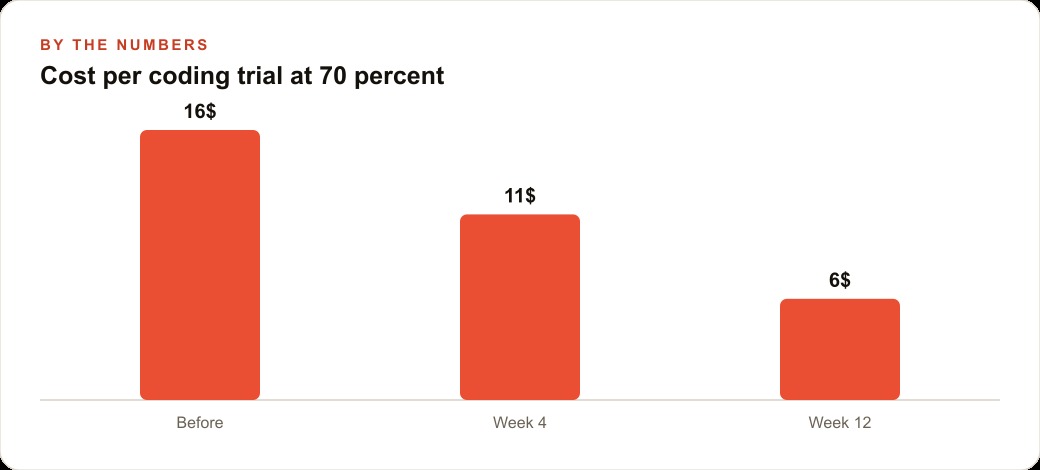
The headline result from DeepSWE is striking precisely because most prior benchmarks showed the top models clustered together. On the contamination-free leaderboard, the leading GPT configuration reaches 70 percent. Opus 4.7 scores more than 15 points lower. Most widely used benchmarks showed these two families roughly tied or within a few percentage points. A 15-point gap that appears when contamination is removed and grading is reliable suggests that prior apparent parity was at least partly an artifact of benchmark design rather than a reflection of actual capability differences.
The gap appears across specific task categories, not just in aggregate. On tasks that require reading existing code contracts in a repository and honoring them without being explicitly told what they are, the higher-scoring model family reads visible code and interprets it literally, patching to honor both the documented behavior and the implied contracts in the surrounding code. That precision on stated requirements is a specific capability that produces measurably different results when the benchmark is designed to isolate it.
The lower-scoring family scores below its headline number on this specific class of task but demonstrates a genuine strength in a different area: when the prompt and the codebase do not immediately align, it explores recent git history and existing patterns before deciding how to proceed. That investigative instinct recovers context that a more literal reader might miss, and it can surface a correct solution from situations where the task as stated is ambiguous. The benchmark captures both the weakness and the strength, which is what makes it useful.
The Token Burn Gap Is Where the Real Cost Difference Lives
When one model family reaches 70 percent at $5.80 per trial and another family scores lower while burning roughly $16 per trial, the cost difference is not a pricing artifact. It reflects a genuine difference in how the two families approach the same task.
The lower-scoring family in this benchmark uses a median of approximately 60,000 output tokens per solution. The higher-scoring family uses approximately 16,000 output tokens for equivalent or better results. The difference is not in the quality of the final code. The difference is in the reasoning path to get there. One family reasons verbosely, explores multiple paths, and produces substantially more text before arriving at the solution. The other reasons more efficiently toward the explicit requirements of the task.
The latency difference compounds the cost difference. The more expensive family runs each trial at roughly 37 minutes. The more efficient family completes the same task in approximately 20 minutes. For a team running coding agents across multiple tasks in parallel, twice the speed at a third of the cost is not a marginal improvement. It is a workload capacity multiplier.
Here is the concrete case. A SaaS startup is running a coding agent on recurring tasks: dependency updates, test generation, documentation patches, and small feature additions described in short engineering tickets. The team runs 500 such tasks per month. At $16 per trial, monthly model spend is $8,000. A colleague reviews the DeepSWE leaderboard and notices the $5.80 per trial alternative scores 15 points higher at a third of the cost. The team runs a 50-task internal evaluation using their actual engineering tickets with the same short behavior-focused prompt style the benchmark uses. The results align with the leaderboard: the lower-cost model handles explicit-contract tasks with fewer missing branches and completes each task roughly 17 minutes faster.
Switching to the lower-cost model saves $5,100 per month, or $61,200 per year, at equivalent or better output quality on their actual task distribution. The internal evaluation cost was a few hundred dollars in API calls and two days of an engineer's time. The payback period was under two weeks.
Claude's Specific Failure Mode and What to Build Around It
The behavioral finding in DeepSWE with the most direct operational implications is the parallel-requirements failure mode identified in the lower-scoring model family. When a task prompt enumerates multiple parallel behaviors, the classic example being "support both sync and async" or "handle both the success path and the error path," the model frequently implements the most obvious branch and leaves the others incomplete. The benchmark records this as a misstated requirement because the code the model produces is often correct for the branch it chose. The gap is in the completeness of the solution across all stated requirements.
This failure mode is systematic and predictable, which means it is also preventable with a workflow adjustment that costs almost nothing. Knowing it exists is the entire value of a benchmark that surfaces behavioral patterns rather than just aggregate accuracy scores.
The prevention is one line added to a PR review checklist: when a ticket enumerates multiple parallel behaviors, the reviewer confirms every branch was addressed before approving the PR. That single checklist item catches the full class of failures the benchmark identifies as the most common error pattern for this model family. It takes five minutes per PR in the cases where it applies and prevents the entire category of intermittent regressions that appear when the less-tested branch is hit in production.
The complementary strength of this model family is its investigative behavior when context is incomplete. It explores recent git history when the prompt and repository do not immediately align, and it can recover the correct solution from situations where a more literal reader would stall. Teams whose work frequently involves ambiguous task descriptions or codebases where the prompt alone does not surface the relevant context may find this characteristic specifically valuable and worth weighing against the parallel-requirements weakness.
How a SaaS Team Uses This to Make a Model Choice That Holds Up
The benchmark's value is not just in reading the leaderboard. It is in using the findings to build a selection process that holds up as models evolve and pricing shifts.
For the SaaS startup in the example above, the process after the initial switch is three steps. First, the team adds the parallel-requirements checklist item to their PR review template immediately. This prevents the class of bugs the benchmark identifies as most common without requiring any change to how prompts are written. Second, the team documents what they found in the internal evaluation: which task types the chosen model handled better, which it handled less well, and the specific prompt patterns that produced the best results. That documentation becomes the team's internal benchmark baseline for future evaluations. Third, the team schedules a repeat evaluation every six months. Model pricing and capability both shift as providers release new versions and adjust costs. A team that picked the right model in early 2025 and never revisited the decision may be paying a premium for a model that was best a year ago but has since been overtaken by a more efficient option.
The six-month evaluation cycle cost is a few hundred dollars in API calls and a day of engineering time. Against $61,200 in annual model savings from getting the initial selection right, that is a 0.5 percent maintenance cost on the value of the decision. That ratio makes the evaluation cycle one of the highest-return investments an engineering team can make in its tooling.
The benchmark is the infrastructure that makes all of this possible. Getting the benchmark wrong means making model selection decisions blind, building on contaminated scores and unreliable grades. Getting it right means every month of model spend is optimized against something verifiable, and every workflow adjustment is targeted at a real and documented failure mode rather than a guess about what might be going wrong.
The underlying takeaway is worth stating plainly: the benchmark is not the product. The product is the model selection decision, the prompting policy, and the workflow adjustment that the benchmark findings make possible. DeepSWE earns its place as the most useful benchmark in this category not because its scores are the final word on any model's quality, but because its design choices make the scores more trustworthy than the scores that came before it. Trustworthy scores lead to better decisions. Better decisions lead to real savings and real quality improvements. That is what makes it worth tracking as models evolve and the leaderboard shifts.
That is exactly what we do at AI DOERS. Book a private 30-minute call with Madhuranjan Kumar and we will map the fastest path to it for your specific business.
Book your call →
Madhuranjan Kumar
Madhuranjan Kumar brings 20 years of performance-marketing experience and has managed over $200 million in Facebook ad spend for brands across the United States and beyond. His expertise spans the full modern marketing stack: Meta, Google Ads, TikTok, email automation, CRM, and the websites that hold it together. At AI DOERS he turns that track record into lead-generation systems for businesses across every industry.