
DeepSeek V4: Near-Frontier AI at a Fraction of the Cost
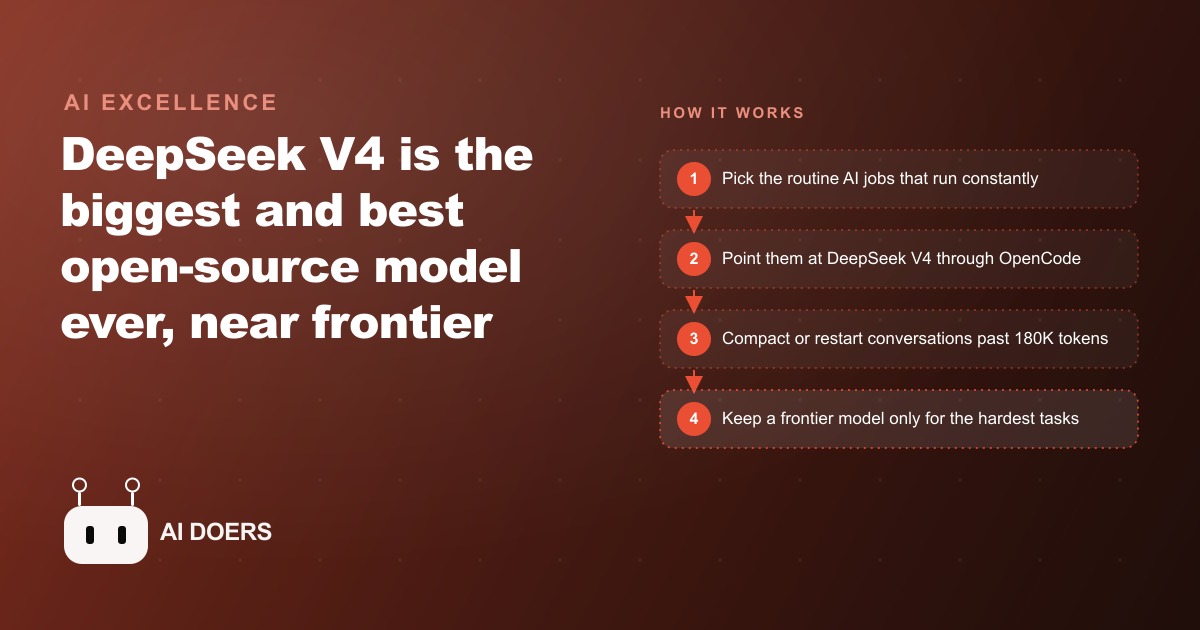
DeepSeek V4 is the largest open-source model ever at 1.6 trillion parameters, delivering near-frontier quality while costing roughly 7 times less than Claude Opus 4.7 and about 40 times less than GPT-5.5 Pro.

Most businesses are dramatically overpaying for AI right now, and the reason is not laziness or ignorance. It is that the cost structure changed very recently and the default is always the last decision made rather than the best current decision. I am Madhuranjan Kumar, and I want to be direct: if you are running routine business AI tasks on a frontier model at thirty dollars per million output tokens when a model delivering comparable results for a fraction of that cost exists and is available today, you are paying a premium that no longer reflects any quality advantage on the work you are actually doing.
Forty times cheaper at comparable quality is not a discount. It is a different category.
DeepSeek V4 is the largest open-source AI model released so far, at 1.6 trillion parameters total, with roughly 47 billion active per prompt through a mixture-of-experts architecture. It launched the same day as GPT-5.5 and costs roughly seven times less than Claude Opus 4.7 and about forty times less than GPT-5.5 Pro for comparable tasks. On coding benchmarks like LiveCodeBench and Codeforces it beats both of those models outright. On the very hardest reasoning edge cases it trails slightly.
The argument I want to make is that "trails slightly on the hardest edge cases" is irrelevant to the decision for the vast majority of business AI use. You are not cracking unsolved mathematical problems. You are running a real business with real customers. The questions your AI handles are: what does this customer's message mean, what should the reply say, what does this document contain, what is the best subject line for this email, how should I categorize this support ticket. For every one of those tasks, the gap between forty-times-cheaper and most-expensive-available is functionally zero in terms of the output quality that your customers actually experience.
The math changes which tasks are worth automating entirely
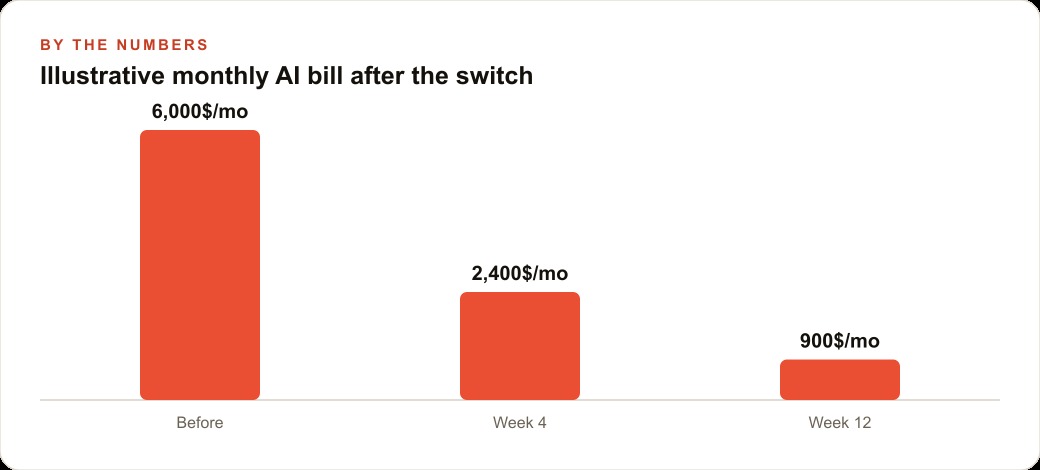
The most consequential effect of a forty-times price reduction is not savings on existing automation. It is that it changes which tasks are economically rational to automate in the first place. At frontier pricing, you build the business case for automating the high-volume, high-impact tasks and leave the medium-volume tasks to be done manually because the math does not close. At forty-times-cheaper pricing, you automate the medium-volume tasks too, and you get the same coverage for a fraction of the original budget.
An auto repair shop getting 80 inbound messages a day runs about 2.4 million tokens per month through an AI model handling those messages. At frontier pricing, that is a real monthly line item. At forty-times-cheaper pricing, it is negligible. The difference is not just the savings on the existing messages. It is that at the lower price, the shop also automates the technician note-to-customer-summary workflow, the review request sequence, and the landing copy for the seasonal promotion, because none of those tasks individually justify the frontier-model cost but all of them justify the fractional cost. The shop gets five workflows automated for less than the frontier-model cost of one.
This is the actual business opportunity in this release: not switching your existing automation to a cheaper model and pocketing the savings, though that is available immediately. It is expanding the scope of automation to cover every medium-frequency task that was previously below the cost-benefit threshold, at a total monthly spend that is lower than what you were paying for the narrower automation before.
Open weights means the cost advantage is yours to own, not rent
The model is open-weights. That means a company can download it, run it on its own infrastructure, fine-tune it on its own data, and eliminate the per-token bill entirely beyond the infrastructure cost. The cost structure becomes fixed rather than variable, which is a fundamentally different operational reality for a business that wants to scale its AI usage without watching the API bill scale proportionally.
Fine-tuning on your own data is the capability that makes open weights commercially interesting beyond just the price. A model fine-tuned on a year of your own customer service transcripts, calibrated to your terminology and your policies, handles your specific use cases better than a general-purpose frontier model handling them generically. A fine-tuned model on a flat-cost self-hosted infrastructure is also more private than a managed API endpoint, because the data never leaves your infrastructure during inference.
For businesses running Facebook and Instagram ad campaigns where AI generates high volumes of creative copy variations for testing, fine-tuning on approved past creatives that performed well above benchmark gives the model a target aesthetic rather than a generic "write me an ad" output. The quality of the first draft improves, the editing time per creative decreases, and the volume of testable variations per week increases, all from a model that runs at a fraction of the frontier API cost.
The practical limit to know before you commit
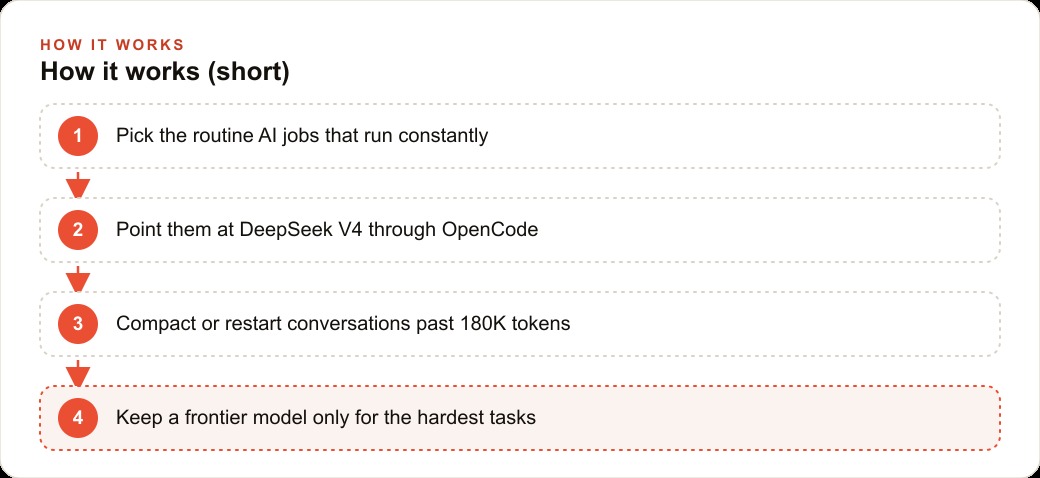
The long context performance of V4 degrades meaningfully after about 128,000 to 200,000 tokens in a single session. The advertised one-million-token context window is a ceiling, not a practical operating number. Workflows that require stuffing a full archive of documents into a single enormous prompt will hit quality degradation before they reach the window limit. The correct design for those workflows is chunking, compaction, and session restarts rather than single-session megaprompts.
For the tasks most businesses actually run at high volume, this limit is not a daily constraint. A customer reply, a document summary, a copy variation, a ticket classification: none of these approach the context limit. The constraint matters for workflows that specifically require very long contexts, like end-to-end analysis of a lengthy legal document or processing a full year of transaction records in one pass. Those workflows need a frontier-model or a carefully designed chunking architecture. Everything else can run on V4 without hitting the limit in normal operation.
The practical setup is a hybrid. Run all volume tasks on V4 or V4 Flash. Keep a frontier model wired in for the handful of tasks per day that genuinely benefit from frontier-level reasoning quality. Monitor which tasks get routed where and adjust the routing as you learn where the quality difference is large enough to justify the cost difference. That ongoing calibration is the work that captures the full cost advantage while maintaining quality where quality matters most. The businesses that do this calibration work in the next month will have a cost structure their competitors will spend the rest of the year trying to match.
Building on top of V4 through an SEO and content workflow at scale is the other concrete application worth naming. If your content operation generates first drafts at high volume, the per-piece AI cost at forty-times-cheaper rates changes whether producing two hundred pieces per month is economically viable versus producing twenty. The businesses that can produce more content at lower marginal cost compound their organic presence faster, which reduces their dependence on paid channels over time and improves their overall unit economics across Google Ads and social paid media simultaneously.
That is exactly what we do at AI DOERS. Book a private 30-minute call with Madhuranjan Kumar and we will map the fastest path to it for your specific business.
Book your call →
Madhuranjan Kumar
Madhuranjan Kumar brings 20 years of performance-marketing experience and has managed over $200 million in Facebook ad spend for brands across the United States and beyond. His expertise spans the full modern marketing stack: Meta, Google Ads, TikTok, email automation, CRM, and the websites that hold it together. At AI DOERS he turns that track record into lead-generation systems for businesses across every industry.