
The AI Scramble After DeepSeek Is Creating Real Tools for Auto Repair Shops Right Now
When DeepSeek disrupted the AI market, every major tech company responded within days by integrating new models and adding thinking features, and the resulting wave of tools is directly applicable to service businesses like auto repair shops.
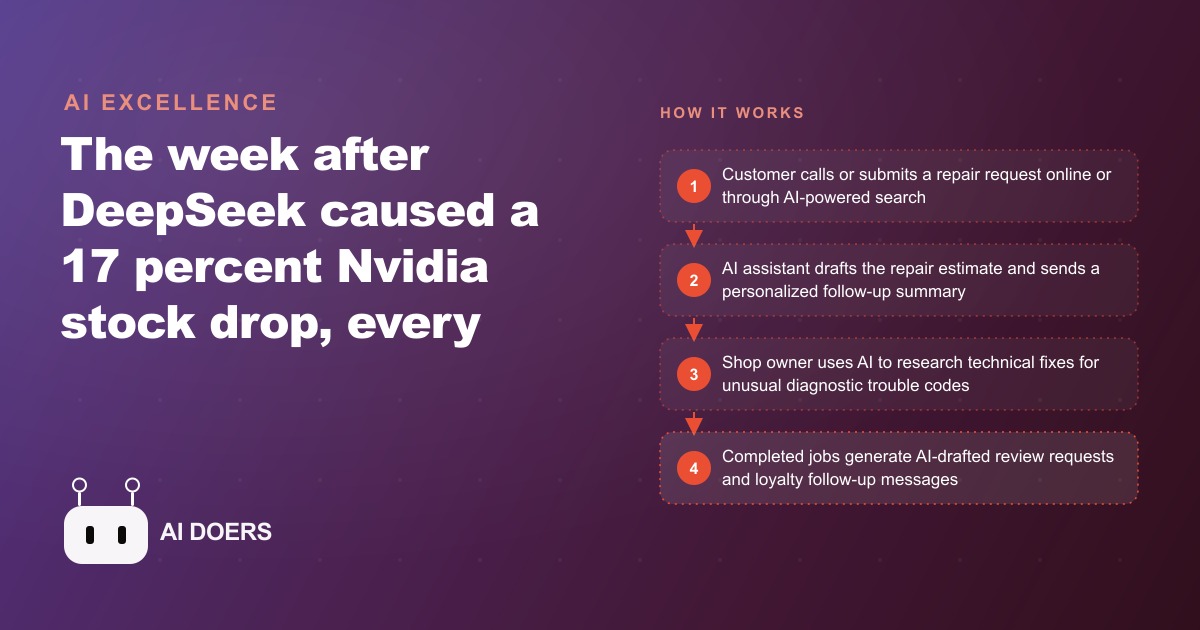
The week DeepSeek's V3 model dropped Nvidia's stock by 17 percent was, by any measure, the most active week in AI product history. I am Madhuranjan Kumar, and I tracked every announcement. Here is what actually happened, why an auto repair shop in Denver sits in exactly the right position to benefit, and what the owner's week looked like three months after the scramble.
The week every AI company moved at once: what actually shipped
The stock drop was a market misread. Jevon's Paradox explains why: when a technology becomes cheaper, total consumption of it increases rather than decreases, because more applications become economically viable. GPU demand is driven primarily by inference, running models to generate responses, not by training new ones. As AI adoption expands because of lower costs, inference demand grows and that growth requires more GPUs, not fewer. The 17 percent drop was a short-term reaction to a misread of the cost curve.
What happened in the days following was a sprint. Microsoft added DeepSeek R1 to Azure AI Foundry and GitHub within days, giving enterprise developers access through Microsoft's security and compliance infrastructure. Perplexity Pro users gained the ability to switch to R1 reasoning mode alongside the existing OpenAI reasoning mode. Nvidia released a microservice for R1 running at 3,872 tokens per second on its H200 systems. Windsurf added both R1 and V3 for coding. OpenAI accelerated its own response: the o3 mini model launched within the same week, and the Canvas tool was updated to render live HTML and React previews directly inside the interface. Microsoft Copilot launched Think Deeper, routing to the o1 model, available to all Copilot users at no additional cost.
In the same week, Google began testing "Ask for Me," a Search feature where an AI agent calls local businesses on a user's behalf to check prices and availability before the user makes direct contact. Pika Labs released a 1080p video model with a turbo mode running at three times the previous speed, requiring seven times fewer credits per generation. Alibaba released QWQ 32B under a free Apache license, a reasoning model comparable to DeepSeek R1, available at no cost through chat.qwen.ai including image and video capabilities.
The pace of that single week exceeded what most industries see in a full year. For the businesses paying attention, it represented the fastest compression in the cost and capability of AI tools in the technology's history.
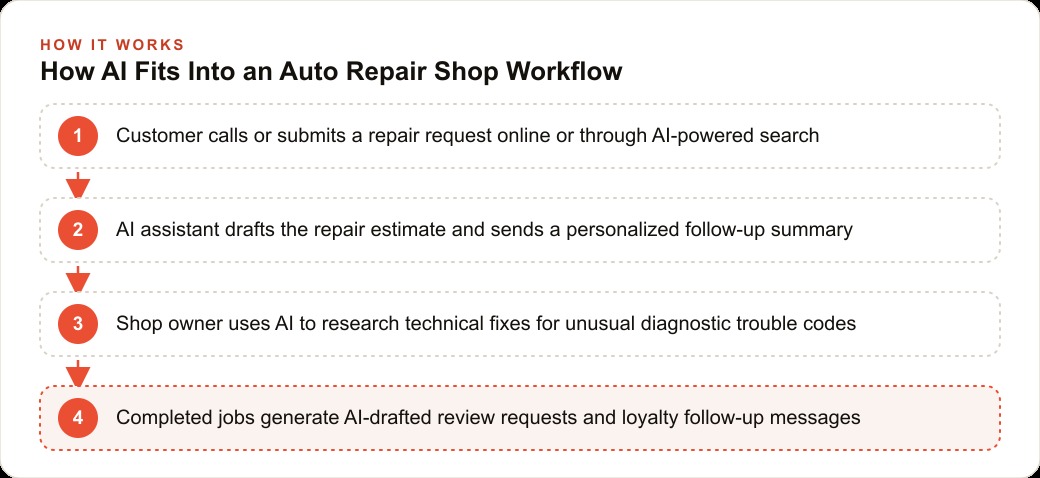
An auto repair shop sits in exactly the right position to benefit
Independent auto repair shops share a specific operational profile that maps directly onto the tools that came out of the DeepSeek scramble period. Their customer interactions are high-stakes and often technical. Customers who do not understand cars are making significant financial decisions based on information they cannot independently verify. Clear, honest, well-written communication builds trust faster than any other factor the shop controls, and it is also where the most administrative time goes.
The shop in this example handled about forty service jobs per week with three technicians and the owner managing all customer communication personally. Six hours per week went to tasks that did not require technical expertise: writing repair summaries for customers, following up on appointments, requesting reviews, and responding to online reviews. Six hours is a quarter of a full workday. Across a month it is a full working day spent on communication tasks that could be systematized.
The DeepSeek scramble mattered to this shop not because of the technical details of any specific model release but because the competition among AI companies to match DeepSeek's capability-per-dollar ratio pushed enterprise-grade reasoning features into free and twenty-dollar-per-month tiers. The shop owner did not need to know what a reasoning model is. They needed to know that the tool that now handled complex, multi-variable communication tasks for free was the same tool that previously required a subscription tier most small businesses could not justify.
Building the repair-summary prompt that saves four hours a week
The first workflow built was a template prompt for repair summaries. The owner wrote a prompt that instructed the AI to produce a plain-language customer explanation of a completed repair given a bulleted list of work performed, parts replaced, and total cost. The prompt specified the tone: reassuring, non-technical, specific about what was fixed and why it matters for the vehicle's performance, and ending with a clear statement of the warranty on the work.
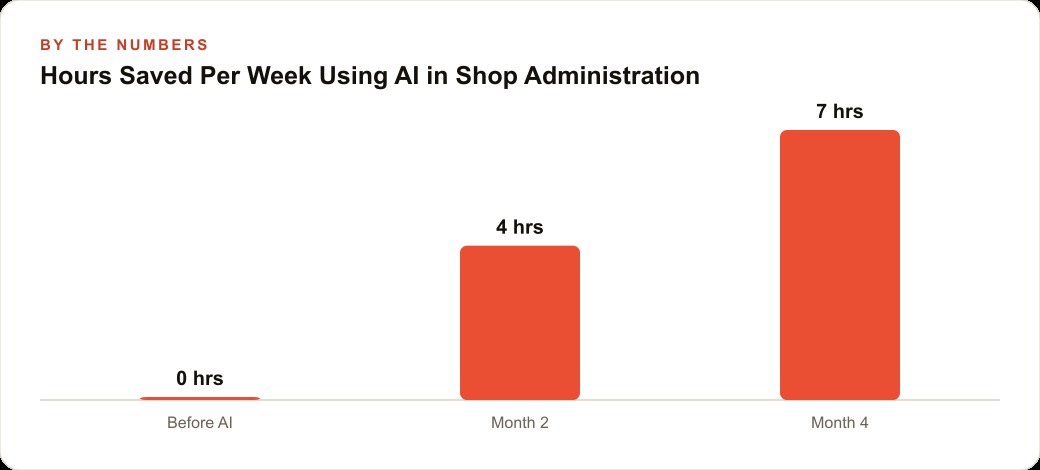
After each job completion, the owner pasted the job details into the prompt, received a two-paragraph customer-ready summary in about ten seconds, copied it into the invoice email, and sent. The task dropped from eight minutes per job to about ninety seconds. Across forty jobs per week, that recovered roughly four hours.
The prompts for review responses followed a similar structure. One prompt handled positive reviews: acknowledge the specific service mentioned, thank the customer by name for the feedback, and invite them back for their next service. A second prompt handled negative reviews: acknowledge the concern without being defensive, briefly explain the shop's process, and offer a direct path to resolution. The owner pasted the review text, received a draft, adjusted any detail that needed a personal touch, and posted.
The first week of using both prompts, the owner tracked the time savings. Four hours on summaries. About ninety minutes on review management across a week of typical volume. A full business day recovered and redirected to customer interaction and shop management rather than administrative writing.
Preparing for Google's AI agent that calls businesses on behalf of customers
The "Ask for Me" feature being tested in Google Search represents a fundamental shift in how some customers will interact with local service businesses. An AI agent calls a shop to ask what a brake job costs on a specific vehicle before the user ever sees the shop's phone number. If the staff cannot answer pricing questions quickly, clearly, and consistently, that inquiry may convert to a competitor whose staff can.
The preparation for this is low-tech: a one-page reference card listing pricing ranges for the thirty most common services, updated monthly by the service manager. When an AI agent calls to check prices, or when a customer asks a front-desk staff member to quote a job over the phone, the reference card ensures answers are fast, consistent, and accurate regardless of who picks up the call.
The shop also trained the front desk to handle the specific pattern of an AI-mediated inquiry: a caller that asks very specific, structured questions about pricing and availability without engaging in the informal back-and-forth of a typical customer call. The response protocol is the same as for any pricing inquiry, but the staff now recognizes the pattern and does not spend time trying to turn the call into a conversation.
For Google Ads campaigns targeting high-intent local searches, this preparation matters because the "Ask for Me" feature intercepts exactly the type of high-intent query that paid search is designed to capture. A shop that ranks for "brake job near me" through paid search but loses the AI-mediated inquiry because the pricing reference is inconsistent is paying for traffic that another business's operational readiness captures.
Three months after the scramble: what the shop's desk work looks like now
Three months after the shop owner began using the tools that emerged from the DeepSeek scramble period, the six hours per week of administrative communication time had dropped to about ninety minutes. The summary prompts ran automatically as part of the job-close workflow. The review response prompts handled every review within twenty-four hours, which the owner had not consistently achieved before. The pricing reference card fielded AI-agent inquiries and walk-in quote requests with the same information.
The recovered time went into two places. First, more direct customer contact: the owner called customers personally on every job over a certain dollar amount to explain the work before sending the invoice, a practice they had wanted to establish for years but could never find the time for. The calls produced a measurable increase in the customer return rate over the quarter. Second, more attention to the SEO and organic search footprint: the owner began responding to every Google review rather than just the negative ones, which improved the shop's review signal in local search ranking over the same period.
The total cost of the AI tools used: the reasoning model access through Microsoft Copilot Think Deeper, which was free, plus a twenty-dollar ChatGPT Plus subscription for higher-volume use during the busiest weeks. Against a recovered workday's worth of owner time per week, the return on that investment does not require a complex calculation.
The broader lesson from tracking the DeepSeek scramble week is not about any specific model or any specific company's announcement. It is that the pace of capability improvement in these tools now outpaces most businesses' adoption rates. The shops and clinics and service providers that build even one productive workflow in the next quarter will be operating differently from their competitors before the end of the year, not because the technology is magic but because the consistency and speed advantages compound visibly over months of real use.
The business case for deeper research before any major content investment
Content marketing investment, whether in blog articles, video series, or social media campaigns, compounds when the topics are correctly chosen and fails to compound when the topics are chosen by guessing at what the audience wants. The research that identifies which topics have high audience intent and low existing coverage quality is the work that makes the difference between a content investment that builds sustained traffic and one that produces isolated outputs with no compounding effect.
AI-assisted research accelerates this topic identification significantly. Instead of manually reviewing competitor content, checking search volume tools one term at a time, and synthesizing the findings across multiple research sessions, a structured AI-assisted research process can surface the topic landscape for a niche in a fraction of the time. The quality of the research determines the quality of the content calendar, which determines whether the content investment compounds.
For a business also investing in search advertising, the topic research for content and the keyword research for ads overlap significantly. The queries that customers use to find information before making a purchase decision are the same queries that should inform both the content calendar and the ad keyword strategy. Research that covers both dimensions simultaneously produces a more coherent customer acquisition strategy than research conducted separately for each channel.
The distribution plan that content research should inform
Research that identifies what to write is necessary but not sufficient. The distribution plan, which channels will carry the content, what format variations will be produced for each channel, and what paid promotion will amplify organic distribution, determines whether the content reaches the audience it was written for.
For most small and medium businesses, the distribution capacity is the constraint, not the production capacity. AI assistance has made it faster to produce good content. It has not made distribution channels more available or algorithms more favorable. The businesses that achieve the highest return on content investment are the ones that produce less content and distribute each piece more thoroughly across the channels where their audience is active, rather than producing more content with minimal distribution per piece.
A blog article that is distributed as the source for a LinkedIn post, two short-form social posts, a newsletter section, and a paid promotion on the highest-performing channel for the niche reaches far more of the target audience than a blog article that is published and linked once from a social profile. The distribution work is repeatable and structured enough that it benefits from the same systematic approach as the research and production work.
The connection between content distribution and meta advertising investment is direct for businesses that use paid promotion to amplify high-performing organic content. Identifying which organic content pieces are performing well on a content and SEO basis and putting paid promotion behind them captures additional reach from content that has already demonstrated audience relevance, which is a lower-risk allocation of advertising budget than promoting content that has not been validated organically.
That is exactly what we do at AI DOERS. Book a private 30-minute call with Madhuranjan Kumar and we will map the fastest path to it for your specific business.
Book your call →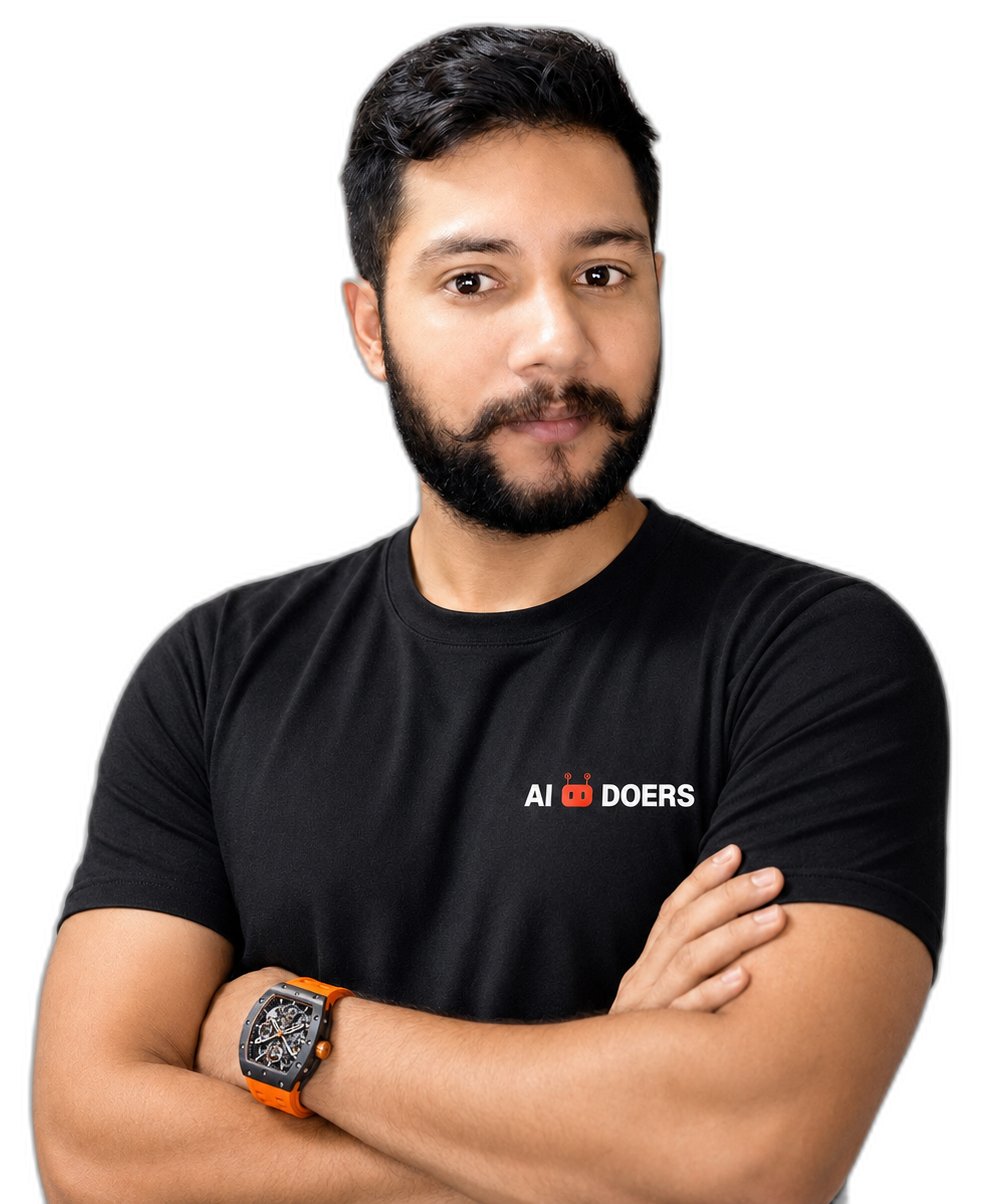
Madhuranjan Kumar
Madhuranjan Kumar brings 20 years of performance-marketing experience and has managed over $200 million in Facebook ad spend for brands across the United States and beyond. His expertise spans the full modern marketing stack: Meta, Google Ads, TikTok, email automation, CRM, and the websites that hold it together. At AI DOERS he turns that track record into lead-generation systems for businesses across every industry.