
DeepSeek 3.2 Is Back, but Claude Opus 4.5 Still Wins the Week
DeepSeek's new open-source model lands near frontier benchmarks yet trails on real builds, which is the whole lesson: test a model on your own task, not its leaderboard score, before you wire it into your business.

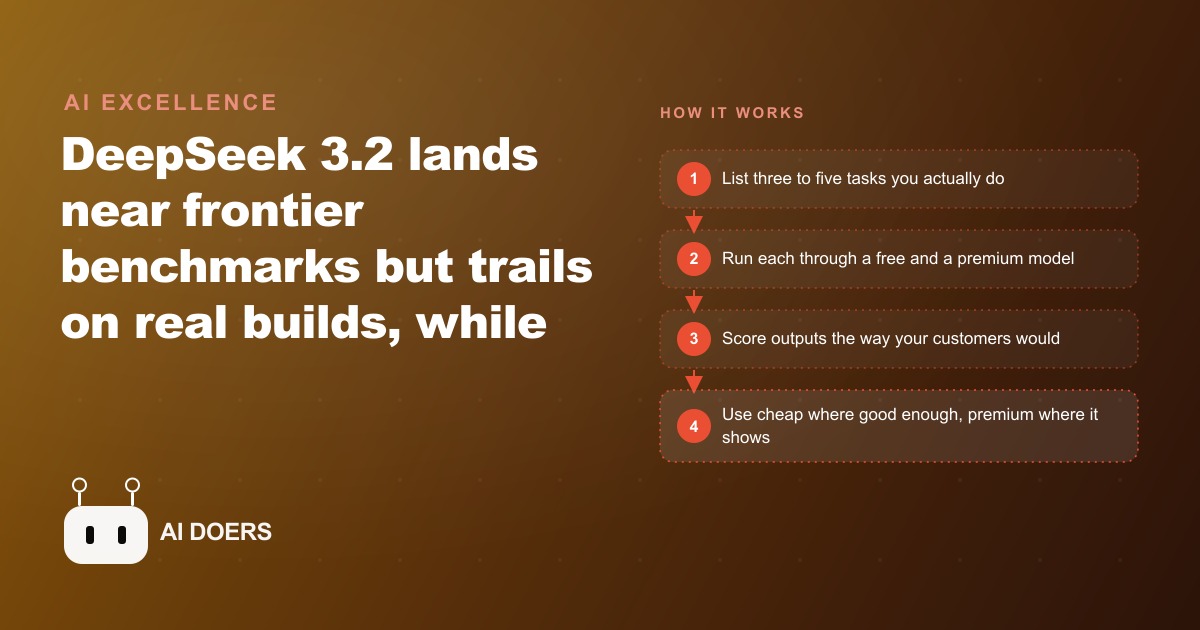
DeepSeek 3.2 scores around 93 on general benchmarks where the leading competing model sits at 95. That two-point gap looks like near-parity. On a real creative and technical build task run with the same prompt, the output quality gap was far wider, and that divergence is the most important thing to understand about how AI models are evaluated and chosen today.
I am Madhuranjan Kumar, and I track these comparisons not to declare winners in a tech competition but because model selection is one of the most consequential and least-discussed decisions a business makes when deploying AI. Choosing the wrong model for the wrong task produces mediocre output at scale, trains the team to distrust AI generally, and creates a recovery problem that is harder to solve than the original inefficiency the business was trying to fix.
Why benchmarks and build quality diverge (the measurement problem)
A benchmark is a test designed by its creators to measure a specific capability, on a specific set of examples, under controlled conditions. The model's score on that test tells you how it performed on that test. It does not tell you how it performs on the specific prompt you will actually use, with the specific kind of output you actually need, evaluated by the standard your actual audience will apply.
The gap between benchmark performance and task performance exists because benchmarks measure what is easiest to measure: accuracy on defined questions with defined answers. They do a reasonable job of capturing mathematical reasoning, factual recall, code correctness on well-specified problems, and logical inference. They do a poor job of capturing aesthetic quality, the coherent handling of ambiguous requirements, the ability to maintain consistency across a long multi-step output, and the kinds of judgment calls that produce a result that actually works in a real context.
A model trained heavily on benchmark-adjacent data can achieve high benchmark scores without developing the broader capabilities that benchmark scores are being used as proxies for. This is not unique to AI. It is a general problem with proxies: once a proxy becomes the target, the connection between the proxy and the underlying quality it was supposed to measure weakens. A model optimized to score well on benchmarks will score well on benchmarks. Whether it also produces high-quality outputs on real tasks depends on whether the benchmark training generalized to real-task performance or just to benchmark performance.
The practical implication for a business is straightforward: a model's benchmark score is a screening filter, not a selection criterion. If a model scores very poorly on benchmarks, it is likely weak on a broad range of tasks. If it scores near-frontier, it is likely capable in many areas. But between two models with similar benchmark scores, the one that performs better on your specific task is the one you should use, and the only way to find out which that is is to test both on your actual work.
What a real build test actually reveals that a benchmark cannot
The comparison that emerged from a week of side-by-side testing was specific: DeepSeek 3.2 and Claude Opus 4.5 were given the same prompt for a real build task, producing a visually sophisticated studio website in a single-file output. The benchmark scores of the two models were close. The outputs were not.
DeepSeek's output was functional in the sense that it was valid code. It lacked the visual hierarchy, the compositional choices, and the design judgment that made the Claude Opus 4.5 output actually look like a professional studio site rather than a generic template. The same instruction, applied to two models with similar benchmark scores, produced outputs at noticeably different quality levels on a task that required aesthetic judgment and holistic design thinking rather than just technical accuracy.
This reveals something important about the category of work where benchmark divergence is most misleading. Mathematical benchmarks, coding accuracy benchmarks, and factual QA benchmarks reward precision and correctness, which are well-defined. Creative, compositional, and multi-step production tasks reward coherence, quality of judgment, and the ability to hold a consistent vision across many interdependent decisions. The latter category does not decompose neatly into a benchmark score.
A real build test, run on your own kind of work, with your own prompt, evaluated by the standard your audience will actually apply, tells you something that no leaderboard does. It tells you whether the model makes the kinds of judgment calls that produce a result you would actually ship.
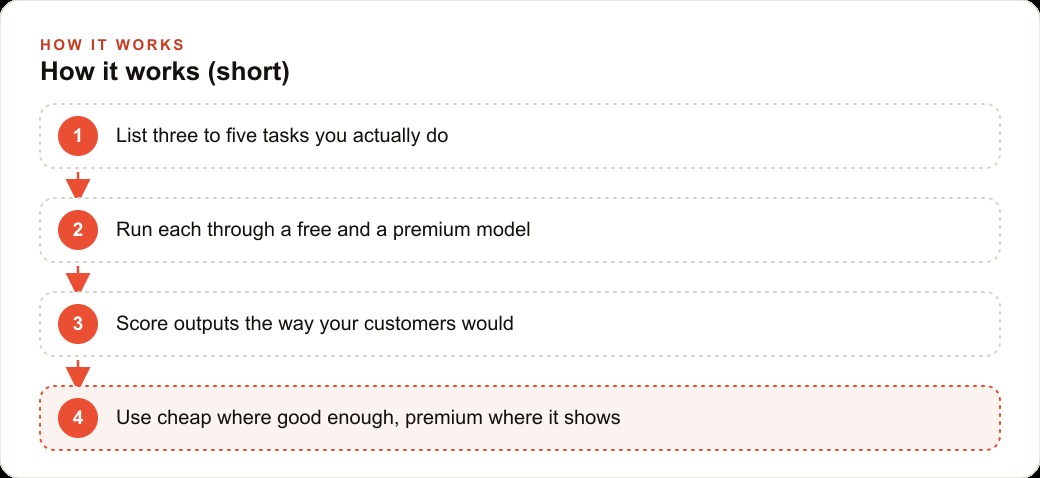
The most honest version of model evaluation for a business is to take three tasks that represent the work you actually do, write a representative prompt for each one, run both models through each prompt, and evaluate the outputs the way a client or colleague would. This takes half a day and produces decision-quality information. No benchmark review comes close to that value.
The specific gap between DeepSeek 3.2 and Claude Opus 4.5 on complex multi-step tasks
After a full week of testing across models, Claude Opus 4.5 emerged as the reliable pick, described specifically as being so good and so consistent that it kept its quality where other models faded after the initial launch excitement settled. That description is a useful diagnostic signal.
"Kept its quality" means the model performs consistently on a wide range of prompts rather than peaking on the specific types of prompts it was tuned to handle well. Many models look impressive on the task type that their training or benchmark focus emphasized and produce noticeably weaker output when the task shifts. A model with a genuine, broad capability distribution does not show those task-type peaks and valleys. It performs well across a range of prompt types and maintains that performance as prompts get more complex, more ambiguous, or more demanding of judgment.
The tasks where this gap is most visible are multi-step builds where coherence across the entire output matters. A single question has a single answer that can be evaluated in isolation. A multi-step build, a website, a report, a structured analysis, a marketing campaign, requires consistent decision-making across every component, so that the pieces fit together into something coherent rather than appearing to have been assembled from individually correct parts that do not relate well to each other.
DeepSeek 3.2 is a genuinely capable model. Its math model reached gold level at the International Mathematical Olympiad, using a technique that generates more than 10,000 candidate answers and uses a verifier to score each before returning the best. That is a legitimately novel approach and a frontier result on a hard, well-defined task. It is also a task that is structurally very different from an open-ended creative or compositional build. Strong performance on the former does not predict strong performance on the latter.
DeepSeek is also fully open source, which means you can download it, run it locally on your own hardware, and build it into applications without ongoing API costs or data-sharing obligations. That is a real advantage for specific use cases. It does not change the fact that on tasks requiring compositional quality and sustained judgment across a complex output, the testing found a meaningful gap.
The cost trade-off and when it changes the decision
The fact that DeepSeek can be run locally at zero marginal cost changes the decision for specific use cases, and it is worth being precise about which ones.
For high-volume, lower-stakes work where the quality difference between a free model and a premium one is invisible to the end user, using the free model is the correct decision. A business that needs to process 10,000 product descriptions, where the quality floor is readable and accurate rather than distinctive and persuasive, should not pay premium-model API rates for that volume of work. The free or locally run option does the job well enough, and the cost difference compounds fast at scale.
For client-facing work, creative tasks, complex multi-step builds, or anything where output quality is the variable that drives the outcome, the premium model's consistency is worth the cost. A poorly executed website does not convert clients regardless of how cheaply it was produced. A quarterly report with compositional errors damages client confidence regardless of how fast it was generated.
Here is a worked example with specific numbers. A content team produces 200 product descriptions per week for an e-commerce client. They also produce 5 landing pages per week for ad campaigns. The product descriptions need to be accurate, readable, and consistent in length and format. The landing pages need to be persuasive, compositionally coherent, and distinct from each other in their angle and approach.
Running both tasks through the premium model costs approximately $1.80 per 1,000 product descriptions in API fees and approximately $0.40 per landing page, for a weekly total of roughly $38. Running product descriptions through a free locally-run model and landing pages through the premium model reduces the weekly cost to about $2 for landing pages plus zero for descriptions. That is a reduction from $38 to $2 per week while maintaining the quality level that actually matters, which is the quality of the high-stakes, client-visible work.
The content team's evaluation, done honestly against the standard their client will notice, is what makes that allocation decision possible. Without testing both models on both task types, the team either overpays for the product descriptions or compromises on the landing pages. The evaluation habit, built once and repeated every time the model landscape changes, is what makes the cost-quality split sustainable.
One additional discipline is worth naming here. Before any model, free or paid, touches sensitive business data, such as client pricing, internal projections, or personal information, anonymize the specifics. The model does not need the exact numbers to do the job. It needs enough context to produce the right kind of output. Replace exact figures with ranges and client names with role descriptions, and you get the same quality of output while keeping the sensitive details out of any external system. A recent incident where an API partner's system exposed user data from developer accounts is a reminder that the convenience of cloud AI comes with real exposure for anything sensitive that gets passed into a prompt.
Model selection is not a one-time decision. The landscape is changing faster than any other technology category most businesses have ever planned around, which means the evaluation habit, run twice a year or whenever a major new model ships, is the mechanism that keeps the allocation rational over time.
What to take away from this week's model news
The week's AI news had several threads running in parallel, and they reinforce each other in a way worth naming explicitly. DeepSeek 3.2 shows that frontier-level capability is spreading into open, freely accessible models faster than most businesses have planned for. Claude Opus 4.5 shows that the performance gap between models still matters on the tasks where quality is visible. A math model solving a problem open since the 1990s shows that AI is beginning to contribute to knowledge domains at a level that was previously the exclusive territory of specialists. A data breach incident at an API partner shows that every cloud AI integration is a potential exposure point for anything sensitive that passes through it.
The businesses that process these signals correctly are the ones that already have an evaluation habit for new models, a cost-allocation framework that separates high-stakes from routine work, and a standing discipline to anonymize sensitive data before it enters any external prompt. Those three habits together produce a position where every week of new AI releases is useful information rather than noise.
The businesses that process these signals incorrectly are the ones that read the benchmark headline, assume the new model is either transformative or overhyped, and go back to using whatever they were using before without testing it. They miss both the genuine improvement when it arrives in a form their work can benefit from and the genuine gap when a model scores well on benchmarks but produces noticeably weaker output on their specific tasks.
Madhuranjan Kumar tracks these weekly signals not to recommend a single tool but to build the evaluation discipline that makes model selection rational rather than reactive. The model landscape will continue to change at this pace. The skill of testing quickly, allocating correctly, and protecting sensitive data consistently is what makes that pace an advantage rather than an overhead.
That is exactly what we do at AI DOERS. Book a private 30-minute call with Madhuranjan Kumar and we will map the fastest path to it for your specific business.
Book your call →
Madhuranjan Kumar
Madhuranjan Kumar brings 20 years of performance-marketing experience and has managed over $200 million in Facebook ad spend for brands across the United States and beyond. His expertise spans the full modern marketing stack: Meta, Google Ads, TikTok, email automation, CRM, and the websites that hold it together. At AI DOERS he turns that track record into lead-generation systems for businesses across every industry.