
The Decade of Agents: A Realistic AI Timeline and What to Do About It Now
A leading researcher says capable agents are years away, not months. Here is the practical takeaway for a small business, plus a worked example.

I'm Madhuranjan Kumar, and the statement that stopped me mid-scroll last month came from a researcher whose credentials in the field are unquestionable: truly capable AI agents are about a decade away.
Not a few model releases away. Not one architectural breakthrough away. A decade.
The natural reaction, given what the last two years have felt like, is to push back hard. We went from GPT-3 being a curiosity to GPT-4 passing professional exams in roughly 36 months. Why would the next decade produce only incremental progress on the technology everyone is racing to build?
The answer is that the researcher was not making a claim about model capability at all. They were making a claim about the full system required to transform a capable model into a trustworthy agent, and that system does not exist yet at the scale, stability, or standardization the word "agent" actually implies. Understanding the gap between those two things is the most practically useful orientation I can give you for how to work with AI right now.
The Infrastructure Gap That Makes a Decade Make Sense
Every major computing transition has had a recognizable shape: the core invention works years before the surrounding ecosystem can actually support it at scale. TCP/IP protocol was functional in 1974. Scalable commercial internet arrived in the mid-1990s. The smartphone processor had the raw capability for useful mobile applications well before the App Store created the distribution and trust layer that made them viable as a business category. Lithium-ion battery chemistry was mature decades before the infrastructure for mass-market electric vehicles existed.
AI agents are in that exact gap right now.
The core capability is real. A language model that can plan a sequence of steps, call tools in the right order, adapt based on results, and handle conditional logic through a multi-stage task is not a fiction. Researchers have verified it. The demos are not fabricated. What does not yet exist is the infrastructure layer that turns this capability into something a business can actually deploy and trust to run without constant supervision on tasks with real consequences.
Think about what a mature software deployment requires beyond the code: structured logging that captures intent alongside output, rollback mechanisms that operate at the decision level and not just the file system, handoff protocols between components with different capabilities and different permission scopes, compliance guardrails that hold without human re-checking at every step. None of these exist in mature, standardized form designed specifically for AI agent deployment. They are being built by dozens of competing teams with competing approaches. Building them well requires iteration across real production systems and institutional trust accumulated through years of track record in enough domains to matter.
The models will improve during that decade too. But the bottleneck is not the model. The bottleneck is everything the model runs on top of.
Why Capability Without Memory Is a Tool, Not an Agent
There is a distinction I keep returning to because it clarifies what you should expect from AI today and what you should not: a tool executes what you ask it to do. An agent acts on your behalf when you are not watching.
The difference between those two things is memory. Not session memory, the ability to recall what happened ten messages ago. Something deeper: accumulated understanding of your preferences, your domain, your recurring mistakes, the specific relational context of ongoing projects, the tacit knowledge a skilled person builds up from months of working alongside you on the same kinds of problems.
Current AI systems have effectively none of this in any durable form between sessions unless it is explicitly engineered externally. Every conversation starts from scratch. You can work around this with structured notes in system prompts, retrieval-augmented generation pipelines, external memory databases. People do, and the results can be impressive. But these are workarounds. They require setup time, maintenance time, and they degrade on edge cases in ways that are hard to predict in advance. They are not the same as a system that naturally accumulates relevant context the way a person does over months of shared work.
This gap matters more than it initially sounds. Without durable memory, an agent cannot build the contextual judgment that makes autonomous action trustworthy in complex domains. It can follow rules precisely but cannot develop intuitions about which rules matter most in a specific situation. It can execute steps correctly but cannot learn which sequence works best for a particular recurring client, or a particular industry nuance, without being re-told from scratch each time.
The result is a system that needs constant supervision, which is exactly the opposite of what an agent is supposed to provide. You end up with a more capable tool that still requires a human minder at every junction, which is better than what we had before but is not an agent in any meaningful sense.
Research on persistent, domain-specific AI memory is active and real: vector databases, long-context architectures, structured memory schemas, session summarizers that compress prior context into reusable briefings. Progress is genuine. But making any of these reliable and trustworthy at production scale, so that an agent's accumulated context actually informs decisions correctly without requiring human review of what it remembered and what it quietly missed, is a multi-year engineering and validation challenge that compounds across every domain that wants to deploy agents.
The Reliability Threshold: Where Capability Ends and Trustworthy Autonomy Begins
A common argument runs roughly like this: AI is already good enough at many tasks, so why wait for perfect? Ship now, edit later, improve with use.
This logic is correct for tools. If you use AI to draft a client proposal and the draft is 80 percent right and you clean up the remaining 20 percent, the value equation is fine. You saved time. You stayed in the loop. The error rate was acceptable because you were the one catching errors before they mattered.
Agents change that calculation entirely. The value proposition of an agent is reduced human oversight. You hand off a task and trust that it runs correctly through multiple steps, potentially involving sent communications, updated records, external system calls, or triggered transactions. In that context, an 80 percent reliability rate is not acceptable. It means one in five task completions requires intervention. And often that intervention means untangling something the agent already did before the error was caught, which can cost more time and credibility than just doing the task yourself.
The researcher's distinction between capability and reliability is precise. The models are capable of the reasoning required for most agent tasks being discussed today. They are not yet reliable enough for most of those tasks to run fully unsupervised at the scale where the economics of deploying an agent, rather than a human, actually make sense. Reaching the reliability threshold requires not just better models but systematic testing across edge cases, robust error detection at every step, graceful degradation when the agent hits the boundary of its competence, and institutional trust accumulated through years of demonstrated track records across enough contexts for the pattern to hold.
That takes time. A decade is not pessimism. It is a realistic read of how long comparable infrastructure and trust-building cycles have taken historically.
What a "Usable Agent" Actually Demands at the System Level
Let me make this concrete by specifying what a single, seemingly simple agent task actually requires to function reliably without supervision.
Suppose you want to deploy an agent that manages initial customer follow-up for a services business: review new inquiries, pull relevant client history, draft a personalized response, send it, log the interaction, and update the CRM.
What does this actually need to work without breaking?
It needs credential management for email read and write access that does not expose secrets in prompts and handles token expiry gracefully. It needs a live, authenticated connection to the CRM that handles rate limits, schema version changes, and intermittent connectivity. It needs structured memory of past interactions per contact, maintained in a format the model can actually use without confusion. It needs error handling that recognizes when to escalate to a human rather than proceeding incorrectly. It needs step-level logging that is readable enough for oversight without generating so much noise the operator stops looking at it. It needs a staging environment where you can safely test prompt changes before they affect live outgoing communications. It needs monitoring that alerts when behavior drifts from expected baselines.
None of these exist as mature, standardized components designed specifically for AI agent deployment. What will eventually exist, the equivalent of what Docker is to containerized deployment or what Stripe is to payments handling, will make deploying reliable agents as accessible as deploying a web application today. That future is real and the infrastructure being built now is real. But arriving there is a decade-scale project, not a model-update cycle.
A Financial Services Team That Found the Gap the Hard Way
Consider a financial services firm that began piloting AI for loan application document review, specifically flagging missing documents, inconsistencies in stated income figures, and checklist items required for compliance sign-off.
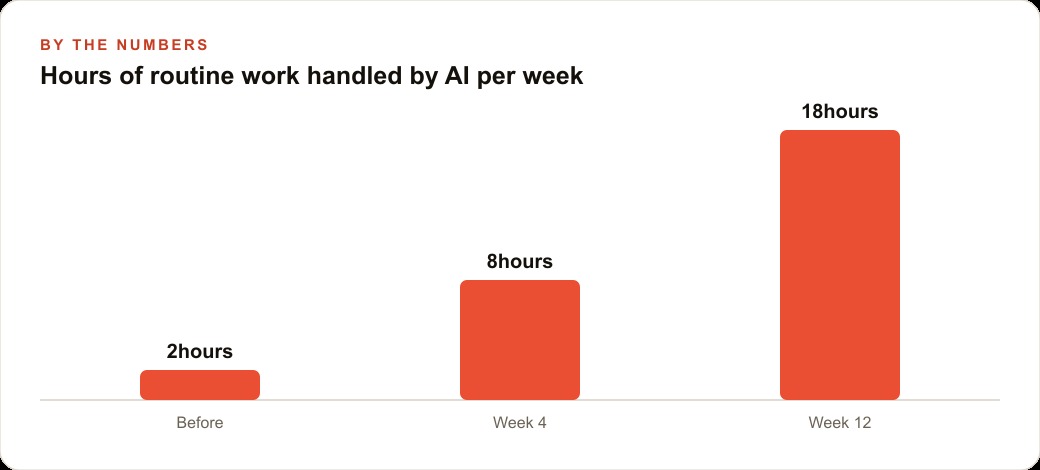
In testing, the model identified issues at roughly the rate of a junior reviewer. The team was encouraged. They deployed it to handle the first pass on 40 applications per week, freeing up roughly 12 hours of reviewer time. Early results held up.
Then three things happened over the following two months. First, a policy change to income documentation requirements was not reflected in the prompt, and the model began clearing files it should have flagged. No alert fired. There was no logging of which prompt version governed which decision, so auditing the prior month's cleared files required manual re-review of everything. Second, a new document type was introduced following a regulatory update. The model, having no knowledge this document existed, did not flag its absence in any application. Third, the team wanted to add a drafting step, having the model prepare follow-up letters to applicants with incomplete packages. Connecting the document review output to the letter drafting system required a custom integration that took an engineer three weeks to build.
Total time savings after one quarter: approximately 8 hours per week saved on review, offset by roughly 6 hours per week of oversight, prompt maintenance, and system upkeep. A net positive, but nowhere near the autonomous productivity gain the original demo had suggested. The model was not the failure. It was largely correct about the documents. The failure was the surrounding system: no version control for prompts, no mechanism to detect when the model encountered a knowledge gap, no standardized protocol for passing output between components. Building that infrastructure properly for this one firm's one workflow took months of engineering effort.
Multiply that by every industry deploying agents across every category of knowledge work, and the scale of what a decade of infrastructure development actually means becomes visible.
Notes Beat Retraining: The Underrated Compound of Small-Chunk Practice
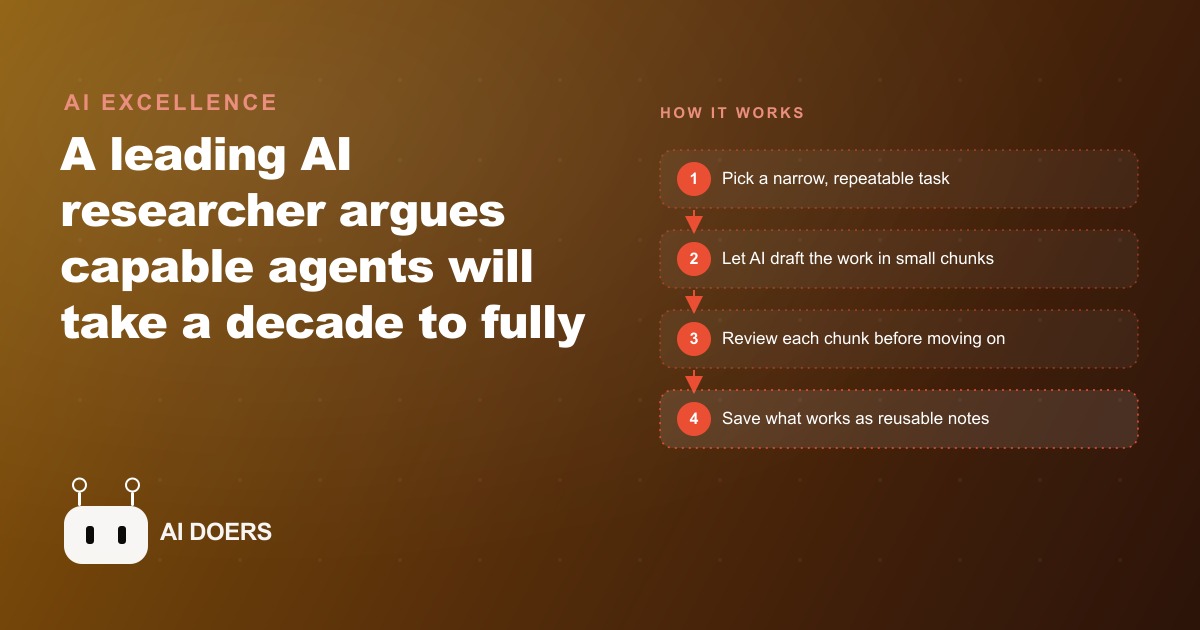
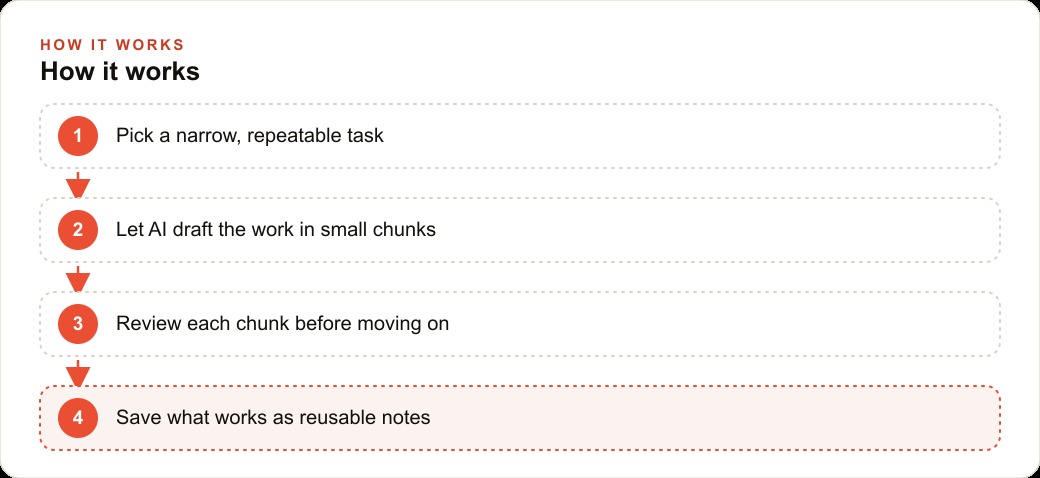
The most actionable point from the researcher's argument was also the most counterintuitive: work in small chunks and review frequently. Do not hand off a ten-step process and return a week later. Give the agent one step, review the output, then give the next step.
This feels like giving up on the vision. But it is exactly the right practice for this moment, for two reasons. First, it is dramatically more reliable with today's tools than blind handoffs are. Second, and more importantly for the long term, it generates a pattern library that compounds.
Notes from small-chunk collaboration beat the effort of waiting for a new model to handle your edge cases by default. A well-maintained record of how the model handles your specific domain, what it consistently misses, what context reliably improves its output, is more portable and more directly useful than hoping the next model release happens to address your particular recurring failure mode.
The notes survive model upgrades. They can be transferred to new model versions as context. They can be shared across a team. They accumulate into something that starts to resemble institutional knowledge, even when the underlying model has no memory of prior sessions. That is not the same as a real agent with durable memory. But it is a meaningful approximation of one that you can build right now, without waiting for the infrastructure to catch up.
The Compound Advantage of Starting Imperfect Practice Now
The strongest argument for starting seriously today, given everything above, is what compounding practice during the infrastructure gap is actually worth.
The financial services team I described is, frustrations and all, further ahead of competitors who ran no pilot than any single model upgrade could make them. They know which document types the model handles well. They have a tested prompt framework for income consistency checks. They have one engineer who understands how to connect model output to downstream systems. They have a culture of logging AI-assisted decisions. When the infrastructure layer matures, they will not be starting from scratch. They will be adapting a tested foundation with two years of institutional learning already embedded.
Businesses and operators who build the discipline of note-taking, prompt refinement, and structured small-chunk collaboration with AI tools during the current gap are compounding a knowledge base that will directly accelerate their deployment when the agent infrastructure is ready. The habit of externalizing context into structured, reusable notes, rather than relying on implicit knowledge that lives only in your head, is both an AI-era collaboration skill and a fundamental operational discipline that pays dividends regardless of how the technology evolves.
The decade timeline is not an argument for waiting. It is an argument for being deliberate about what you practice during the gap. The operators who log systematically, iterate carefully, and build in small reviewable chunks will be the ones the coming infrastructure was designed to serve. I'm Madhuranjan Kumar, and the researcher who said a decade is giving you the most useful orientation available for deciding exactly what to do this month.
That is exactly what we do at AI DOERS. Book a private 30-minute call with Madhuranjan Kumar and we will map the fastest path to it for your specific business.
Book your call →
Madhuranjan Kumar
Madhuranjan Kumar brings 20 years of performance-marketing experience and has managed over $200 million in Facebook ad spend for brands across the United States and beyond. His expertise spans the full modern marketing stack: Meta, Google Ads, TikTok, email automation, CRM, and the websites that hold it together. At AI DOERS he turns that track record into lead-generation systems for businesses across every industry.