
Create and Edit Images With Nano Banana Free in Your Browser
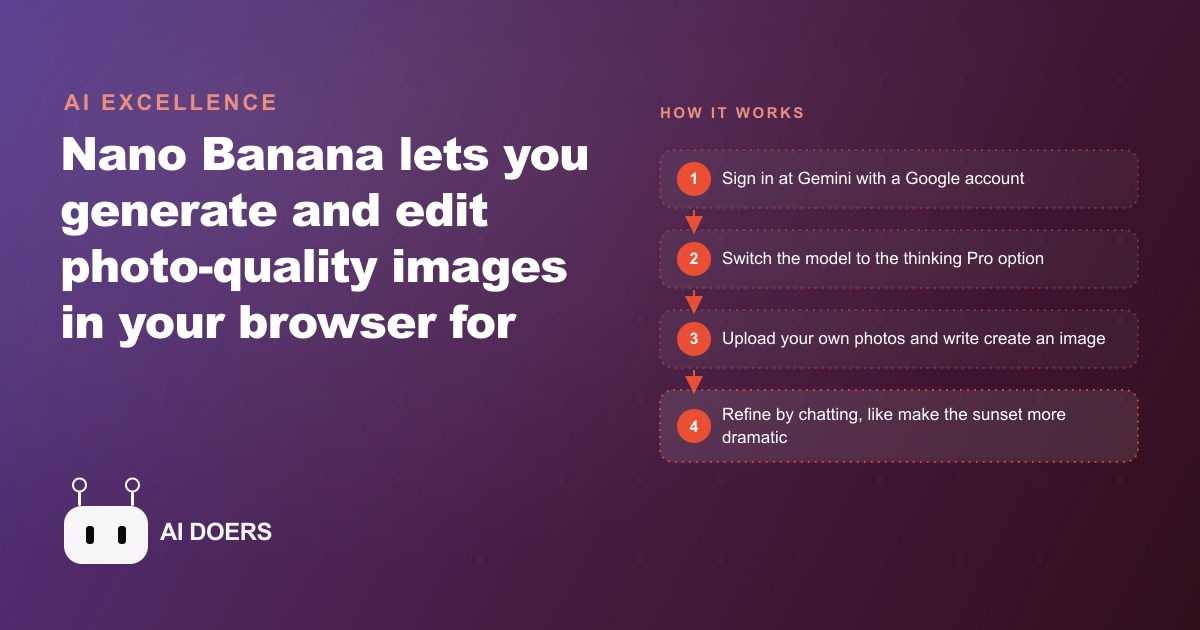
Nano Banana generates and edits photo-quality images in the browser for free, including blending your own photos into custom scenes. Here is how it works and how a small business can put it to work.

When the bottleneck is not the tool but the asset
The most expensive line item in most small business marketing budgets is photography, and it is now optional for a whole category of creative output. I am Madhuranjan Kumar, and the shift I have been watching is not the arrival of another AI image generator. It is the arrival of one that starts from your own photos rather than from nothing, and produces results that feel real because, in the part that matters most, they are.
Generic AI image generation tools produce images from a text description alone. The results are often technically impressive and practically useless for a specific business, because the business in the image is not the real business. The storefront is the wrong color. The product is not the actual product. The team members are not the actual people. The output is a plausible fiction that communicates nothing specific, and customers can sense this even when they cannot articulate why the marketing feels vaguely off.
Nano Banana's approach is different. You upload your own photos, the actual storefront, the actual product, the actual team member, and the tool builds a custom scene around that real source material. The background changes. The context changes. A promotional overlay appears. A lifestyle setting replaces a cluttered workspace. But the thing you are actually selling, the real object or person or place, remains at the center because it was in the source image. The output feels real because the core of it is.
This distinction changes what is possible for a business with limited photography resources. A restaurant that has one professional photo of its signature dish can generate a dozen distinct marketing visuals from that single asset: a dark moody background for evening social posts, a bright airy setting for the lunch menu, a seasonal setting for a holiday promotion, a close-crop variant for a story format, a wider shot for a banner. All from one photograph, without a photographer, without a studio, in under 20 minutes.
Uploading your own reality into the creative process
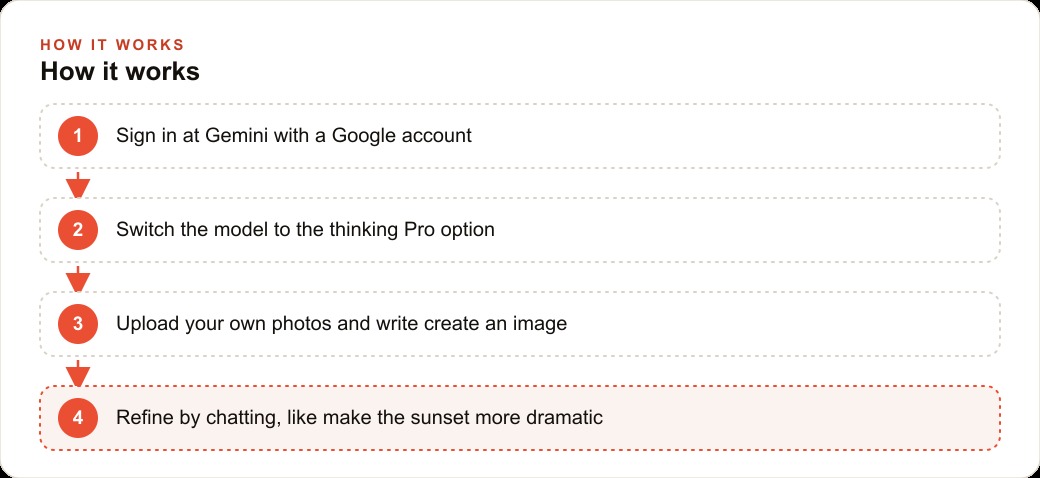
The mechanics of the tool matter for understanding what it can and cannot do. Nano Banana runs inside Gemini with a Google account. Switching the model to the thinking option, what the interface calls the Pro mode, activates the more capable version of the image model. This version handles advanced edits more accurately and deals better with images that contain substantial text or complex product details.
The upload flow accepts your own photos directly. Once the photos are in the conversation, a prompt that includes the phrase create an image signals to the model that it should synthesize from the uploaded materials. The distinction from a text-only generation prompt is significant: the model uses the uploaded photos as source material and builds around them rather than inventing from scratch.
The editing loop that follows is the feature that makes this useful for producing a batch of creative assets rather than a single image. Refer to the generated image and describe a change: make the lighting warmer, extend the background to include more of the room, shift the text overlay to the bottom third of the frame, try a version with a darker color palette. The model adjusts without starting over. The continuity between iterations means each refinement builds on the previous result rather than producing a new starting point that may have lost something you wanted to keep.
The conversation-based editing workflow is what separates this from an upload-and-generate tool. The ability to guide the output through successive refinements, saying I like the composition but the background reads as too cold, try warm amber tones instead, is what produces output that fits a brand's specific aesthetic rather than a generic aesthetic that happens to include the right product. That specificity is what makes AI-generated visuals feel like real marketing rather than like experiments.
What the rate limit teaches you about creative discipline
Nano Banana's free access operates within rate limits. After generating several images in a session, the tool slows down or pauses. This is not a significant operational obstacle for most use cases, but it is an instructive one.
The rate limit functions as an unintentional discipline mechanism. Because you cannot generate unlimited images in a continuous session, the most productive approach is to be clear about what you need before you start generating. Which specific source photos are strong enough to build from? What contexts or settings does this product need to appear in to serve the business's marketing calendar for the next month? What specific changes are worth testing in variants?
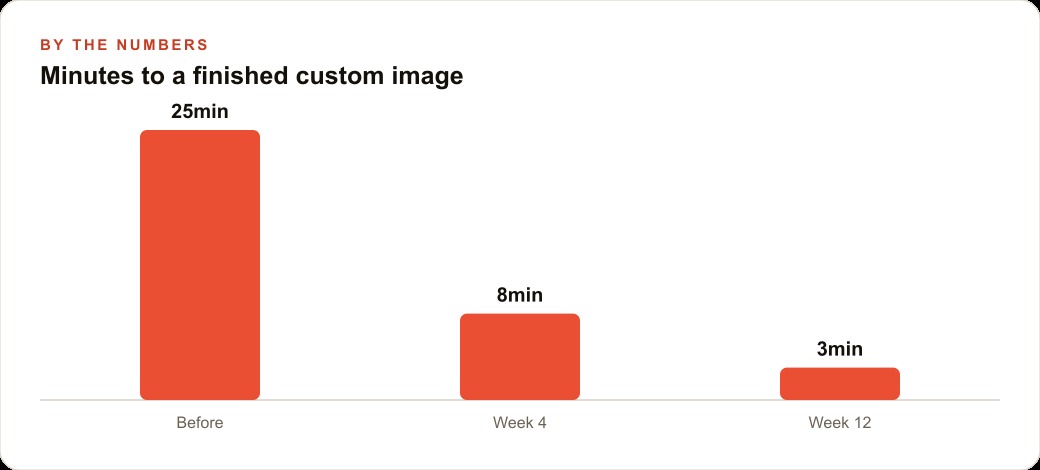
Owners who answer these questions before opening the tool generate their full set of needed assets within the free tier limit and have usable output in 20 to 30 minutes. Owners who open the tool and experiment freely tend to use their rate limit on exploratory generations that do not serve a specific marketing purpose, run out of free generations before producing the assets they actually need, and conclude that the tool is less capable than it is.
The discipline is about knowing the marketing destination before the creative production begins. What is the post this image will appear in, and what does that post need to communicate? What is the ad this creative will run in, and what response behavior are you designing for? Answering those questions first produces better prompts, better outputs, and more efficient use of the available generation credits.
This connects to a broader principle about AI creative tools. The tools that produce useful output for a business are not the most powerful ones in isolation. They are the ones whose capabilities match a specific workflow need, paired with a user who understands that need clearly before starting. Nano Banana's particular capability, building custom scenes around your own source photos in a conversational editing interface, matches a specific and common small business need: producing varied marketing visuals from a limited asset library without a recurring photography budget. Recognizing that match is what produces the result. The tool handles the execution; the user supplies the direction.
The celebrity face restriction the tool applies is a policy limit, not a capability limit. For a business using photos of its actual team, products, and locations, this restriction is irrelevant. The consent and propriety questions that apply to real photography apply equally here: use photos of people who have consented to be in marketing materials, use photos of products you own or represent, and use photos of locations you have permission to photograph. Within those reasonable constraints, the creative range is substantial.
A small business that commits to building a monthly content batch using this tool, spending two sessions per month of 45 minutes each on directed image generation, can produce enough distinct visual assets to run consistent social posting and multiple ad creative rotations without ever repeating an image. That production rate, at zero monetary cost, is what photography used to cost several hundred to several thousand dollars per month to achieve. The shift is real, it is operational, and it is available to any business willing to approach it with the discipline of knowing what they need before they start generating.
The difference between generic and personal that the scroll stops for
There is a specific moment in a content creator's relationship with AI image tools when something clicks. The first phase is experimentation: Madhuranjan Kumar types a description of a scene, the tool generates something plausible, and Madhuranjan Kumar is impressed. The second phase is disappointment: after producing fifty plausible images, none of them feel like they belong to Madhuranjan Kumar's brand. They could have been made by anyone with the same tool and the same prompt.
The third phase, when it arrives, is the one that actually matters. It arrives when Madhuranjan Kumar discovers that the tool produces something distinctly theirs when the input is distinctly theirs. Not a description of a generic scene, but a specific photo from a specific place at a specific time that carries the visual signature of the way they see the world.
This is the phase most tutorials skip because it requires Madhuranjan Kumar to have accumulated a body of personal visual work worth drawing from. If the only images you have are stock photos and screenshots, you are stuck in the generic phase. If you have years of your own photography, travel imagery, or visual documentation of the life and work you have actually lived, you have raw material that no competitor can replicate with the same prompt.
Why the rate limit is a creative discipline rather than a platform problem
When a tool restricts how many AI-generated images you can produce per day or per month, the instinctive response is frustration. The restriction feels like an artificial scarcity imposed on a creative process that should be unlimited.
The counter-intuitive reading of the rate limit is that it imposes a discipline that most creative processes benefit from having. An unlimited image generation tool produces unlimited images. Most of them are unnecessary. The quality threshold that applies to any piece of creative work should filter most generated images out, not because they are low quality in an absolute sense, but because they do not serve the specific purpose Madhuranjan Kumar is working toward.
A creator who generates 5 images per day and reviews each one critically against the creative goal they have defined for that day produces better creative output than a creator who generates 200 images per day and chooses from them by feel. The constraint of scarcity focuses the prompt-writing toward precision and the evaluation toward rigor.
The rate limit also forces a creator to be intentional about which creative problems they bring to the AI tool and which they solve differently. Not every visual problem is best solved by AI generation. Some are better solved by returning to the archive of personal photography. Some are better solved by commissioning a specific type of image that the AI tool produces poorly. The rate limit surfaces these distinctions in a way that unlimited access obscures.
What the volume-to-quality ratio reveals about a creator's actual strategy
The amount of AI-generated content a creator produces and publishes is a proxy for their actual creative strategy, even if they would not describe it that way. A creator who publishes 30 AI-generated images per week has made a bet that volume creates discovery. A creator who publishes 3 carefully selected images per week has made a bet that curation creates loyalty.
Both strategies can work, and the right one depends on Madhuranjan Kumar's platform, audience, and goals. But the strategy that produces sustainable competitive advantage is almost always the second one. Volume creates discovery in the short term because the algorithmic distribution systems reward frequent publication. Curation creates loyalty in the long term because the audience that finds Madhuranjan Kumar through any one piece stays because the rest of the work maintains the same standard.
The personal photo upload workflow changes the volume-to-quality equation in a specific way. The constraint is not the AI tool's rate limit. The constraint is the size and quality of the personal photo archive. A creator with a rich archive of distinctive personal imagery can produce a relatively small number of AI-generated pieces per week that are consistently distinctive and recognizable. The output is curated by the archive, not by a deliberate selection process after the fact.
This is the mature creative workflow that the most effective AI-assisted creators are developing: not a pipeline that produces maximum volume, but a system that ensures every published piece carries the visual signature that makes Madhuranjan Kumar's work immediately identifiable in a feed. The archive is the filter. The AI is the transformation engine. Madhuranjan Kumar's judgment is the final gate.
Madhuranjan Kumar who builds this system, personal archive feeding AI transformation engine filtered by deliberate curation, produces work that is simultaneously more efficient and more distinctive than work produced by either raw personal photography or generic AI generation alone. The efficiency comes from the tool. The distinctiveness comes from the archive. The quality comes from the judgment that Madhuranjan Kumar applies at the final gate.
That is exactly what we do at AI DOERS. Book a private 30-minute call with Madhuranjan Kumar and we will map the fastest path to it for your specific business.
Book your call →
Madhuranjan Kumar
Madhuranjan Kumar brings 20 years of performance-marketing experience and has managed over $200 million in Facebook ad spend for brands across the United States and beyond. His expertise spans the full modern marketing stack: Meta, Google Ads, TikTok, email automation, CRM, and the websites that hold it together. At AI DOERS he turns that track record into lead-generation systems for businesses across every industry.