
Codex Is Not a Coding Tool, It Is a Unified AI Agent for All Your Work
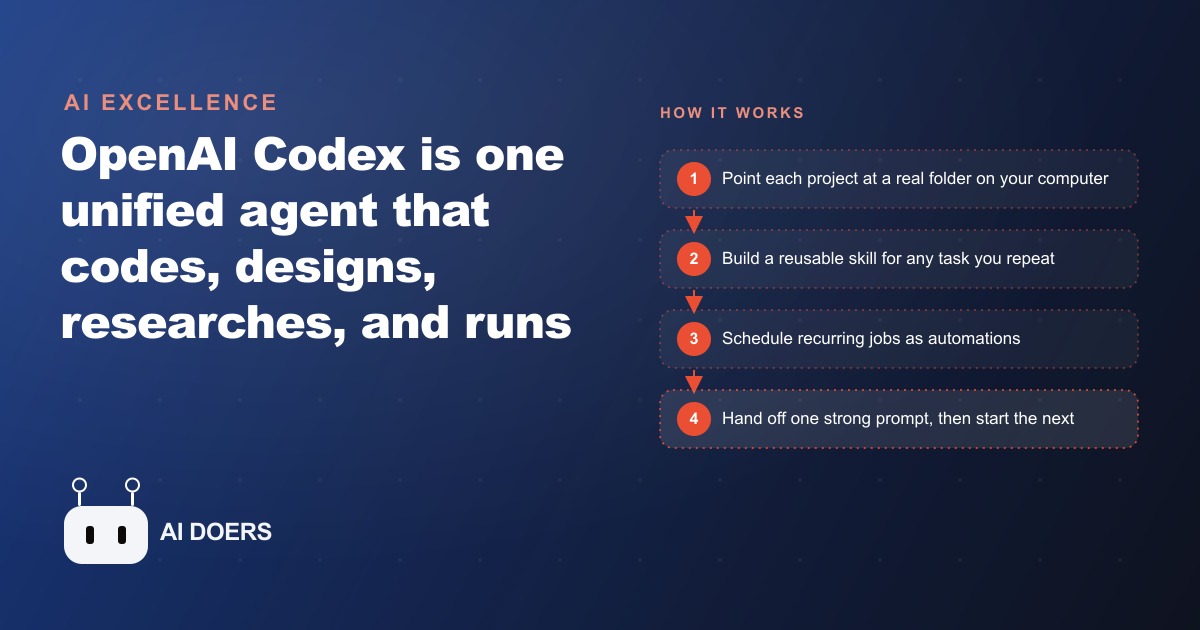
OpenAI Codex is a single agent interface that combines coding, document and deck creation, design, research, and full computer use, so one app builds spreadsheets, ships apps, wires databases, and runs automations side by side. Here is how a small business can put it to work.

Before: The Back-Office Bottleneck That Looked Normal
From the outside, the administrative operation of a small dental practice looks manageable. One office manager handling scheduling, insurance pre-authorization, patient recalls, billing follow-up, appointment confirmations, and a rotating queue of phone calls. A front desk that doubles as the intake point, the payment processing station, and the first and last impression for every patient who walks in.
From the inside, it looks different. The office manager at this particular practice, a four-chair office with two associate dentists and a patient roster of roughly 1,400 active records, was arriving at 7:30 in the morning and consistently not clearing her task queue until after 5:30. The backlog was not caused by any one category of task. It was caused by the cumulative friction of tasks that each required a moderate amount of judgment combined with a moderate amount of writing. Insurance pre-authorization letters required the right clinical language but also needed to be specific to the carrier. Recall reminders needed to feel personal rather than templated, because the practice had built its reputation on relationships. Appointment confirmation messages needed to match the tone the practice had established, professional but warm, not the automated-sounding blasts that patients had learned to ignore.
None of these tasks were hard. All of them were slow. And the slowness added up to roughly three and a half hours per day of the office manager's time consumed by work that was essentially drafting, reviewing, and sending variations of the same categories of text over and over.
The practice was not understaffed by any standard industry metric. The office manager was competent, experienced, and well-organized. The problem was that the tools available to her were essentially a word processor, an email client, and a practice management system that generated data but offered no help turning that data into outbound communication.
She had heard of OpenAI Codex. She understood it as a coding tool for programmers. She was not a programmer. She had no folder of code files to give it. She almost dismissed it before reading more carefully.
Week One: The First Folder and the First Skill
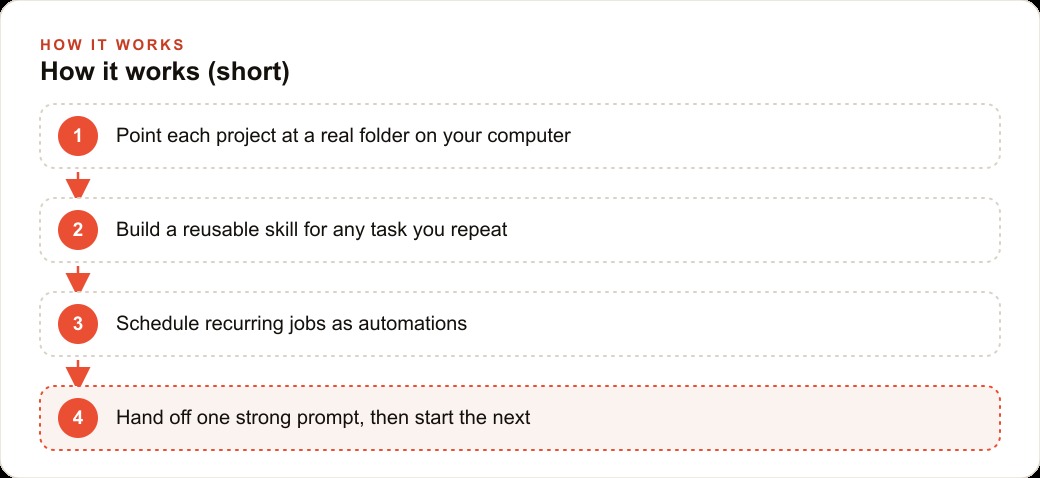
The concept that changed her thinking was that in Codex, every project points at a real folder on a real computer. Not a simulated workspace, not a sandboxed environment. An actual folder on the desktop, with actual files in it.
She created a folder called "Practice Communications" and put three things in it: a document titled "Our Tone" that described in plain language how the practice communicated with patients (warm, direct, no medical jargon without explanation, always ending with a clear next step), a template file with the practice's standard rates and insurance language, and the previous six months of recall reminder messages she had drafted personally and considered the best examples of the practice's voice.
Then she described what she wanted: a reusable skill that, given a patient's name, the date of their last visit, and the procedure they had done, would draft a personalized recall reminder. She did not write code. She described the task the way she would describe it to a new staff member.
Codex read the folder, understood the context documents, and produced a skill. The first time she used it, she gave it the information for a patient who was fourteen months past due for a cleaning. The output took forty seconds to generate. It was specific, it referenced the procedure type without being clinical in a way that would feel cold, and it ended with a clear call to action to call or text. The draft she would have written manually would have taken eight minutes and produced something similar in quality.
She did not deploy the skill immediately to the full recall backlog. She ran it on twenty patient records over two days, compared each output to what she would have written, and adjusted the context documents in the folder based on what she noticed. By the end of the first week, the skill was producing drafts she was approving with single-word edits or no edits at all.
The time savings in week one alone were enough to eliminate the after-5:30 overrun every day but one.
Week Three: The First Morning the Automation Ran Without Anyone Asking
The second threshold was reached in the third week, and it felt different from the first.
She had built a second skill for insurance pre-authorization letter drafts, which she described to Codex in plain language the same way she had described the recall skill. She also described a Monday morning task she had always done manually: pulling the week's list of patients more than twelve months past their last recall appointment, drafting reminders for each, and organizing them for batch review before sending.
She described this to Codex as an automation. She told it what day she wanted it to run, what data to pull from the folder she updated each Friday with the weekly patient activity export, and what the output should look like: a single Google Doc with all the drafts for that week, organized by patient name, ready for her to review.
On Monday morning of the third week, she arrived at 7:30. The Google Doc was already there. Twenty-three drafts, ready for review. She went through them in nineteen minutes, made three small edits across the full set, and had the batch ready to send by 7:52.
Before the automation, that same task had taken her between ninety minutes and two hours, and it had never been the first thing she did. It was always pushed later in the day because it felt like a block of time she had to clear for rather than a task she could complete in a morning corner.
The automation did not change what the task was. It changed when she encountered it and what condition it was in when she did.
The Number That Changed the Conversation Inside the Practice
At the twelve-week mark, the office manager put a simple accounting to the practice's owner.
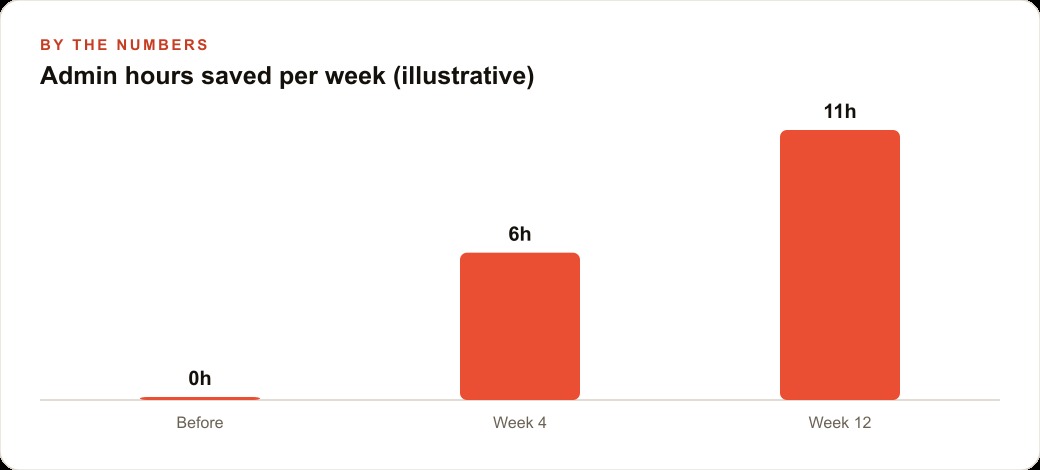
Before Codex: approximately 3.5 hours per day on drafting and sending communications. Across a five-day week, that was 17.5 hours per week.
After the two skills and the Monday automation were stable: approximately 55 minutes per day reviewing, approving, and handling exceptions. Across a five-day week, that was just under five hours per week.
Twelve and a half hours per week recovered. At an administrative labor cost of twenty-eight dollars per hour, that was three hundred and fifty dollars per week in recovered capacity. Over twelve weeks, four thousand two hundred dollars.
But that number was not what changed the conversation.
What changed the conversation was that approximately two hours of the recovered time each week was now being spent on the front desk during the morning peak, the period from 8:00 to 10:00 when patient calls, arrivals, and questions peak. Before the automation, the office manager had been unavailable during that window most mornings because she was in the queue of drafting tasks. The front desk had been handling peak volume with less support than it needed.
With two additional staffed hours per week during peak, the practice started capturing calls that had previously gone to voicemail. The owner estimated, conservatively, that three additional new patient consultations per month were being scheduled that would have been missed. At an average lifetime value of eighteen hundred dollars per new patient to the practice, the automation's downstream impact was not the labor cost recovery. It was the new patient capture that had been leaking through a gap no one had identified as an automation problem.
Month Three: What the Stable Workflow Actually Looks Like
By month three, the Codex workflow at the practice had settled into something the office manager described as "like having a staff member who works overnight and never gets tired."
Every Monday morning: the recall automation runs. A Google Doc is ready for review by the time she arrives. She reviews and approves in under twenty-five minutes.
Every Wednesday: the pre-authorization drafts for the following week's procedures are generated in the same way, from the appointment data file she updates each Tuesday. She reviews and submits the actual pre-auths, which now takes forty minutes instead of two hours because the drafting is done.
New patient intake follow-up messages, appointment confirmation reminders, and post-procedure check-in drafts are generated on demand using the skills she has built and refined. The context documents in the Practice Communications folder have been updated three times as she noticed patterns in the edits she was making. Each update made the subsequent outputs more accurate.
She has started routing new categories of tasks to Codex the same way. The most recent addition was a skill for drafting responses to online reviews, using the practice's tone document and a set of example responses she considered exemplary. The first outputs required more editing than the recall skill had required by week three. She expected that. She was in week one of that skill's learning curve.
The practice's owner, at month three, asked her what she would need to take the administrative burden of a fifth chair if the practice expanded. Before Codex, her answer would have been a second part-time administrative hire. Her answer now was a new folder, a new context document, and about a week to build the right skills.
The tool did not make the work disappear. It changed what the work was. The work became reviewing judgment rather than producing first drafts, which is the kind of work that scales without proportional increases in labor. ## What the Recovered Time Actually Bought the Practice
The four hours per week returned to the office manager over the first twelve weeks of Codex integration did not disappear into undifferentiated administrative buffer time. The practice tracked specifically where those hours went, because the practice manager asked. Three categories emerged.
Approximately one and a half hours per week went into patient experience work that had previously been deferred indefinitely. The office manager had maintained a list for nearly a year of small improvements she wanted to make to the new patient onboarding sequence: a clearer pre-visit email, a better explanation of what to bring, a more welcoming follow-up message after the first appointment. None of these had priority over the tasks the schedule demanded each day. With the drafting work condensed, they did.
Approximately one hour per week went into insurance follow-up, specifically reactivating claims that had sat in pending status past thirty days. This is a revenue category that most dental practices manage reactively. When a biller has four hours of drafting work to do and three hours available, insurance follow-up gets deferred to the next review cycle. When the drafting work takes forty minutes instead of four hours, the follow-up cycle tightens.
The remaining ninety minutes per week varied. Some weeks it became patient phone calls that had been queued but not completed. Some weeks it was process documentation the office manager had been meaning to write for months. Some weeks it was simply finishing at 5:00 instead of 5:30, which the practice's owner observed with enough regularity to ask what had changed.
An illustrative calculation of the insurance follow-up impact: if tightening the follow-up cycle from sixty days to thirty days reactivates three additional claims per month at an average reimbursement of three hundred dollars, that is nine hundred dollars per month in revenue the practice was technically owed but not collecting. Over twelve months, the difference between a sixty-day and thirty-day follow-up cycle is worth approximately ten thousand eight hundred dollars in collected reimbursements. The practice's annual cost for the Codex subscription at the organizational tier that supports this usage is under three thousand dollars.
The office manager's answer about what she would need for a fifth chair would have been different six months earlier for a simple reason: she had not yet learned what the work looks like when the first-draft burden is removed from the equation. Learning that changed the answer.
That is exactly what we do at AI DOERS. Book a private 30-minute call with Madhuranjan Kumar and we will map the fastest path to it for your specific business.
Book your call →
Madhuranjan Kumar
Madhuranjan Kumar brings 20 years of performance-marketing experience and has managed over $200 million in Facebook ad spend for brands across the United States and beyond. His expertise spans the full modern marketing stack: Meta, Google Ads, TikTok, email automation, CRM, and the websites that hold it together. At AI DOERS he turns that track record into lead-generation systems for businesses across every industry.