
Codex GPT-5 vs Claude Code: Which AI Coding Tool Should Your Business Use?
Two of the most talked about AI coding tools went head to head on identical prompts. Here is what the comparison teaches a local business owner who wants to build software without code.

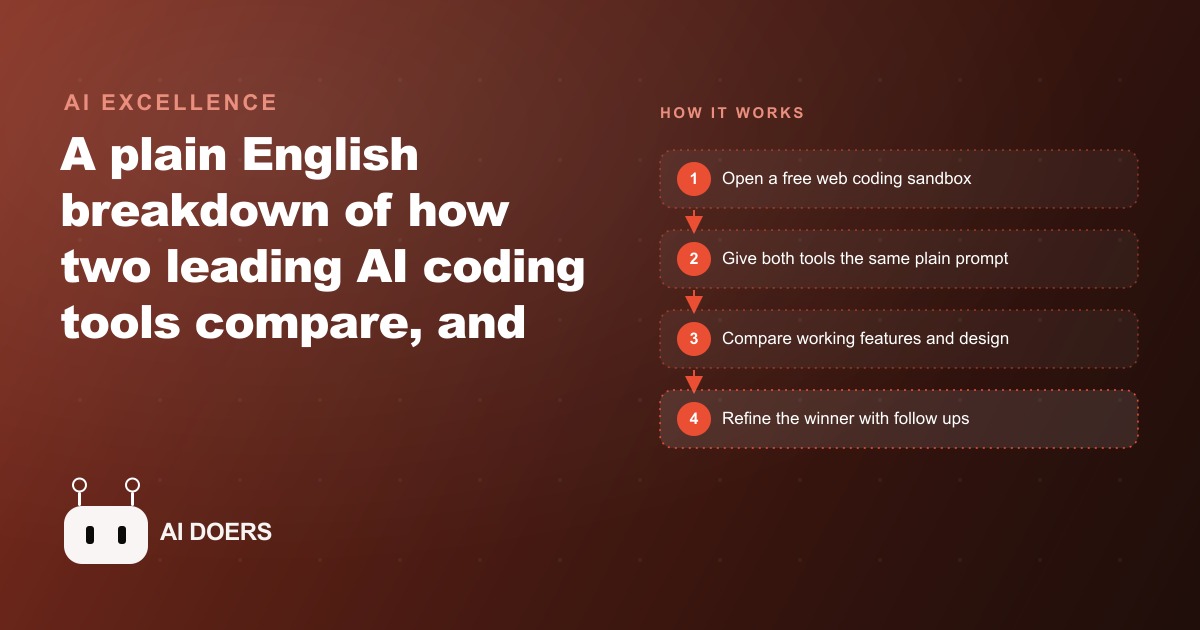
There is a specific kind of content that circulates every time two AI coding tools go head to head in a comparison. The format is reliable: same prompt to both tools, evaluate the builds, declare a winner. I am Madhuranjan Kumar, and I want to argue that this content, even at its best, almost always teaches the wrong lesson. The lesson most people take is about which tool won on this particular test. The lesson that actually matters is about how the test was structured, because the structure of any comparison determines whether the result is transferable to your situation or whether you are simply borrowing someone else's conclusion about someone else's use case.
I watched a clean side-by-side test of Codex running on GPT-5 against Claude Code. The methodology was as fair as these comparisons get: identical prompt, identical starting conditions, both tools given the same task at the same time with no assistance between runs. Two tasks were used. The first was a browser-based personal operating system with draggable windows, a notes panel, a task list, and a built-in fake browser frame. The second was a small physics game, an Angry Birds style experience built from a single prompt. Both tasks were concrete enough in scope that you could evaluate outputs against clear criteria, which is the minimum bar a comparison has to clear to tell you anything useful at all.
What came back from the two tools was genuinely interesting, not because one dominated the other but because the outputs revealed different instincts about what a prompt is supposed to do. One tool followed instructions precisely and delivered exactly what the prompt described, nothing more and nothing less. The other interpreted the goal more liberally and built something more complete, sometimes including features the prompt never asked for. For the game build, one version was a genuinely playable experience with advancing levels while the other was visually polished but shallower as a game you could actually play through. For the operating system build, the dynamics played differently. The precise tool delivered exactly the requested components. The generative tool delivered something richer but with behaviors the prompt had not specified, requiring correction afterward.
The point of observing this pattern is not to conclude that one instinct is better. The point is that these tendencies are stable across task types. Stable tendencies are predictable, and predictable behavior is something you can write prompts to steer effectively. A tool that follows instructions precisely requires more complete instructions if you want a complete result. A tool that interprets the goal liberally requires explicit boundary-setting if you want a controlled result. Neither is a flaw. Both are design orientations that make more sense once you understand what each tool is optimizing for, and that understanding, not the ranking, is the real transferable value from any good comparison.
Most people watching a comparison like this walk away with a conclusion about which tool is better. That conclusion is almost always too broad to be reliable. The tool that built the better game may lose badly on a booking page for a local salon, where following instructions precisely matters far more than creative interpretation. A salon booking page that adds unrequested fields or restructures the flow based on what the tool thinks you probably want is a broken booking page for practical purposes, because it does not match the scheduling system it needs to connect to or the specific intake questions the salon's process requires. The tool that won the game comparison on creative richness is the wrong tool for that job. The comparison did not fail. The lesson drawn from it was just too broad to hold up across different task types.
This pattern, where the performance ranking inverts across task types, is not a quirk unique to AI coding tools. It is a fundamental property of any comparison that measures performance on one specific task and then generalizes the conclusion. It happens with AI tools more acutely than with traditional software because AI tools have a much wider range of possible behavior. Traditional software does what it is programmed to do within tight bounds. AI tools have learned tendencies, interpretive instincts, and probabilistic behavior patterns that vary depending on how the prompt is worded, what kind of task is being attempted, and how the tool's training shaped its default approach. A comparison that tests only one task type cannot reveal this range, and any conclusion drawn from it is valid only within the narrow frame of that particular task.
Running both tools in parallel, across several browser windows or tabs simultaneously, lets you keep the best version rather than committing to a single output. That detail is more practically valuable than the ranking itself. For a given project you might run both tools, take the layout approach from one and the functional logic from the other, and arrive at a better result than either produced alone. The goal is not to find a permanent winner. The goal is to find the best starting point for this specific task and then refine it from there.
The Comparison Methodology Is the Only Part Worth Borrowing
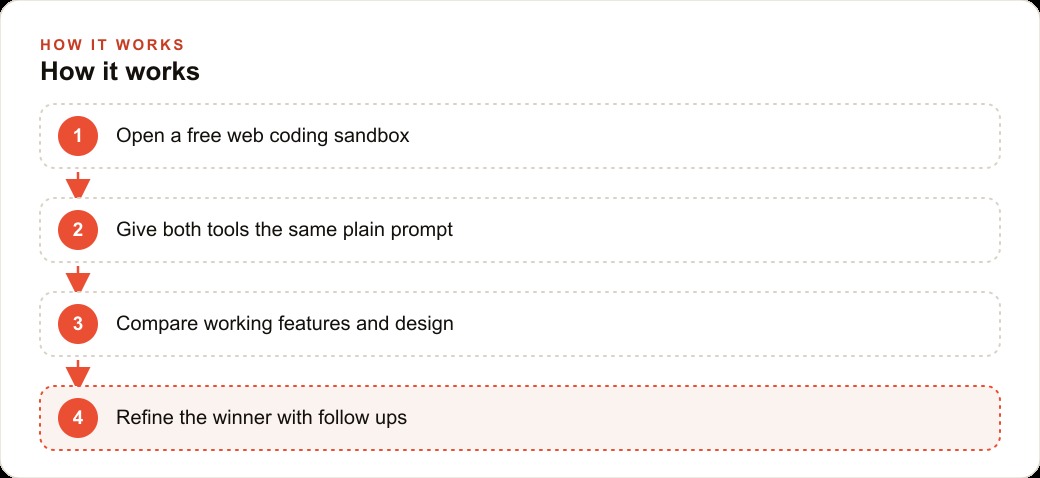
The businesses that benefit most from published AI coding comparisons treat them as a methodology to adapt, not a conclusion to accept. The methodology in the comparison I watched was sound: choose a concrete task, define evaluation criteria before seeing the results, give both tools the identical prompt simultaneously, and assess outputs honestly against the pre-defined criteria rather than letting visual polish substitute for functional performance. That methodology, applied to your actual use case with your actual criteria, produces a conclusion that is valid for you. Someone else's conclusion about a game or a personal operating system, built under someone else's evaluation criteria, is not valid for your situation.
The stack choice matters more than the comparison usually acknowledges. Both tools offer several starting configurations: a web app stack for sites, tools, and business applications; a game stack for interactive physics-driven experiences; and a handful of other specialized starting points. Choosing the wrong stack for your task type is a mistake that no amount of follow-up prompting will fully correct, because the scaffolding built into the starting configuration shapes everything that comes after it. A salon booking page built on a game stack will have the wrong defaults and the wrong structure from the beginning. A web app built on a game stack will fight the underlying configuration the entire way. Before you even write a prompt, match the stack to the category of thing you are building, because the stack choice is a structural decision and structural decisions are expensive to reverse.
The follow-up prompt dynamic is the comparison variable that almost never gets demonstrated because it is slower and harder to show in a short-form format. Every AI coding tool produces a draft on the first run. That is universal. The quality of the result after three or four targeted follow-up prompts varies much more than the first-run quality does, and the total distance from first draft to final usable result depends on how responsive each tool is to correction. The tool that produced the slightly better first output is not necessarily the tool that produces the best final result, because that depends on how precisely it responds to iterative refinement. A rougher-looking first draft from the tool that then closes the gap quickly through precise follow-up corrections may be worth far more than a polished-looking first draft from the tool that is harder to steer through iteration. This dynamic matters far more for a business owner who will work with a tool repeatedly over weeks than any first-impression screenshot suggests.
For a salon that wants a booking landing page, the practical path is clear. Write down in plain language exactly what the page needs to do. Describe the services listed, the prices shown, the booking flow, the brand colors, the specific platform the appointments feed into, and what the experience should feel like on a phone. Give that to both tools. Click through every button on your actual phone. Attempt to complete a booking. The tool that produces a working booking flow that matches your system is the right tool, regardless of which one looked better in the preview screenshot before you clicked anything.
Illustratively, comparing two tools on a salon booking page might reveal that one produces a visually appealing result with a broken form submit and no mobile adaptation, while the other produces a simpler-looking page where every button works, the form submits correctly, and the layout adapts cleanly to a phone screen. On that specific task with those specific criteria, the plainer-looking tool wins decisively. The same evaluation on a visually complex animation or a physics game might reverse that result. That is not inconsistency. That is the expected behavior of two tools with different design orientations, visible only when you test on your own task with your own criteria rather than importing a conclusion from a comparison built around someone else's priorities.
Why Function Beats Flash for Any Business Tool, Every Time
For business tools specifically, there is a reliable pattern in how to evaluate any AI coding comparison output honestly. Working reliably is worth more than looking impressive. A booking page that captures customer information and connects correctly to your scheduling system is worth more to your business than a visually beautiful booking page where the submit button does not function. A sales dashboard that displays your actual numbers correctly in a readable format is worth more than an impressively designed dashboard that shows placeholder data or breaks when you try to filter it.
This is obvious when stated directly. It becomes less obvious in the moment when you are looking at two outputs on a screen and one of them has better styling, smoother animations, and a more impressive initial visual impression. The visual polish activates a gut response that functional correctness does not, and that dynamic can push you toward the tool that builds more beautifully rather than the tool that builds more reliably. The comparison methodology that guards against this is simple: do not evaluate a tool on how the output looks in the first thirty seconds. Click through every button. Try to use it the way a real user would. Attempt to complete the task it was supposed to enable. Function is easier to test than beauty but requires more active effort to check because it requires actually using the thing rather than looking at it.
The cost comparison is also worth keeping in mind when evaluating either tool for business use. Both of these tools are free or very cheap to try, with API or subscription costs that are modest compared to the alternative of hiring a developer. A first exploration with both tools, built around your actual use case, might cost nothing or a few dollars. A developer building the same booking page or internal tool would cost 1,500 to 6,000 dollars depending on the scope and their hourly rate. The comparison cost is so low that there is no rational reason not to run your own test before committing to one tool or the other based on someone else's evaluation.
Why Your Own Test Is the Only Benchmark That Holds Up Under Real Conditions
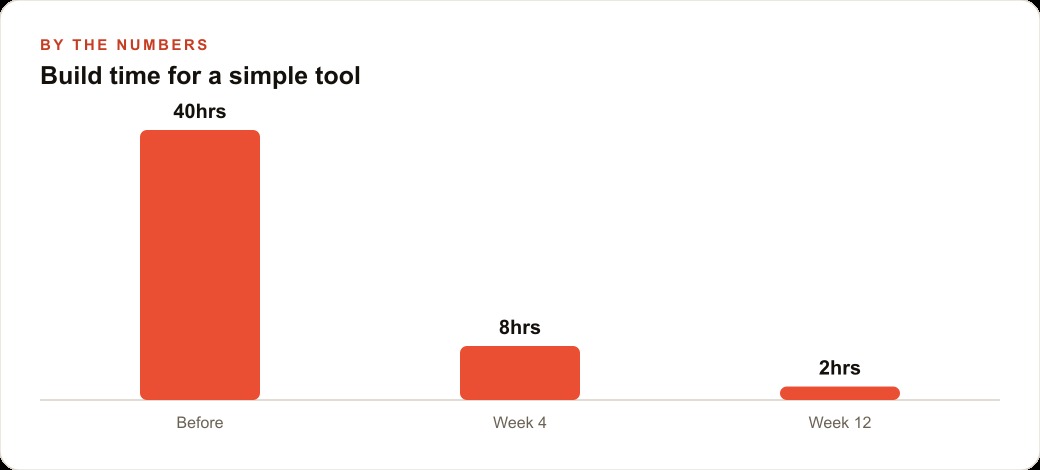
The cost of running your own comparison is near zero. Both tools have free or near-free tiers that let you build a first version without any significant financial commitment. The time required is a few hours, less if you write a specific and detailed prompt on the first attempt. The value of the conclusion you reach is substantially higher than any benchmark borrowed elsewhere, because it is based on your exact use case, your exact prompting style, your exact evaluation criteria, and the specific way your business actually operates. That is the only kind of conclusion worth carrying into how you use these tools on real work.
The broader truth about any AI coding comparison is that the field changes faster than almost any other technology category right now. A tool that trails on one capability today may lead on it in six weeks. The comparison you watched several months ago is already partially outdated on the specific capabilities that mattered most to the person who ran it. What stays current across updates and releases is the methodology: define your use case clearly, write a specific prompt, run both tools, evaluate on your real criteria, pick the winner for this task, and revisit when the tools have been updated significantly.
The most important thing I want to leave with anyone deciding between AI coding tools is this: the question to ask is not which tool won on someone else's test. The question is which tool produces better results on your actual task when you test both yourself with your own real criteria. That test costs almost nothing and takes an afternoon. The answer it gives you is worth far more than any benchmark, because it is grounded in your actual situation rather than in someone else's priorities and evaluation criteria.
For any business that is ready to build something practical today, whether a booking page, an internal report, a simple customer tool, or something else that has been on the wish list for months but never had the budget or the developer time, the barrier is now genuinely low. Pick a concrete task. Write a specific prompt that describes the real use case with real details. Let both tools take a pass at it. What you learn in that afternoon, about which tool's instincts match your prompting style and your evaluation criteria, is worth more than any comparison video. The comparison methodology is the lesson. The result from your own test is the answer.
That is exactly what we do at AI DOERS. Book a private 30-minute call with Madhuranjan Kumar and we will map the fastest path to it for your specific business.
Book your call →
Madhuranjan Kumar
Madhuranjan Kumar brings 20 years of performance-marketing experience and has managed over $200 million in Facebook ad spend for brands across the United States and beyond. His expertise spans the full modern marketing stack: Meta, Google Ads, TikTok, email automation, CRM, and the websites that hold it together. At AI DOERS he turns that track record into lead-generation systems for businesses across every industry.