
Clawdbot vs Claude Code: An Honest Comparison for Small Businesses
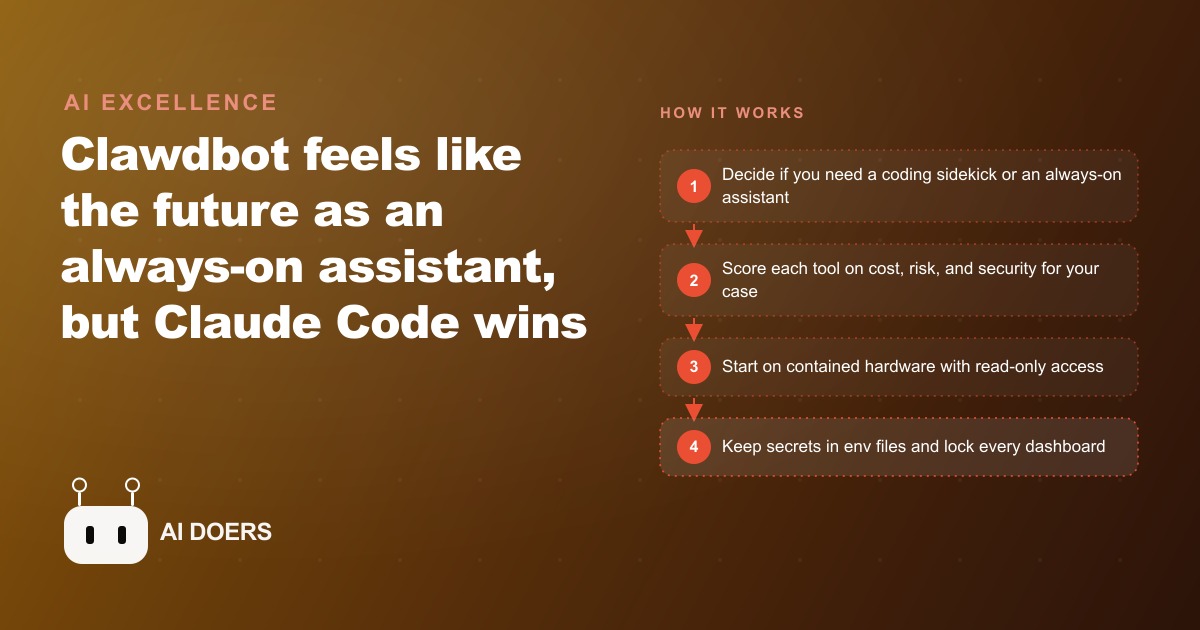
After putting both tools through heavy testing, the scorecard favors Claude Code on security and proven results, while Clawdbot wins on ambient presence and feels like the future. Here is how to choose, with a worked example for an insurance agency.

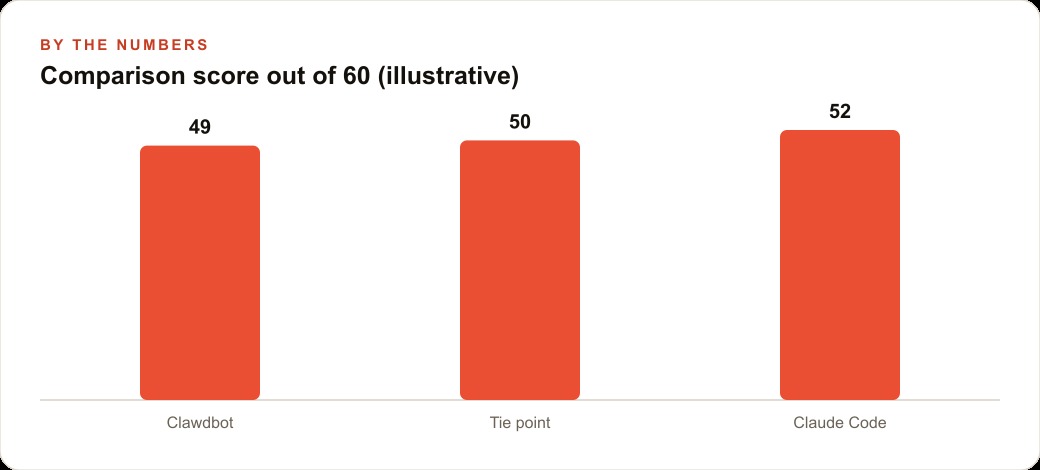
A comparison score of 49 to 52 out of 60 does not look like a dramatic verdict until you understand which dimension accounts for most of the gap, and that dimension is the one the most widely shared setup guides consistently skip: security.
Clawdbot and Claude Code are built on the same underlying model capability. Both can read, plan, write, and take action. On a narrow feature comparison they look nearly identical. The gap in the overall score comes from a single factor that most tutorial authors buried in an afterthought paragraph, and once you understand what that factor means in practice for a business holding real customer data, the gap looks a great deal wider than three points. This analysis treats both tools seriously rather than rooting for either one, because the right answer genuinely depends on who you are and what you actually need from an AI tool running inside your operation.
The Actual Difference Between a Coding Sidekick and an Always-On Presence
Claude Code is a coding tool. It lives on your machine, inside a terminal or a code editor, and its job is to help you read, write, understand, and fix code. When you close the terminal, it stops. It does nothing between sessions unless you explicitly start a new one. Its reach extends to the files and folders you point it at, and no further.
Clawdbot is an always-on presence. It runs on a server, talks to you through a chat interface like Telegram or a custom web UI, and stays active whether you are at the keyboard or not. You can message it from your phone while traveling and it will take action on your behalf. You can configure it to monitor your inbox, check your calendar, respond to messages, and run workflows on a schedule without anyone triggering it manually. The ambient nature of the tool is its central appeal, and for certain use cases, that ambient quality is genuinely powerful.
That difference in architecture shapes every other dimension of the comparison. The way you install them differs because one runs locally and one runs on a server. The security considerations differ because one is limited to your machine and one is exposed to network traffic. The cost model differs because one operates on a flat subscription and one charges per token for every message the assistant generates or receives. The damage radius of a misconfiguration differs because one can only touch files you pointed it at, while the other has the reach of whatever accounts and systems you connected it to.
Understanding the architectural split is the prerequisite for understanding everything else in this comparison. Feature lists do not capture it. Both tools can summarize a document, write a draft, or check a formula. The difference is whether the tool is waiting for you or working while you sleep, and that difference has cost, security, and reliability consequences that a feature checklist cannot communicate.
Why First Impressions Favor Clawdbot and Why That Is the Wrong Signal to Act On
The first time most people interact with Clawdbot, it feels more powerful than Claude Code. You type a question, it answers. You ask it to do something, it does it. You do not need to understand what a terminal is or how a command works. The conversational interface makes capability feel immediate in a way that a developer tool in a code editor does not.
Claude Code works differently. To get real value from it, you need to understand what it is doing and why. The first sessions often feel slower than expected because you are learning a pattern of interaction that is less conversational and more directional. You are pointing it at a specific problem and reviewing its work, not having a chat. That learning curve is real, and it is why first impressions consistently favor Clawdbot among people who come to both tools with no prior experience in developer workflows.
The problem is that first impressions reflect onboarding friction, not output quality or business suitability. Claude Code, once you understand how to use it, produces reliable, auditable, correctable output on the kinds of tasks a business can integrate into a real workflow. The steep-feeling start becomes invisible within a few hours of practice. Clawdbot's smooth first impression can mask the harder problems that appear later: a cost structure that can surprise you, security configuration that most tutorials skip, and a limited track record of shipped production work compared to a year of documented Claude Code results.
There is also a selection bias in how Clawdbot is showcased. The videos and posts that circulate show it working perfectly on carefully chosen demonstrations. They do not show the failed configurations, the security oversights, or the half-finished automations that quietly never shipped. Claude Code's reputation is built on the messy middle of real business use, including the iterations, the corrections, and the auditable output trail that a business actually needs to verify the tool is doing what it claims.
The Security Surface Is the Real Comparison Point, Not the Feature List
Security is where this comparison stops being about preference and starts being about business risk. Misconfigured Clawdbot servers have been found in the wild with no password protection at all, exposing API keys, months of private chat history, connected account credentials, and whatever sensitive conversations the instance had recorded. These are not theoretical scenarios. Documented cases exist of open instances accessible to anyone who located the right IP address.
The exposure happens because Clawdbot needs a server to run on, and setting up a server introduces a layer of configuration that most people who followed a getting-started tutorial did not learn in depth. Port management, authentication gates, environment variable handling, rate limiting, and IP allowlisting are all real security concerns that the viral tutorials tend to treat as optional finishing steps. They are not optional for a business running the tool on real client data.
Claude Code has a narrower blast radius by design. Its reach extends to the files and folders you point it at, the API keys you expose to it, and the actions it can take within the scope you explicitly defined. A mistake is recoverable because the scope was bounded before the tool started. A Clawdbot instance with full system access and no authentication gate is a different kind of exposure, closer to a misconfigured server than a misconfigured coding tool, and the recovery from a data leak is not comparable to the recovery from an incorrectly written function.
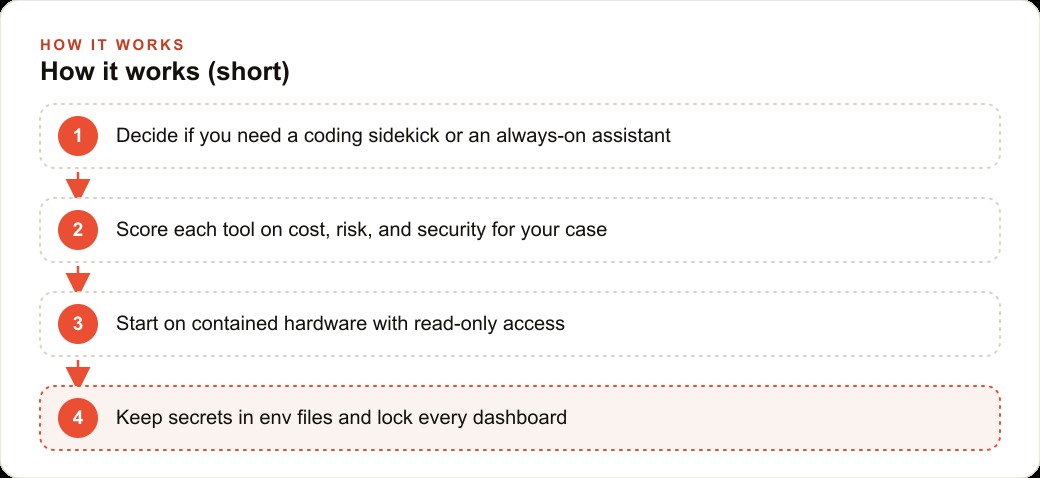
The practical guidance is consistent: if you run Clawdbot at all, run it on contained hardware dedicated to that purpose rather than on your main machine. Give it its own accounts with the narrowest permissions the use case requires rather than your master credentials. Keep secrets in environment files rather than in chat history. Put every exposed interface behind a login. Audit the configuration regularly rather than only at setup. These are not burdensome steps for a technically skilled operator. For a business owner without a server security background, they represent a meaningful skills gap that the tutorials do not close.
Cost Structure Determines Which Tool Stays Affordable When Usage Scales
Claude Code operates on a flat monthly subscription. The cost is predictable, budgetable, and does not change based on how many words you exchange with it during a session. For a business using the tool on a regular schedule of defined tasks, the flat structure makes financial planning straightforward. You know the line item before the month starts, and it does not move.
Clawdbot runs on a pay-per-token API. Every message you send and every response the assistant generates costs a fraction of a cent, which sounds inconsequential until you multiply it across a day of conversational interaction. A genuinely chatty session where you ask questions, explore ideas, and follow up on responses can burn through millions of tokens without a visible warning until the billing summary arrives. A day of heavy use, particularly if the tool is monitoring communications and responding throughout the day as an always-on assistant, can generate a bill that was not in the budget.
The cost dynamic also changes when you move from personal to business use at any meaningful scale. A business deploying Clawdbot as an always-on presence, processing incoming messages and generating responses continuously, is creating token consumption around the clock. The monthly cost on that pattern is not the small casual-use figure that makes Clawdbot look economical in tutorials. It scales with usage in a way that the flat-subscription model of Claude Code does not.
For a business evaluating both tools on a real operating budget, the predictability of the flat subscription is a genuine operational advantage over the variable token model, particularly in the early months when usage patterns have not yet stabilized and the cost-per-task is still being calibrated.
A Year of Shipped Work Is Worth More Than an Impressive Demo at This Stage
Clawdbot is a genuinely capable product with a fast-growing community and visible momentum. Claude Code has something different: a year of documented, shipped work across real business use cases, with a track record of reliable output that has been refined through real-world feedback and iteration. That asymmetry matters when you are deciding which tool to integrate into operations that cannot afford a significant failure in the middle of a client deliverable.
The Clawdbot community shares impressive demonstrations. Full business workflows built in an afternoon. Complex automations that work on the first try. These are real demonstrations of genuine capability. They are also selected for impressiveness, which is a sampling bias problem. The videos and posts that circulate are the ones that worked cleanly on the first attempt. The failed configurations, the security oversights, and the automations that started strongly and then drifted into unreliable behavior quietly stay out of the highlight reel.
Claude Code's track record includes the messy middle of real business use. Not just demonstrations that worked on the first try, but iterative refinement on tasks that required correction, auditing of outputs that needed human review, and a workflow discipline that builds genuine confidence in reliability over time. A year of that kind of real-world feedback represents a meaningful maturity advantage that shows up when the tool is handling something important rather than a demo scenario.
The Insurance Agency That Needed Reliable Help on Defined, Auditable Tasks
An independent insurance agency handling quotes, renewals, and a steady volume of client questions holds personal financial data and operates under compliance requirements around how client information is handled and documented. The operator wants AI assistance that saves meaningful time without introducing compliance risk that a regulator or a client could later scrutinize.
For this agency, the right answer is Claude Code, configured conservatively. The agency does not need an always-on presence with reach across all its systems. It needs reliable, auditable help on a defined set of repetitive tasks: pulling upcoming renewals into a tracking sheet, drafting reminder emails for a licensed agent to review and approve, summarizing a long policy document in plain language for a client call, and checking intake forms for missing required fields before they go into the record system.
Each of those tasks is scoped to a specific folder or data source, runs when the operator asks rather than continuously, and produces output that a human reviews before it reaches a client. Every sensitive credential stays in an environment file rather than in the chat history. The agency gets meaningful time savings without the exposure of an always-on server with broad system access that a compliance review might flag.
The time recovered is substantial. A staff member who currently spends three hours per week on the drafting and checking tasks that the tool can accelerate, and who then spends forty-five minutes reviewing AI output rather than producing it from scratch, recovers more than two hours per week of professional time. Over a month that saving is real and measurable. Over a year it is the equivalent of several weeks of professional time returned to the operation, producing better client service and more capacity for the revenue-generating work that the tool cannot yet replace.
Reading Your Own Risk Tolerance Before Choosing Which Tool to Run First
The choice between these tools is a risk tolerance question as much as a feature question. Both tools are genuinely capable. Both improve steadily. The right question is not which tool is better in the abstract but which tool fits your current skill level, your security posture, and your tolerance for the kind of failures each tool can produce.
If you are a technically skilled operator comfortable with server configuration, port management, and environment variable handling, and you want an ambient presence that runs without you being at the keyboard, Clawdbot is a reasonable experiment on contained hardware with appropriately scoped permissions. If you are building familiarity with AI tooling for the first time, or you are running the tool on data you cannot afford to expose, Claude Code on your local machine is the lower-risk starting point with the stronger proven track record.
The overall comparison score of 49 for Clawdbot against 52 for Claude Code out of 60 is not a wide gap. It reflects the fact that both tools are genuinely capable and the competition between them is real. What the score does not convey is that most of the difference comes from security and proven return on real operations, which are the two dimensions that matter most when a business is deciding what to trust with data and workflows that affect real clients. First impressions, feature counts, and demo videos are the wrong inputs for that decision. Risk tolerance, skill level, and the question of what happens when something goes wrong are the right ones.
That is exactly what we do at AI DOERS. Book a private 30-minute call with Madhuranjan Kumar and we will map the fastest path to it for your specific business.
Book your call →
Madhuranjan Kumar
Madhuranjan Kumar brings 20 years of performance-marketing experience and has managed over $200 million in Facebook ad spend for brands across the United States and beyond. His expertise spans the full modern marketing stack: Meta, Google Ads, TikTok, email automation, CRM, and the websites that hold it together. At AI DOERS he turns that track record into lead-generation systems for businesses across every industry.