
Clawdbot and the Rise of AI Agents That Actually Work for You
A viral open-source assistant called Clawdbot turned AI agents from a demo into something people use every day. Here is what it is, why it matters, and how a small business can put one to work.

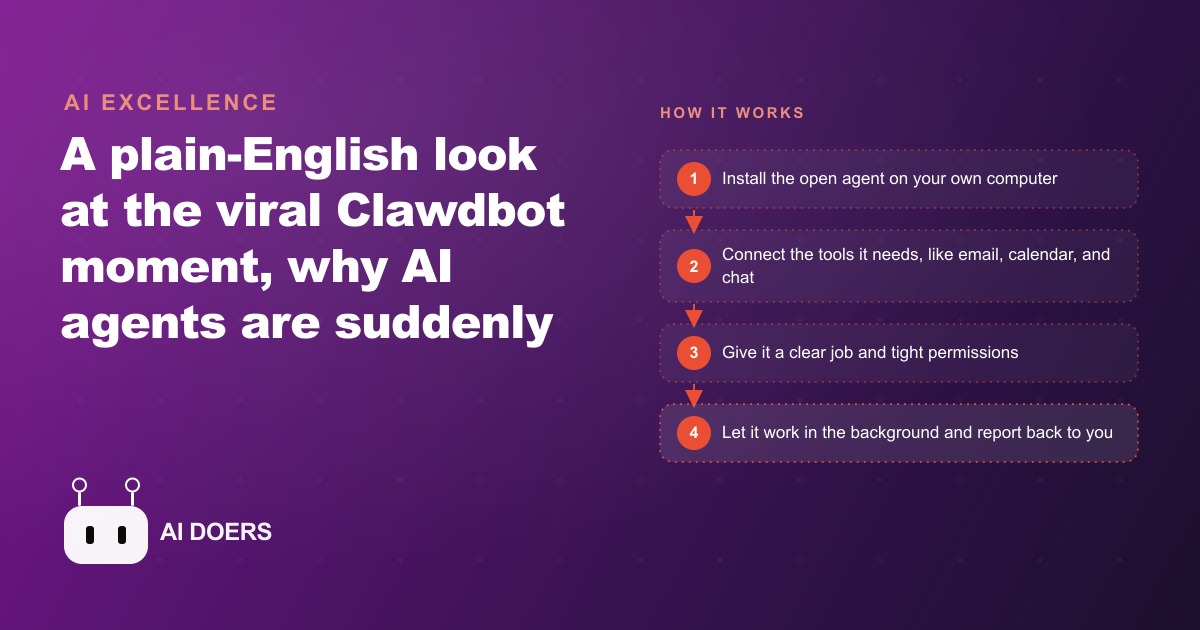
An open-source AI assistant called Clawdbot went viral across developer communities this week, generating more GitHub stars in 48 hours than most tools see in their first month. I am Madhuranjan Kumar, and the story is not primarily about Clawdbot specifically but about what its viral adoption reveals about where AI agents are in their development cycle and what that means for businesses evaluating whether to build with agents now. The signal in this story is clearer than the noise if you read it correctly.
What Made Clawdbot Go Viral Is the Same Thing That Makes Viral Tools Rare
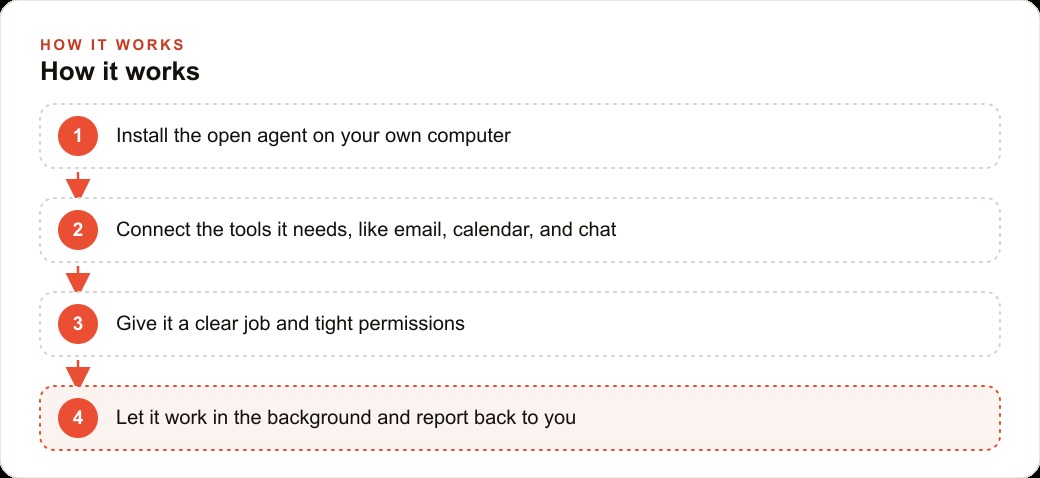
Clawdbot's specific design choice that drove adoption is that it lives inside the applications users already use rather than requiring them to go to a new interface. It connects to email, calendar, and document tools through their existing APIs, appears as a helper within those contexts, and responds to natural language requests about the content of whatever the user is currently looking at. The "help me with this" request, when it works consistently and produces genuinely useful output in the application the user is already in, removes the mental overhead of context-switching that makes most AI tools feel like additional work rather than less work.
Viral adoption in developer communities happens when a tool solves a real problem in a demonstrably better way than existing alternatives, not when the technology is impressive in isolation. Clawdbot's viral moment suggests that the combination of capabilities it brought together, in-context assistance without leaving the current application, consistent enough to rely on for real tasks, is a combination the market was waiting for. The developer community enthusiasm is also a leading indicator of broader adoption, because the tools developers adopt for their own productivity typically become the tools they build for business users in the following six to twelve months.
It Lives in the Apps You Already Use, Which Changes the Adoption Friction Calculus
The in-app design is worth dwelling on because it addresses the failure mode of most productivity AI tools that have reasonable standalone capability but low sustained adoption. The typical adoption pattern for a new tool with a separate interface is: trial period with high enthusiasm, declining usage after the initial novelty fades because the context-switching friction accumulates, and eventual abandonment in favor of the familiar interface that may be less capable but requires no additional switching. Tools embedded in existing applications do not face this friction because there is no switch to make. The capability is available when the user is already in the context where the capability is useful.
For a business that has tried AI tools and found sustained adoption difficult beyond the initial enthusiasm phase, Clawdbot's in-app design philosophy is a more reliable adoption model than standalone tools. The practical implication is to prefer AI tools that integrate directly into the applications your team uses daily over equally capable tools that require a separate interface, even if the standalone tool has slightly higher benchmark performance. Adoption reliability matters more than peak capability if the alternative to reliable lower-performance adoption is sporadic high-performance use that never becomes part of the daily workflow.
Agents Got Their Own Communication Networks, and That Changes What Multi-Step Automation Can Look Like
The more technically significant development behind Clawdbot's popularity is the emergence of agent-to-agent communication protocols that allow different AI agents to exchange information and coordinate actions without human mediation between each step. Historically, even sophisticated AI automation required a human to be in the loop between each major step: the AI produces an output, the human reviews it, triggers the next step, and the AI produces the next output. Agent networks allow the first agent's output to trigger the next agent's work directly, with human review happening at defined checkpoints rather than at every step.
For a small business, the practical relevance is not that multi-agent automation is immediately deployable without technical help, but that the capability infrastructure for building it is now maturing. The businesses that begin understanding how multi-step automated workflows work, what they can and cannot be trusted to do without human review, and where the checkpoints should be in a given workflow are the ones that will deploy this capability most effectively when the tools become accessible enough for non-technical operators to configure.
The playbook for building this understanding without committing to a full automation project is to document one existing multi-step process in your business as if you were designing an automated version of it. Write out each step, what information each step requires, what the acceptable output of each step looks like, and where a human would need to review before the process continues. That documentation exercise builds the conceptual understanding needed to evaluate any agent automation tool, without requiring any technical infrastructure to produce it.
There Is Always a Human Upstream Who Decided the Agent's Purpose and Its Constraints
One of the persistent misframings of AI agent capabilities is the presentation of agents as autonomous systems making independent decisions about what to do. Every AI agent that produces useful, safe output in a business context was configured by a human who decided what the agent's purpose is, what tools and data it has access to, what constraints limit its actions, and what outputs it should produce. The agent executes within those decisions. It does not make them.
This distinction matters for business owners evaluating whether to trust an AI agent with a specific business task. The question is not "can this AI be trusted" but "have the humans configuring this AI established appropriate purpose, access, constraints, and output standards for this task." An AI agent with well-designed constraints and appropriate access is trustworthy for the tasks it was configured for. An AI agent with poorly designed constraints or inappropriate access is untrustworthy regardless of the underlying model quality. The trust is in the configuration, not in the AI system in the abstract.
For any business deploying an AI agent that touches customer data, financial systems, or external communications, the configuration review is as important as the capability evaluation. What access does the agent have that it does not need for its stated purpose? What output does it produce that goes to customers or external parties without human review? Those questions identify the places where poor configuration creates risk, regardless of how capable the underlying model is.
New Technology Always Copies Familiar Patterns Before It Invents New Ones
Clawdbot's design, which mirrors the interface pattern of a human assistant sitting alongside you in the applications you use, follows a consistent historical pattern in technology adoption. Every major technology platform, when it first reaches a mass audience, is experienced through metaphors and interaction patterns borrowed from the technology it is replacing or augmenting. Early websites were designed to look like printed newspapers. Early smartphones ran apps that looked like desktop software. Early AI assistants look like a colleague sitting next to you helping with the work in the application you are already using.
The borrowed metaphor works for adoption because it reduces the conceptual distance between what users already know and what they are being asked to use. The limitation of the borrowed metaphor is that it initially constrains what the technology is asked to do to a subset of what it could actually do in an interface designed specifically for its capabilities. Over time, the familiar metaphor gives way to interaction models designed for the specific properties of the new technology. For business owners evaluating AI agents today, understanding that current agent interfaces are transitional, designed for adoption rather than for maximum capability, helps calibrate expectations about how the interaction model will evolve.
Security Caution Is Mandatory Before Connecting Any Agent to Real Business Systems
The enthusiasm around Clawdbot and similar tools creates a specific risk for business owners who connect them to real business systems before conducting a basic security evaluation. Any tool that connects to email, calendar, customer data, or financial systems through API access has the potential to access, modify, or share that data in ways that may not be immediately visible in the tool's interface. For an open-source tool with a young community, the security review process has had less time to identify and address vulnerabilities than established enterprise tools with years of production use and formal security auditing.
The minimum security evaluation before connecting any new agent tool to real business systems covers four questions: What data does this tool request access to, and does the access scope match the stated functionality? Where is the data processed, meaning on your device, on the tool provider's servers, or through a third-party AI provider? What happens to conversation content and accessed data after the session, and does the tool's privacy policy address this explicitly? What is the process for revoking access if you decide to stop using the tool?
For any business running paid social advertising through connected accounts, the same security questions apply to any tool that requests ad account API access. For any business managing client relationships through a CRM system, a tool requesting CRM access should be evaluated on all four questions before the connection is established. The five minutes spent on this evaluation is significantly less costly than the alternative of discovering a data handling problem after business or client data has been processed through an insecure path.
Small Businesses Win on Cost When Agents Handle Routine Work at a Fraction of Staff Cost
The most direct business case for AI agents for small businesses is the cost comparison on specific routine tasks against the human alternative. An AI agent handling initial email triage, routing to the right person, and drafting a first response template for common inquiry types costs a fraction of what a part-time administrative person costs for the same task volume. An AI agent pre-qualifying inbound leads from a website form and scheduling discovery calls handles a task that previously required either a dedicated person or a founder's evening hours.
For the small business owner who is personally handling tasks that could be delegated to an AI agent, the value of building the agent is the recovery of personal time that was previously unavailable for higher-leverage work. The time the owner spent answering routine inquiries is the time available for client acquisition, relationship management, and operational improvement once the agent handles the routine layer. That leverage multiplication, from routine-task time to high-value-work time, is the economic justification for any AI automation investment, and it is most powerful precisely for the small businesses where the owner's time is the most constrained and most valuable resource in the operation.
The Real Value of the Viral Moment Is Identifying Which Specific Task the Agent Does Best
When a new agent tool goes viral in developer communities, the practical exercise for a business owner is not to evaluate the tool as a general-purpose assistant but to identify the single most time-consuming routine task in the business's operations and test whether the agent handles that task reliably. The viral moment is a signal that the tool is worth testing, not that it is the right solution for every problem you have. The test should be specific, time-boxed, and evaluated on a concrete output: does the agent handle this specific task at acceptable quality without requiring more human intervention than the manual alternative would have required? If yes, deploy it for that task. If no, revisit in three months when the tool has likely improved based on the volume of user feedback that viral adoption generates.
The trap to avoid is evaluating an agent tool on a general impressiveness scale rather than on a specific task fitness scale. An impressive demo of general capability that does not map onto a real bottleneck in your workflow produces interesting conversations at no practical benefit. A less impressive demo of a specific capability that your business currently handles manually is the adoption case that creates real returns.
For businesses running CRM and client communication workflows, the test should be on the most common and most repetitive client communication type the business handles. For businesses running paid advertising campaigns, the test should be on the reporting or analysis task that currently takes the most manual time. Specificity in the test produces specificity in the conclusion.
That is exactly what we do at AI DOERS. Book a private 30-minute call with Madhuranjan Kumar and we will map the fastest path to it for your specific business.
Book your call →
Madhuranjan Kumar
Madhuranjan Kumar brings 20 years of performance-marketing experience and has managed over $200 million in Facebook ad spend for brands across the United States and beyond. His expertise spans the full modern marketing stack: Meta, Google Ads, TikTok, email automation, CRM, and the websites that hold it together. At AI DOERS he turns that track record into lead-generation systems for businesses across every industry.