
Claudebot: The Self-Hosted AI Assistant You Run From WhatsApp
Claudebot is a self-hosted AI assistant that lives on your own server and that you message from chat apps like WhatsApp, letting it clear your inbox, manage your calendar, orchestrate other agents, and even place phone calls, all while keeping your data on your machine.

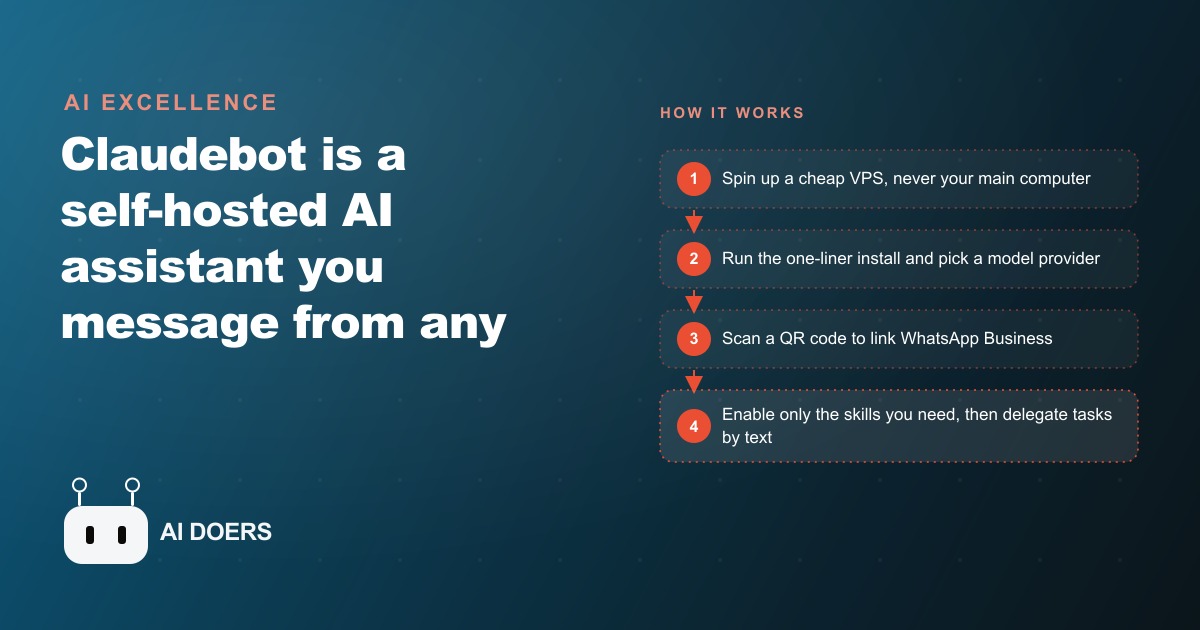
Claudebot is quietly more popular than Claude Code right now, and the reason is simple
Claudebot is quietly more popular than Claude Code right now, and the reason is simple: most business owners do not need a terminal, they need an inbox that answers itself. Claude Code is a developer's tool. Claudebot is a business owner's tool. You install it once, connect it to WhatsApp, and then you run business operations the same way you send a text message. No app switching. No browser tabs. No login screens for tools you use twice a month. The input method is the phone that is already in your hand.
What I want to do here is walk through eight specific things a business owner can do with Claudebot from WhatsApp, because the general description misses the point. The point is the specificity. It is not that you can use AI from WhatsApp. It is that you can clear your overnight inbox before you sit down for breakfast, brief yourself on a sales prospect in the hour before a call, and run the weekly business review from the job site while the crew finishes loading the truck. The specific use cases are what make this worth setting up.
Clear the overnight inbox before you finish your first coffee, from a text message
The overnight inbox problem is one of the most consistent friction points for small business owners. You wake up to a mix of new inquiries, existing client messages, delivery updates, vendor questions, and spam. Sorting through all of it before you can start the day costs anywhere from 20 to 45 minutes, and it happens before you have had time to think clearly about what the most important work of the day actually is.
With Claudebot on WhatsApp, I send a message before I am out of bed: "Summarize overnight emails and flag anything that needs a response before noon." Claudebot reads the inbox, categorizes the messages by urgency and type, drafts responses for the routine ones, and surfaces the two or three things that genuinely need my attention today. By the time the coffee is ready, I know what the morning looks like.
The draft responses are the part that saves the most time. A new inquiry asking about pricing, turnaround, and availability gets a draft response that answers all three questions in the tone and format the business uses. I review the draft, approve it or make a quick edit, and send it. The inquiry is handled before the customer has finished their own morning routine. Response time goes from hours to minutes and the business looks more professional than most competitors who are answering the same message type manually every single morning.
The habit change is more significant than it sounds. When clearing the inbox takes 20 minutes instead of 45, it stops being the thing you dread about mornings and starts being the thing you get done before the day really starts. The operational rhythm shifts.
Get a one-page prospect brief delivered to WhatsApp the morning before a sales call
Sales calls perform better when you have done the preparation. The business name, the industry, the decision-maker's background, the company's recent activity, the competitive landscape they are navigating, the specific problem they mentioned in the inquiry that triggered the call, all of that assembled into a readable brief before you sit down makes the conversation sharper and shows the prospect that you did the work.
The traditional alternative is 30 to 45 minutes of manual research the morning of the call, assembled into notes in whatever format you use, or arriving underprepared and hoping the conversation surface the relevant context naturally. Neither is ideal.
I prompt Claudebot the evening before: "I have a sales call tomorrow at 2pm with [business name]. Build me a one-page brief covering what they do, who I am talking to, what they are likely trying to solve, and three questions I should ask early in the call." The brief arrives in WhatsApp by 8am, formatted as a message I can read in five minutes. It includes the business background, the contact's professional history, the likely pain points based on their industry and size, and the opening questions calibrated to get useful information early rather than letting the call meander.
The brief has changed the quality of my calls measurably. The prospect senses that I understand their context without being told, which builds trust faster than any pitch. The questions I ask are better calibrated to their actual situation rather than generic discovery questions I would use with anyone. The calls close at a higher rate and move through the qualification stage faster because I am not spending the first fifteen minutes establishing context that I already know.
Book a reservation through a voice call when the online system fails
Online reservation systems fail more often than they should. The website is down, the booking widget is broken, the time slot shows available online but actually is not, the confirmation email never arrives. Every one of those failures is a potential lost customer, and most of them happen at the worst times, weekend evenings when the most desirable reservations fill fastest.
Claudebot's voice capability handles the fallback case. When the online system fails, customers can call a number connected to Claudebot, describe what they want in natural language, and Claudebot handles the booking through your backend reservation system. "I want to book a table for four on Saturday evening, any time between 7 and 9" is enough. Claudebot checks availability, confirms the slot, takes the name and contact information, creates the reservation in your system, and sends a confirmation to the customer's phone.
For the business owner, this means the phone line is always operational even when you are not available to answer it personally. For the customer, it means the booking experience is faster and more reliable than navigating a broken widget on a slow mobile connection. The voice interaction is natural enough that customers who call expecting a human frequently do not realize they are talking to an AI assistant until they ask directly.
The reliability of the fallback is what makes this worth setting up. A reservation system that is only as good as the online widget is a system that loses bookings every time the widget has a bad night. A reservation system with a voice fallback retains those bookings.
Ask for a summary of yesterday's logs and let it repair what broke
Server logs, application error logs, and system event logs are the kind of thing most small business owners with technical operations know they should be reading but rarely do because reading raw logs is slow and uncomfortable without specific training. Errors pile up unreviewed, small problems become large ones, and the first warning of something wrong is often a customer complaint rather than a proactive alert.
Claudebot changes this because the interface lowers the barrier. A text message at 8am: "Summarize yesterday's server logs and flag any errors that need attention." Claudebot reads the logs, identifies the error patterns, distinguishes between routine warnings that do not need action and genuine errors that do, and writes a plain-language summary that tells you what happened yesterday and what, if anything, needs to be done about it.
The repair capability is the more powerful feature for businesses running straightforward technical operations. A broken configuration, a failed scheduled task, a database connection error that is causing intermittent failures, these are things Claudebot can identify from the log summary and repair directly if you give it access to the relevant system. The workflow is: summary arrives in WhatsApp, I review it, I confirm the repair if one is needed, Claudebot executes the fix, and the fix is logged so there is a record of what happened.
For businesses that run e-commerce or any kind of web operation, this routine covers the most common class of technical problems before they escalate into customer-facing failures.
Give field staff the ability to query business records from their phone between jobs
Field staff, the people who are at job sites, client locations, delivery stops, and service calls all day, are often cut off from the business records they need to do their jobs well. Inventory levels, client account details, previous job history at a location, scheduling information, pricing for add-on services, all of that information lives in office systems that are not designed to be accessed from a phone in a driveway between jobs.
Claudebot connected to WhatsApp Business solves this with no new app for staff to install. The crew member texts a question: "What did we install at the Morrison Street job last fall?" or "Is the Thermarest Pro 400 still in stock at the warehouse?" Claudebot queries the relevant system and returns a plain-language answer in seconds. No login, no app, no browser, just a text message that gets answered faster than calling the office.
For a moving company, this means a crew can check whether the client added items to the move manifest without calling dispatch. For an HVAC technician, it means checking the service history at an address before arriving so the conversation with the homeowner starts from a more informed position. For a delivery business, it means a driver can confirm whether a package requires a signature without calling back to base.
The productivity gain for field operations is significant because the information request and the answer both happen in under 30 seconds instead of a phone call that interrupts both the field staff member and whoever picks up at the office.
Coordinate two parallel research tasks and merge the outputs before committing to a direction
Strategic decisions often benefit from multiple lines of research that need to be synthesized before a conclusion is possible. The traditional process is linear: research one thing, then research the other, then try to hold both bodies of information in your head while making a decision. The linear process takes longer and often results in a conclusion reached before the second line of research is complete.
Claudebot handles parallel research tasks and merges the outputs before presenting them to you. I prompt it: "Research two things in parallel: first, what are the current pricing benchmarks for residential HVAC installation in the Denver metro area; second, what are the most common objections customers raise during HVAC sales calls and how do competitors address them. Merge the findings and tell me what the data suggests for our pricing and objection-handling script."
Both research threads run simultaneously. The merged output arrives as a single briefing that covers both topics and synthesizes the implications. The synthesis step is what makes the output actionable rather than just informative. I am not receiving two separate research reports that I then need to connect. I am receiving a recommendation that already incorporates the relationship between the two bodies of research.
For strategic decisions that benefit from seeing multiple angles simultaneously, this collapses the research cycle from days to hours and produces a better-integrated output than sequential research typically generates.
Keep every customer record on your own machine instead of a third-party cloud
Data ownership is a concern that most small businesses think about in the abstract but rarely address in practice. The default for most cloud-based CRM and customer management tools is that your customer data lives on the vendor's servers, is subject to the vendor's privacy policy, and is at risk if the vendor experiences a breach, an outage, or a business failure. When the vendor raises prices, you are negotiating from a position of dependency rather than choice.
Claudebot is self-hosted, which means all of the customer records it manages live on your own machine or your own server, not on a third-party platform. The customer conversation history, the preferences, the account notes, the booking records, all of it stays under your control. There is no monthly subscription that determines whether you retain access to your own customer data. There is no terms-of-service update that changes what the vendor can do with that data.
For businesses handling sensitive customer information, including health and wellness businesses, financial services, legal services, and any business serving a customer base that expects privacy as part of the relationship, the self-hosted architecture is not just a preference, it is a requirement. Claudebot satisfies that requirement without sacrificing the conversational interface that makes the tool useful.
The practical setup requires a machine or a small server running continuously. A dedicated mini computer or a modest cloud server you control is sufficient. The ongoing cost is the hardware or server, not a per-user subscription, which means the economics improve significantly as the business grows and the number of customer interactions increases.
Run the weekly business review by texting a question from the job site
The weekly business review is a management discipline that most small business owners know they should be doing and most skip because it requires sitting down at a desk with multiple data sources open simultaneously. Sales numbers from the POS, labor hours from the scheduling tool, marketing results from the ad platform, customer feedback from the review aggregator, operational issues from the field notes, all of it needs to be assembled and reviewed in one session.
That assembly step is the bottleneck. It takes 30 to 45 minutes before the actual review begins, which means the review itself gets compressed or skipped when the week is busy. The weeks when the review is most needed are the weeks when it is most likely to be skipped.
Claudebot eliminates the assembly step. The prompt goes out as a text message from wherever I happen to be: "Run the weekly review. Pull this week's sales numbers, labor cost, and review sentiment. Tell me how this week compared to last week and flag anything that needs attention before Monday." Claudebot pulls from the connected data sources, runs the comparison, and returns a weekly review in plain language before I have finished reading the service ticket from the current job.
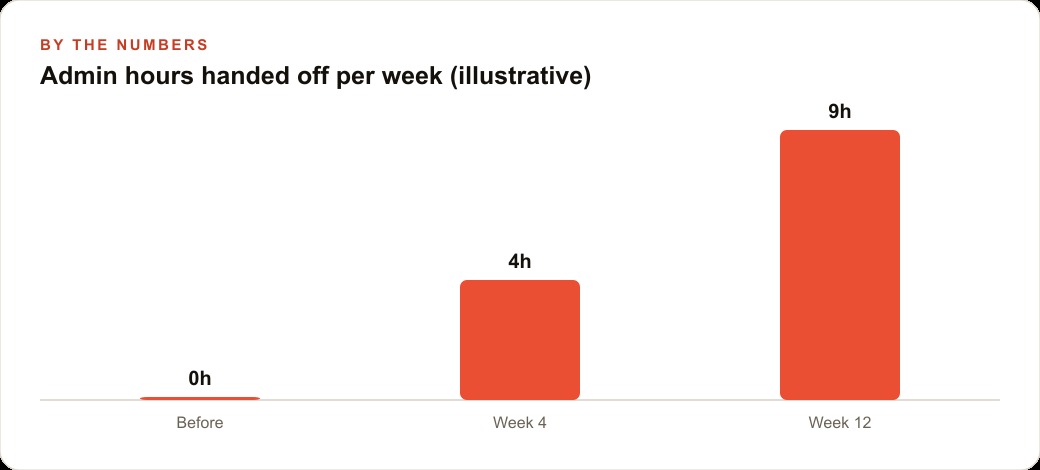
A moving company owner handling 40 inquiries per week used this to change her Monday morning routine entirely. Previously, Monday started with 90 minutes of administrative review that compressed the time available for client calls and crew coordination. With Claudebot delivering the weekly review as a WhatsApp message before she reached the office, she arrived knowing exactly what needed attention, where the week was strong, and what the crew needed to hear at the morning standup. The 90-minute review compressed to a 15-minute read on the drive in. Response time to new leads improved from 4 to 6 hours to under 5 minutes because the administrative burden had moved out of the same morning time block that used to absorb all of her focus.
That is exactly what we do at AI DOERS. Book a private 30-minute call with Madhuranjan Kumar and we will map the fastest path to it for your specific business.
Book your call →
Madhuranjan Kumar
Madhuranjan Kumar brings 20 years of performance-marketing experience and has managed over $200 million in Facebook ad spend for brands across the United States and beyond. His expertise spans the full modern marketing stack: Meta, Google Ads, TikTok, email automation, CRM, and the websites that hold it together. At AI DOERS he turns that track record into lead-generation systems for businesses across every industry.