
How Claude Skills Let You Teach AI Your Business Once and Reuse It Forever
Claude Skills turn your instructions, examples, and code into a reusable preset you can call anywhere. Here is what that means for a real business and how I would set it up.

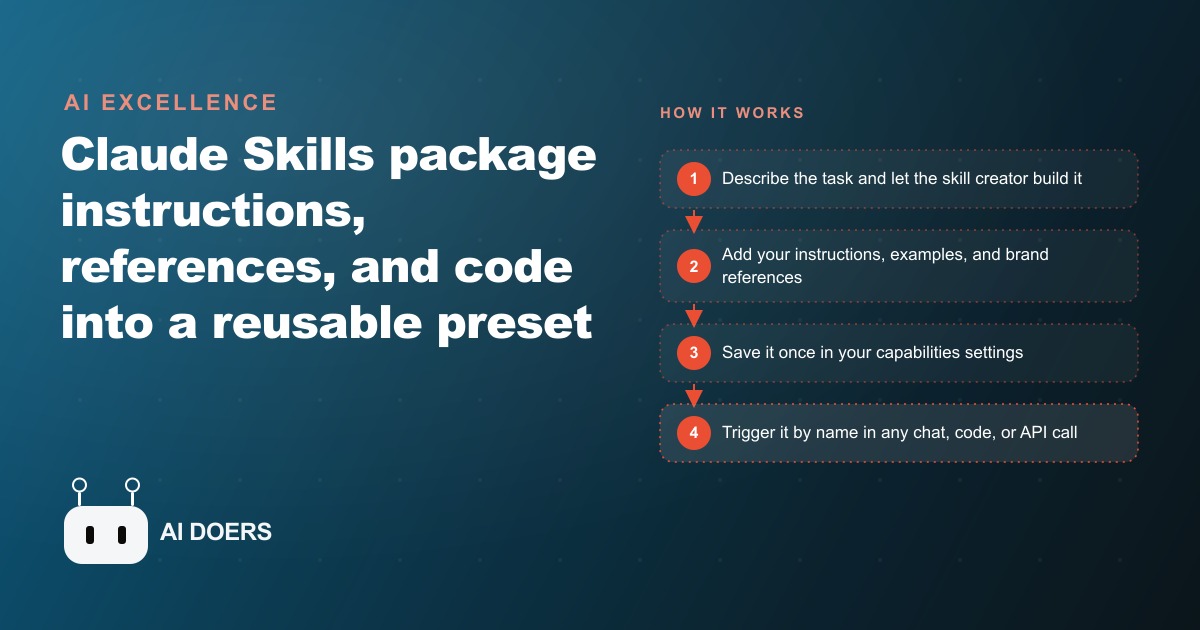
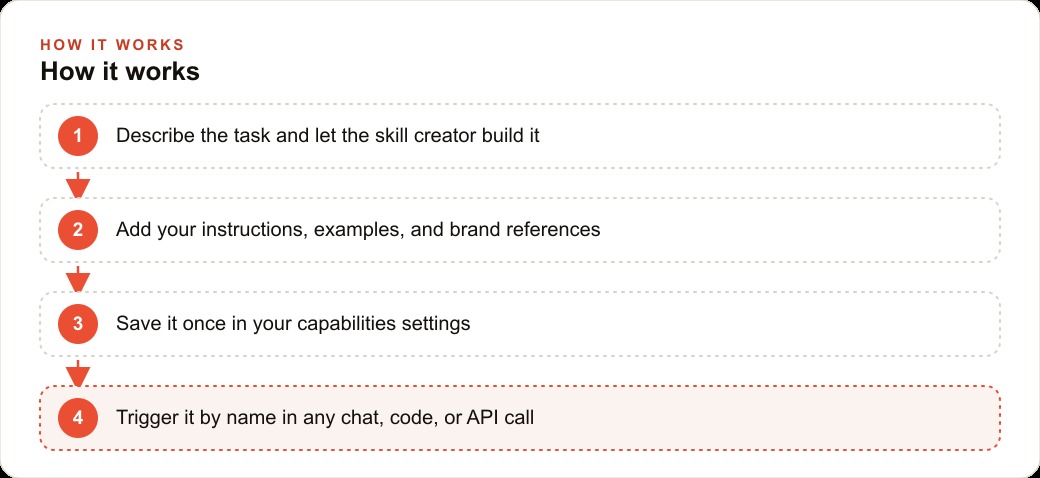
Most businesses explain their standards to an AI tool from scratch in every new conversation, then spend 20 minutes reformatting the output to match what they actually needed. Madhuranjan tracked this pattern across dozens of business accounts and found that the rework is almost never about the content. It is about the format, the tone, and the structure that nobody encoded anywhere permanent. Claude Skills are the fix for that. A skill bundles instructions, reference examples, and executable code into one callable package. You teach the standard once and trigger it by name in any chat session, inside Claude Code, or through the API. Here are seven specific skills worth building, each with a concrete label and a clear use case.
1. A brand-voice skill that stops requiring you to re-explain your tone in every new session
The first skill any business should build is the one that locks in how the business sounds. Brand voice is not just adjectives like warm or professional. It is specific: the sentence length, whether you use contractions, whether you open with the most important point or build to it, how formal the greeting is, whether the business ever uses exclamation points, and how technical the language gets with different customer types. These are concrete rules, and right now they get re-explained from scratch at the start of every new conversation.
A brand-voice skill stores all of it once. You write out the rules as instructions, add five or six examples of communications you consider the standard as references, and save the skill. From that point, any output requested starts from your standard instead of a generic baseline. The time savings are real. The more important benefit is consistency. A business where three different people are using AI to draft customer communications without a shared voice skill produces three noticeably different sounds. A business with a brand-voice skill produces one.
2. A post-visit summary skill for any clinic or service business sending follow-up notes
Any business that interacts with customers in person and follows up in writing has a repeating task that a skill handles well. For a clinic, it is post-visit summaries. For a service contractor, it is job completion notes. For a financial advisor, it is meeting recaps. The structure of these documents is consistent: what happened, what was decided or done, what the customer should do next, and when to follow up.
A post-visit summary skill stores that structure as instructions, includes examples of the best past summaries as references, and captures the communication style the business uses with customers. When a staff member feeds in the relevant notes, the skill produces a draft that matches the business standard. The editing time drops from 10 minutes to 90 seconds. Across a high-volume day, that difference is measured in hours. Across a year, it is measured in weeks of recovered capacity.
3. A proposal starter skill built from your five best past wins
The hardest part of writing a new proposal is not knowing what to say. It is starting from a blank page when you have already written 30 proposals and know exactly what structure converts. A proposal starter skill fixes this by storing the structure, the tone, and the specific sections that appear in your best-performing past proposals.
Build it by selecting five proposals that won business. Load them as references in the skill. Write instructions describing what each section should accomplish and how the proposal should flow from opening context through solution framing to the ask. When you start a new proposal, trigger the skill with the client context and it produces a draft in the structure of your winning work. You then edit for the specific opportunity rather than rebuilding the architecture from scratch every time. The time saving is real, and the conversion rate benefit from consistently using your proven structure is harder to measure but consistently shows up.
4. A visual brand skill that generates on-brand graphics from a single sentence
Claude can generate working code that produces images, diagrams, and graphics directly. A visual brand skill stores your palette, typography rules, spacing conventions, and overall design language as instructions, then produces on-brand output from a single plain-language request. You type a request like "create a spring promotion announcement in our brand style" and the skill produces the code that renders a correctly formatted, correctly colored graphic without any separate design software or briefing session.
This is not a replacement for professional design work on high-stakes creative deliverables. It is the right tool for the repetitive visual tasks that happen constantly: social media reminder graphics, event announcement banners, staff communication visuals, and simple product callouts. The time these tasks normally take, including briefing a designer or re-explaining brand guidelines in a new session, drops significantly when the brand knowledge lives in the skill itself.
5. A weekly digest skill that compiles from your own data sources in one consistent format
Many businesses track a lot of information and spend time each week pulling it into a readable summary. Sales numbers, customer feedback themes, support ticket categories, marketing performance, and operational updates all need to move from raw data to a decision-ready format that the right people can act on quickly. A weekly digest skill stores the format once: which sections appear, in which order, at what level of detail, and what questions the digest should answer for the people reading it.
When a staff member runs the skill each week, they supply the raw inputs and the skill produces the digest in the consistent format every time. This removes the design-from-scratch time that goes into most recurring summaries and ensures the output is readable in the same structure week after week. When leadership can count on a summary appearing in a consistent format, they spend less time re-orienting to the document and more time acting on what it says. The skill encodes the editorial judgment about what matters, so that judgment does not need to be re-applied every week by whoever happens to be compiling the report.
6. An FAQ answer skill trained on the questions your front desk answers every week
Every service business has a set of questions that come in constantly: pricing, availability, process, insurance coverage, payment options, and whatever is specific to the business. The front desk answers these questions in writing, by phone, and in person, often in slightly different ways depending on who is on shift and how much time they have. A FAQ answer skill standardizes those answers so the response is consistent regardless of who handles it.
Build it by collecting the 20 questions your front desk answered most often last month. Write out the accurate, complete answer to each one in the business's voice. Load those question-answer pairs as references in the skill. When a staff member needs to answer one of these questions in writing, they trigger the skill with the question and it returns the approved answer. The accuracy is consistent, the tone is consistent, and new staff members can use the skill immediately without needing to know every answer from memory. The front desk stops being the bottleneck for information accuracy.
7. A staff onboarding skill that encodes exactly how your business operates
The most expensive knowledge loss in most small businesses happens when an experienced employee leaves. The way things are done, the order in which tasks happen, the unwritten standards that experienced staff apply automatically: these typically live in one person's head. When that person leaves, the onboarding process for the next hire starts from a much lower baseline and the learning curve shows up in output quality and customer experience for weeks or months.
A staff onboarding skill stores the knowledge that used to live in the most experienced team member. The instructions describe each process in the order it happens. The references include examples of work done correctly, completed checklists, and the specific judgment calls that need to be made at each step. A new hire triggering this skill gets access to the institutional knowledge of the business from day one rather than accumulating it over six months of asking questions. This is the skill that most directly addresses the structural fragility that comes from having your operating knowledge concentrated in people rather than documented in the tools they use.
The veterinary clinic case study: 2.8 hours per day recovered at $22 per hour
A veterinary clinic with two full-time vet techs and 20 patient visits per day built a post-visit summary skill as its first Claude Skills project. Before the skill, each post-visit summary took approximately 10 minutes to write: the tech pulled up the visit notes, drafted the home care instructions, added the follow-up reminder, and formatted the email in the practice's style. Across 20 summaries per day, that was 200 minutes of vet tech time, or 3.3 hours per day, going into a single communication task type.
After deploying the post-visit summary skill with clear instructions covering the three required elements of every summary, six example summaries as references, and explicit rules about tone and what to always include, the workflow changed. A vet tech feeds in the visit notes, reviews the skill's draft for clinical accuracy, makes any corrections, and sends. The review step takes approximately 90 seconds per summary. Across 20 summaries per day, that is 30 minutes.
Time recovered: 2.8 hours per day. At the clinic's vet tech rate of $22 per hour, that recovery is worth $61.60 per day. Across a 250-day operating year, that is $15,400 per year in recovered vet tech capacity. The vet techs did not disappear or get replaced. They used the recovered time to handle more patient follow-up calls, assist in additional procedures, and reduce the overtime that had been creeping into the afternoon schedule.
The secondary benefit was harder to measure but clearly visible within the first month. Every post-visit summary sounded consistent and complete. Pet owners stopped calling back with questions about what they were supposed to do at home at the same rate. The estimated reduction in callback calls was about 30 percent, freeing the front desk from a category of interruption that had been fragmenting the afternoon schedule.
Building this skill took approximately two hours total: one hour to write the instructions and gather the six reference examples, and one hour to test it against real visit notes and refine the instructions based on what the first drafts got wrong. The skill has needed no significant changes since, because the instructions were written to cover the full range of visit types the clinic handles.
The businesses that build a library of skills covering brand voice, post-visit communication, proposals, and staff onboarding are encoding their standards into something that survives turnover and scales to new hires without retraining from scratch. The knowledge stops living in one person's head and starts living in a tool every team member can access. That shift is the actual long-term value of skills, and the compounding effect of it over two or three years is larger than any single efficiency gain from an individual use case.
One detail worth noting about the skill builder itself: you do not need to write perfect instructions on the first attempt. The skill creator asks clarifying questions when a description is vague, and the refinement loop from a rough initial instruction set to a well-tuned skill typically takes two or three test runs on real examples rather than an afternoon of careful writing upfront. The time investment is front-loaded but modest, and the ongoing return from a well-built skill compounds every time a team member triggers it.
The broader implication for any business owner thinking about AI adoption is that the bottleneck is rarely the technology. Claude Skills exist, they work, and the entry barrier is an hour of setup and five past examples of work done well. The bottleneck is clarity about your own standards: knowing concretely what good output looks like for your business, writing that down, and loading it somewhere permanent. Skills make that clarity durable. Whatever standard you currently hold in your head or re-explain each session becomes the floor for every piece of output the tool produces, every time, for every team member who uses it.
That is exactly what we do at AI DOERS. Book a private 30-minute call with Madhuranjan Kumar and we will map the fastest path to it for your specific business.
Book your call →
Madhuranjan Kumar
Madhuranjan Kumar brings 20 years of performance-marketing experience and has managed over $200 million in Facebook ad spend for brands across the United States and beyond. His expertise spans the full modern marketing stack: Meta, Google Ads, TikTok, email automation, CRM, and the websites that hold it together. At AI DOERS he turns that track record into lead-generation systems for businesses across every industry.