
Claude Skills Explained: The Agent SOP That Can Beat MCP
A Claude skill is one file that bundles a prompt with optional functions and templates so your agent performs a task the same way every time. Because it loads only the relevant instructions, it can replace a heavy MCP for a fraction of the tokens.

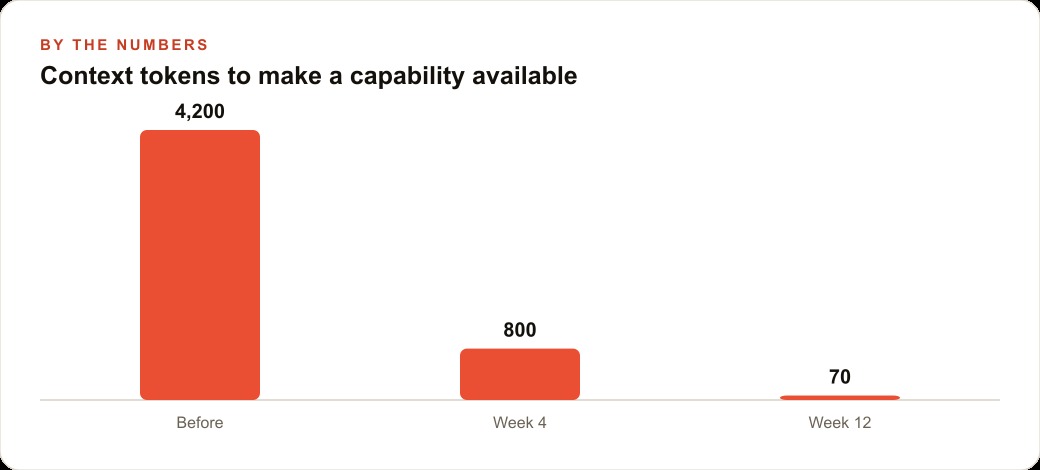
The discovery that changed how I think about agent architecture was a token count. A seven-tool MCP server consumed 4,200 tokens the moment it was connected, before the agent had done anything useful at all. The same capability rebuilt as a Claude skill dropped to 70 tokens. That is a 98 percent reduction in context overhead for the same functional result. I am Madhuranjan Kumar, and I want to take that number apart carefully, because the implications reach well beyond the obvious cost saving and into how you design AI systems that stay reliable at scale.
What a Skill Actually Is, Stripped of the Marketing Language
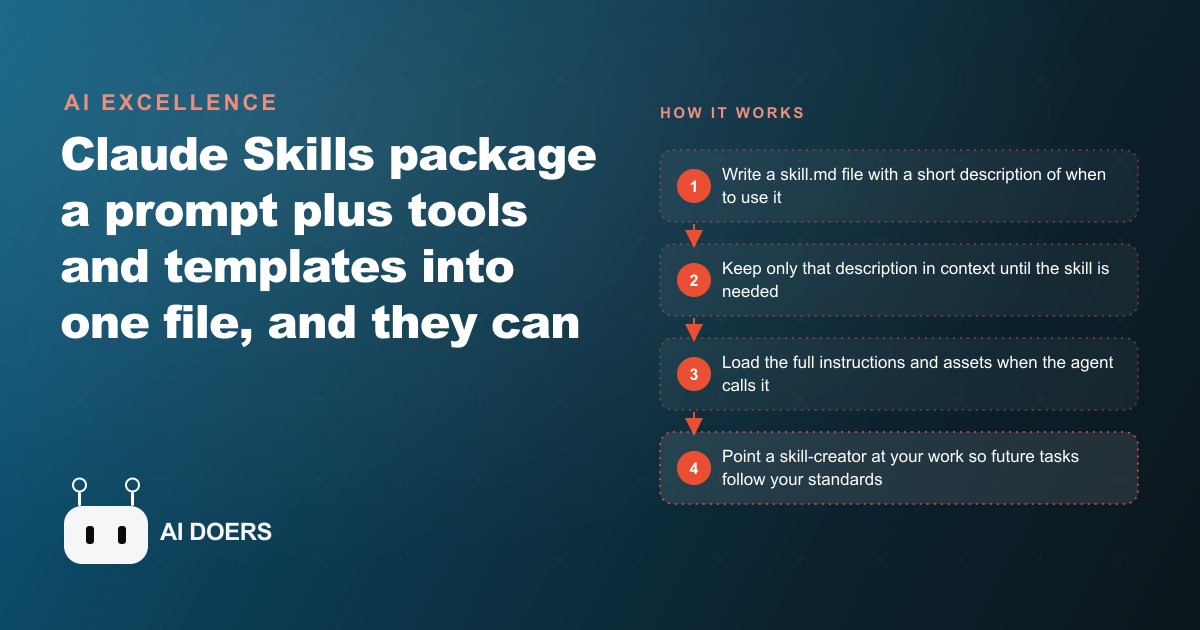
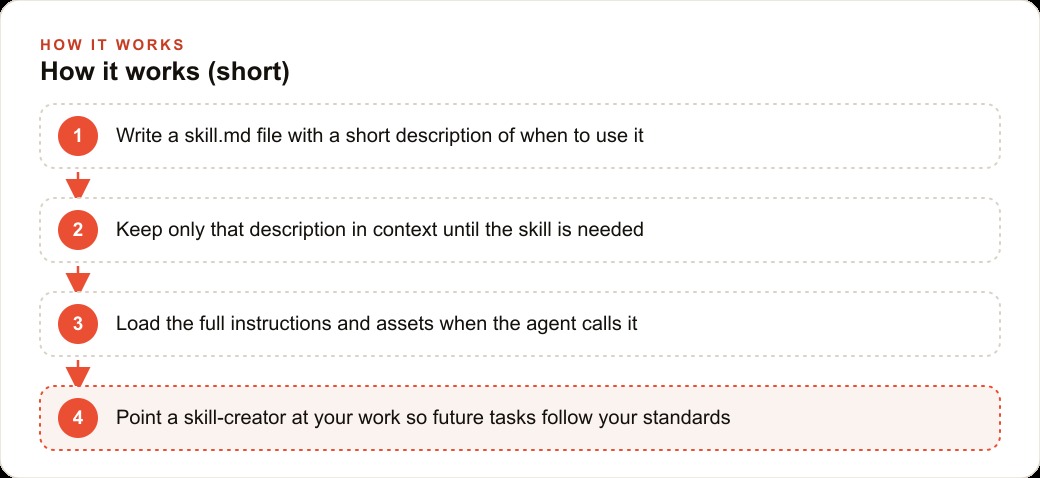
A Claude skill is a standard operating procedure for an AI agent, written into a single file called skill.md. The file has two parts. The first is a short description at the top that tells the agent when to use this skill. That description sits in the agent's active context at all times. The second part contains the actual instructions, any bundled functions, templates, or guidelines. That second part stays dormant until the agent decides the current task matches the description, then it loads and runs.
The key structural insight is that the bulk of the skill costs nothing until it is needed. Only the description is always present. If you have fifteen skills configured and the agent is working on a task that only involves one of them, the other fourteen sit in a dormant state contributing almost nothing to the context window. That architecture is the entire reason a skill can do the same job as an MCP server at a fraction of the token cost.
A skill can be as minimal as one paragraph. A brand voice skill might be a single description saying write all copy in a direct conversational tone without jargon, followed by a short list of preferred word choices and sentence patterns. No code, no tools, no templates. Just a document that encodes how you want a job done. That is the baseline version, and it already delivers the main benefit: the agent does the task the same way every time instead of improvising each time from scratch. The simplicity is the point, because it means anyone who can write clear instructions can build a working skill without needing a developer's help to set it up.
More complex skills can include bundled functions and example implementations. A code generation skill might include a set of pre-tested utility functions the agent should use, reducing the chance of the agent writing a new function that conflicts with one you already have. A data reporting skill might include a template the agent fills in rather than inventing a structure from scratch each time. The functions and templates are bundled directly in the skill file, which means they load precisely when they are needed and vanish from the context when the task is done.
The Token Footprint Problem and Why It Compounds Over Time
An MCP server works by exposing a set of tools the agent can call. Each tool has a description and an input schema. When a server is connected, all of those descriptions and schemas load into the agent's active context whether any of them are used in the current task or not. For a server with seven tools, that overhead reaches 4,200 tokens per session. For a server with twenty tools, the number is higher. If you have three MCP servers connected and the agent is working on a task that needs only one function from one server, you are still paying the full context cost for all three servers for the entire session, on every call.
That overhead carries two costs. The first is the literal API cost at current model pricing. For a team running hundreds of agent sessions per week, the overhead from idle MCP tool descriptions becomes a real budget line, not a rounding error. The second cost is less obvious but more consequential in practice: a noisier context degrades model reliability. A model working through 4,200 tokens of tool descriptions it is not using has more information to parse on every response. The irrelevant descriptions still occupy space and add parsing burden. As context fills with noise, the model's ability to stay focused on the actual task degrades in ways that show up as subtle errors, inconsistent outputs, and an increased rate of reaching for the wrong tool.
This degradation is not dramatic in any single session. It is a consistent friction that accumulates across every session and adds up to real productivity loss over time. Teams notice it first as a need for more correction prompts per session, then as a gradual increase in the time each task takes to complete reliably, and finally as a sense that the agent is less capable than it used to be, which is usually not a model regression but a context bloat problem that has crept in as more tools were added.
How Lazy Loading Solves the Problem Without Sacrificing Any Capability
The skill architecture solves the noise problem by inverting the loading order. Instead of loading everything at startup and using a fraction of it, you load almost nothing at startup and pull in the relevant piece when it is needed. The agent sees a list of brief descriptions and nothing else until a task arrives that matches. When it does, the full skill loads for that specific task and becomes dormant again when the task is done. The context never carries more than what is currently relevant.
The practical consequence is that your agent can carry many skills without any of them degrading the performance of the others. Ten skills configured as skill files add ten short descriptions to the context, perhaps 200 to 300 tokens total regardless of how complex each skill's underlying instructions are. Ten MCP servers connected would add tens of thousands of tokens of combined description and schema overhead, all present all the time. The skills approach scales horizontally without a cost penalty, which means a well-configured agent can carry a complete library of operating procedures covering everything from quoting to compliance to customer follow-up, each available instantly, none of them adding noise when they are not in use.
The comparison also holds on setup simplicity. An MCP server requires a running process, often a separate service with its own dependencies, port configuration, and maintenance requirements. A skill file is a text document. It travels with the project, gets edited like any other document, and can be version-controlled alongside the codebase. The sequence of steps the agent should follow is written directly into the skill, so there is no separate configuration to manage and no service to restart when the instructions change. A developer who leaves the team does not take MCP configuration knowledge with them because that knowledge is in a plain text file anyone on the team can read and update.
The Self-Improving Loop That Changes Long-Term Value
The most underrated capability that the skill architecture enables is self-improvement. When you point a skill-creator skill at your own existing outputs, whether finished documents, code files, or previous agent sessions, it can study how you do things and write a new skill that captures your conventions. That skill then becomes a guide the agent reads before doing similar work in the future.
For a business with an established voice and established processes, this is genuinely powerful. After the agent has drafted a dozen quote emails in your style, you ask it to write a skill capturing those patterns. The skill captures the tone, the typical opening structure, the phrases you use for pricing explanations, and the sign-off format. Every future quote email reads from that skill first, which means the hundredth email maintains the consistency of the first. The agent is not improvising from a vague prompt. It is following a documented procedure derived from your own actual work.
For a technical team, the same pattern applies to code conventions. After the agent has built several components in your preferred framework and style, a skill-creator studies those outputs and writes a coding style skill that captures the naming conventions, the file structure preferences, and the error-handling patterns the team actually uses. Future components read that skill first. The agent stops making assumptions about which utility functions are preferred or how your team structures its modules. It follows the conventions that are written down, and those conventions are derived from what your team actually built, not from some generic best-practice document.
What This Means for a Business That Is Not Running a Technical Team
The skill architecture is often described in developer terms because the people who noticed its token advantages tend to be developers. But a skill is not a developer artifact. It is a document that tells an agent how to do a job the right way. Writing a quoting skill, a compliance language skill, or a brand voice skill requires the same ability as writing a clear procedure manual. You describe the task, list the rules you want followed, give an example or two, and save the file. Any business owner who has ever trained a new employee can write a skill.
For a medical practice running an AI agent to draft patient-facing communications, a compliance skill captures the exact language requirements, the required disclaimers, and the approved tone. That skill loads every time the agent drafts a patient communication and never loads when the agent is answering an internal scheduling question. The compliance overhead exists only where it is needed, at no performance cost to the rest of the agent's work.
For an electrical contracting business running an agent to draft quotes and follow-up emails, a pricing skill captures the labor rates, the standard parts markup, and the format the owner has used for five years. A brand voice skill captures the informal but professional tone that works with this client base. A safety language skill captures the exact phrasing for the liability and warranty section the owner's attorney approved. All three skills run independently, load only when relevant, and together take up less context space than a single medium-complexity MCP server.
To make the token economics concrete at business scale: an operation running 300 agent tasks per week where each task currently loads a multi-tool MCP with 4,000 tokens of overhead carries 1.2 million tokens of weekly context overhead just from idle tool descriptions. At typical API rates for a capable model, that adds up to a meaningful monthly cost before any actual work is done. The same 300 tasks with skills-based overhead at 70 tokens per task produces 21,000 tokens of weekly overhead, a reduction of more than 98 percent. The monthly saving in that scenario more than covers the time it takes to build the skill library, and the saving continues indefinitely because skill files require no ongoing maintenance beyond updating them when the underlying process changes.
The right place to start building a skill library is not with the most complex workflow. It is with the most repeated one. What is the task your agent handles twenty times a week where the output quality matters most? A business owner who identifies that task, documents it clearly, and converts the documentation into a skill file will see the value immediately: the task runs more consistently, the context overhead for that session drops, and the output matches the expected standard without a correction pass. That single skill is the proof of concept that makes the rest of the library easy to justify building. From there, adding skills for the next most common task, and the one after that, scales the system incrementally without requiring a large upfront investment in time or configuration. The architecture rewards starting small and building deliberately, which is the same discipline that makes any good system reliable over time rather than impressive once and unreliable thereafter. The context overhead and reliability improvement are both measurable within a single week of consistent agent use, and both compound over time as the skill library grows and the agent accumulates a cleaner, more focused working context for every session.
That is exactly what we do at AI DOERS. Book a private 30-minute call with Madhuranjan Kumar and we will map the fastest path to it for your specific business.
Book your call →
Madhuranjan Kumar
Madhuranjan Kumar brings 20 years of performance-marketing experience and has managed over $200 million in Facebook ad spend for brands across the United States and beyond. His expertise spans the full modern marketing stack: Meta, Google Ads, TikTok, email automation, CRM, and the websites that hold it together. At AI DOERS he turns that track record into lead-generation systems for businesses across every industry.