
Claude's Managed Agents: What They Actually Do, and the One Thing They Are Missing
Managed agents let Anthropic host your agent on its own cloud so you skip months of infrastructure, but with no native scheduler the agent cannot wake itself up. Here is what they really do and how I would use them for a business.

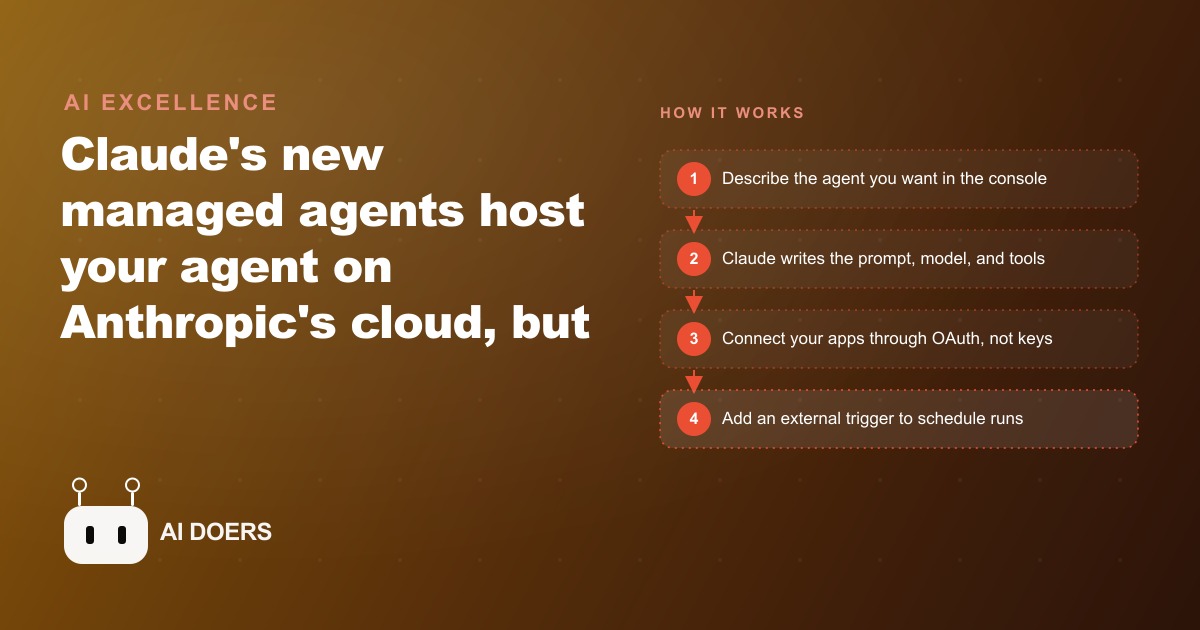
I have been watching the managed agents rollout from Anthropic closely because it represents a meaningful architectural shift in how you can deploy Claude to do real work. I am Madhuranjan Kumar. What I want to do here is not recap the announcement but actually work through what each piece means from the perspective of someone building business automations, not a developer demo. Seven things stand out. One of them is a gap that matters more than Anthropic's own materials suggest.
1. Infrastructure Responsibility Transferred to Anthropic
Let me start with what is actually new here, because the word "managed" gets used in software contexts so broadly that it has lost most of its meaning. In this case, managed means that Anthropic owns the compute, the container, the networking configuration, and the runtime environment where your agent operates. You are not spinning up an EC2 instance, configuring Docker, managing package dependencies, or worrying about what happens to the agent process when Madhuranjan Kumar machine restarts. All of that is Anthropic's problem now.
To understand why this matters, you need to picture what running a persistent agent used to require. Before this feature, if you wanted a Claude agent to be available continuously, you needed either a local process running on a machine that was always on, or a deployment on a cloud server you were paying for and maintaining. The local option fails whenever the laptop sleeps or reboots. The server option requires knowing enough infrastructure to provision a running process, handle environment variables securely, monitor for crashes, and manage updates without breaking the agent. Neither option is trivial, and the operational overhead compounds over time as you add more agents to your stack.
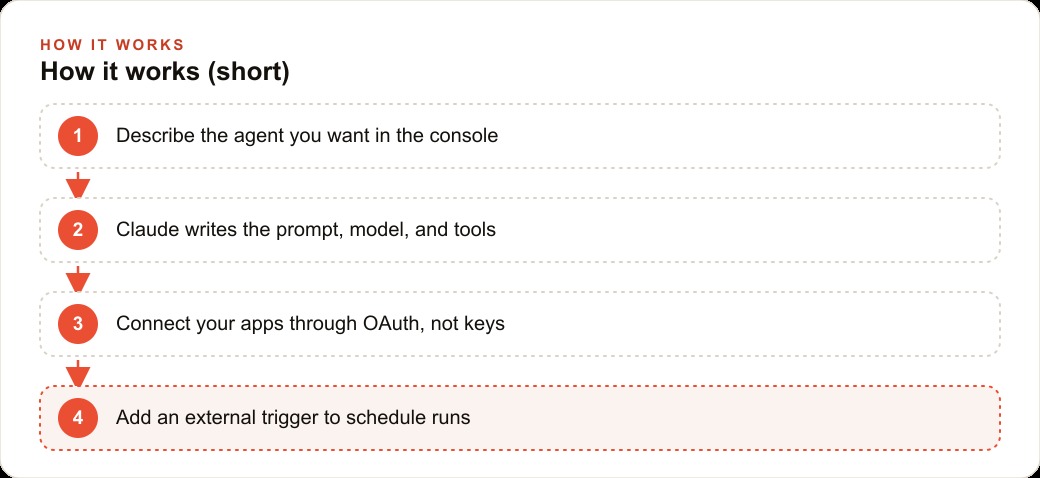
The shift managed agents represent is that provisioning and maintenance work is now built into the product itself. When I set up a managed agent through the Anthropic console, I describe what I want the agent to do, and the hosting environment is instantiated automatically. The container comes with common packages pre-installed and networking rules that allow the agent to reach external services. This is a meaningful reduction in the time between deciding you want an automation and having it run in a real environment against real data.
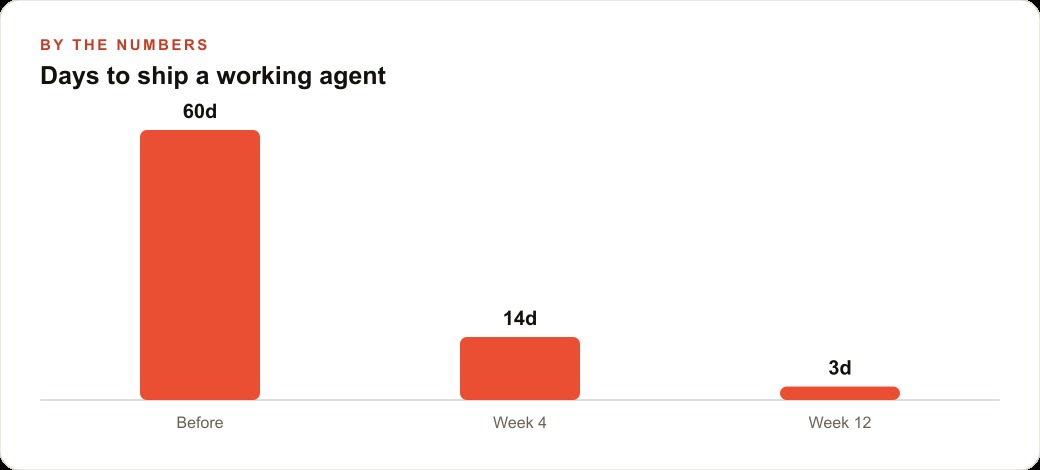
The concrete before-and-after from my testing: building a comparable persistent agent capability from scratch took me roughly four working days the first time, between infrastructure setup, authentication wiring, environment debugging, and deployment configuration. Setting up a comparable managed agent through the console took about forty minutes. Anthropic shares a graph showing agent shipping time dropping from sixty days before managed agents to three days by week twelve of adoption. That trajectory is consistent with what I experienced, though the initial steep drop is proportional to how much infrastructure background a given person is starting from.
2. Describing a Goal Replaces Configuring Steps
Traditional automation tools are step-oriented by design. You specify a trigger, then the first action, then the conditions that branch to different paths, then what happens at each branch endpoint. The mental model is a flowchart, and when the flowchart is complex, the configuration is complex in proportion. Maintaining it over months means maintaining that complexity indefinitely as the underlying services change their APIs and your workflow requirements evolve.
Managed agents take a different approach that I find more natural for the kinds of tasks I build automations around. Instead of specifying steps, you describe the goal. In the console there is a chat interface where I can write something like: "I want an agent that monitors my team's task list each morning, identifies items that are past due, drafts a brief summary of what is overdue and why based on the task context, and formats that into a short daily report." Claude then generates the agent configuration: the name, the system prompt, the model selection, and the specific tools the agent would need to accomplish that goal.
What this means in practice is that I spend my time thinking about the outcome I want and describing it clearly, rather than figuring out which automation primitives to assemble. The configuration Claude generates from that description is something I can then inspect and refine, but the starting point is already coherent and complete rather than blank. For people who have experience describing what they want in plain language but less experience translating that into software configuration, this entry point removes a significant cognitive barrier.
There is a real limitation worth naming clearly. Because the agent has more discretion about how it accomplishes the goal rather than following a fixed sequence you designed, the behavior can vary between runs in ways that step-based automation would not. For most business tasks, this variation is acceptable or even preferable since rigid step-based flows break when upstream services change. For any task where the exact process matters as much as the output, for compliance or auditability reasons, you would want to review the generated configuration carefully and constrain the agent more explicitly than the goal description alone provides.
3. Session-Based Pricing Fits Experimental Adoption
The pricing model Anthropic chose for managed agents is usage-based: eight cents per hour per active session, plus the normal API token costs for the work the agent actually performs. You pay for compute time when the agent is actively running. When the agent is idle between triggers, you pay nothing for that idle capacity.
I ran a concrete calculation against one of my recurring tasks to understand what this translates to in practice. I have a weekly competitive pricing review that currently involves someone spending about two hours gathering data from roughly twenty competitor pages, formatting it into a comparison table, and noting changes since the previous week. The human cost of that work at a reasonable rate for a skilled assistant is between fifty and eighty dollars per week. Running the same task as a managed agent using browser access to navigate the competitor sites and extract pricing fields took forty-three minutes of active session time in my test run. The session cost was under four cents. The API token cost for all the browsing and extraction work added roughly sixty to eighty cents depending on how much content the agent processed on each page. Total cost per run: under one dollar.
That comparison is not perfectly parallel because a human brings judgment calls that the agent sometimes handles inconsistently. But for a structured data gathering task with a well-defined output format, the cost difference is large enough that even accounting for occasional errors requiring human review, the economics favor the agent substantially. More important than the absolute cost is what the pricing structure enables in the evaluation phase. I loaded five dollars in credit, ran six test iterations on different task types, and had enough data to make a real decision about where agents would actually work for my use case. That five-dollar entry point, with no subscription required, is the right model for a feature still early in adoption.
4. Browser Access and Code Execution Turn the Agent Into a Research Worker
An agent that only processes text passed directly to it has limited utility for the kinds of tasks that consume significant human time in a real business. Managed agents run in an environment that includes browser capabilities for navigating websites, a code execution layer for running data processing scripts, and file system access for reading and writing documents. These three capabilities together make the agent genuinely useful for a much broader category of work.
The browser access is what I found most practically valuable during testing. In concrete terms, it means the agent can navigate to a URL, interact with page elements, extract content from the rendered page, and move through pagination. This covers a wide range of tasks that previously required either a purpose-built scraper, which requires development time and maintenance as sites inevitably change, or a human clicking through pages manually. An agent with browser access can conduct competitive research, extract pricing from sites that do not offer APIs, pull data from web dashboards, and interact with form-based tools that have no programmatic interface at all.
Here is a numbers-led example from my testing. A team member spends about five hours per week tracking pricing changes across twelve software tools in our market and formatting those into a structured weekly update. I tested the agent on a comparable research pass. It completed the work in twenty-eight minutes of browser session time at a total cost of roughly a dollar forty. Even if the team member's time is worth thirty dollars per hour, the weekly cost of the human approach is around one hundred and fifty dollars. Running the agent version at that pace would cost under ten dollars per month. The difference is not marginal. It is the kind of cost reduction that justifies re-evaluating how you staff recurring research tasks.
The code execution capability extends the agent's usefulness into data processing work. The agent can write and run a Python script mid-session to transform collected data, generate a formatted report, or run calculations against numbers it gathered. Tasks that combine data gathering and data processing, which previously required separate systems wired together, can be handled within a single agent session. That consolidation removes one category of integration work from your automation stack entirely.
5. Parallel Sub-Agents Reduce Wall-Clock Time on Multi-Source Tasks
One managed agent can instantiate and coordinate additional sub-agents. When a task can be decomposed into independent parallel workstreams, the primary agent handles the decomposition logic, dispatches sub-agents to each workstream, collects results as they complete, and synthesizes the combined output. The reduction in wall-clock time for parallelizable tasks is where this architecture delivers disproportionate value.
The math is direct. If a task requires gathering structured data from fifteen sources, and each source takes roughly three minutes of agent processing time, running them serially takes forty-five minutes of clock time. Running them in parallel across fifteen sub-agents takes approximately the duration of the slowest individual source, three to five minutes, plus a small synthesis step. That is a ten-to-one reduction in wall-clock time for the parallel case. When you need this kind of task completed and available for someone at a specific time, the difference between a three-minute turnaround and a forty-five-minute turnaround can determine whether the automation is actually useful to the workflow it feeds.
I tested this on a market research task requiring structured information from sixteen company websites: each company's product description, its homepage positioning statement, its pricing tier names, and any stated customer counts. A single agent working serially through all sixteen took fifty-one minutes. The same task orchestrated across sixteen parallel sub-agents took about four and a half minutes. Both produced comparable quality output. The session cost was slightly higher for the parallel version since more simultaneous sessions were running, but the total token cost was similar since the same volume of content was processed either way. The cost-per-minute trade-off favors parallel for any task where the output feeds a time-sensitive step.
The orchestration logic itself is not complex. The primary agent needs a clear instruction about how to decompose the work, what format each sub-agent should return its results in, and how the final synthesis should be structured. The synthesis step, combining fifteen independent results into coherent output, is where prompt engineering on the primary agent pays off most.
6. The Missing Scheduler Is the Substantive Gap, Not a Minor Footnote
I want to be direct about this because the announcement materials treat the absence of a native scheduler as a detail and I think it is actually the central limitation for the user segment managed agents are targeting most aggressively.
The core value of a managed agent is that it handles a recurring task automatically, without requiring you to initiate each run manually. A competitive pricing review should run every Monday morning at seven. A lead enrichment pass should trigger whenever new contacts enter your CRM. A weekly report should generate on Friday afternoon. All of these require the agent to be triggered on a schedule or by an upstream event, without a human clicking a button or making an API call each time.
Managed agents do not have a native scheduler. The agent only runs when something external calls its API. If nothing calls that API, the agent does nothing. For the business owner without a technical background who is the primary target audience of the managed-agents pitch, setting up an external trigger is a real obstacle. The options are: a cron job on a server, which requires having a server and enough command-line familiarity to configure cron; a third-party scheduling service, which requires another account and integration work; or calling the agent manually each time, which defeats the automation entirely.
The workarounds are not technically complex. A cheap VPS running a single cron job that calls the managed agent API costs about five dollars a month and takes under an hour to configure for someone comfortable at a terminal. For a no-code builder, that same setup is a genuine blocker. Anthropic will almost certainly add native scheduling as the product matures. Until they do, anyone building recurring automations with managed agents should factor the external scheduling layer as a separate step in their build plan and allocate time for it accordingly. It is not a reason to avoid managed agents. It is a reason to go in with clear expectations about the scope of the work.
7. Four Characteristics Define Whether Your Use Case Actually Fits
After running tests across a range of task types over several weeks, four characteristics consistently predicted whether managed agents delivered value or whether a different approach would work better for a given scenario. Knowing these before you start building saves the time you would otherwise spend discovering them partway through.
The first: the task has clear success criteria that do not require human judgment on every output. The agent needs to complete work without someone reviewing each step and redirecting in real time. Tasks like "extract the pricing from this page" or "classify this document into one of these five categories" have criteria that are clear enough to evaluate without a human in the loop. Tasks like "determine whether this prospect is worth pursuing" require judgment the agent can inform but not replace.
The second: the input varies but the processing logic stays consistent across runs. A weekly competitive research task processes different data each week but follows the same extraction pattern. A document routing task handles different documents but applies the same classification rules. This pattern is where agents return consistent value over time. When the logic itself needs to change frequently based on context the agent cannot access, the maintenance overhead of updating the agent offsets the automation benefit.
The third: the task requires tool access that traditional automation would struggle to replicate cleanly. Specifically, tasks that require browser interaction with sites that have no API, code execution on data that arrives in unstructured form, or reasoning about the meaning of content rather than just transforming its format. If a simple API integration or a spreadsheet formula could accomplish the same outcome, a managed agent is probably more infrastructure than the task warrants.
The fourth: the task does not require real-time latency. Managed agents operate on the timescale of minutes, not milliseconds. Any workflow where the output needs to feed something waiting for it in real time is not well matched to this architecture. Batch processing, scheduled tasks, and asynchronous enrichment workflows are the natural home. If the trigger for action is "something happened upstream and the next step needs to begin within two seconds," look at a different architecture.
If your target use case meets all four, managed agents are worth putting real time into testing with your actual data and your actual workflow. If it fails on latency or on the clear-criteria requirement, identify the mismatch before building, not after. The feature set is genuinely capable for the right problems, and it is not well matched to the wrong ones in ways that prompt engineering alone cannot resolve.
That is exactly what we do at AI DOERS. Book a private 30-minute call with Madhuranjan Kumar and we will map the fastest path to it for your specific business.
Book your call →
Madhuranjan Kumar
Madhuranjan Kumar brings 20 years of performance-marketing experience and has managed over $200 million in Facebook ad spend for brands across the United States and beyond. His expertise spans the full modern marketing stack: Meta, Google Ads, TikTok, email automation, CRM, and the websites that hold it together. At AI DOERS he turns that track record into lead-generation systems for businesses across every industry.