
Claude Opus 4.8: Smarter, Same Price, And Dynamic Workflows
Claude Opus 4.8 raises intelligence over 4.7 while holding the same price, which is effectively a price cut, and adds dynamic workflows that fan out hundreds of parallel agents with adversarial checking. Here is what that means for a real business.

The most important fact about Claude Opus 4.8 is the one that does not appear in any benchmark chart: it got smarter and the price did not move. Anthropic shipped a model with sharper judgment, more honesty about its own progress, and the ability to work independently for longer, and it left the price exactly where Opus 4.7 sat. That sounds like a footnote. It is actually the whole story. I am Madhuranjan Kumar, and I tell every client to read a frozen price on a smarter model as what it really is, a price cut, because you are now getting more intelligence for the same money you were already spending.
Anthropic's models tend to sit at the expensive end of the market, so this matters more than it would for a cheaper provider. When the premium option quietly becomes more capable at a constant price, the calculus for using it on real work shifts. There is a speed angle underneath the same theme, too. Fast mode now runs at roughly two and a half times normal speed and costs about three times less than it used to, so instead of paying something like six times more for haste, you pay around two times for two and a half times the speed. Read together, these two moves say the same thing: the cost of serious AI work is falling even when the sticker price holds still, and the businesses that notice early get a head start on the ones still waiting for a dramatic announcement.
The reason Anthropic could ship something this compute-hungry now comes down to supply. Deals for extra capacity appear to have ended the compute crunch that had been limiting what these labs could offer. That is not a detail for engineers to care about and owners to ignore. It is the physical reason the price could hold while the intelligence rose. More compute in the building is why you are getting the discount, and it is a hint that the trend continues rather than reverses, which is worth keeping in mind before you decide to wait for a cheaper moment that a competitor will not wait for.
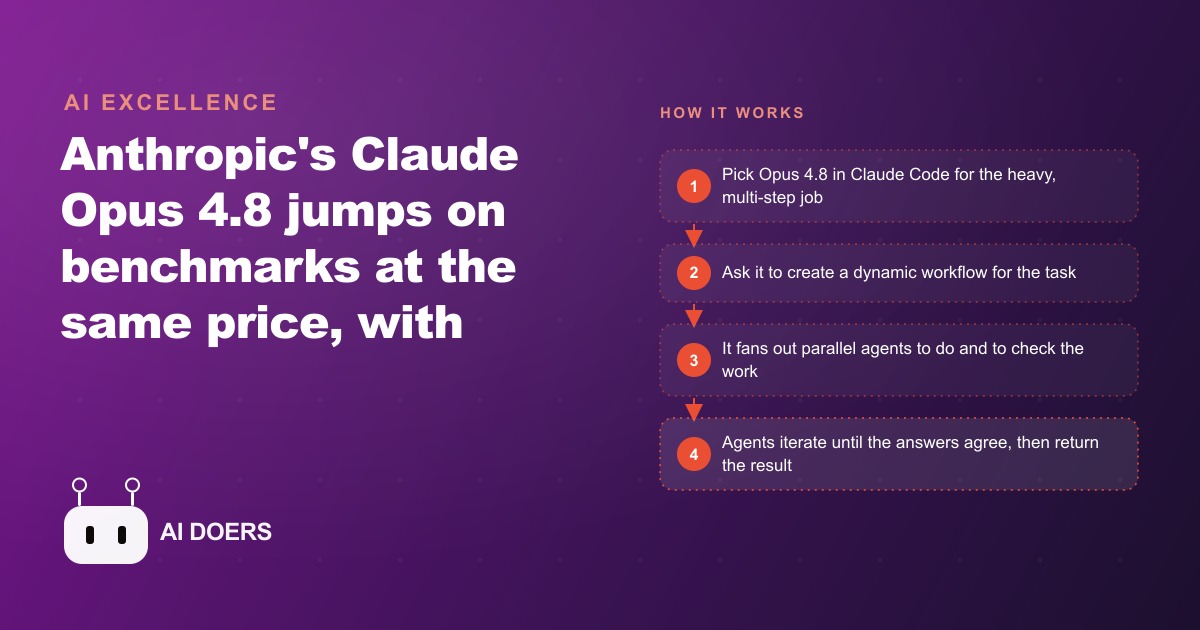
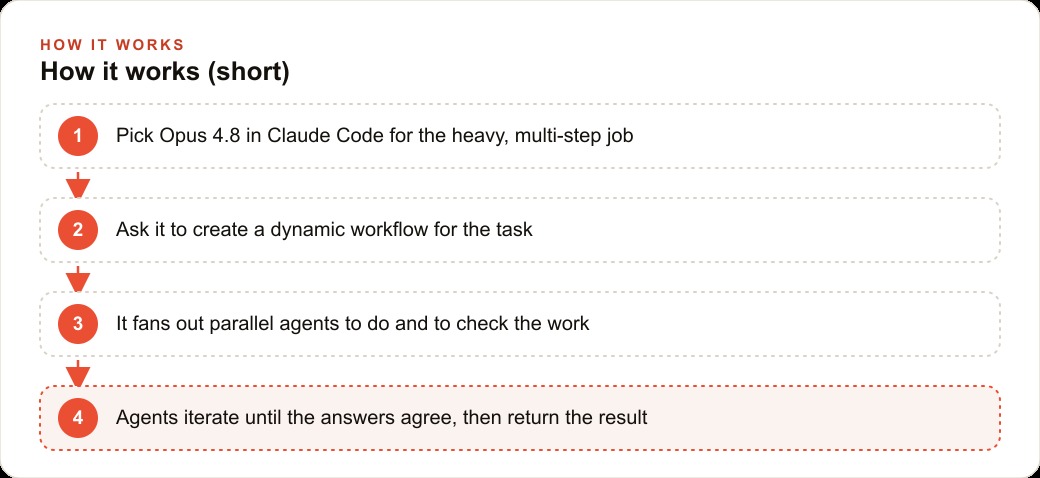
But the frozen price is only half of why Opus 4.8 matters. The other half is a genuinely different way of running the model, called dynamic workflows in Claude Code. Instead of answering your question in a single pass, Claude can now write its own orchestration script that fans out tens to hundreds of parallel agents in one session. Some of those agents work on solving the problem. Others are adversarial, actively trying to refute what the first group found. The run keeps iterating until the answers converge, which is something a single pass simply cannot reach. You turn it on with a setting called ultra code, which pushes effort to extra high, or you just ask Claude to create a dynamic workflow, and the model builds the orchestration for you.
It is worth slowing down on what fanning out actually means, because it is easy to nod past. In a normal interaction, one model reads your request and writes one answer. In a dynamic workflow, the model writes a program that launches many copies of itself, hands each a slice of the job, and coordinates the results. A migration across thousands of files, or a bug hunt through an entire codebase, stops being one long careful read and becomes many short parallel ones that finish together. That is why these workflows target exactly the jobs that used to be too big to attempt: the size that made them impractical by hand is the size that makes them a natural fit for parallel agents.
I want to sit on the adversarial part, because it is the piece that changes what a business can safely attempt. In an ordinary AI interaction, you get one confident answer and you have to decide whether to trust it. With a dynamic workflow, one group of agents produces the work and another group is explicitly tasked with poking holes in it, and the process only settles when both sides agree. That built-in disagreement is a form of self-checking, and it matters most exactly when a wrong answer is expensive. The system catches its own errors before a human ever sees the output, which is a very different proposition from a single pass that is fluent and occasionally, invisibly, wrong. For work where a mistake costs real money, that difference is the entire value.
The benchmark picture supports the upgrade without pretending it is a clean sweep, and I think the honesty helps rather than hurts the case. Opus 4.8 reaches sixty-nine point two percent on the SweBench Pro agentic coding test, a five-point jump over 4.7 from only six weeks earlier, while a leading rival sits at fifty-eight point six percent. On the multidisciplinary reasoning benchmark it gains three points without tools and three more with them, clearing that rival. On a knowledge-work test built to mirror real professional tasks, it shows roughly a one hundred forty point Elo gain over 4.7. The one place a competitor still leads is terminal navigation, where a rival holds the top spot, and that is part of why some people still prefer it day to day. A model that wins most tests but not all of them is more believable than one that claims to win everything, and it tells you to match the tool to the task rather than crown a single champion.
So what does a business actually do with a smarter model that also checks its own work and did not get more expensive? The answer is that dynamic workflows are built for a specific shape of problem, the big, repetitive, error-prone job that is too large for one careful pass. Cleaning thousands of records. Auditing an entire system for mistakes. Stress-testing a plan from many angles before you commit real money. A law firm can run a review across years of documents. A logistics team can reconcile shipping data across dozens of spreadsheets. These are the jobs where the parallel agents and the adversarial checking pay for themselves, and where the higher token cost of ultra code is worth spending because the alternative is a person doing it slowly and imperfectly, or nobody doing it at all.
Let me make it concrete with one illustrative example. Picture an e-commerce store owner sitting on a large product catalog, scattered analytics, and a long list of small fixes that never get done because each one is boring on its own. First, put Opus 4.8 to work on the catalog. Ask it to create a dynamic workflow that reads every product listing, flags missing sizes, weak titles, duplicate descriptions, and broken specs, then drafts a clean rewrite for each one. Because the workflow fans out parallel agents, a job that would take a person a full week comes back in an afternoon, and the adversarial agents catch the listings the first pass got wrong. Those cleaned listings do double duty, because better titles and descriptions strengthen the store's SEO and organic search at the same time they tidy the catalog.
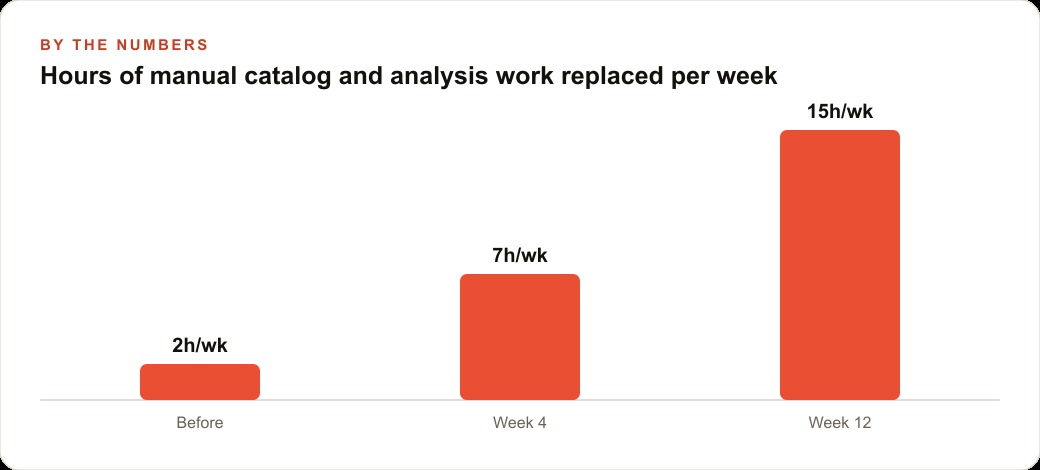
Then point the same approach at the numbers. Feed in the store's sales export, ad spend, and returns data, and ask the workflow to find which products quietly lose money after refunds and shipping, which bundles actually lift cart size, and where a price change is safe. One group of agents builds the analysis, another group tries to break it, and the run only finishes when both agree. The owner gets a short, trustworthy summary instead of a guess, and the insight about which products deserve budget flows straight into smarter Facebook and Instagram ad campaigns. For the everyday work, regular Opus 4.8 in fast mode handles support replies, restock reminders, and weekly performance notes cheaply, and the heavy dynamic workflow gets reserved for the big quarterly clean-ups where being right is worth the extra tokens. Imagine the manual catalog and analysis work it replaces climbing from a couple of hours a week before, to seven by the first month, to fifteen by the third. The numbers are illustrative, but the direction is exactly what happens when a smarter model takes over the boring, high-volume work.
What makes this durable rather than a one-time cleanup is that the workflow becomes a routine. The catalog audit that took a week by hand is now a quarterly button press, and the money-losing-product analysis that never got done because it was too tedious now runs whenever the owner wants a gut check before a sale. The model does not just do the big job once. It turns the big job into something small enough to repeat, which is where the compounding on that illustrative curve actually comes from, and it is the reason the second and third months look so different from the first.
There is a sensible way to adopt all this and a wasteful way, and the difference is discipline. Anthropic is upfront that dynamic workflows burn far more tokens than a normal chat, so start small and scoped. Open Claude Code, choose Opus 4.8, and run one ordinary task first so you trust the output before you scale up. When you have a genuinely large job, ask it to create a dynamic workflow for just that task and watch how the agents check each other. Keep fast mode on for routine work now that it is cheaper, and save the ultra code setting for the problems where a wrong answer would cost real money. None of this requires you to write a line of code yourself, which is precisely the point.
The cost discipline deserves a sentence more, because it is where people get burned. Ultra code and dynamic workflows are the heavy machinery of the toolset, and heavy machinery is expensive to run. The mistake is reaching for it out of habit on tasks a normal chat would have handled for a fraction of the tokens. The rule I give clients is simple: default to regular Opus 4.8, and only escalate to a dynamic workflow when the job is genuinely too big for one pass or too costly to get wrong. Treated that way, the higher ceiling is a tool you deploy on purpose, not a leak in your budget.
It also helps to understand that none of this demands technical skill from the person pointing it at a problem. An owner who can describe the job in plain language, cleaning up the catalog, finding the money-losing products, checking a plan for holes, can set a dynamic workflow in motion and read the verified summary that comes back. The technical part is that the model writes and coordinates its own agents. The human part is knowing which problem is worth the effort and being able to tell whether the answer is right, which is exactly the judgment a good owner already has about their own business.
There is one more thing on the horizon worth keeping in view. Anthropic has signaled a new class of model above Opus, and a small number of organizations already have preview access for security work. I mention it not to chase the next announcement but to make a point about posture. The right response to a fast-moving series of releases is not to wait for the final, perfect model, because there is no final model. It is to build the habit of putting today's best tool on your biggest, most expensive problems, verify the output, and let the compounding start. Opus 4.8 is a strong place to start that habit, because it is smarter, it checks its own work, and it did not cost you anything more to get there.
You can absolutely do this on your own, and I would encourage any store owner to try one scoped workflow this week to feel the difference. If you would rather have someone map your exact catalog and data, build the workflow so it returns clean, verified output on the first run, and set sensible limits so it never overspends, that is the kind of build I do for clients, and you can bring me in to handle it.
That is exactly what we do at AI DOERS. Book a private 30-minute call with Madhuranjan Kumar and we will map the fastest path to it for your specific business.
Book your call →
Madhuranjan Kumar
Madhuranjan Kumar brings 20 years of performance-marketing experience and has managed over $200 million in Facebook ad spend for brands across the United States and beyond. His expertise spans the full modern marketing stack: Meta, Google Ads, TikTok, email automation, CRM, and the websites that hold it together. At AI DOERS he turns that track record into lead-generation systems for businesses across every industry.