
Claude Opus 4.8 Review: The One-Prompt Demos That Set It Apart
Claude Opus 4.8 leads nearly every benchmark over 4.7, hallucinates about four times less, and builds working interactive apps from a single prompt, all at the same token price as 4.7. Here is what that means for a real business.

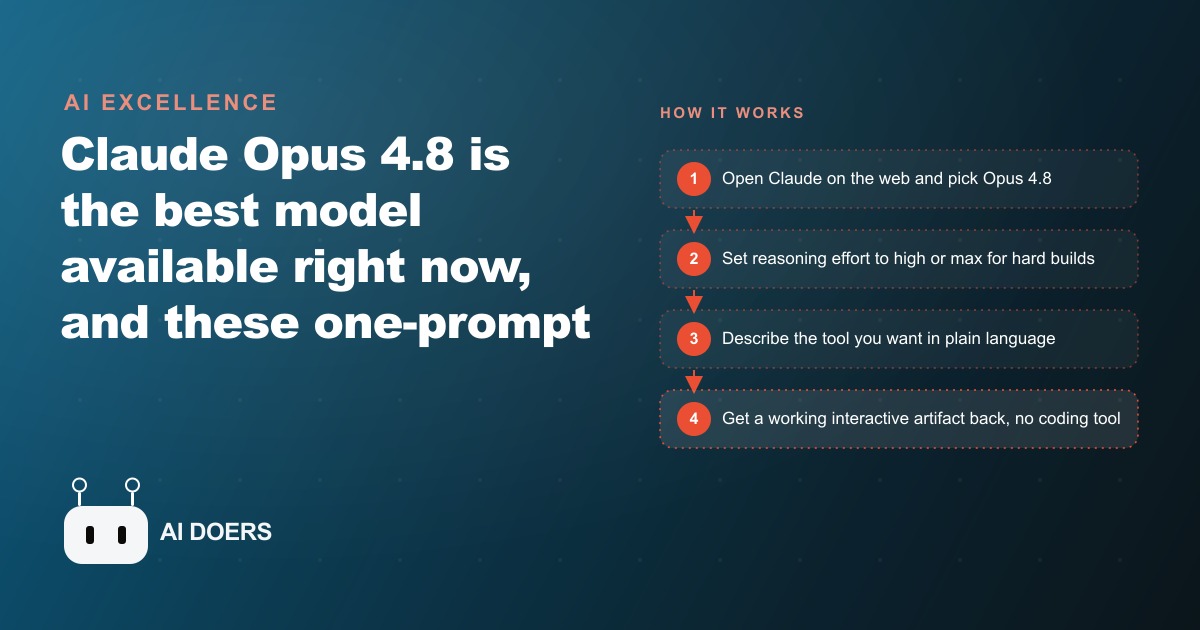
Claude Opus 4.8 arrived less than 45 days after 4.7, leads nearly every benchmark against its predecessor, the strongest ChatGPT model, and Gemini 3.1 Pro, and costs exactly the same per token as the model it replaced. I am Madhuranjan Kumar, and the number I want to open with is not the benchmark ranking. It is this: Opus 4.8 is roughly four times less likely to hallucinate than 4.7. It flags its own uncertainty. It makes fewer unsupported claims. That one shift rewrites the risk calculation for every customer-facing, high-stakes, or frequently-used application that a business has been holding back because the previous model was too unreliable to put in production.
The one-prompt demos will get most of the attention, and they deserve it. A Sims-style interactive city with buildings and working traffic built on the very first prompt, while 4.7 threw errors and produced something unfinished. A flyable 3D solar system with toggleable orbit lines and visitable planets, completed from a single prompt that left 4.7 stuck across three separate chats. A decade-by-decade interactive history of AI built in artifacts mode in under 1,000 lines of code. A rebuilt 1996 Space Jam website plus a modern animated version with smooth transitions in over a thousand lines of HTML. A quantum entanglement explainer for a 10-year-old, self-narrated with built-in voice. A CSV uploaded and returned as a dashboard with an executive summary, key insights, and recommended next steps in the exact order requested.
Each of those is a real result produced in a real session. And each one is being read primarily as a capability story when it is primarily a reliability story. That distinction is the throughline I want to pull through this piece, because getting it right changes what you build with this model and when you trust it.
The four-times reliability gain is what changes the business case
When a model hallucinates, the cost is rarely just the wrong answer. It is everything downstream from that answer: the action taken on it, the customer who received it, the time spent diagnosing where the error entered the workflow and correcting what it touched. Organizations that have experienced this develop a mandatory review tax on every AI output, a step that absorbs the time the tool was supposed to save. That tax exists because the model earned it through inconsistency.
Cutting the hallucination rate by roughly four times does not remove the review step, but it changes its character. Opus 4.8 explicitly flags what it does not know, surfacing uncertainty rather than filling gaps with plausible-sounding fiction. Reviewing an output that says it is not certain a regulation applies in your state and suggests you verify directly is a fundamentally different task from reviewing one that states the wrong regulation with the same confidence as the correct one. The first helps you move faster. The second is a trap. When uncertainty is marked, review becomes efficient. When uncertainty is hidden, every line carries equal suspicion and the review time cannot compress.
For any business deploying AI to answer customer questions, summarize proposals, or draft estimates that go to a real person, this threshold matters more than any benchmark position. The operative question for every operator of a customer-facing AI tool is not whether it is smart. It is whether it will embarrass them. Opus 4.8 answers that more reassuringly than any previous generation of this model, and that answer is what makes previously too-risky deployments viable now.
The demos are evidence of reliability, not just raw capability
A model that builds a flyable 3D solar system from one prompt is maintaining internal consistency across a large, interdependent build without fabricating function calls that do not exist, without drifting off the specification midway through, without substituting a simpler version of the hard parts when the hard parts are genuinely hard. The same discipline shows up in the interactive AI history timeline built decade by decade without inventing plausible-sounding but inaccurate dates. It shows up in the Space Jam rebuild, where quality held across a thousand-plus lines of HTML without degrading as the session context grew.
One of the most common failure modes in earlier models is that output quality falls as the session grows longer and context fills. The model starts strong and then drifts, misremembering earlier constraints or filling gaps in its recall with invented content. Opus 4.8 held quality over a thousand-line session. That matters specifically for any business task that is not trivially small: a multi-section proposal, a detailed research brief, a complex onboarding module, a customer-facing explainer built to match a specific inspection report rather than a generic template.
The voice-narrated quantum entanglement explainer is a slightly different point. Voice narration requires text structured to be spoken, not just read. Sentences need different rhythm, transitions need to be audible, and pacing needs to match a listener who cannot re-read a line. Producing that from a single prompt, correctly, demonstrates that the model understood a delivery constraint that was implicit rather than spelled out. A model that hallucinates frequently tends to miss implicit constraints, because filling uncertainty with defaults is the same mechanism as making things up. Flagging uncertainty is also noticing it, which means catching the implicit constraint rather than overriding it with a confident wrong default.
Reasoning effort control moved into the app for a reason
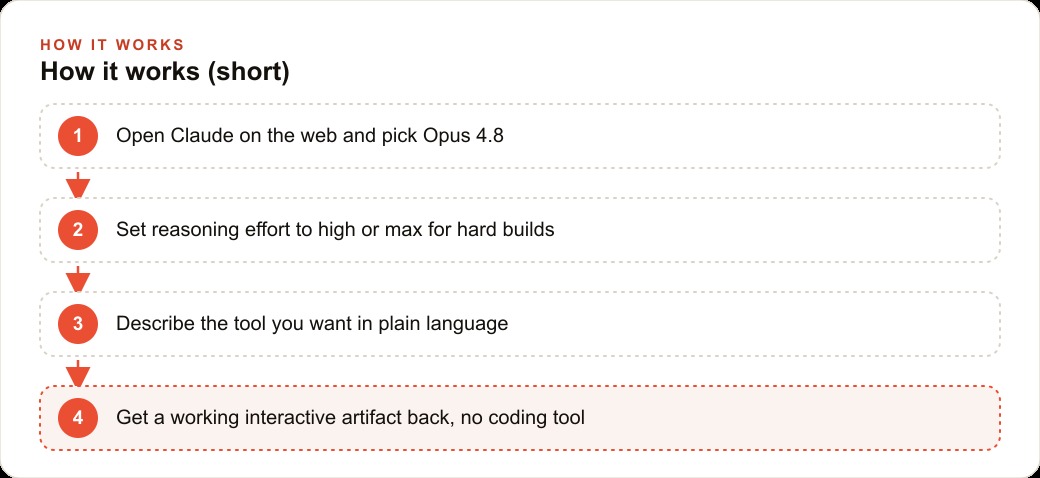
Until Opus 4.8, reasoning effort was an API parameter. Developers could set it. Business owners using Claude on the web could not. Anthropic moved this setting into the web app with this release, making it accessible in the same interface where most non-technical users work. The default is high, which already outperforms previous Opus versions. Max produces stronger output on the hardest tasks, at the cost of more credits and more time.
The people most likely to use Opus 4.8 for interactive estimate pages, internal job tracking dashboards, and self-narrating training modules are often not developers. They are business owners who need the tool more than they need to understand how it works. Putting the reasoning effort dial in the web app gives them access to the full ceiling without any configuration. The result behind the most striking demos is now available to someone who has never opened an API console.
The practical rule is simple. High effort is the right default for anything that benefits from structured thinking: research synthesis, business analysis, multi-section documents. Max effort is worth the extra credits for sessions where getting it right in one shot has clear value, where a revision round costs significant time or credibility. Know what the session is worth and set the dial accordingly. For a quote that might close a five-figure project, max reasoning effort costs a fraction of a percent of the job value.
One month, three working tools, five recovered hours a week
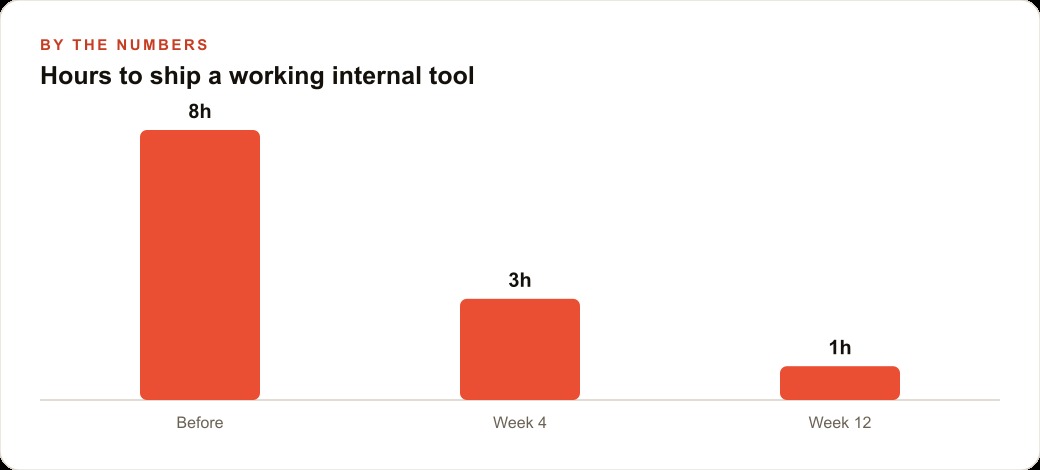
Here is a concrete worked example. The owner of a roofing business sends homeowners a multi-page PDF estimate filled with industry terminology most homeowners cannot parse. Calls come in asking about specific line items. The same explanations repeat every week. Across ten quotes in progress at any given time, the owner spends roughly thirty minutes per active quote fielding questions, totaling five hours a week on explanations that do not advance any job.
Conversion lags because confusion creates hesitation, and hesitation about a roofing estimate is especially sticky because the homeowner cannot see what they are paying for until the crew shows up. A homeowner confused about what a line item means will delay indefinitely rather than sign, even when the price is competitive.
In a single Opus 4.8 session with reasoning set to max, the owner feeds in a sample inspection report, a few representative line items, and a plain description: build an interactive estimate page where clicking any section of the roof shows what the repair involves and why it is needed, in plain language a homeowner can understand without any industry background. The model builds a working page. The homeowner now walks through the scope on their own, at their own pace, asking fewer questions before they are ready to decide. The five weekly explanation hours move toward one.
The job tracking dashboard is the next session. The owner uploads the Excel spreadsheet they already maintain, with addresses, stages, and crew assignments, and asks for a visual summary that shows at a glance which jobs are on schedule and which are waiting on materials or permits. No subscription, no developer, no new data entry. Just the file that already exists and a clear description of what the view should show.
For new crew onboarding, the self-narrating safety walkthrough is one prompt per topic: a module that talks a worker through ladder setup and harness checks step by step, accessible on a phone before a job starts. The module requires no trainer in the room and no video production. One session, one prompt per safety topic.
A realistic timeline: week one for the interactive estimate page, tested on two real quotes with crew input. Weeks two and three for the job tracking dashboard in daily use by the full team. Week four for the first training module. By month two, three working tools are in regular daily use, built for the specific operation, and the five hours of weekly explanation time has been cut to under one.
The tools compound in a second way. The business is also running paid advertising, whether through Facebook and Instagram ads or Google Ads, to bring in new homeowner inquiries consistently. Those leads now arrive into a process that closes better. The estimate is clearer. The follow-through on pending quotes is more organized. The conversion rate at the bottom of the funnel improves not because the advertising changed but because the friction that turned interested homeowners into confused ones has been reduced. The ad spend drives traffic; the operational tool converts it.
The same token price at four times less hallucination
Pricing held flat. Token input and output costs on Opus 4.8 are identical to 4.7. Pro subscribers get the upgrade as their default model at no additional charge. The practical implication: if you are already paying for Opus, you now receive something meaningfully more reliable at exactly the same cost. A four-times reduction in hallucination rate is not a marginal improvement. It is the difference between a model you cautiously pilot for low-stakes tasks and one you confidently deploy for the workflows that matter.
For teams that use AI to produce content at any scale, the same reliability that makes Opus 4.8 useful for internal tools makes it the right choice for SEO content that must be factually accurate across many pieces. The model that hallucinates four times less is the one you want writing anything that goes on your site with your name on it. Accuracy compounds in published content the same way errors do: a single confident wrong claim requires a correction, a republish, and a credibility cost that takes time to repair.
The model selection principle has not changed. Light tasks, routine drafts, and simple summaries belong on a lighter, faster, cheaper model. Complex builds, high-stakes synthesis, and customer-facing output belong on Opus at the reasoning level the task deserves. What changed is that the ceiling of the top tier is now higher, and the cost of reaching it is the same.
The question worth sitting with is which recurring friction in your business would disappear if a working tool replaced the manual process behind it. That is the starting point. One session, one prompt, one tool the team starts using the week it is built. The reliability gain is what makes it safe to deploy. The one-prompt capability is what makes it fast to build. The price parity is what makes it a straightforward decision to start today rather than next quarter.
That is exactly what we do at AI DOERS. Book a private 30-minute call with Madhuranjan Kumar and we will map the fastest path to it for your specific business.
Book your call →
Madhuranjan Kumar
Madhuranjan Kumar brings 20 years of performance-marketing experience and has managed over $200 million in Facebook ad spend for brands across the United States and beyond. His expertise spans the full modern marketing stack: Meta, Google Ads, TikTok, email automation, CRM, and the websites that hold it together. At AI DOERS he turns that track record into lead-generation systems for businesses across every industry.