
Claude Opus 4.7: A Real Upgrade, Or A Cure For A Self-Inflicted Disease?
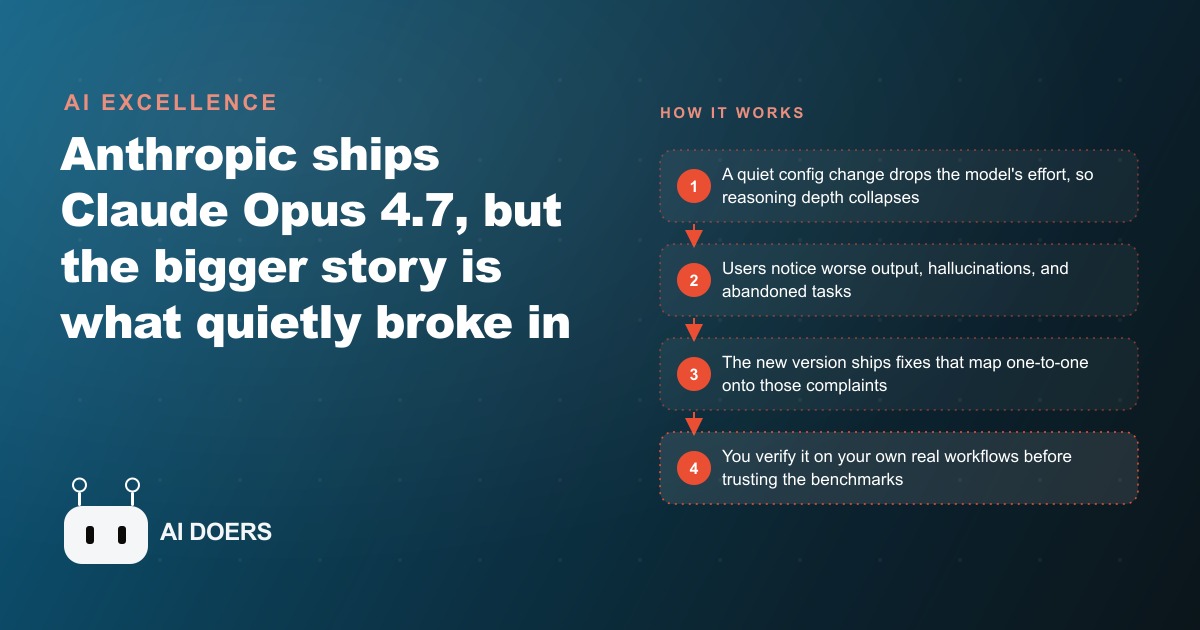
Claude Opus 4.7 ships with genuine upgrades, but it arrives right after Opus 4.6 quietly degraded, when a hidden setting change cut its reasoning depth by 73 percent. The practical lesson for any business using AI is to test new models on your own work and check your own settings before trusting a chart.

Build your private test pack before any announcement lands
The Claude Opus 4.6 and 4.7 episode is the clearest recent illustration of a risk that applies to every AI model from every provider: a model can degrade silently, your outputs can suffer for weeks, and you will not know unless you have a private evaluation habit that runs independently of whatever the provider chooses to tell you.
I am Madhuranjan Kumar, and I want to walk through what actually happened, because the sequence of events is instructive. A settings change caused the model's reasoning depth to drop by roughly seventy-three percent. Users reported worse outputs for weeks. An independent analysis of nearly seven thousand Claude Code sessions confirmed that thinking depth fell from approximately twenty-two hundred characters to approximately six hundred. The model started skipping file reads before edits at a much higher rate, fabricating commit hashes, and producing outputs where the word simplest appeared nearly three times more often than before, a signal the model was optimizing for the easiest path rather than the correct one. Tasks were abandoned mid-way. The failure was not in the model weights. It was in a settings change that defaulted the effort level to medium without announcement, affecting paying accounts for approximately a month before the pattern was publicly identified.
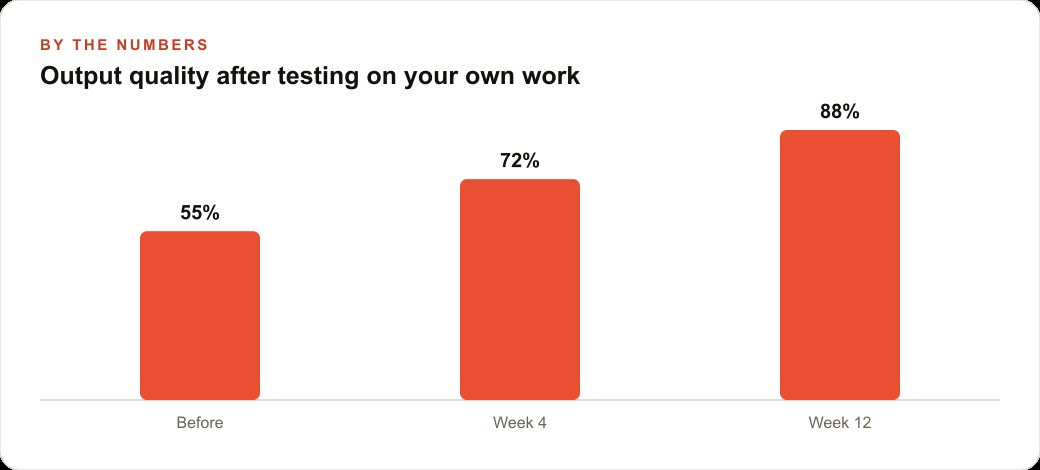
The businesses that caught this early had a testing habit. They ran the same known inputs through the model on a consistent schedule and compared outputs. When the quality dropped, they noticed within days, not weeks. The businesses that ran a full month on degraded output had no such habit. They were working from trust accumulated over a long positive track record, and that trust ran longer than the evidence justified.
Your private test pack is the practical tool that creates the difference between those two outcomes. Build it before the next release, before the next quiet configuration change, before the next provider update that ships without sufficient documentation of its behavioral effects. Fifteen to twenty real inputs from your actual workflows, the actual product descriptions, the actual customer questions, the actual code files, the actual reports you ask AI to produce. Keep them in a folder with the expected outputs noted. Run them every time a model version changes or you notice output quality shifting.
The test pack does not need to be comprehensive. It needs to be representative. Cover the categories of task your workflows depend on most: a few drafting tasks, a few analytical tasks, a few tasks where you have previously caught the model making errors, and at least one task that represents an edge case in your specific use. Fifteen inputs done carefully is far more useful than fifty chosen hastily.
Run old and new models side by side on the same real production inputs
When a new model version ships, the only question worth answering is: does this version perform better than the one I am currently using on my actual inputs? Not on the provider's benchmarks. Not on the inputs the announcement post illustrated. On the specific inputs that appear in your production workflows.
The parallel evaluation process is straightforward. Take your test pack and run every input through both the current model and the new model without changing anything else. Record both outputs. Evaluate them side by side on the dimensions that actually matter for your use case: accuracy, tone, format, completeness, and the presence or absence of the specific failure patterns you have documented from past experience.
The Opus 4.6 situation produced a specific catalogue of failure patterns: hallucinated commit hashes, fabricated API version numbers, excessive use of simplest in responses, incomplete task execution, and a high rate of skipped file reads before code edits. If you were evaluating a model update during that period, your test pack should have included inputs that would surface exactly those patterns if they were present. A test pack that only covers the standard inputs where the model performs well will miss the failure modes that matter most.
The side-by-side comparison also surfaces regressions. A new model version may be better on the capabilities featured in the release announcement and simultaneously worse on a capability your workflows depend on. This is a known pattern in AI development. Improving performance in one area sometimes comes with a cost in another. Without testing both models on the same inputs, you will not catch a regression in your specific use case until it reaches production.
Run the comparison on at least twenty inputs before making any decision about upgrading. Twenty is enough to surface the most common failure patterns while being small enough to complete in an afternoon. If the new model is clearly better on eighteen out of twenty and the two regressions are in low-stakes areas, the upgrade makes sense. If the new model shows regressions in the tasks your business depends on most, the right call is to stay on the current version until the regression is addressed, regardless of how impressive the benchmark chart looks.
The Opus 4.7 release is a useful test case for this process. The release ships genuine improvements: a new extra-high effort mode that addresses the shallow reasoning complaints from the Opus 4.6 period, a hand-off confidence mechanism that requires the model to express and justify uncertainty before stopping a task rather than quietly abandoning it, and meaningful improvements on benchmark performance for complex coding work. A third-party report on enterprise usage showed significantly higher production task resolution. Those are real changes worth testing for. But the fact that each specific fix maps so neatly onto a specific complaint about Opus 4.6 also means the right approach is to verify the fix on your specific inputs rather than assuming the improvement is uniform across all task types.
Check the effort setting explicitly before you conclude the model changed
The single most important technical lesson from the Opus 4.6 episode is also the most easily overlooked. The model did not change. The settings changed. The weights were the same before and after the period of degraded output. The behavior changed because the default effort level was silently moved to medium, which meant that users running on standard configurations were getting less reasoning depth without being informed and without having made any change on their end.
The practical implication is that when you notice a drop in output quality, your first diagnostic step should not be to assume the model has been updated or that your prompts have degraded. Your first step should be to check the current effort setting explicitly and confirm it matches what you expect.
This check takes about thirty seconds. You look at the API configuration or the tool settings, confirm the effort or reasoning level is set to the value you intended, and document that confirmation before drawing any conclusions about quality. If the setting has changed, restore it to the intended value and test again before assuming the problem is more complex.
The Opus 4.6 situation showed that a single quiet setting change could produce a seventy-three percent drop in reasoning depth with no announcement and no automatic notification to paying accounts. Boris Cherny, a member of the Claude Code team, confirmed publicly that the specific turns where the model fabricated output were exactly the zero-reasoning turns, not a random distribution. The symptom was model quality. The cause was a configuration variable. Without knowing to check the configuration, a reasonable person would spend days or weeks adjusting prompts, switching task descriptions, and testing different approaches before stumbling onto the real cause.
The broader habit the episode recommends is to document your intended settings for every AI workflow you run in production. Not just the model version, but the specific parameters: effort level, temperature, context window settings, any system prompt text, and any routing configurations if you are using a multi-model setup. Documenting these means you have a reference to check against after any provider update, and it means that when settings drift or reset to defaults, you can identify the change immediately rather than spending time diagnosing a problem whose source is a configuration file.
Calculate the tokenizer cost change before migrating any high-volume workflow
The Opus 4.7 release brought a practical consideration that is easy to miss in the excitement of capability improvements: a new tokenizer. The tokenizer is the component that converts text into the tokens the model processes and charges for. Different tokenizers convert the same text into different numbers of tokens. When a provider ships a new tokenizer, the same input that previously cost a certain amount per call may now cost ten to thirty percent more, depending on the specific vocabulary changes and the characteristics of your input text.
For businesses running a handful of AI calls per day, a ten to thirty percent cost increase is a small number in absolute terms. For businesses running hundreds or thousands of calls per day, it is a meaningful budget change that deserves calculation before the migration rather than discovery on next month's invoice.
The calculation is straightforward. Take a representative sample of your actual production inputs, the same test pack you use for quality evaluation, and run it through both the old model and the new model. Compare the token counts reported by each call. If the new model consistently uses more tokens on your inputs, extrapolate that difference to your monthly call volume and calculate the total cost increase. Compare that cost increase to the quality improvement the new model produces. If the improvement justifies the cost at your scale, migrate. If the cost increase is substantial and the quality improvement is marginal for your specific task types, the decision deserves more careful analysis before committing.
The tokenizer consideration is also relevant when a new model introduces new effort or reasoning modes. The extra-high effort level in Opus 4.7 produces better reasoning but also produces more reasoning tokens, which means the cost is higher than the base model price alone. The correct calculation for any high-effort mode is: base tokenizer cost at the new rate, plus the additional reasoning tokens consumed at the higher effort level, multiplied by your expected call volume. Running that calculation against the quality improvement the higher effort produces gives you the data to make the upgrade decision rationally rather than reactively.
One practical note worth emphasizing: the cost calculation is not a reason to avoid upgrading. It is a reason to upgrade with eyes open. A model that is meaningfully better and ten percent more expensive is almost certainly worth the cost increase if the quality difference reduces errors, reduces human review time, or produces better outputs for your customers. The calculation tells you the size of the trade-off. It does not determine whether to make it, but it prevents the surprise that comes from discovering the trade-off after the fact.
Schedule a recurring review date so the next silent change does not run for a month undetected
The most durable practice the Opus 4.6 episode recommends is a recurring calendar date for reviewing AI model performance in your production workflows. Not an event triggered by noticing something wrong. A standing date, monthly at minimum, where you run your test pack, compare the results to the documented baseline, check the current settings against the intended configuration, and confirm the quality and cost profile is within the range you expect.
The businesses that ran for a full month on degraded Opus 4.6 output had no such standing review. They were relying on the provider to inform them of changes that affected their outputs, which did not happen in this case, and on their own ability to notice quality degradation in the flow of daily work, which is unreliable when the degradation is gradual and the baseline has not been formally documented.
A standing monthly review solves both problems. The provider notification problem is solved because you are actively checking on a schedule regardless of what the provider announces. The gradual degradation problem is solved because you are comparing against a documented baseline rather than against your subjective memory of what good output used to look like.
The review session does not need to be long. Running twenty inputs through the current model and comparing against the documented expected outputs takes about forty-five minutes once the test pack is organized. Checking the current configuration settings against the documented intended settings takes about five minutes. Reviewing the month's cost data against the projected cost takes about ten minutes. An hour per month is a reasonable investment to ensure the AI systems running in your business are performing and costing what you expect.
The review also serves a positive function, not just a protective one. When a new model version ships and your monthly review shows it outperforms the current one on your specific inputs, you have the data to make a confident upgrade decision. When the review shows the new version regresses on your inputs despite strong benchmark numbers, you have the data to stay put until the issue is resolved. Both outcomes are valuable, and both depend on having the testing infrastructure in place before the decision needs to be made.
The Ops 4.6 and 4.7 sequence is a useful reminder that the companies building these models are moving fast, making decisions that affect your production workflows, and not always communicating every change with the detail that would let you respond appropriately. Your standing review process is your independent check on a system that is changing beneath you. The businesses that maintain that independence will catch the next silent change before it runs for a month. The ones that rely entirely on provider communication to keep them informed may not be so fortunate the next time a configuration change ships quietly in a mid-cycle update.
That is exactly what we do at AI DOERS. Book a private 30-minute call with Madhuranjan Kumar and we will map the fastest path to it for your specific business.
Book your call →
Madhuranjan Kumar
Madhuranjan Kumar brings 20 years of performance-marketing experience and has managed over $200 million in Facebook ad spend for brands across the United States and beyond. His expertise spans the full modern marketing stack: Meta, Google Ads, TikTok, email automation, CRM, and the websites that hold it together. At AI DOERS he turns that track record into lead-generation systems for businesses across every industry.