
Claude Opus 4.6 vs GPT 5.3 Codex: Inside the Day AI's Two Giants Went to War
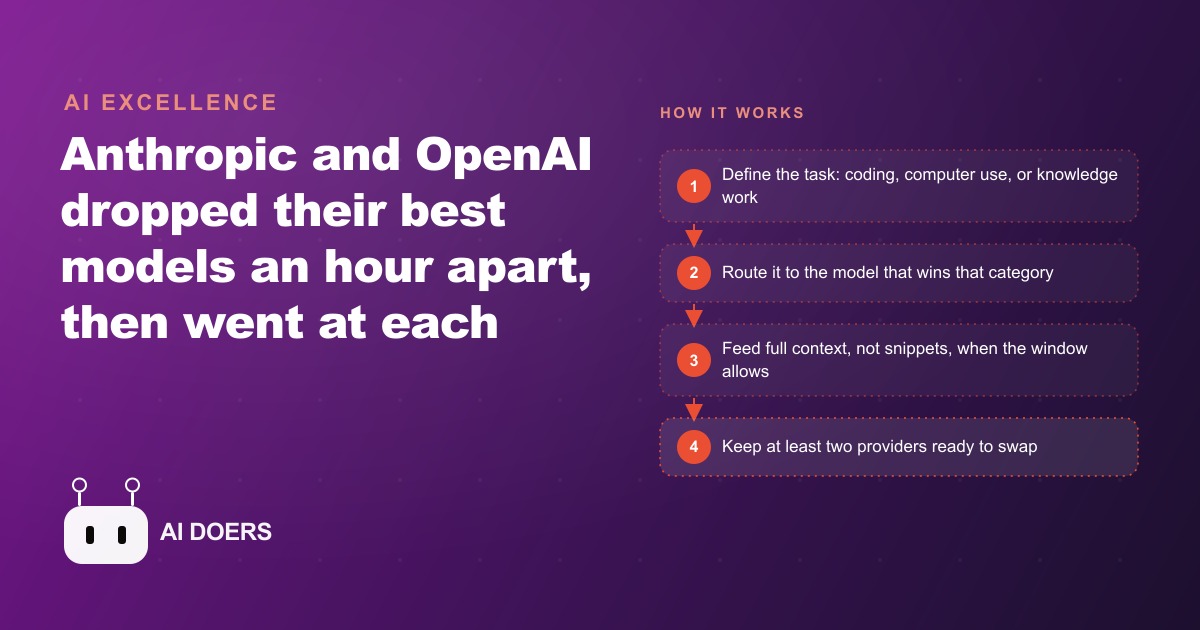
Anthropic and OpenAI shipped their best-ever models within an hour on the same morning, with Claude winning computer use and a million-token window while GPT won the headline coding benchmark. The real lesson for a business is to stop marrying one model.

Before 11 a.m. Pacific time on a single morning, the two largest AI labs in the United States had each announced their best-ever flagship models. The announcements landed within roughly sixty minutes of each other, and neither lab had the day to itself. By mid-morning, the AI industry's benchmark rankings had shifted, the marketing departments had taken public shots at each other, and a large fraction of the analysis circulating online was already outdated by the time anyone finished reading it.
That compressed timeline contained more signal than a typical six-month release cycle. Here are the six things that actually happened that day, and what each one means for how you should think about these tools.
1. Anthropic moved its launch earlier to beat the other lab to the headlines by roughly one hour
Both companies had reportedly planned a 10 a.m. Pacific launch. Per reporting from technology publications at the time, Anthropic pushed its Claude Opus 4.6 announcement forward to approximately 9 a.m. OpenAI dropped GPT-5.3 Codex roughly an hour later. Both are flagship models aimed squarely at coding and agentic use. The fact that both companies were racing to control a news cycle by minutes reveals something genuinely useful about the pace of this industry.
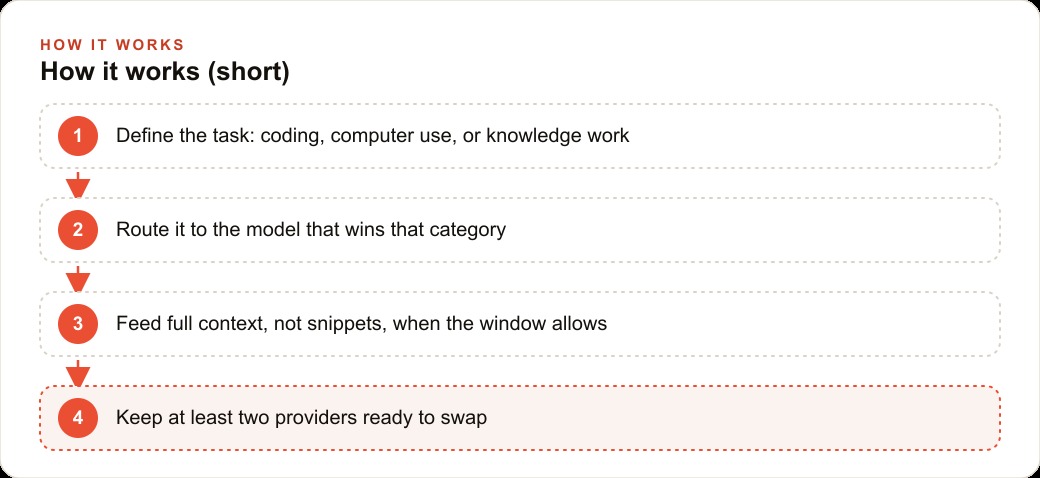
The AI frontier is no longer running on an annual product cycle. When major labs are adjusting launch times by hours to control which story dominates the morning's coverage, the implication is clear: releases are arriving faster than any business can reasonably track by waiting for each one to stabilize before adopting it. The correct response is not to try to follow every release in real time but to build a workflow that can evaluate and absorb new capabilities quickly when they arrive, rather than treating each release as a one-time decision that settles the question for the next twelve months.
The teams that are already routing different tasks to different models have a structural advantage that compounds with every new release, because they have the infrastructure to evaluate quickly and adopt what is genuinely better for each specific task rather than starting from scratch each time a new flagship arrives. Timing is not just a PR strategy for the labs. It is a signal to every business user about how quickly the ground is moving.
What this also reveals is something about the human dynamics at work between these two organizations. The decision to push a launch forward by an hour to outpace a competitor is not a product decision. It is a public-positioning decision, and it is being made at the level of flagship model releases. That level of competitive intensity at the announcement layer is matched by competitive intensity at the capability layer, and businesses that follow the announcements closely will keep finding capabilities that matter for their work arriving faster than they would have predicted six months earlier.
2. Both companies spent Super Bowl ad budgets attacking each other's monetization models instead of selling to new users
Anthropic purchased four Super Bowl advertising spots. All four shared a single theme: a helpful AI gives thoughtful advice and then, midway through the answer, the advice shifts into a promotional pitch. The implication was pointed: some AI tools inject advertisements into the answers users receive as a monetization strategy, and Anthropic was publicly characterizing that approach as a betrayal of user trust.
OpenAI's chief executive responded publicly, calling the ads funny but ultimately misleading, and stating that his company would never run advertising within its answers in the manner depicted. His response reached approximately 8.8 million views, compared to roughly 2.7 million for the original advertisement. He amplified the very message he was attempting to counter.
Underneath the noise is a genuinely useful observation for any business that depends on AI output for client-facing work. The competitive pressure between labs is now functioning as an accountability mechanism for user trust. When companies are running Super Bowl spots to attack each other on questions of how AI tools make money, no single provider can quietly normalize intrusive monetization without triggering an immediate public response from competitors. That dynamic is a form of protection for business users that a market dominated by a single provider would not provide. The rivalry itself is worth something to you as an end user, separate from any particular model's capabilities. The louder this competition gets, the harder it is for either side to quietly erode the user experience that users chose them for.
3. Claude took the computer-use benchmark while GPT took the coding benchmark, and neither won both
On OS World, the agentic computer-use benchmark that measures how well a model can operate software interfaces autonomously, Claude Opus 4.6 scored 72.7 percent. GPT-5.3 Codex scored 64.7 percent. On Terminal Bench 2.0, the headline coding benchmark, GPT-5.3 Codex scored 77.3 percent. Claude Opus 4.6 scored 65.4 percent. On knowledge work, agentic search, and the most demanding academic reasoning benchmarks available, Claude held the lead at launch.
The split is more informative than either number in isolation. These models are not general-purpose winners. They are optimized for different task categories, and the benchmark results reflect that directly. Claude is better at operating software autonomously on your behalf. GPT is better at raw code generation throughput at the levels Terminal Bench measures. Neither wins both categories, and both winning their respective category by margins of 8 to 12 percentage points means the gap is large enough to matter in practice for a business running meaningful volumes of AI-assisted work.
The performance gap at the category level is too large to ignore. A business routing computer-use and interface-automation work to Claude and coding-heavy build work to GPT is using the stronger tool for each job. A business defaulting to one model for everything is accepting below-peak performance on roughly half its tasks, and it may not even notice because there is no comparison point in a single-model workflow. The benchmark split is that comparison point. Running a task through both and comparing the output is the simplest way to make the routing decision concrete for your specific use cases rather than relying on benchmark numbers alone.
4. GPT reportedly helped debug its own training data, which makes AI a meaningful input to the next AI's development
OpenAI reported that early versions of GPT-5.3 Codex had been involved in debugging their own training pipeline, managing deployment steps, and reading their own evaluation results. An AI system that is a meaningful input to the development of the next, more capable version of itself is qualitatively different from one built entirely by human engineers working without AI assistance in the loop.
The practical implication for release velocity is direct. If AI assistance is reducing the time required to identify and fix issues in training data and evaluation pipelines, the timeline between frontier models shortens further. A gap between major model releases that used to be twelve months may compress to six, then three. Each iteration is informed not just by human engineering decisions but by the analytical capabilities of the model being iterated on, which creates a compounding effect in how quickly capability improves.
The pace of releases you are experiencing now is likely a floor, not a ceiling. Building a workflow that can absorb new model capabilities without a full rebuild each time is not a luxury or a forward-planning exercise. It is a practical necessity for any business that intends to keep using AI tools competitively over the next two to three years, because the tools themselves will keep changing faster than annual planning cycles can accommodate. A routing practice, where each task goes to the model best suited for it, is easier to update when a new model arrives than a workflow built entirely around a single provider. The routing practice is what scales with the pace of releases rather than breaking under it.
5. Claude's 1 million token context window quietly changed what full-context reasoning means for document-heavy work
Claude Opus 4.6 ships with a 1 million token context window, approximately 750,000 words of combined input and output in a single session. That figure does not land with the drama of a benchmark number, but it is the feature with the largest practical effect on knowledge-work output quality for businesses dealing with large volumes of text.
Prior context limitations forced businesses doing document-heavy AI work into a fragmentation approach: break a large contract or research archive into chunks, run multiple separate sessions, manually reconcile the outputs. That approach consistently produces worse results than feeding the complete document, because context that falls outside the window cannot inform the model's reasoning about the parts that are inside it. A model reasoning over a complete 300-page agreement produces different and typically better output than one reasoning over sections processed in isolation, because it can hold contradictions, track defined terms, and notice patterns across the whole document rather than within a fragment.
A 1 million token window makes full-context reasoning practical for an enormous range of business tasks: complete contract review rather than sampled clauses, full sales call transcript analysis rather than summarized highlights, complete codebase review rather than individual file inspection. For each of these, full context is not just faster. The output quality is categorically different. Businesses that switch from fragmented context to full context on their existing AI-assisted workflows will see quality improvements without changing anything else about their underlying process, and that shift alone is worth the evaluation time even if you change nothing else about how you use these tools.
The one caveat worth noting: a 1 million token window costs more tokens than a smaller one, and filling it with content the model does not need for the task at hand adds cost without adding quality. Use full context when the task genuinely benefits from it, and use focused context when a shorter session will produce the same result. Knowing the difference is the skill, and you develop it quickly once you start running the comparison deliberately.
6. Both models built a working landing page from a single sentence, and the day proved that routing by task is the only durable strategy
In side-by-side testing, both models received a single prompt asking them to build a landing page for a surfboard company. Both returned complete, functional, styled HTML with animations. Neither result required significant editing. Neither was clearly superior for that specific task.
That result is the clearest signal the day produced about baseline capability: for straightforward, self-contained creative builds, the choice between the two leading models is not a meaningful performance decision. Both are good enough that output quality is comparable on tasks that do not push either model's category strengths. This is useful to know because it means you do not need to agonize over which model to use for quick, uncomplicated builds. Either will do. Save the routing decisions for the tasks where the category advantages are real and measurable.
The meaningful differences emerge at the category level, computer use versus coding throughput versus long-context knowledge work, and routing by task category captures most of the performance advantage available. Routing by loyalty to one provider for all tasks captures very little of it, and that gap will only widen as each lab continues to specialize more deeply in its strongest areas.
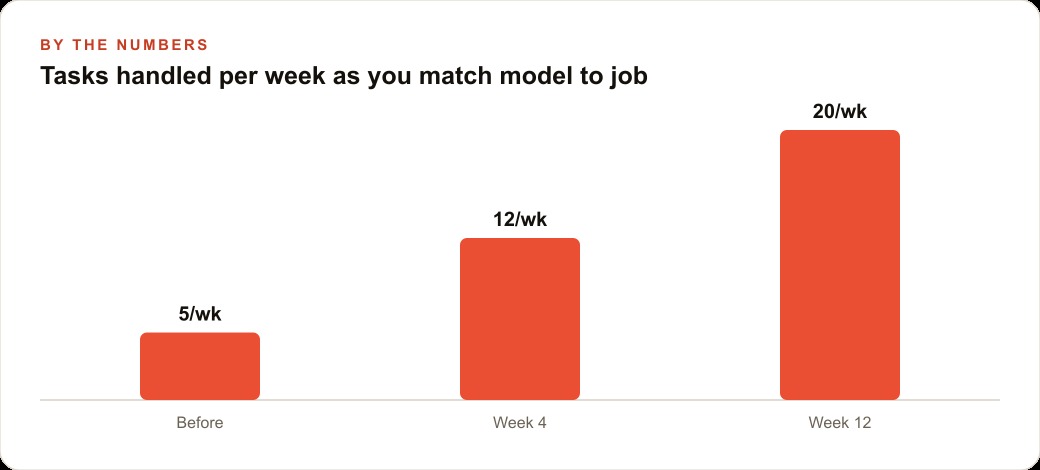
What the day as a whole reveals: the correct strategy is not to pick a winner and commit to it for all tasks. It is to build a routing practice, to know which model is stronger for which category of work, and to send each task to the appropriate tool. That practice will remain correct regardless of which lab releases the next benchmark-winning model, because the category leads will keep shifting, and because the differences between models at the task-type level will keep being real even as the overall quality floor rises. The competitive pressure between these two labs is accelerating both capability development and release velocity. The businesses positioned to benefit are the ones that can evaluate quickly and route intelligently, not the ones committed to any single provider through habit or familiarity.
That is exactly what we do at AI DOERS. Book a private 30-minute call with Madhuranjan Kumar and we will map the fastest path to it for your specific business.
Book your call →
Madhuranjan Kumar
Madhuranjan Kumar brings 20 years of performance-marketing experience and has managed over $200 million in Facebook ad spend for brands across the United States and beyond. His expertise spans the full modern marketing stack: Meta, Google Ads, TikTok, email automation, CRM, and the websites that hold it together. At AI DOERS he turns that track record into lead-generation systems for businesses across every industry.