
Claude Mythos 5 and Fable 5 Explained: What Anthropic Actually Shipped
Anthropic shipped two models a tier above Opus. Fable 5 is available to everyone, while Mythos 5 is the same model with cybersecurity safeguards removed and is restricted to Glasswing partners. Here is what that means for picking a model for real work.

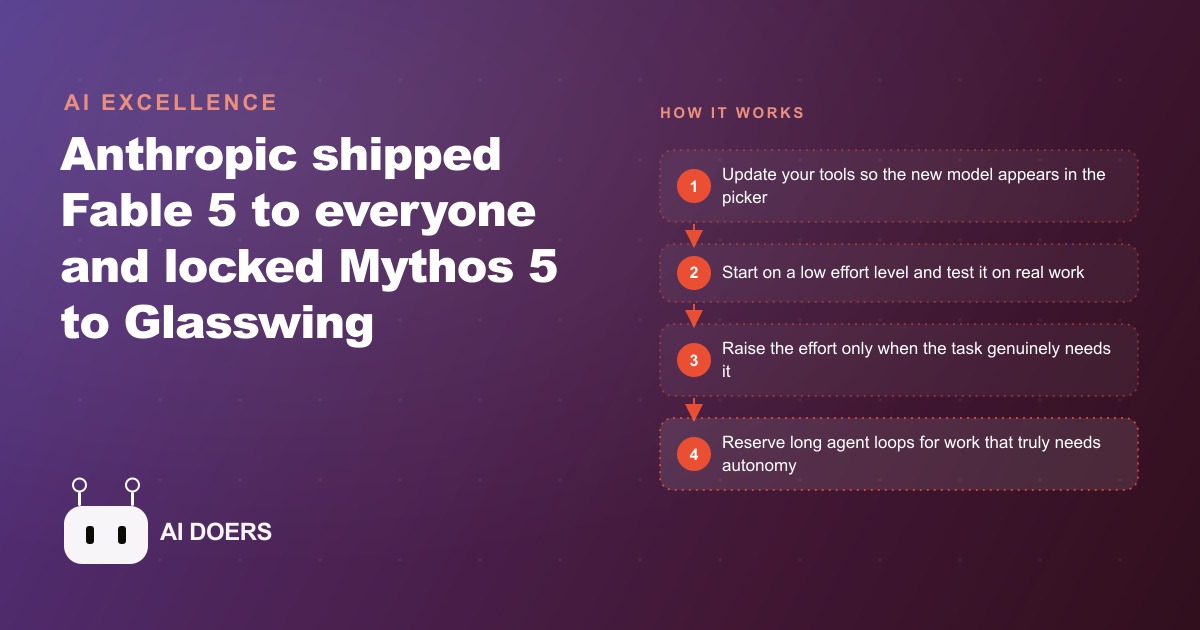
Anthropic shipped Claude Fable 5 for the general public and restricted Claude Mythos 5 to Glasswing partners, and within hours the discourse collapsed into the familiar debate about which model tier is best, a debate that misses the variable that actually determines most of what you spend and most of what you get.
I am Madhuranjan Kumar. I want to make a contrarian case and back it with logic: the effort-level setting on Fable 5 is more important than whether you chose Fable or Opus, and most businesses using frontier models are misconfiguring this setting in a way that wastes budget without improving outcomes. The tier debate has a winner, and it is the labs, who profit from upgrades. The effort-dial debate has a different winner, and that is you, who pay less for equivalent or better results by configuring the tool correctly from the start.
Most businesses are spending their AI budget wrong and it is not the model's fault
The pattern I see repeatedly when I talk to businesses about their AI spend is consistent. They upgraded to the most capable model available, left everything on the default setting, which is typically high or max effort, and they are spending two to three times what they need to for the tasks they actually run. The output quality is not two to three times better. It is marginally better on genuinely hard tasks and identical on easy ones, which represent the majority of what most knowledge-work businesses do every day.
The model is not responsible for this misconfiguration. The model is doing exactly what it was asked to do: applying substantial computational effort to every task regardless of whether the task warrants it. Drafting a follow-up email to a client about a scheduling change does not require the same reasoning depth as writing a detailed legal brief or debugging a complex codebase. Running both at max effort is like using the most expensive route for every delivery regardless of distance. The tool gets the job done, but the cost is completely out of proportion to what the job required.
The root of the problem is that most organizations never explicitly assign tasks to effort levels. They pick a model and accept whatever default the interface sets. The result is predictable: the bill is high, the outputs on easy tasks are not better than they would have been on medium effort, and the budget that could have gone toward the hard tasks where max effort genuinely changes the outcome is spent on tasks that did not need it. Fixing this is not complicated, but it requires one deliberate audit: list the tasks the team runs with AI, group them by complexity, and assign each group an effort level that matches what the task actually needs.
Most teams discover in that audit that sixty to seventy percent of their AI usage could drop to a lower effort level without any measurable change in output quality. The savings on that majority of tasks fund the max-effort runs that actually need depth, often at no increase in total spend.
The effort dial is the variable that changes your bill more than anything else
Fable 5 runs across a range of effort settings, from low to max, and the behavior at each setting is meaningfully different. On low, the model responds quickly and efficiently, applying just enough reasoning to produce a solid answer for well-defined tasks. On max, it engages much more deeply, which is appropriate for tasks requiring extended chains of reasoning, nuanced multi-step analysis, or complex problem solving where the correct answer is not obvious. The token cost scales significantly across this range, and the dollar bill scales with it.
The gap between low and max effort on Fable 5 is wider than the gap between Opus and Fable 5 at the same effort level. That is the point most tier debates miss entirely. You gain more by calibrating effort correctly within a single model than by upgrading tiers while leaving effort misconfigured. A business running Fable 5 at low effort on appropriate tasks and at max effort on genuinely hard ones will produce better results and spend less than a business running Opus at constant high effort regardless of task complexity.
For a business managing advertising accounts, this translates directly. Writing a brief social caption to accompany a Meta ads creative is a low-effort task. Auditing a full advertising account, identifying structural inefficiencies across the campaign hierarchy, budget allocation, and audience overlap, and writing a restructuring recommendation is a high-effort task. Both pass through the same interface but they should not both run at max. The caption runs faster and cheaper at low. The audit gets the full benefit of max. Treating them identically overpays on the caption and may actually underperform on the audit if the context fills with tokens that did not contribute to the analysis.
The labs benefit financially when users do not understand this distinction. A user who defaults every task to max effort drives token consumption up predictably. A user who routes tasks intelligently across effort levels uses the model more efficiently and pays less for the same or better quality output. Anthropic publishes the pricing and the effort-level options, but the incentive to actively educate users on optimizing their spend is limited when revenue tracks directly with consumption volume.
Why defaulting to max effort on every task is both wasteful and counterproductive
Max effort is not just more expensive than low effort. On certain task types it is actively counterproductive. When an agent applies maximum computational depth to a task that has a single, well-defined correct answer, it does not simply find the correct answer faster. It may explore alternatives, hedge against edge cases, and produce an output that is longer, more tentative, and more heavily qualified than the task required.
A business asking an agent to extract the five most-used keywords from a competitor's landing page for a Google Ads campaign does not need the model to analyze the page in depth, consider the competitive context, weigh semantic relationships across the category, and offer a nuanced discussion of confidence levels for each keyword. It needs five keywords. Asking max effort for that task produces an output that costs more, takes longer to generate, and requires the human to do additional work extracting the actual five keywords from the surrounding commentary.
This is the counterproductive dimension of defaulting high. The model becomes less useful on tasks where precision and brevity matter more than analytical depth. Response speed matters too, and max effort is meaningfully slower than low effort. For a team running many small, fast tasks across a workday, the slowdown from unnecessary max-effort runs accumulates to real delays by afternoon, compounding the dollar cost with a time cost that affects the team's pace.
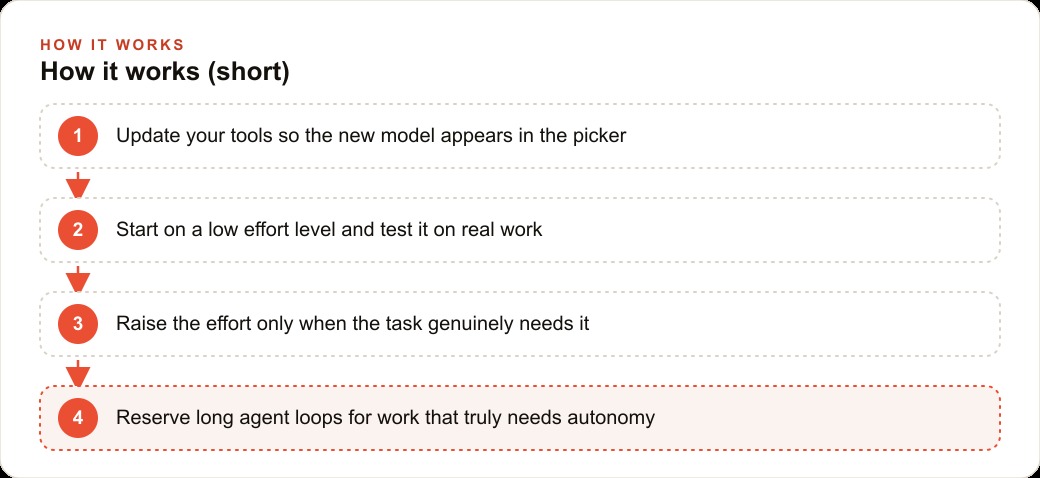
The best practice that counters this is to start every new task at the lowest effort level, read the first output critically, and raise the effort only if the output is genuinely inadequate for what the task requires. This habit builds a clear empirical understanding of which of your task types actually benefit from higher effort levels, based on real evidence rather than assumptions about complexity. Most teams are surprised by how well their routine tasks perform at low effort once they actually test it rather than assume.
Fable 5 at low effort already beats Opus at high for most knowledge work
This is the claim that tier-upgrade advocates do not want to linger on. Anthropic's characterization of the effort-level behavior is that Fable 5 on low effort performs comparably to Opus on extra-high effort for most knowledge work tasks, while costing less per token and responding faster. The model architecture improvements in Fable 5 produce better results at lower effort settings than the previous generation could achieve even at maximum effort on those same tasks.
That means for a large portion of what most business teams do, the right move is to stay on Fable 5 and tune the effort level, not to chase a higher tier. The tasks that genuinely benefit from Mythos-level capability are specialized: deep scientific reasoning, advanced cybersecurity analysis, complex multi-disciplinary legal or financial synthesis. The tasks that fill a typical marketing team's or operations team's day, drafting, summarizing, researching, formatting, reviewing, planning, all fall comfortably within what Fable 5 handles well at moderate effort.
The practical test for SEO content production illustrates this clearly. Writing a well-structured article on a specific topic, pulling in research from provided sources, matching a defined voice, and hitting the required structural requirements is a task where Fable 5 at medium effort produces output that matches Opus at high effort. The version on medium arrives faster, costs less, and requires no more revision. The version on high spends additional tokens exploring editorial angles the brief did not request and returns a longer first draft that takes more time to cut down to the required length.
The honest conclusion from this pattern is that most organizations should choose Fable 5 for the volume of their everyday work, configure effort levels explicitly by task type, and reserve higher effort settings for the subset of tasks where the depth genuinely changes the outcome. That configuration produces better results at lower cost than the default setting on a higher tier, and it requires deliberate configuration rather than the assumption that more model equals more value.
The only honest test: run your real tasks before you commit to the tier
Benchmark results from the labs deserve to be read carefully. Every company benchmarking its own model has a financial interest in presenting its model favorably. The tasks selected for benchmarks are often chosen to highlight strengths. The benchmarks showing the largest gains are the ones that make it into the announcement. The tasks where the improvement is minimal or where a lower tier already performs adequately are not headline material.
The only test that actually matters for a business decision is running real tasks on the model and measuring what you observe. Not what the benchmark claims. Not what the announcement says. What appears when you run the things your team does every week and compare the output to what you were getting before.
For a business running Google Ads and Meta ads, that test might mean asking the model to audit five weeks of campaign data and surface the three most actionable changes, then comparing the quality of the analysis to what you were getting on the previous model at the same effort level. For a team producing proposals, the test is straightforward: does the proposal at medium effort require meaningfully less revision than the proposal at high effort, and is the revision savings worth the cost delta?
These tests take a few hours to design and run. They produce evidence specific to your workload, your quality bar, and your team's judgment. That evidence is worth substantially more than a benchmark from a company with a financial interest in one outcome. The habit of testing on real tasks before committing to a tier or an effort level is the single most valuable discipline a business can develop when navigating a market where competing model claims arrive faster than anyone can evaluate them independently. Madhuranjan Kumar helps businesses run exactly this kind of task audit, identifying which effort levels and model configurations produce the best outcomes for the work that actually fills the team's day. The trial window Anthropic provided at no extra cost for subscription holders is the right moment to run that audit, because it puts real data in front of a business decision before money is committed. A model tested on five of your real tasks tells you more than any benchmark deck, and the thirty minutes spent on that test is the most economical research a team can do before locking in a configuration for the next quarter. The audit is a one-time investment that pays on every task the team runs afterward.
That is exactly what we do at AI DOERS. Book a private 30-minute call with Madhuranjan Kumar and we will map the fastest path to it for your specific business.
Book your call →
Madhuranjan Kumar
Madhuranjan Kumar brings 20 years of performance-marketing experience and has managed over $200 million in Facebook ad spend for brands across the United States and beyond. His expertise spans the full modern marketing stack: Meta, Google Ads, TikTok, email automation, CRM, and the websites that hold it together. At AI DOERS he turns that track record into lead-generation systems for businesses across every industry.