
Claude Drops the Wall of Text, and the AI Ads War Goes Public
Claude now renders interactive interfaces like live maps, weather widgets, and recipe layouts instead of plain text, while OpenAI's Codex and Anthropic's Opus split the coding crown and the two companies trade public jabs over ads.

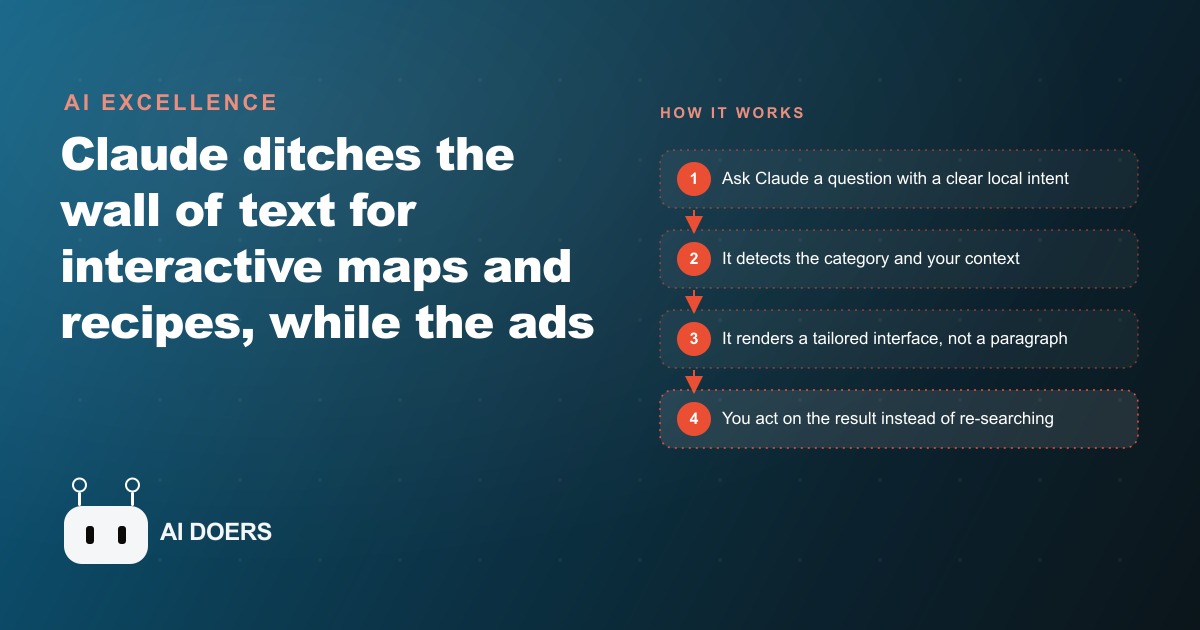
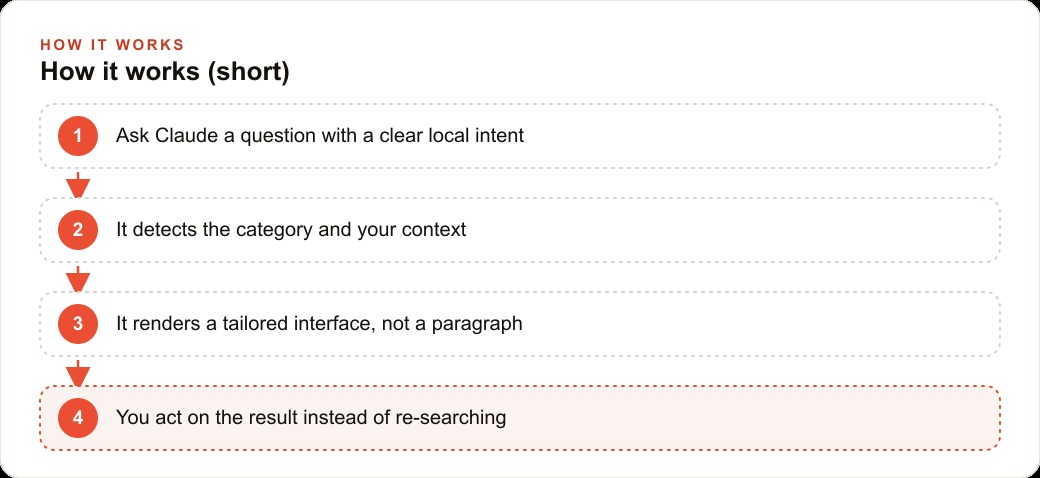
When Claude started rendering live maps in response to local search queries, most coverage described it as a user experience improvement. The map looks cleaner than a list of addresses in a paragraph. You can pan it. The directions button hands you off to Google Maps. That framing is wrong, and the businesses that treat this as a UI upgrade are about to find out why. I am Madhuranjan Kumar, and what Claude's map rendering actually represents is the first visible signal of a structural shift in how local businesses get discovered, ranked, and booked. The aesthetics are incidental. The mechanism underneath is a competitive ranking system, and it is already running.
The map result that appears when someone asks an AI for the best ramen nearby, or the nearest urgent care clinic, or a good florist for tomorrow morning, is not a display layer on top of the old search-and-click model. It is a different discovery model with different criteria for what appears and what gets skipped. In the old model, a business competed for position on a results page through a combination of relevance signals. In the new model, a business competes to be one of the pins on a live map, with a correct name, an accurate location, current hours, and a tap-to-navigate interaction that removes every remaining friction between discovery and action. The criteria overlap but they are not the same, and the businesses that tuned themselves for the old model without considering the new one are already at a disadvantage.
This matters right now because the adoption curve is at exactly the moment when preparation still creates a meaningful competitive advantage. The businesses that clean up their structured data, update their hours, add current photos, and link their booking flow this quarter are building a position in these results before the majority of their competitors understand what is being ranked. That window does not stay open indefinitely.
A live map result is not a convenience, it is a competitive ranking
The distinction that matters is between a presentation format and a ranking mechanism. When a search engine returns a page of links, the order of those links is a ranking. Some businesses appear in the top three positions and receive most of the clicks. Others appear lower and receive almost none. Everyone understands that the ranking is competitive.
When an AI returns a live map with four pins representing the four businesses it recommends for your query, those four pins are also a ranking. Someone appeared. Someone did not. The businesses on the map receive the interaction. The businesses not on the map are invisible to that user at that moment, regardless of how many years they have been operating or how good their actual service is. The map is not a directory. It is a curated recommendation, and the curation is based on the quality and completeness of the information the AI can access about each business.
The specific signals that drive map results are not fully transparent, but the pattern is clear from how these systems work. Accurate location data is the baseline: the business appearing at its correct physical address in every major data source. Consistent and current hours matter because an AI that surfaces a business with wrong hours creates a bad experience for the user who shows up to find it closed, and these systems are designed to avoid bad user experiences. Photos matter because a map pin with a clear, current photo of the exterior is more useful to a user deciding between options than a pin with nothing. A clean, navigable menu or service list matters because the next user action after the map is often a follow-up question, and an AI with access to structured menu or service data can answer it without the user needing to leave the conversation.
The businesses on the map today are the ones whose public information is accurate, complete, and structured in a way these systems can read. This is not a future state. The gap between businesses that have done this work and businesses that have not is already visible in who appears and who does not.
The businesses with stale listings are already losing the interaction
Stale listings do not look stale to the business that has them. When the owner looks at the business's own Google profile or their own website, it looks fine. The problem is that "fine to the owner" and "readable by an AI recommendation system" are different conditions, and the staleness that matters is the kind that makes the AI uncertain or incorrect in ways that hurt the business in moments the owner never sees.
Hours that have not been updated since the business changed its schedule are the most common form of this problem. A business that moved to extended weekend hours six months ago but did not update its listing appears to close at 5pm on Saturday in every system that pulls from that listing. An AI recommending local businesses for a Saturday evening query will either skip it or include it with incorrect hours, and either outcome is bad. The business does not see the lost interaction because the person who would have visited simply visited a competitor whose hours were correct.
Inconsistent location data is the second most common form. A business that has slightly different address formatting across different data sources creates ambiguity that systems resolve by deprioritizing the uncertain entry. The business has not changed location. The problem is invisible to the owner and costs real traffic.
Photos from several years ago are the third area where staleness has a direct cost. A business whose public profile shows an old interior from before a renovation looks different from what customers will find when they arrive. An AI trying to help a user choose between two restaurants based on available information may have better and more current photo coverage for one than the other, which shapes what it recommends.
Businesses running paid advertising through platforms like Google Ads sometimes discover this problem indirectly. A paid campaign drives clicks to a landing page, but conversions are lower than expected because the surrounding context, the hours, the photos, the directions, creates friction that the ad itself cannot overcome. The ad gets the user to look. The stale listing loses them before they act.
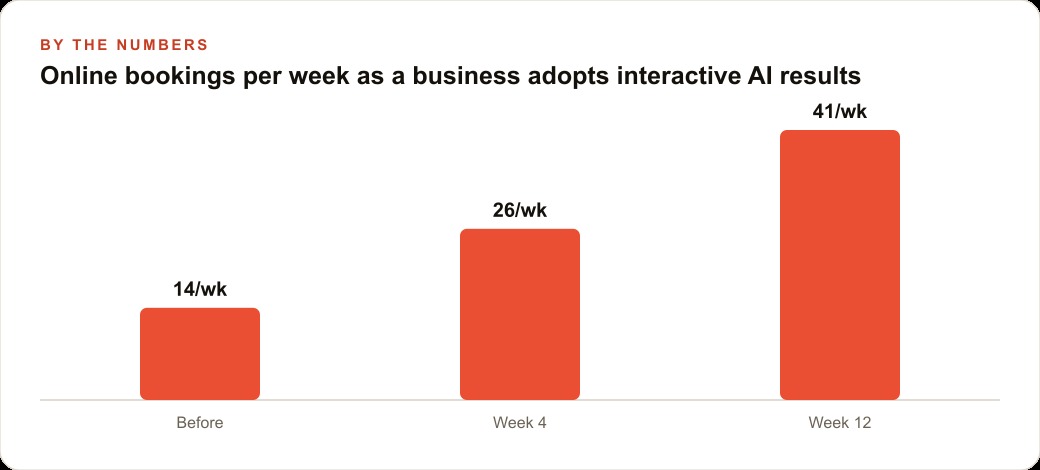
A dental practice provides a useful concrete example. The practice had been running paid campaigns for two years with decent results. Testing showed that asking any major AI assistant for cosmetic dentists nearby returned results that consistently included two competitors but not the practice itself. Investigation found outdated hours from before a Saturday-morning schedule addition, no structured service listing beyond a general category, only two photos both from several years earlier, and inconsistent address formatting across the three major listing platforms. None of these were problems the owner had noticed. A focused afternoon of cleanup, updated hours, a structured list of 12 specific services with short descriptions, 14 current photos organized by category, and consistent address formatting across all major platforms, produced a measurable result. Within 45 days the practice appeared consistently in local AI recommendations for cosmetic dental work nearby. New patient inquiries from online sources increased by 31 percent over the following two months, with no change in ad spend. The investment was an afternoon. The return was additional discovery-channel traffic the practice had previously been invisible in.
Accurate structured data is what gets you into the rendered result
Structured data is information organized in a way that a system can read, interpret, and use without requiring a human to explain it. The opposite is narrative data: a paragraph describing what hours the business is open, what services it offers, and what the experience is like. Narrative data is useful for people reading it. Structured data is what AI recommendation systems can work with directly to populate a map pin, answer a follow-up question, or display a booking option.
For a local business, the most important structured data is the set of machine-readable facts: a precise geographic coordinate pair, hours formatted as a machine-readable schedule with days and time ranges clearly labeled, a service or menu listing formatted as a structured catalog rather than a paragraph, and a primary category that matches how people search for the type of business. This data lives in several places: the business's Google Business Profile, Apple Maps, Bing Places, the business's own website schema markup, and the aggregator directories that pull from these primary sources.
Keeping these facts consistent and current across all relevant sources is the underlying work that gets a business into the rendered result. It is not a campaign. It is a maintenance task, but it is the maintenance task that determines whether the business appears when someone nearby asks an AI for a recommendation in its category.
For businesses that invest in Meta ads or other paid discovery channels, accurate structured data works in parallel with the paid work. Paid ads bring people to the business's landing page or profile. Accurate structured data makes the business findable in the AI-mediated discovery layer that operates before the paid click. Having both working correctly is better than relying on either alone.
The mechanism is the same across different business types. A restaurant with a current, structured menu, correct hours, strong recent photos, and a clean reservation link is easy to render in a map result with a booking tap. A hair salon with a structured service list including specific services and approximate price ranges, correct hours, and before-and-after photos organized by service type is easy to surface when someone asks for the best option for a specific treatment nearby. A veterinary clinic with a structured list of species served, specialties, and current hours is easy to recommend when someone asks for an emergency vet that handles rabbits at 9pm on a Sunday. In every case, the AI's ability to render a useful, accurate result depends on the quality of the structured information it can access.
Where the interactive AI output trend goes after maps and recipes
The map result and the recipe widget are two early implementations of a broader pattern: AI moving from generating text that describes something to generating interactive output that lets users act directly on the information. The trajectory of this pattern is clear and its implications for local business discovery extend well beyond the current implementations.
The most obvious next development is integrated booking. A map result that shows a restaurant pin with correct hours, good photos, and a cuisine category naturally leads to a user wanting to reserve a table. An AI that already has the restaurant's information can also have the booking link, and a tap-to-book option on the map pin collapses the remaining steps between discovery and action. For businesses where booking is the conversion action, a linked and working booking system in the structured data is what allows that integration to happen. Businesses that have a booking system but have not linked it to their public business profiles are leaving that step in the discovery flow disconnected.
Service listings with structured pricing will follow the same pattern. When a user asks for the nearest electrician who handles panel upgrades, an AI with access to structured data about which local electricians offer that specific service and at roughly what price range can produce a more useful result than one that only knows they are electricians generally. The businesses that publish structured information about their specific services, not just their general category, position themselves for more specific recommendations as these systems become more capable.
Voice delivery is the context where this trend becomes most significant for local businesses. When someone asks a voice assistant for a recommendation while driving, the result comes back as audio. The business's name, hours, distance, and key details are read aloud. The user says "navigate there" or "call them" and the action happens directly from the recommendation. In this context, accurate and structured data is the entire discovery experience. There is no visual result to skim. The business either has the information the AI needs to include it confidently, or it does not appear at all.
The consistent principle across all of these directions is that being easy to render in any format is the underlying goal. Easy to render in a map pin. Easy to render in a booking flow. Easy to render as a spoken recommendation. Easy to render in a structured service comparison when someone asks an AI to compare options across multiple businesses. All of these rendering contexts pull from the same underlying structured data, and maintaining that data accurately is a single investment that pays dividends across every context simultaneously.
The businesses that treat Claude's map result as a user experience story will optimize for the wrong thing. The ones that treat it as the first visible expression of a new local ranking system, and prepare their structured data accordingly, are the ones who will be on the map pins while their competitors wonder why their traffic has shifted.
That is exactly what we do at AI DOERS. Book a private 30-minute call with Madhuranjan Kumar and we will map the fastest path to it for your specific business.
Book your call →
Madhuranjan Kumar
Madhuranjan Kumar brings 20 years of performance-marketing experience and has managed over $200 million in Facebook ad spend for brands across the United States and beyond. His expertise spans the full modern marketing stack: Meta, Google Ads, TikTok, email automation, CRM, and the websites that hold it together. At AI DOERS he turns that track record into lead-generation systems for businesses across every industry.