
How Claude Computer Control and This Week's AI Releases Change Operations for an E-Commerce Store
Claude can now organize your files, Gemini reads your inbox and photos to answer questions, and VO3.1 makes AI product video practical. Here is what every e-commerce store should do with these tools.

Anthropic gave Claude the keys to your file system this week, and the shift from AI-as-assistant to AI-as-operator quietly became a fact for anyone already on the twenty-dollar Pro plan. The same seven days brought Gemini inside your inbox and photo library, a video model that generates native vertical content, and a standalone translation tool that changes the math on international sourcing.
Claude Co-work just crossed from developer playground to general release
The original Claude Code was designed for software engineers. Anthropic noticed something unexpected: marketing managers, small shop owners, and operations staff were quietly using it to organize folders, scan meeting notes, and sort through years of accumulated files. The team ran a sprint and shipped Co-work as a version any non-technical person on Mac can use, with no command line required.
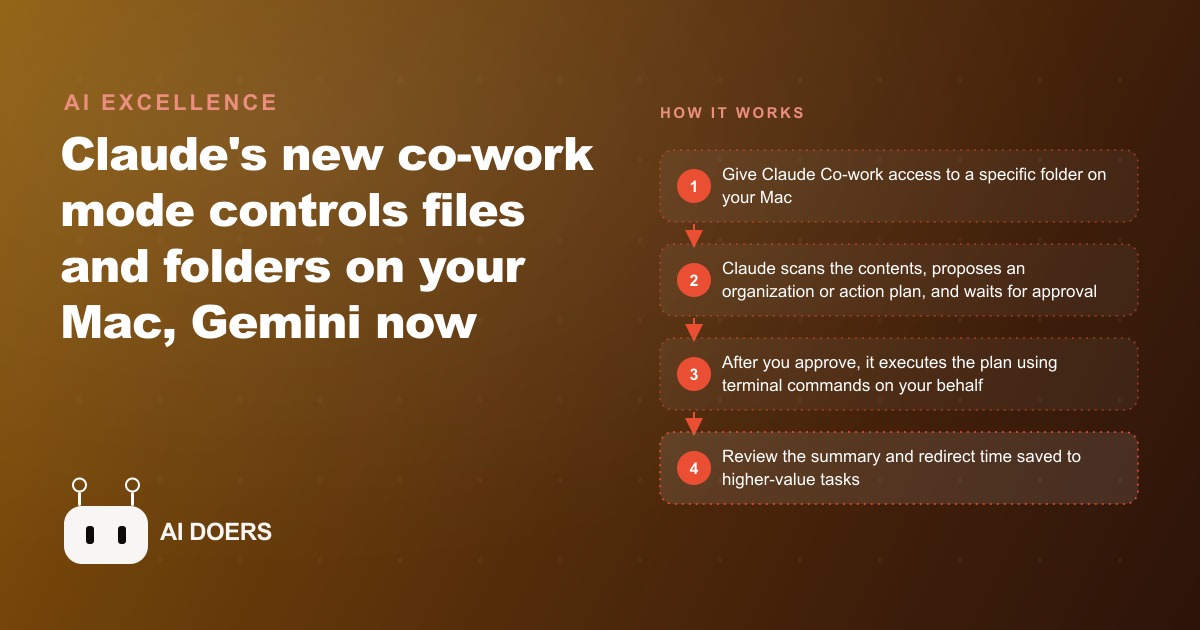
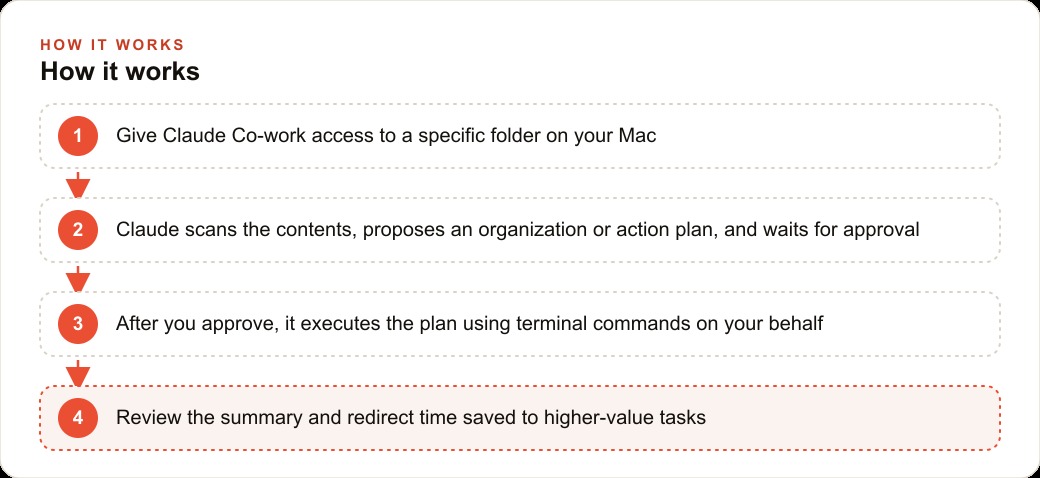
The distinction that matters for a store owner is that this tool operates on real files, not on descriptions of files. When you grant access to a folder, the AI reads actual file names and contents, proposes a structured plan of what it intends to do, waits for your written approval before touching anything, and then executes each step using file system commands while tracking progress. After finishing, it produces a plain-language summary of exactly what changed: how many files moved, which folders were created, what it flagged for human review. Nothing happens without a visible checkpoint.
This launched first on the hundred-dollar Max plan and extended to the twenty-dollar Pro plan within weeks. If you are a Mac user already subscribed to Claude Pro, you have this capability now at no extra cost. Windows support is on the roadmap but not yet released.
For a store that has been running for two or three years, the product asset situation is usually the same story: hundreds of photos loosely sorted by shoot date, supplier PDFs scattered across an inbox export, customer feedback files from three different tools named inconsistently, and marketing assets from five campaigns living in a single flat folder. Sorting that manually takes half a day at minimum and produces results that drift back into disorganization within months. Co-work turns that into a thirty-minute task including review, and the output is a clean, browseable structure that survives because the folder names reflect actual business logic rather than whatever seemed reasonable at 9 PM during a product launch.
The approval requirement is what makes this trustworthy rather than risky. You are not handing an AI access to your files and hoping for the best. You review the proposed changes, adjust anything that does not match how you think about your business, and only then say proceed. If the AI proposes separating supplier documents by product category when you prefer organizing by supplier name, you say so before a single file moves. That interaction teaches the tool how your mental model works, which improves future tasks in the same folder structure.
Gemini Personal Intelligence is the competitor research upgrade living inside Google Workspace
Google shipped Gemini Personal Intelligence alongside these tools, and for any business already running on Google's ecosystem it is worth understanding immediately. The feature connects the Gemini chatbot to Gmail, Google Photos, YouTube watch history, and Google Drive. Once connected, questions you ask Gemini can pull from your actual accounts rather than from general knowledge alone.
For an e-commerce operation, the competitive intelligence application is the most practical use case. A store manager who has been saving supplier emails in Gmail, filing competitor pricing screenshots in Google Drive, and watching YouTube review videos of competing products now has a research assistant that can search all of that at once. Ask Gemini which supplier has historically had the longest fulfillment windows based on your inbox threads, and it searches your actual email history to answer. These are research tasks that previously required manually searching three separate applications.
The setup is straightforward: log into Gemini, navigate to the settings area, select Personal Intelligence, and enable the accounts you want it to read. The toggle is off by default. The feature requires a Google AI Pro or AI Ultra plan and is currently US-only.
The privacy consideration matters and is worth naming directly. Once enabled, Gemini can read your Gmail, photos, and Drive during any conversation. In a setting where you share your screen or your Gemini interface is visible to others, answers may surface personal information without you expecting it. For a store owner with separate personal and professional Google accounts, enabling this on the business account only is the clean approach.
VO3.1 portrait mode removes this breakdown production bottleneck for product marketing
Google's VO3.1 model now outputs natively in 9:16 vertical format, which means you can generate a portrait-orientation video clip suitable for Instagram Reels, TikTok, and YouTube Shorts directly from product images, without cropping or reformatting landscape footage. Character and object consistency across frames has also improved meaningfully in this release, addressing the most common complaint about AI video from the previous generation of tools.
For a physical product store, the most expensive type of marketing content has historically been lifestyle video: a clip showing the product in a realistic context, in use, with natural motion and light. Professional lifestyle video production requires a location, a crew, lighting setup, and editing time that far exceeds a standard product photography shoot. The gap between what a well-funded brand can produce and what a solo operator can commission has been one of the more durable competitive disadvantages for small stores.
VO3.1 does not close that gap entirely. For product detail pages where close-up texture, hardware finish, and precise color accuracy matter, AI video generation is not the right tool. For the awareness-stage ambient clips that accompany Facebook and Instagram ad campaigns, where the goal is emotional context rather than technical specification, VO3.1 produces content that is genuinely competitive with freelance production at a fraction of the cost and time.
The practical workflow is: upload two or three product images as reference inputs, write a scene description focused on atmosphere and motion rather than product specifications, select portrait orientation, and generate three to four variations before selecting the best one. The model produces different results on identical prompts, and the variation is high enough that generating multiple runs is worth the few minutes it takes.
ChatGPT translation at chatgpt.com is the sourcing communication upgrade most stores have not noticed
OpenAI launched a standalone translation tool at chatgpt.com/translate handling more than fifty languages at no cost on the free plan. This is a separate interface from the main ChatGPT experience, optimized for translation rather than general conversation.
For e-commerce stores that source internationally, the difference between this tool and standard machine translation is accuracy on technical product terminology. A payment terms clause in a Japanese supplier agreement, a material specification sheet from a Korean manufacturer, a product description from a Chinese factory looking to expand distribution channels, all of these contain vocabulary where generic machine translation frequently produces ambiguous or technically incorrect output. A model trained on far more contextual data handles that vocabulary more reliably.
The same tool works in reverse. A store expanding into a second-language market can now draft customer service responses, shipping confirmation emails, and product description translations without a bilingual hire or a paid translation service. That same content foundation also feeds SEO and organic search in secondary language markets, and the per-unit cost of producing verified translations compounds into meaningful savings across a catalog with hundreds of SKUs.
For any legally binding document, supplier contract, or compliance-sensitive content, a professional translator should still review the output. The tool produces excellent first drafts and handles routine business communication with high accuracy, but the liability profile of a contract is different from the liability profile of a shipping confirmation email.
What a four-person e-commerce team does with all of this this week
I am Madhuranjan Kumar, and here is how I would sequence these tools for a store selling physical products with a lean team.
The first task is a Co-work cleanup session on the product asset folder. One team member grants Co-work access to the main images folder, describes the current problem: hundreds of photos sorted by date rather than by SKU, and asks it to propose a folder structure organized by product category and SKU prefix. After reviewing and approving the plan, they run the reorganization. Budget thirty minutes including review. The result is a browseable archive that reduces time-to-find for any image from minutes to seconds, which matters every time the team needs to pull assets for an ad or a listing update.
The second task is three VO3.1 lifestyle clip generations for the top three products by revenue. Each team member writes a scene description for one product, specifies portrait orientation, and generates four variations. They select the best one from each set. Those clips become the visual foundation for a month of organic social content and provide raw material for testing against static images in paid ad campaigns. The cost is zero beyond the time spent writing the prompts and reviewing the output.
The third task is setting up ChatGPT translation for the supplier communications currently sitting in the inbox untranslated. Paste each one into chatgpt.com/translate, verify the output against any known context, and draft the response in English, then translate that response back to the supplier's language for sending. This takes twenty minutes and establishes the habit for all future international supplier communication.
Consider this worked example from a store selling kitchen goods. The owner spent roughly four hours per month manually organizing product photos and supplier documents, two hours per month on translation tasks with a freelance translator at forty dollars per hour, and zero on lifestyle video production because it was too expensive to justify. After adopting these three tools: Co-work, VO3.1, and the translation tool, the organization time dropped to forty minutes per month, translation cost dropped to zero, and the store began publishing two to three lifestyle video clips per week to social channels. The monthly saving on translation alone covered six months of the Claude Pro subscription, and this breakdown content drove measurable increases in engagement on Facebook and Instagram ad campaigns for the two products featured in the clips.
The leads generated by this content and advertising activity land in the CRM and website stack, where follow-up sequences handle the next several touches automatically. A VO3.1 clip that drives traffic to a checkout page without a follow-up sequence leaves a significant portion of the ad spend's value uncaptured. The tool stack only compounds when the post-click experience is also working.
None of these tools require a technical hire or a development timeline. They require an afternoon of setup and a habit of reaching for them when the right problem comes up. The stores that build that habit now will have operational advantages by the end of the quarter that competitors starting from scratch will take months to close.
That is exactly what we do at AI DOERS. Book a private 30-minute call with Madhuranjan Kumar and we will map the fastest path to it for your specific business.
Book your call →
Madhuranjan Kumar
Madhuranjan Kumar brings 20 years of performance-marketing experience and has managed over $200 million in Facebook ad spend for brands across the United States and beyond. His expertise spans the full modern marketing stack: Meta, Google Ads, TikTok, email automation, CRM, and the websites that hold it together. At AI DOERS he turns that track record into lead-generation systems for businesses across every industry.