
Claude Code vs Google Antigravity: What 100 Hours of Testing Actually Shows
After 100 hours with both, Claude Code and Google Antigravity each win different jobs. Claude Code thinks and plans better and is more production reliable, while Antigravity produces nicer designs and runs faster, so the smart choice depends on the task in front of you.

The observation that changes how the test begins
By hour twelve of a 100-hour test, something becomes clear that no benchmark captures. Hand the planning-first tool a habit tracker with complex user journey logic and it asks three clarifying questions before writing a single line. Hand the design-first tool the same prompt and it ships a polished interface in minutes without asking anything at all. Both produce working code. One produces better logic. The other produces a better-looking product.
That gap, visible only when you run both tools on the same task in the same session, is the whole story of this comparison. The numbers matter and they are worth stating clearly: SWE Bench Verified scores of 80.9 percent versus 76.2 percent are real, and a Terminal Bench result of 65.4 percent for one platform versus 77.3 percent for another running the other direction is equally real. But benchmark summaries tell you what a tool can do under controlled conditions. They do not tell you what it does when you hand it the ambiguous, context-heavy, multi-file problems that actual work looks like. That is what 100 hours of genuine testing surfaces that a leaderboard score cannot.
The argument here is not that one platform wins. It is something more useful: that these two agentic coding tools together reveal something fundamental about what it means to pick an AI partner for serious work. The answer has nothing to do with loyalty to a single platform. It has everything to do with routing, and routing is the skill the 100 hours actually teaches.
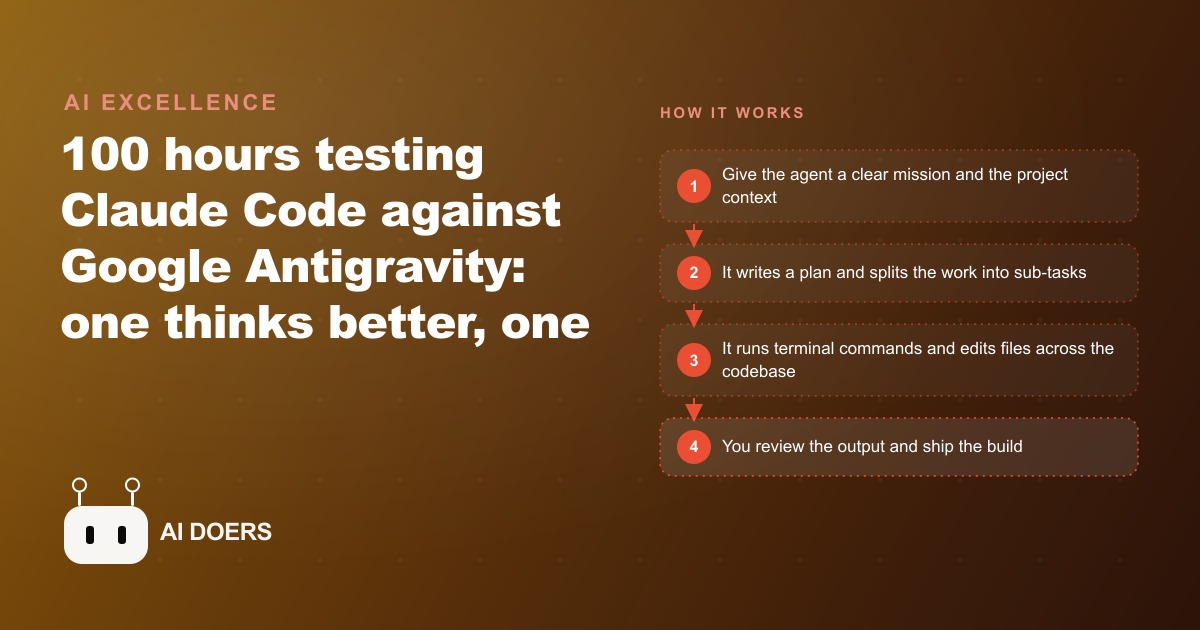
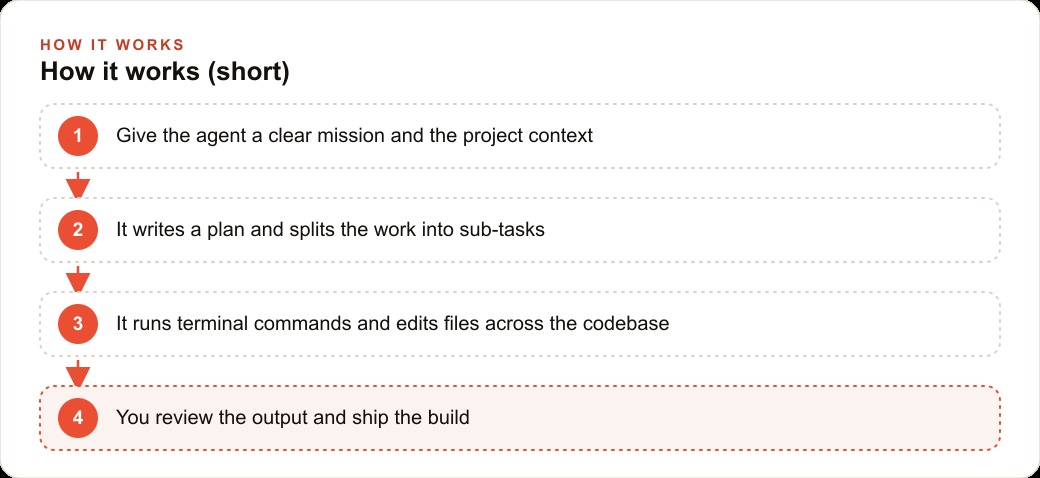
Both tools work on the same basic architecture. You hand each one a large goal. It breaks the work into a plan, spins up sub-agents to handle pieces in parallel, manages files, runs terminal commands, and executes across the whole codebase. The capability is similar on paper. What differs is where that capability lives and how it performs when the task gets genuinely hard. One lives in the terminal, plugging into the editor and shortcuts you already use. The other is a standalone IDE you move into, with a manager view that shows parallel agents working and a built-in browser agent that interacts with web interfaces as part of a task.
One practical detail that often gets missed: both tools are free to access. What you pay for is the model behind them, the tokens. Running a top-tier model through either tool produces a fundamentally different experience than running a speed-optimized budget model, and the same gap exists between a pro and a flash model inside each platform. The harness shapes the workflow, but the model sets the ceiling. Token cost matters for real business use and deserves honest accounting before you pick a default, because a tool that costs more per session but consistently finishes with fewer revisions may be cheaper overall once you factor in your own time spent cleaning up output.
What the benchmarks show and what they leave out
Claude Opus inside Claude Code scored 80.9 percent on SWE Bench Verified. Gemini 3 Pro inside Antigravity hit roughly 76.2 percent. That 4.7-point gap looks decisive on a chart. In practice it means neither tool wins every coding task. It means the distribution of where each tool is strong differs, and understanding that distribution is worth more than memorizing the headline number.
Terminal Bench tells a different story. There, Claude Code scored 65.4 percent while GPT scored 77.3 percent, a gap running the other direction. Reading only one benchmark produces a confident but incomplete conclusion. Reading both shows what is actually happening: these tools have different strength profiles, and the task in front of you determines which profile matters more in any given session.
An independent 21-day test found that 94 percent of Antigravity-generated code passed linting with no errors. That is a meaningful signal about greenfield build quality. Equally meaningful from the same testing period is the consistent finding that Claude Code planned better, asked better questions before starting, and produced code that fit existing project patterns instead of treating the project as if it started from nothing. Neither of those signals appears cleanly on a leaderboard, which is why head-to-head testing on real tasks consistently produces different rankings than synthetic benchmarks.
There is also the maturity question, which no benchmark captures but which matters enormously for any business use that goes beyond prototyping. Claude Code is production-released, with improvements shipping multiple times per week. Antigravity is in public preview. The stability gap is not about intelligence; it is about what you can depend on when work cannot afford loop errors or sessions that stall on login issues. On tasks where the cost of failure is high and recovery is slow, maturity is a real tiebreaker, and it currently favors Claude Code clearly.
Speed deserves its own note because it is the most-cited difference and one of the most misunderstood. An independent clock put Claude Code at roughly 4 minutes for a sample task and Antigravity at roughly 8, suggesting one is twice as fast. But in real sessions during the 100-hour test, Antigravity consistently finished first and felt faster in practice. The difference is that clock time and total-task time including post-session review and rework are different things. A tool that produces cleaner output and requires less correction can feel faster even when the raw session runs longer. Total time from task receipt to shippable result is the only number that matters commercially, and it is harder to measure than a stopwatch, which is why raw speed comparisons mislead more often than they inform.
What routing actually means and why it beats tool loyalty
Routing is the skill that separates teams getting consistent results from teams that keep hitting walls. Every time the wrong tool got assigned to a task during the 100-hour test, the output was worse than average rather than better. The pattern determining which tool was wrong was consistent enough by hour 40 to become a reliable rule.
Logic-heavy tasks, multi-file planning, fitting new code into an existing system, and research requiring citation and structure: these consistently went better with the planning-first tool. It has a read-only mode that maps the codebase before touching anything, asks clarifying questions, and scales into deeper reasoning for genuinely hard problems. It reads existing patterns and writes code that feels native to the project rather than pasted in from somewhere else. Sending tasks like these to the design-first tool produced functional but foreign code that required substantially more cleanup before it could ship.
Design-first tasks, new front ends, greenfield builds, and pages where visual quality directly influences whether a user does what you want: these consistently went better with Antigravity. It builds full applications with real visual taste. The output looks finished rather than just algorithmically correct. Sending tasks like these to the planning tool produced correct but visually plain results that needed significant additional work before they were client-ready.
The research PDF test made the routing principle undeniable. Both tools received the same prompt. The planning tool structured the report, styled the output appropriately, and cited real sources from credible publications, delivering something that looked finished. The design tool returned an unstyled document with nothing to support its claims. Neither was malfunctioning. One was simply wrong for the task type, and no amount of better prompting would have closed that gap, because the gap reflects a genuine difference in what each tool was built to do well.
Once the routing rule was clear, the test stopped being about which tool is better overall and started being about how quickly the routing decision could be made. By hour 80 that decision happened in under 30 seconds, because the key question is simple: is this task primarily about logic and fit with existing code, or primarily about look and feel? The answer routes the task. That instinct, not any benchmark score, is what produces consistently strong output across a real working quarter.
What a media company learns in quarter one
Consider how routing plays out for a team that builds both editorial products and internal software tools, a media operation that wants to use agentic coding to cut down on freelance development costs without sacrificing output quality. In the first quarter of integrating both tools, the pattern reflects exactly what the 100-hour test predicted.
Design-first tasks go to Antigravity. A new editorial dashboard used by writers to manage assignments and track story status starts as an Antigravity session. The tool produces a polished, component-rich interface the team adopts with only minor brand tweaks. In illustrative terms, a build like this would have taken a freelance developer 3 to 4 days at standard rates, representing $1,500 to $3,000 in project cost. Antigravity produces a working version in an afternoon session that requires one round of minor color and labeling adjustments before shipping. The team deploys it that week.
Code-quality tasks go to Claude Code. The same dashboard needs a backend reading from an existing content database, handling multiple user permission levels, and integrating with the company's existing authentication system. Claude Code maps the existing codebase first, asks about the permission model before writing anything, and produces integration code that fits existing patterns as if a developer familiar with the project had written it. Post-session debugging is minimal because the code is consistent with what was already there, rather than bolted onto it from the outside.
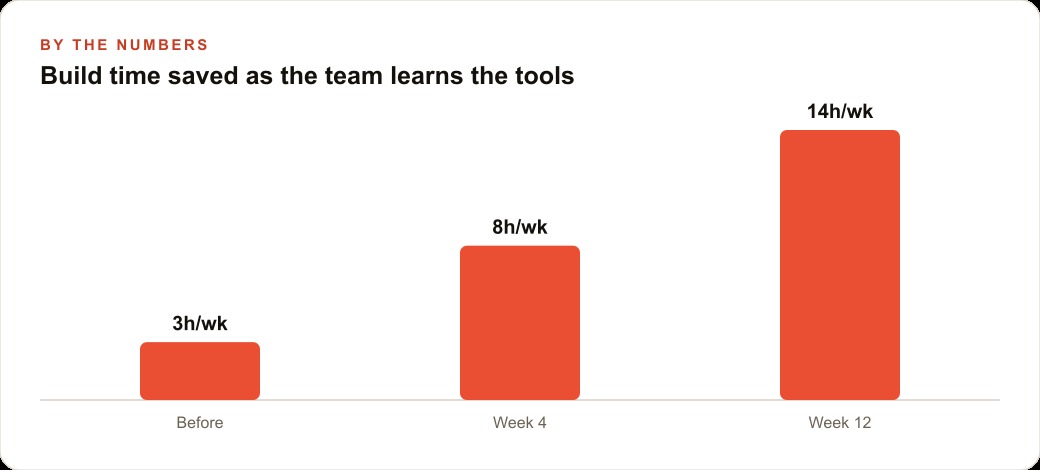
A weekly report that the editorial director used to receive only after someone assembled it by hand, pulling figures from three internal sources and formatting them into a summary, becomes a Claude Code task. It maps the data sources, handles edge cases in the data correctly, and produces a script that runs on a schedule without supervision. Time saved is roughly 90 minutes per week, which over a year compounds to 75-plus hours of reclaimed capacity at any reasonable estimate of the time's value.
The cost of model tokens across both tools stays modest because sessions remain focused: one clearly defined task per session, starting fresh when it is complete. Both tools lose context quality as sessions run long, and disciplined session hygiene directly determines how much useful output you get per dollar spent on model tokens. In the first month this discipline requires conscious effort. By month two it becomes automatic, and the output-per-dollar ratio rises noticeably.
The team also encounters the maturity gap directly. Antigravity improves visibly week over week, but occasional sessions are interrupted by login issues or agents that loop without resolving the task. For internal prototyping where downtime costs an afternoon of iteration, this is acceptable. For client-facing production systems that generate revenue, it is not. Claude Code earns every high-stakes backend task regardless of which tool seems more exciting in a given week, because consistency in production matters more than peak capability in demos.
Over the quarter the routing approach produces more shipped work, a cleaner codebase, and lower revision costs than either tool applied uniformly to every task. The compounding effect is visible by month three, when the team has developed a shared instinct about which kind of task they have before they open a session at all. That instinct saves time on every task that follows, because the first decision made on any build is now the right one almost every time.
The principle the 100-hour test actually proves
One hundred hours of testing does not produce a winner. It produces a routing instinct, and the routing instinct is worth more than any amount of platform loyalty. The teams that will get the most from agentic coding tools are not the ones that find the best single platform and use it for everything. They are the ones that recognize, quickly, what kind of task they have in front of them and send it to the tool most likely to handle it well.
That sounds obvious stated plainly, but it runs against how most people actually adopt new tools. The default behavior is to pick one platform and commit to it, partly from habit and partly because learning a second tool feels like duplicated effort. The 100-hour test shows the extra effort pays back fast. The time spent learning both platforms and developing the routing reflex is recovered in better output within the first serious month of use, and it continues paying forward on every task that follows.
Benchmark scores will shift as both platforms keep updating, and both are updating aggressively. Antigravity is moving fast as a public preview product with real competitive pressure pushing it forward. Claude Code is stable and shipping multiple improvements every week. In six months the relative numbers will be different. The routing principle will not be, because it is grounded in genuine differences in what each approach does well, not in the current moment's benchmark snapshot.
Logic, reliability, and fit with an existing codebase: send those to the tool that plans before it acts. Polish, speed, and greenfield visual quality: send those to the tool that ships first and asks questions after. The question to ask when a new task lands is not which tool is better overall. It is which kind of task this is. Get that right consistently, across a real working quarter rather than a single session, and both tools perform above what their individual benchmarks would predict.
That is exactly what we do at AI DOERS. Book a private 30-minute call with Madhuranjan Kumar and we will map the fastest path to it for your specific business.
Book your call →
Madhuranjan Kumar
Madhuranjan Kumar brings 20 years of performance-marketing experience and has managed over $200 million in Facebook ad spend for brands across the United States and beyond. His expertise spans the full modern marketing stack: Meta, Google Ads, TikTok, email automation, CRM, and the websites that hold it together. At AI DOERS he turns that track record into lead-generation systems for businesses across every industry.