
Claude Code Plus Opus 4.7: Why It One-Shot a Full 3D Game
Claude Opus 4.7 in Claude Code built a complete 3D browser game in a single file from one prompt, because it tops the build-from-scratch benchmarks and runs far longer on a single task than the version before it.

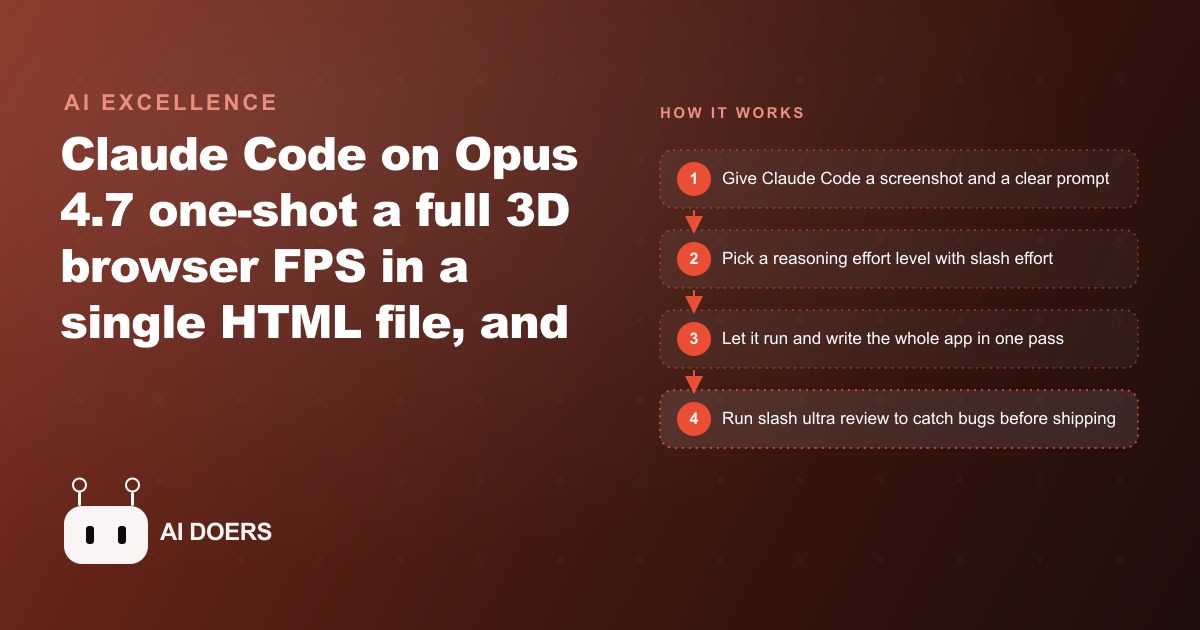
I watched a demo earlier this year where Claude Code, running on Opus 4.7, built a complete 3D browser first-person shooter from a single screenshot and a plain-language prompt. Six weapons, progressive difficulty waves, working animations, inside one HTML file. No external 3D asset files. It ran for eleven minutes before producing a result that played correctly. And I want to be honest about what that demo actually means, because the reaction most people have, the mild disbelief, the reaching for a benchmark chart to contextualize it, those instincts both miss the point. I am Madhuranjan Kumar, and the part worth paying attention to is not the game. It is the threshold that moved underneath it.
A game built in eleven minutes that changed how I think about non-developer software
The game is the extreme version of a capability that matters at the ordinary end. What made it work was that this model could hold an entire working application in memory and produce it in one pass without losing coherence in the middle. That is the specific quality the eleven-minute run time represents. Previous versions would have lost the thread somewhere around the third subsystem and required a human to stitch pieces together. Opus 4.7 pushed through to a finished result. The game was a demonstration of that capability in the most legible format possible: a thing you could run and play and verify worked.
The same quality that built the 3D game also builds a booking widget that works correctly on mobile, a pricing calculator that handles edge cases without breaking, a lead quiz that routes people to the right outcome and fires the right backend call. Those are the things small businesses actually need, and they are all in the category that can be described clearly in a prompt, built in one pass, and deployed as a single file or small package. The game showed the ceiling. The useful range is everything below it.
What shifted is the distance between having an idea for a tool and having a working version of that tool in front of real users. That distance used to be measured in weeks and require a developer. It is now measured in hours and requires a clear brief. That compression changes the risk calculus for experimentation. You can afford to try a tool idea, put it in front of a few customers, and discard it if the conversion data does not support it, rather than committing two weeks of developer time before you know whether the concept is sound. The cost of a wrong hypothesis about what your customers need dropped dramatically.
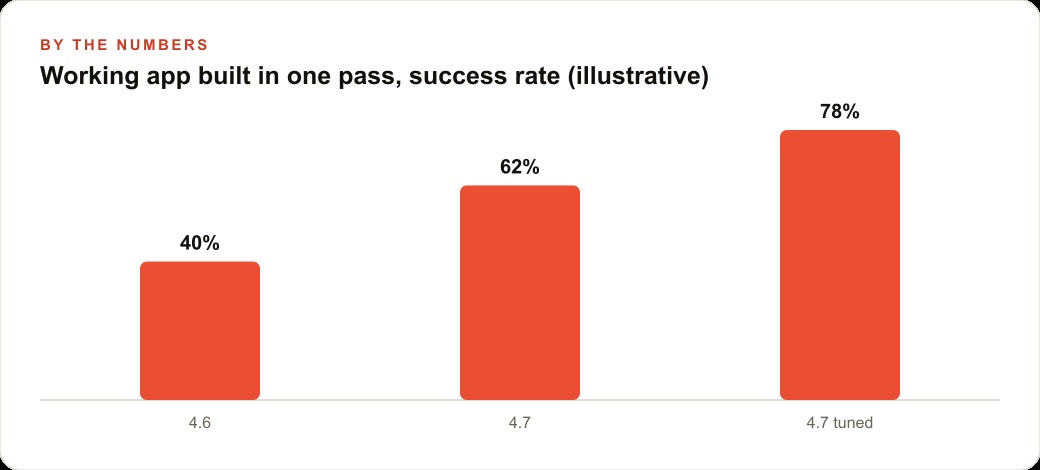
There are also benchmark numbers worth knowing, though they need to be read with appropriate context. Opus 4.7 moved to the top position on Vibe Code Bench, which tests whether a model can build web apps from scratch from a description. It gained roughly eleven percentage points over the prior version on SweBench Pro, a harder engineering benchmark, while competitor models in the same period stayed in a lower range. Vision resolution climbed substantially, which means it reads screenshots of existing designs accurately enough to use them as reference for matching a visual style. None of these numbers are what you should build strategy around directly, but together they describe a tool that became meaningfully more reliable at the specific category of work that produces one-shot results.
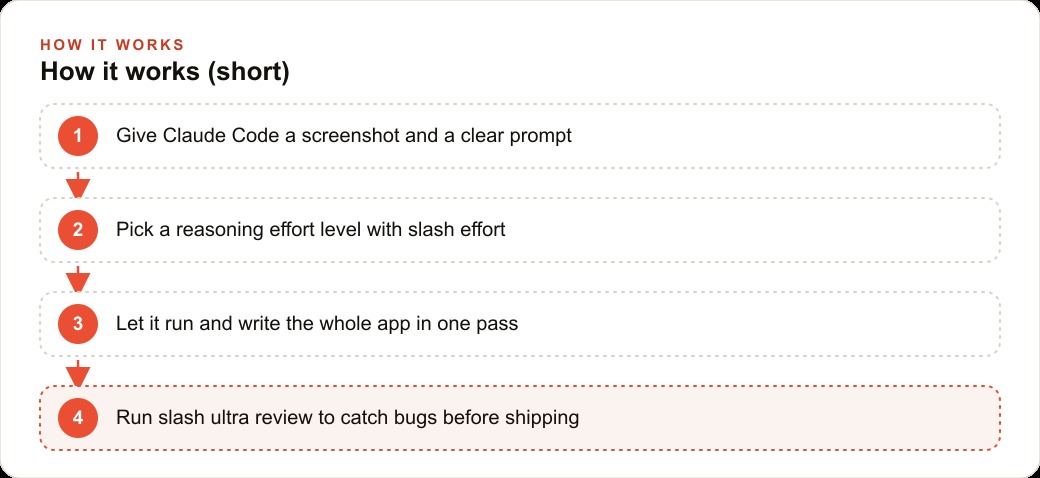
The new depth of reasoning effort available in Claude Code is also worth naming concretely. There is now an extra-high setting between the previous high and maximum options. Setting that level on a complex build and letting the session run for ten minutes rather than cutting it off early is what produced the eleven-minute game demo. For ordinary business tools, the high setting is usually sufficient. But when a task is genuinely complex, having the option to let the model work longer without stalling or losing context is the difference between a session that produces a finished result and one that produces something that needs manual completion.
The real story is not the game, it is the threshold that moved
For years, AI-assisted software development meant helping a developer work faster. The developer was still necessary. The AI drafted, the developer reviewed, fixed, and integrated. That division of labor was productive, but it did not change who needed to be in the room for software to get built. What has changed is that a bounded category of work no longer requires the developer to complete it. Describe a tool clearly, provide a screenshot of the existing brand, specify the inputs and outputs, and the tool comes back built. That is not assistance. That is delegation.
The category of work where that delegation holds today includes a surprisingly large share of what small businesses actually need. A gym needs a member portal for class booking. An accountant needs a one-page calculator for estimating quarterly taxes. A salon needs a rebooking form that integrates with their scheduling tool. A local contractor needs a quote submission form that sends an email and saves to a spreadsheet. None of these require engineering leadership, architecture decisions, or cross-functional planning. They require a clear description and a model capable of following it without losing the thread midway.
The practical implication for a business running paid digital campaigns, whether through Google Ads or social platforms, is that the interactive landing page tools that make those campaigns convert better are no longer gated by developer availability. An interactive quiz that qualifies a lead before showing a price, a calculator that demonstrates value before asking for a form fill, a personalized recommendation tool that routes visitors based on their answers: all of these can now be built in an afternoon, tested against real traffic within a week, and iterated based on what the data shows. The businesses that run more iterations per quarter consistently learn faster than the ones limited to two or three landing page tests per year because developer time was the bottleneck.
There is a cost reality worth noting directly, because the eleven-minute demo does not come for free. The new tokenizer in Opus 4.7 means the same English prompt uses more tokens than the prior version would have, even though the per-token price did not change. Longer sessions, which produce the most impressive single-pass results, cost proportionally more. For a business building one focused tool per month and testing it seriously before building the next, the cost remains manageable within a standard subscription. For a team trying to build dozens of tools rapidly in parallel, the economics require attention.
The automated deep review command that ships with this version of Claude Code is the piece most worth adding to any serious workflow. It runs for five to ten minutes on its own, scans the branch you give it, and surfaces bugs that a quick manual test misses: edge cases in form validation, state management problems that only appear with specific input sequences, error handling gaps that only surface under unusual conditions. The cost is a few dollars per review session. The alternative cost is a bug that reaches a paying customer and has to be fixed under pressure rather than during the build. The comparison is straightforward.
What the eleven-minute game demo actually announced was this: the gap between a description and a working piece of software closed enough that a non-developer with a clear brief can now produce and ship tools that reach real customers. The developer is still needed for complex systems, integrations at scale, and anything requiring significant architecture. But for the bounded category of tools that describe one outcome for one audience, that category is now accessible to anyone who can write a clear brief. The businesses that figure this out in the next six months will have a head start in operational capability that compounds over the following year, because each tool they test and deploy produces data that informs the next one, and the iteration cycle never required a developer to be hired or scheduled.
Internal links to service pages fit naturally here because this capability changes what is possible across the full stack. A business that can build its own interactive lead capture tools reduces its cost per lead on Facebook and Instagram ad campaigns because the landing experience matches the ad promise more precisely. A business that builds its own comparison calculators feeds better-qualified leads into its CRM and website stack, because visitors who have already done the math are further along the decision process by the time they fill in a contact form. The connection between what Opus 4.7 can build and what those tools produce commercially is direct, not theoretical.
The benchmark that matters more than Vibe Code Bench for most businesses is the one you run on your own task. Take the most common custom tool your team has wished it had, write a clear brief, specify the visual style by attaching a screenshot of your existing brand, and run it. Score the result on whether it actually solves the problem. That test tells you more about what this model can do for your specific situation than any external leaderboard will. The leaderboard establishes that it is worth trying. Your own test establishes what you can build on.
That is exactly what we do at AI DOERS. Book a private 30-minute call with Madhuranjan Kumar and we will map the fastest path to it for your specific business.
Book your call →
Madhuranjan Kumar
Madhuranjan Kumar brings 20 years of performance-marketing experience and has managed over $200 million in Facebook ad spend for brands across the United States and beyond. His expertise spans the full modern marketing stack: Meta, Google Ads, TikTok, email automation, CRM, and the websites that hold it together. At AI DOERS he turns that track record into lead-generation systems for businesses across every industry.