
Claude Code On Your Phone Is Useless Without An AI Operating System
Claude Code remote control lets you resume an agent session from your phone, but it only matters once you have built an AI operating system around your business: a layered stack of context, unified data, and meeting intelligence that the phone simply controls.

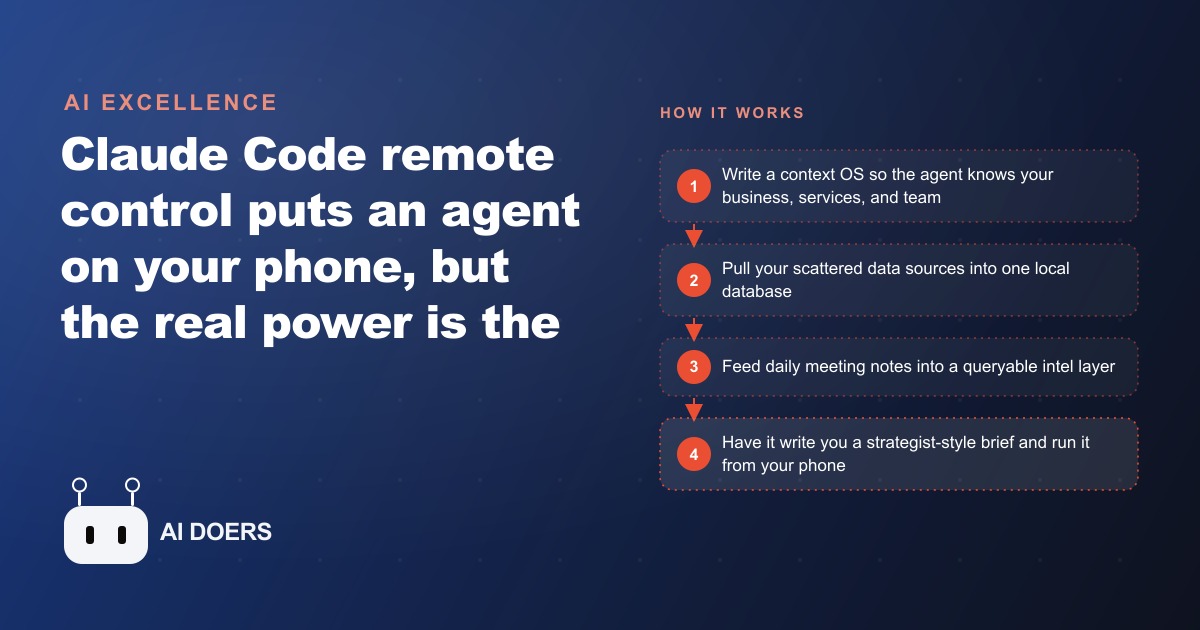
The phone is the last thing you should build. Almost everyone trying AI business automation gets this order backwards, and it is why most of them feel underwhelmed after a week of experimenting. They install the remote, then discover there is nothing powerful on the other end. I, Madhuranjan Kumar, want to make the correct sequence explicit before walking through what the operating system actually looks like, because getting the two things in the wrong order is the single most common reason serious business owners dismiss AI automation as not ready for real use.
Anthropic recently shipped Claude Code remote control, which lets you scan a QR code and resume an active agent session from your phone while you are away from your desk. The feature went loud on social media immediately, and the coverage was almost uniformly focused on the wrong thing: the phone. Showing someone queuing a marketing audit, a call analysis, and a lead-magnet page from their phone while walking around and getting back finished deliverables while still filming looks impressive. It is impressive. But the impressive part is not the phone. The impressive part is the system on the other end that received those tasks, understood the business context without any explanation, knew where the relevant data lived, remembered the last several weeks of decisions and commitments from meeting transcripts, and produced finished output without asking a single clarifying question.
Building that system is the actual project. The phone is just where you send it instructions once the system exists.
The phone is the remote, not the television
Owners who hear that someone runs multiple companies from their phone and assume the phone is the clever part are making the same mistake as someone who thinks the impressive thing about a remote control is the plastic and the buttons. The clever part is what the remote controls. In AI-assisted business operations, the system being controlled is an AI operating system built in layers around the business over weeks or months. The phone is just the most convenient interface to query it and queue tasks once the system has been built and trained.
This matters practically because the common failure mode goes like this. An owner reads about Claude Code remote control, sets it up on their phone, points it at a blank workspace with no context files and no data connections, and types a question. The response is generic. It does not know what the business is. It does not know what decisions were made last week. It does not know what the P&L looks like. It does not know what a client said in a consultation two days ago. The owner concludes the tool does not work for real business use and moves on. The tool was fine. The operating system was missing.
The word code in Claude Code is also a barrier that keeps many owners from ever starting. They assume the tool is for developers, that they need to understand programming to use it, and that an AI operating system is an engineering project rather than a configuration project. That assumption is wrong. The context files that form the base of the system are plain text. The data connections are mostly integrations you already use. The meeting transcripts come from tools that already record and transcribe calls automatically. A non-technical owner who is willing to spend an afternoon writing out who they are, what they sell, and how their team is structured can build the first and most important layer of the system without writing a single line of code.
The result of doing this correctly is what makes the phone demo look the way it does. The founder queuing a full marketing audit from their phone gets back a finished audit because the system already knows the company's services, positioning, current client mix, recent campaign results, and any commitments from the last round of strategy calls. The phone is just the trigger. The knowledge base is the actual intelligence.
Building the operating system in three layers
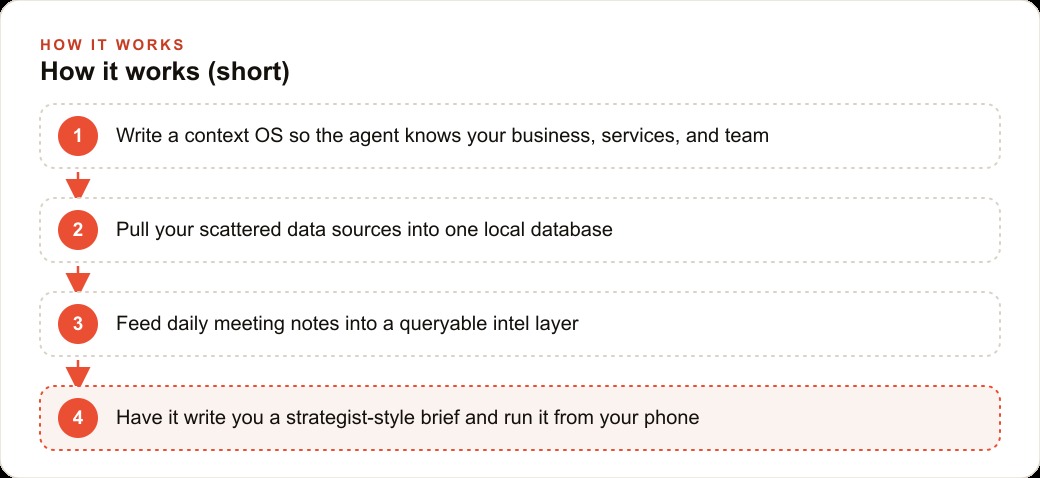
The system is built in three distinct layers stacked in a fixed order. Skipping any one of them breaks the utility of every layer above it, which is why the order is not flexible.
The first layer is the context OS. This is a set of files, or a single structured document, that teaches the system who you are, what your services are, your brand values, how you communicate with clients, what each member of your team is responsible for, and what rules apply to how the business makes decisions. Every automation, every query, every brief the system produces after this layer is in place inherits this context automatically. The agent stops producing generic output and starts producing output that sounds like it comes from inside your specific business. Writing this layer well takes an afternoon. The quality of everything built above it depends on the quality of this foundation, so the time investment here pays compounding returns. The context OS does not need to be long. It needs to be clear, direct, and complete on the essentials.
The second layer is the data OS. Most business owners have their critical numbers scattered across multiple tools that do not talk to each other: a spreadsheet for revenue, a dashboard for ad spend, a calendar for bookings, an analytics tab for traffic, a CRM for pipeline status. Pulling those sources into one local database means the agent can answer real operational questions from real data rather than estimates. You can ask which service generated the most booked clients last quarter, whether cost per lead from Meta ads or Google Ads has been trending up or down over the last six weeks, which day of the week sees the highest cancellation rate, and get a clear answer in seconds rather than spending an hour stitching together a manual report. The data OS transforms the agent from something that helps you think to something that helps you decide.
The third layer is the intel OS. Meeting notes are one of the most consistently underused assets a business generates every day. Transcription tools record and transcribe calls automatically, and feeding those transcripts into a queryable database gives the system a searchable memory of every commitment, every concern, and every strategic conversation your business has had. You can ask what a specific client said about their budget in the last consultation, what the team decided in the previous planning session, or whether a particular objection has come up in multiple recent calls. The intel OS is what makes the daily brief genuinely useful rather than generic.
With the three layers in place, the daily brief emerges as the visible product of the whole system. Every morning, the agent reads the funnel numbers from the data OS, absorbs the previous day's meeting transcripts from the intel OS, applies the brand and business logic from the context OS, and writes a strategist-style summary with a clear recommendation for the one or two things that would make the biggest commercial difference that day. On days with heavy meeting loads, the system is reading across dozens of calls and synthesizing the patterns rather than surfacing individual items. The brief that comes out of this process is not a status report. It is an operational intelligence document that replaces an entire category of morning mental overhead.
Once this infrastructure exists, the phone demo makes sense. The owner walking around and queuing tasks is not doing something magical. They are sending plain-language instructions to a system that already has everything it needs to execute them. A request to run a marketing audit is answered without clarifying questions because the system knows what the marketing currently is, what the goals are, and what the relevant data says. A request to analyze a month of client calls is executed quickly because the transcripts are already in the queryable database. A request to draft a lead magnet comes back sounding like it belongs to the business because the context OS has the voice, the positioning, and the audience already defined.
For a business managing customer acquisition and SEO and organic search in parallel, the data OS layer is particularly valuable. When organic traffic data, paid acquisition data, and booked client data all live in the same queryable database, the agent can surface the kind of cross-channel analysis that used to take a marketing coordinator several hours to assemble. Owners who build this layer early find that the monthly review meeting changes character: instead of building the data story during the meeting, the story is already written and the conversation moves directly to decisions.
The compounding effect is real and it is understated in most coverage of this topic. Each layer you add makes every other layer more useful. Context makes the data answers more relevant to your actual business rather than to businesses in general. Data makes the intel summaries more actionable because you can connect what clients said to what the numbers show. Meeting intel makes the daily brief sharper because the system is synthesizing commitments and concerns from real conversations rather than generating generic recommendations. A system that has been running for six months is meaningfully better than the same system at launch, not because the underlying AI has changed but because the operating system has been refined through actual use.
For a med spa with an owner who is simultaneously managing treatments, front desk operations, and marketing, the three-layer build addresses a specific bottleneck. The context OS captures the full treatment menu with pricing, the brand voice used in client consultations, the team structure from injectors to coordinators, and the flow from inquiry to booked appointment. The data OS pulls the booking calendar, the revenue by treatment category, the cost per booked consultation from paid channels, and the review flow from Google. The intel OS sits over consult notes and follow-up messages so nothing a client mentioned gets lost between visits. With those three layers running, the daily brief tells the owner which slots are soft for the coming week, which clients are overdue for a rebook, where the paid spend is going relative to booked revenue, and what one move would produce the most impact that day. The phone then lets the owner act on that brief between appointments rather than waiting until the end of the day to catch up on operations.
The sequence matters. The context OS must come first because everything else inherits from it. The data OS comes second because the intel layer is more useful when it can be cross-referenced with operational numbers. The intel OS comes third because the brief is only as good as the data and context it pulls from. And the phone comes last, as the access point to a system that can already do the work, rather than first as a tool looking for something to point at.
Building the context OS is genuinely accessible for any owner willing to spend an afternoon writing clearly about their business. The data OS requires connecting two or three existing tools to a shared database, which is a configuration task rather than an engineering one. The intel OS requires a transcription tool that already records your calls automatically and a step to ingest those transcripts daily. None of these three layers require technical expertise. They require clarity about your business and willingness to set up the infrastructure before expecting results.
The owners who build this foundation first and treat the phone as the last piece of the system are the ones who end up with a genuinely useful AI layer in their business. The owners who start with the phone and wonder why the results feel generic are the ones who installed the remote before building the television. That distinction is the entire difference between AI automation that changes how a business operates and AI automation that produces an impressive week-one demo before quietly going unused. The foundation takes a few afternoons. The phone takes five minutes. Build in that order and the phone becomes genuinely powerful rather than a shortcut to generic output.
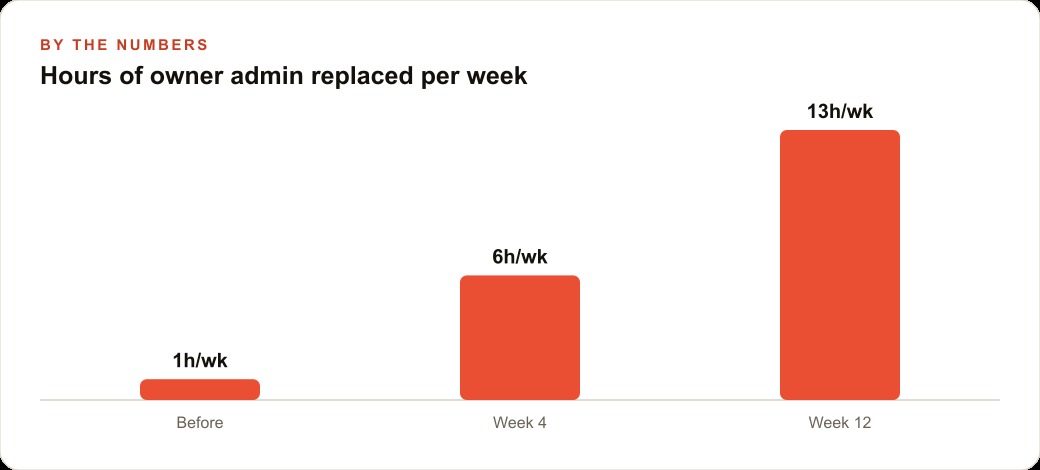
That is exactly what we do at AI DOERS. Book a private 30-minute call with Madhuranjan Kumar and we will map the fastest path to it for your specific business.
Book your call →
Madhuranjan Kumar
Madhuranjan Kumar brings 20 years of performance-marketing experience and has managed over $200 million in Facebook ad spend for brands across the United States and beyond. His expertise spans the full modern marketing stack: Meta, Google Ads, TikTok, email automation, CRM, and the websites that hold it together. At AI DOERS he turns that track record into lead-generation systems for businesses across every industry.